

Last week, football playoff-field expansion caused a bit of a backlash. An announcement of a sizable increase in the number of clubs that will qualify for playoff spots starting in 2027 led to blowback from fans, which in turn prompted a statement from the league. “I know amongst the confidence and excitement about the changes, there are some fans that worry about them,” one official said. “I understand. Not everyone’s going to agree with every step we make, and that is okay. If you’re going to think big, occasionally you’re going to create debate.”
Oh, you thought I was referring to college football? I was actually talking about the Canadian Football League.
That quote came from CFL commissioner Stewart Johnston. (His un-American “amongst” may have been a tell.) When the CFL unveiled a sweeping set of changes earlier this year—including a new playoff format that will feature eight of the league’s nine teams, instead of six—Johnston enthused, “More games. More drama. More entertainment. That was the mission and that’s exactly what this format will deliver. We’re raising the stakes so every game carries real consequences—more teams in the hunt, right to the end.”
Johnston was booed at last week’s Grey Cup, Canada’s equivalent of the Super Bowl (which the Grey Cup predates). Being booed is the lot in life of most league commissioners, but in this case, the rude greeting seemed to be spurred by unrest regarding the league’s impending refresh. Granted, CFL fans may be more cheesed about a downsized field than an expanded one; the CFL playing surface is shrinking from 110 yards to an NFL-esque 100. But there’s also some ire reserved for the cheapening of playoff berths, as CFL star Brady Oliveira expressed this past spring.
Even if you don’t know your Hamilton Tiger-Cats from your BC Lions, that sentiment probably sounds familiar. College football fans were also up in arms last week when word arrived that the College Football Playoff, which debuted during the 2014-15 Football Bowl Subdivision (FBS) season, will double in size to 24 teams—a change that almost no one wanted—just three years after tripling from four to 12. (Which followed a previous doubling from two national championship teams during the BCS era to four at the outset of the CFP.) As the newsletter Your Sports Best Friend put it, “The only reason to expand the bracket is to find a way to include three-loss teams from the SEC and Big Ten, and to make roughly 40 executives at ESPN and other big players in the college football media world insane amounts of money.” Even ESPN wasn’t super excited about it.
CFP director Rich Clark defended the decision on the grounds that the much-maligned, newly supersized playoffs would be good, actually. “We’re aware of the fan sentiment and that many fans aren’t in favor of expansion, but that was certainly weighed into the decision,” he said. “It was considered, but ultimately, we just need to make a spectacular playoff. The CFP has a responsibility to our fans. They’re the lifeblood of college football, and we owe it to them to make this great, and that really is our intent. But we appreciate our fans. We did take into account their sentiment, and that was rolled into this decision, but we decided to move forward with it.”
In other words, sorry not sorry. Clark came close to musing, Am I so out of touch? No, it’s the fans who are wrong.

Fans have had ample opportunities to form opinions about playoff creep of late. MLB, MLS, and the NBA (if we count the play-in tournament) have all made their postseason pictures more crowded in the 2020s. The men’s and women’s March Madness tournaments are growing from 68 to 76 teams next year. There’s already buzz about the World Cup—which fattened from 32 teams to 48 this year—further inflating to 64 for 2030, and the Club World Cup may swell as well. (Neither uptick is a done deal, but this genie rarely returns to its bottle.) The playoff-industrial complex is ascendant across sports, and anyone who opposes the rampant proliferation of playoff teams is sliding down the slippery postseason slope.
There’s a stand-up bit, often attributed to George Carlin but widely delivered for decades, about airplane flight recorders. You probably know how it goes: If the black box is never damaged during a plane crash, why don’t they just build the whole plane out of the black box material?
Sportocrats seem to be asking a similar question. If people like playoffs, why not just build the whole league out of playoff teams?
To assess the shape and pace of playoff expansion, I charted the number of playoff teams per season in 10 leagues or competitions—the NFL, the NBA, the NHL, the WNBA, the FBS, MLB, MLS, men’s and women’s March Madness, and the World Cup—during the 50 years from 1978 (which happens to have been the inaugural year of FBS predecessor Division I-A) through 2027 (projected).
A few caveats: I’m interested in premeditated playoff formats, not consequences of (or ad hoc solutions to) unusual circumstances, so I ignored any one-off spikes or cancellations in seasons affected by work stoppages or the pandemic. (Although some of those desperate experiments may have provided permission structures for sports to impose similar permanent measures.) I also counted play-ins as playoffs, even though the NBA technically doesn’t (whereas the NCAA does). For leagues whose seasons span multiple years, each point on the plot below denotes the year the season started. Finally, although the World Cup takes place every four years, I graphed it continuously to keep things clean and looking like a London Tube map.

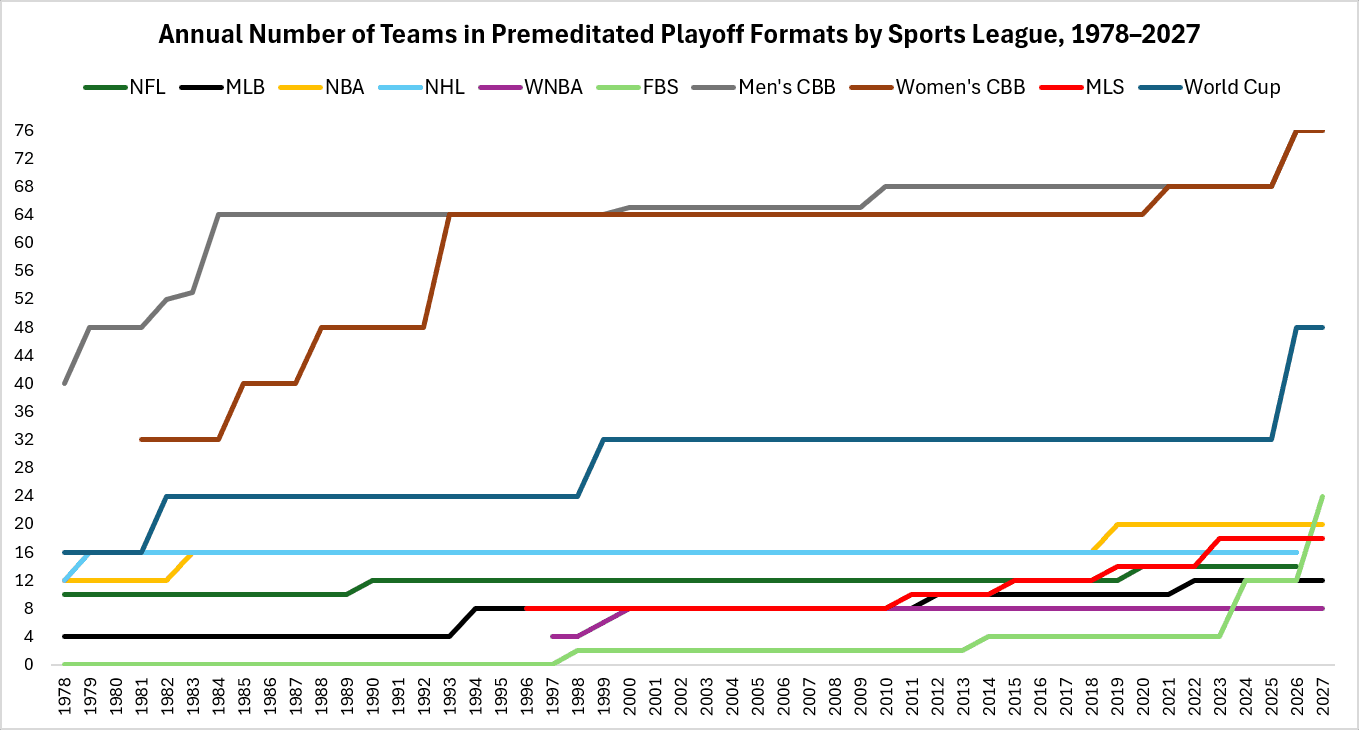
Obviously, over time, the lines tend to go up. They definitely don’t go down, unless it’s in response to the enlargement of an adjacent tournament. (RIP, CFB conference championship games.) There are exceptions: The NHL has barely budged from a 16-team playoff format for decades, and the WNBA has held steady this century at eight playoff squads. (Although this display doesn’t account for increases in playoff games without a corresponding increase in teams; the W has lengthened rounds before and may do so again.) Beyond them, though, these lines look like the “Stonks” meme, minus the Meme Man.
Granted, this image is missing some important information. Those lines represent the numerators: the number of teams in each competition that made the playoffs. For a more complete picture, though, we should also incorporate the denominators: the total number of teams that were eligible in each league. After all, as player populations and fan bases bulge and the memberships of leagues, divisions, and federations grow along with them—in many cases, although MLB, the NFL, and the NBA have gone more than 20 years since upping their overall team tallies—playoff fields might be expected to expand somewhat just to keep pace. Thus, the next chart presents the percentage of eligible teams that could qualify for the playoffs each year, using the full lists of Division I football teams and men’s and women’s basketball teams for the CFP and March Madness tournaments, respectively, and the number of participants in each World Cup qualification for the World Cup.
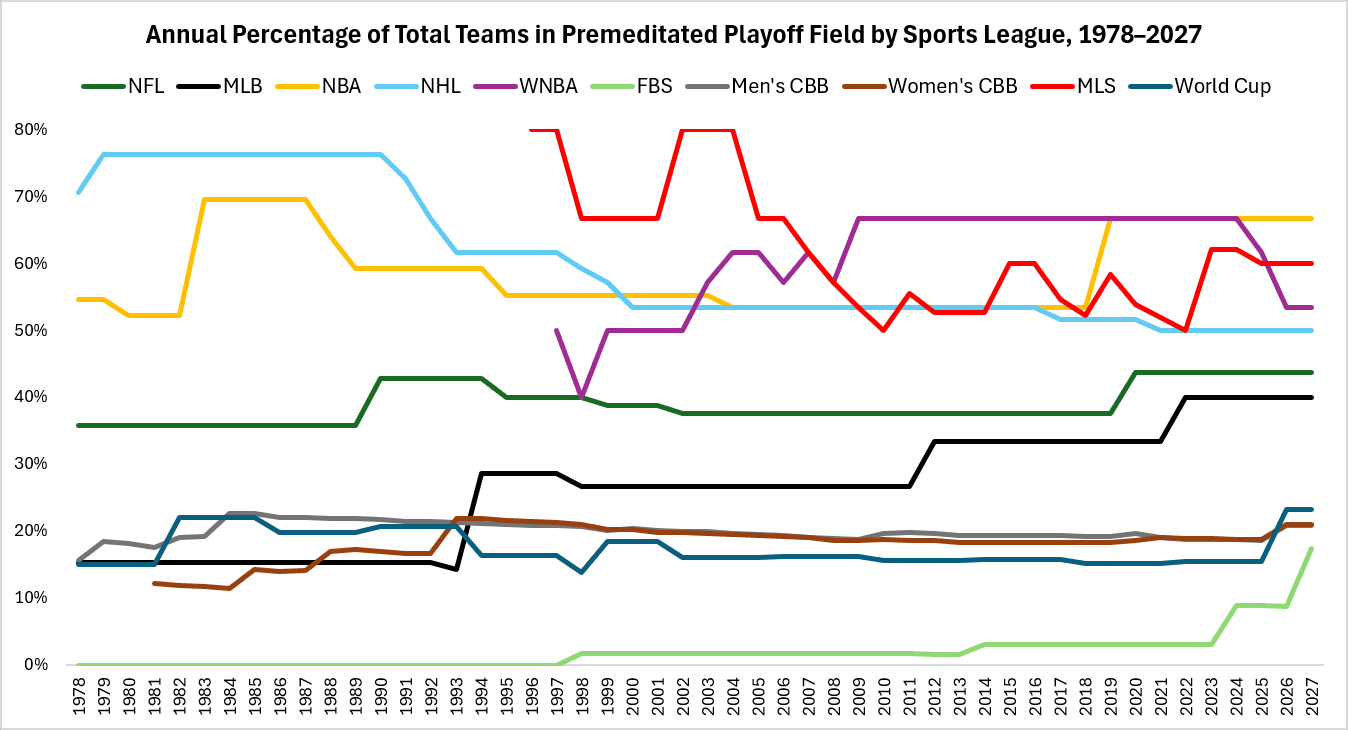
This chart tells a slightly different story. When we account for the context of league size, we see that some circuits, such as the NHL and MLS, have made their postseasons a good deal more exclusive than they used to be. And participants in March Madness and the World Cup have multiplied much more modestly than they previously appeared to.
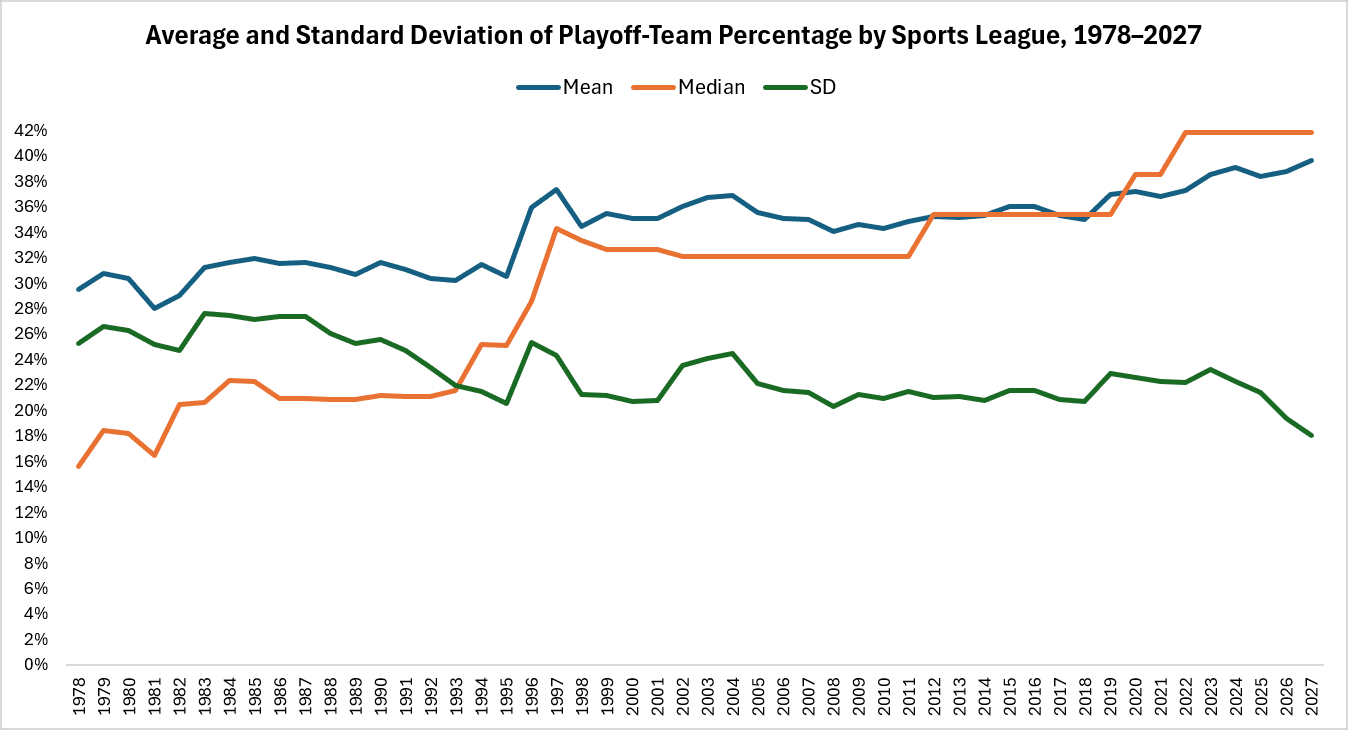
Still, the overall trend is toward greater playoff representation. The next (and final) chart shows the yearly average (mean and median) percentage of teams that made the playoffs per premeditated playoff formats across all of the competitions I tracked. Both have gradually climbed to the vicinity of 40 percent, from significantly lower starting points. The standard deviation of the playoff-team percentages—a measure of how closely clustered they are around the mean—has also decreased slightly, which reflects the gradual convergence of the sports with extremely high (NHL) or low (FBS) playoff percentages at the start of this 50-season sample. There’s more agreement across sports than there used to be about the optimal ratio of contenders to also-rans. And that ratio has generally gone up.
Unchecked playoff-field surges could come at a cost. Let’s go back to the black box analogy. There’s an explanation for the supposed aviation mystery that’s padded many a stand-up routine, and it’s not that comedians are more competent than aeronautical engineers. For one thing, the black box often does get damaged during a crash. For another, it’s not feasible to black boxify entire commercial airliners: Steel is dense and heavy, and titanium is costly and difficult to machine. Also, fortifying the outside of a plane wouldn’t prevent passengers from being killed by collisions on the inside.
When it comes to hitting whole leagues with the postseason stick, the greatest risk is devaluing the regular season. Why watch months of mere throat clearing if the stakes don’t really ramp up until later?
Some leagues hand out hardware—such as the NHL’s Presidents’ Trophy, the NBA’s Maurice Podoloff Trophy, and MLS’s Supporters' Shield—to their team-level regular-season standouts, over and above the rewards of making the postseason and having home-field advantage (the impact of which has declined over time), but these distinctions don’t mean that much to most fans. North American sports powers rarely take pains to prioritize rewarding regular-season success and reducing playoff randomness as much as, say, Asian professional baseball leagues like the KBO and NPB, which employ multi-round byes and/or “ghost wins” to stack the playoff deck in favor of full-season leaders.
Another possible fix for regular-season indifference might be more in-season tournaments, à la the NBA Cup. But if everything turns into a tournament, nothing seems special. Some things can’t be banner wins—at least not until taking care of more pressing business. Just as printing currency makes it more common but less valuable on a per-bill basis, playoff inflation leads to diminishing returns. Take that tactic to its logical extreme, and you may end up putting every team into the playoffs and essentially reconstructing the regular season from first principles, like a tech bro reinventing a bus.
Even if an enlarged playoff field (which sounds like something that should be surgically removed) is proportionate to smaller playoff fields from an earlier era, the larger one still contains more teams, more games, and maybe more rounds. Hence, bigger-tent tournaments last longer and run the risk of overstaying their welcome—especially if, like the NBA’s and NHL’s playoffs, they overlap and give the suits more incentive to stagger their games and minimize head-to-head battles for eyeballs. Plus, while admitting more postseason teams can keep fans invested late in what would otherwise look like lost seasons, lowering the barrier to entry too much discourages greatness. When tons of teams get in, no one team has to try hard.
In a sense, leagues already do construct their whole schedules out of playoffs; what is the regular season if not a protracted play-in tournament? Yet actual playoff creep continues—and the culprit could be a case of misaligned incentives.
Here’s another analogy—a sports analogy, no less. In baseball, strikeout rates have climbed over time in part because, counterintuitively, Ks are more valuable for pitchers than they are detrimental to hitters. Thus, pitchers aggressively pursue strikeouts, and teams aggressively recruit hurlers who miss bats, but the countervailing preference for hitters who make contact isn’t as strong. Bill James labeled this “the strikeout push/pull effect.” Relatedly, the strike zone expands on 3-0, even in the ABS era, in part because pitchers really want strike calls on that count (so as to avoid issuing walks), whereas batters aren’t too upset to pass up a walk and get another chance to swing away on a hitter’s count, 3-1.
A similar dynamic comes into play re: playoffs. Team owners and their toadies, the commissioners, covet extra playoff teams and rounds because they view those games as valuable inventory to be auctioned off to one of any number of broadcast networks and streaming services. (ESPN is ponying up an additional $345 million per year for bonus CFP contests.) The stars of those games aren’t as gung-ho; they may or may not reap that revenue directly, and more games mean more workdays. But players typically don’t oppose expanded playoffs that strenuously (except as a bargaining tactic, because playing hard to get gives them leverage against leagues). Yes, they have to work a little longer and harder, but they also stand to gain some money, national exposure, and additional shots at a title. They won’t go to the mats to preserve the sanctity of the regular season. As a result, the pro-playoffs forces prevail, and playoff-team tallies (and franchise values) rise.
In effect, the only constituency that potentially opposes playoff creep (on paper, at least) is fans, who don’t have a vote—except, that is, for the votes they cast with their time, attention, and money. And even if many fans profess to be bothered by well-populated, perpetual playoffs, their revealed preference, for now, suggests otherwise: Networks wouldn’t pay for rights to playoff games if fans weren’t watching them. Maybe the thrill will wear off, and sports will reach an equilibrium point where piling on playoffs won’t be beneficial. But unless and until viewers revolt against perceived postseason slop, leagues will keep contracting playoff fever—and their only prescription may be more playoff teams.