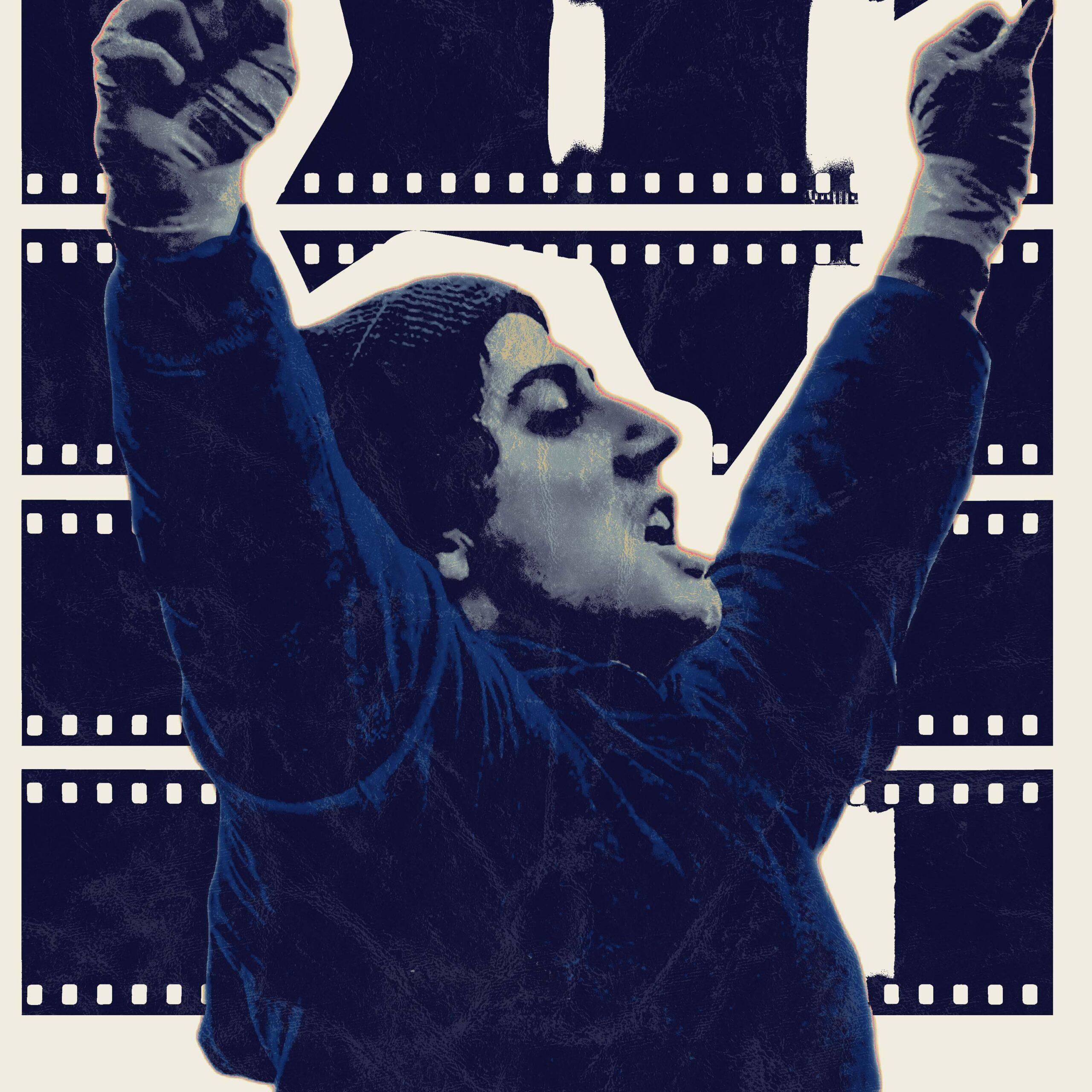
“Go for the ribs! Don’t let that bastard breathe!”
That’s Mickey Goldmill (Burgess Meredith) exhorting his fighter—southpaw out of Philadelphia, last name of Balboa, maybe you’ve heard of him—to take it to Apollo Creed at the end of 1976’s Rocky. It’s good advice. In boxing, as in filmmaking, you do what you have to do to get the duke: What the Italian Stallion lacks in finesse, he makes up for in pure relentlessness.
You don’t really need a movie like Peter Farrelly’s I Play Rocky to draw a triumphant parallel between one of American cinema’s most beloved underdog heroes—a palooka who just wants to go the distance and show what he’s got—and the screenwriter-slash-actor who created him. By now, pretty much everybody knows the broad strokes of how Sylvester Stallone channeled his frustration with his showbiz failures into a script that changed his life and the industry around him; he’s been living happily ever after for 50 years now. The ostensible pleasure of I Play Rocky, which opens wide this week after generating awards buzz at TIFF, lies in its familiarity. It’s the sort of movie that encourages passive gratitude: It invites us to spend two hours sharing the last laugh with one of Hollywood’s most powerful figures, rope-a-doping through various tropes en route to a gloriously foregone conclusion.
What I Play Rocky truly clarifies—again, not that anyone was really murky on the issue—is that, as a filmmaker, Peter Farrelly is a graduate of the Mickey Goldmill school. With honors. His sweet science, in both the transcendently goofy comedies he authored with his brother, Bobby, back in the ’90s and his more recent bids for gold-plated industry respectability, involves pummeling the viewer into submission. Gross-out gags, tear-jerking reunions, inspirational platitudes—take your pick. We all remember the knockouts in the Farrellys’ oeuvre: the dead parakeet and the most annoying sound in the world in Dumb and Dumber, milking the bull in Kingpin, “frank and beans” and hair gel in There’s Something About Mary. The reason those jokes land, though, is because the Farrellys understood, like Mel Brooks and the ZAZ brain trust before them, that you have to work the jab, over and over and over, to soften the audience up and keep them punch-drunk on the possibility that the next one is going to be a haymaker.

The Oscars bestowed on 2018’s Green Book may be slightly incongruous by Academy standards: only slightly, given how much the film resembles statuette magnets like Guess Who’s Coming to Dinner and Driving Miss Daisy. The movie itself, though, slots in nicely alongside the brothers’ repertory of openhearted, open-road buddy comedies. At their best, the Farrellys ennobled the concept of multiplex picaresques; wearing their hearts on hand-me-down sleeves, they kept their jokes low (i.e., below the belt in every way) and spirits high. The problem with Green Book was that it was caught between pugnaciousness and prestige—the artistic equivalent of a split decision. That the elder Farrelly wants to make old-school, demographically broad crowd-pleasers is a nice idea, and it’s very much in his skill set. The question is how to keep things punchy and middleweight without inadvertently settling for middlebrow.
Maybe next time. In terms of tone and technique, I Play Rocky is more or less in the same class as Green Book: a piece of coworker cinema par excellence, with the proviso that excellence isn’t really the goal here. More like effectiveness, or efficiency, or accessibility—or shamelessness, which is admittedly its own kind of standard, and harder than it looks, or more filmmakers would manage it. As a showcase for star Anthony Ippolito to add another Italian American icon to his repertoire after successfully impersonating Al Pacino in The Offer, it’s pretty much perfect: The 27-year-old actor is on-screen in basically every shot, and at no point does he break faith with his performance or lapse into sketch-comedy exaggeration—no easy feat when Stallone himself has dined out on self-parody for decades. The fact is that, around the time of Rocky, Stallone was a pretty darned good actor—no less than Pauline Kael compared him to Marlon Brando—and it’s worth deconstructing the layers of Ippolito’s achievement here. Not only does he have to believably inhabit the body and soul of one of the most famous movie stars of all time, but he also needs to convey how that persona is still inchoate, in formation, and not necessarily impressive to the people around him, either. In retrospect, it really is incredible—unbelievable, in fact—that United Artists green-lit what was, on some level, a vanity production from a multi-hyphenate without even a fraction of the cred of contemporaneous figures like Warren Beatty. Taken purely as a case study of the mid-’70s tensions between the bean counters of the old Hollywood and the upwardly mobile tyros of the new—with Stallone and his decidedly retrograde, ’40s-style prizefighter melodrama as a bridge between them—I Play Rocky is fertile stuff.
The sociological context is rich, too: Early in the film, we see the young Sly tossing back shots at the bar while the TV blares a confrontation between Muhammad Ali—circa 1975 and staggering in the aftermath of the Rumble in the Jungle—and professional tomato can Chuck Wepner; when it becomes apparent that the pasty-faced challenger is holding his own, Stallone and the other white working-class patrons go into a collective fugue state. “This guy won’t go down!” yells our hero, mesmerized by what he recognizes as his reflection in the TV set; in this context, a culture hero like Ali—so brave for punching up against various emissaries of the social and political establishment—is reconfigured as a villain and an obvious model for Carl Weathers’s glad-handing, fiercely proud Apollo Creed. Stallone really did take inspiration from the story of the Bayonne Bleeder when creating Rocky: The myth of a mediocre white boxer parlaying a racial inferiority complex into success and stardom—at the expense of a Black champion—is potent, troubling stuff. But Farrelly isn’t interested in exploring the subtext of Wepner’s fight with Ali one millimeter beyond how it serves the film’s structure: It’s just another stop in an expertly paced jog through the stations of the (right) cross.
Much has been made of the fact that I Play Rocky is an unofficial and unauthorized portrait of its subject’s salad days: “Aren’t we jumping the gun a little bit?” joked the octogenarian Stallone back in September, adding, “I’m not dead yet.” Maybe he was annoyed that Farrelly’s film is being released parallel to his own long-gestating memoir, The Steps, although in theory each should drive interest and profits for the other. If you’re looking for proof that Stallone is a genuinely fine writer, The Steps is persuasive—a two-fisted bildungsroman filled with stranger-than-fiction recollections about everything and everybody from wizened Spanish fortune tellers and man-eating lions to Woody Allen and Roger Corman. The book’s mix of egoism and self-deprecation is predictable and basically irresistible. What’s surprising is how earnestly Stallone talks about his artistic inspirations—specifically his sojourns in the New York Public Library, which he calls the “Vatican of Words.”


‘Rocky’ in Review
Suffice it to say that Farrelly and his screenwriter Peter Gamble aren’t particularly interested in Stallone’s formidable literary frame of reference. (Although I Play Rocky does open with Stallone reciting Walt Whitman’s “I Sing the Body Electric” as an elocution exercise: Our man is small, but he contains multitudes.) They also don’t really want to plunge into the chilly depths of familial dysfunction and internalized shame that led to their protagonist being briefly institutionalized as a teenager (a story told in harrowing, semi-hilarious detail in The Steps). What we get instead is a (literally) PG-13 version of the Stallone origin myth that doesn’t just selectively compress characters and events—an unavoidable by-product of the biopic-industrial complex, but ironic since the film’s not-so-subtle theme is the importance of to one’s own self being true. Wandering aimlessly around Times Square, booking auditions for two-bit thug roles under the less than inspiring stage name of “Mike,” Sly is worried about a lot of things: his career, his rent, his love life, his adopted dog Butkus. But he’s mainly preoccupied with selling out—doubly so once he relocates to L.A. and slips a script to a couple of high-powered Hollywood producers who are willing to purchase it as a star vehicle for somebody else.
Does it really matter that the order of events in I Play Rocky is off, or that the real-life figures driving the plot—not just Stallone and his wife Sasha (AnnaSophia Robb), but also his backers Irwin Winkler and Robert Chartoff (P.J. Byrne and Toby Kebbell) and Rocky director John G. Avildsen (Jay Duplass)—have been revised to the point of unrecognizability? Or that the skeptical studio honcho (Tracy Letts) stubbornly holding the line against Stallone’s titular ultimatum (while offering increasingly outlandish sums of money as potential compromise) is a completely fictional creation (certainly, he bears no resemblance to Arthur Krim, described by his biographer as a man of “impregnable discretion”)?
The answer is “not really” across the board, and definitely not in the case of the latter, since letting Letts loose on several pages’ worth of profane, self-aggrandizing dialogue is typically a good idea. (No surprise that a guy who’s worked for his share of paychecks takes pleasure in satirizing the know-nothing arrogance of studio executives.) Of slightly more concern, perhaps, is a bad-taste-in-the-mouth subplot vilifying local unions for trying to interfere with—and inflate the budget of—Rocky during its location shoot in Philadelphia. The clash between Stallone’s producers and the union reps leads to all kinds of wacky high jinks as the (nonunion) crew members are forced to hide in a meat locker, hoping not to be discovered. Typical Farrelly silliness is made slightly suspicious by the fact that I Play Rocky is being financed by the famously union-friendly folks at Amazon.
There’s a whisper of a profound and timely idea in Gamble’s script, which is that it was the strict financial and creative limitations imposed on Stallone, Avildsen, and their crew—everything from location scouting to camera equipment to shooting days—that gave Rocky the friction it required to come together as a populist masterpiece. It’s a fine line between insight and cliché, of course, and it’s just as true to say that I Play Rocky inadvertently trivializes the artistry of people like Avildsen, whose genial hackery as played by Duplass is hard to reconcile with the actual wit and power of the real director’s work. (There’s no sense that the guy we see on-screen here could have made something as manipulative and visceral as Joe.) And so it goes: When in doubt about how to get a laugh, Farrelly and Gamble fall back on the premise that everything good or enduring about Rocky came about because of Stallone’s professional and creative integrity. There’s no real friction here, just brute force. Farrelly doesn’t have a deft touch, and he doesn’t need one—each pleasing, pandering beat lands as intended, like a side of beef being tenderized. I Play Rocky works us over, all right, but the grateful fatigue of waiting out the inevitable—of making it through all that ersatz adversity to get to the run up the steps and the Bill Conti music and the Oscar speech—isn’t the same thing as exhilaration. The reason I Play Rocky doesn’t breathe is because there’s no real life in it, just a vacuum-packed simulacrum of a classic.
An earlier version of this piece misidentified the name of the TV show starring Anthony Ippolito as The Deal. It is The Offer, not The Deal.