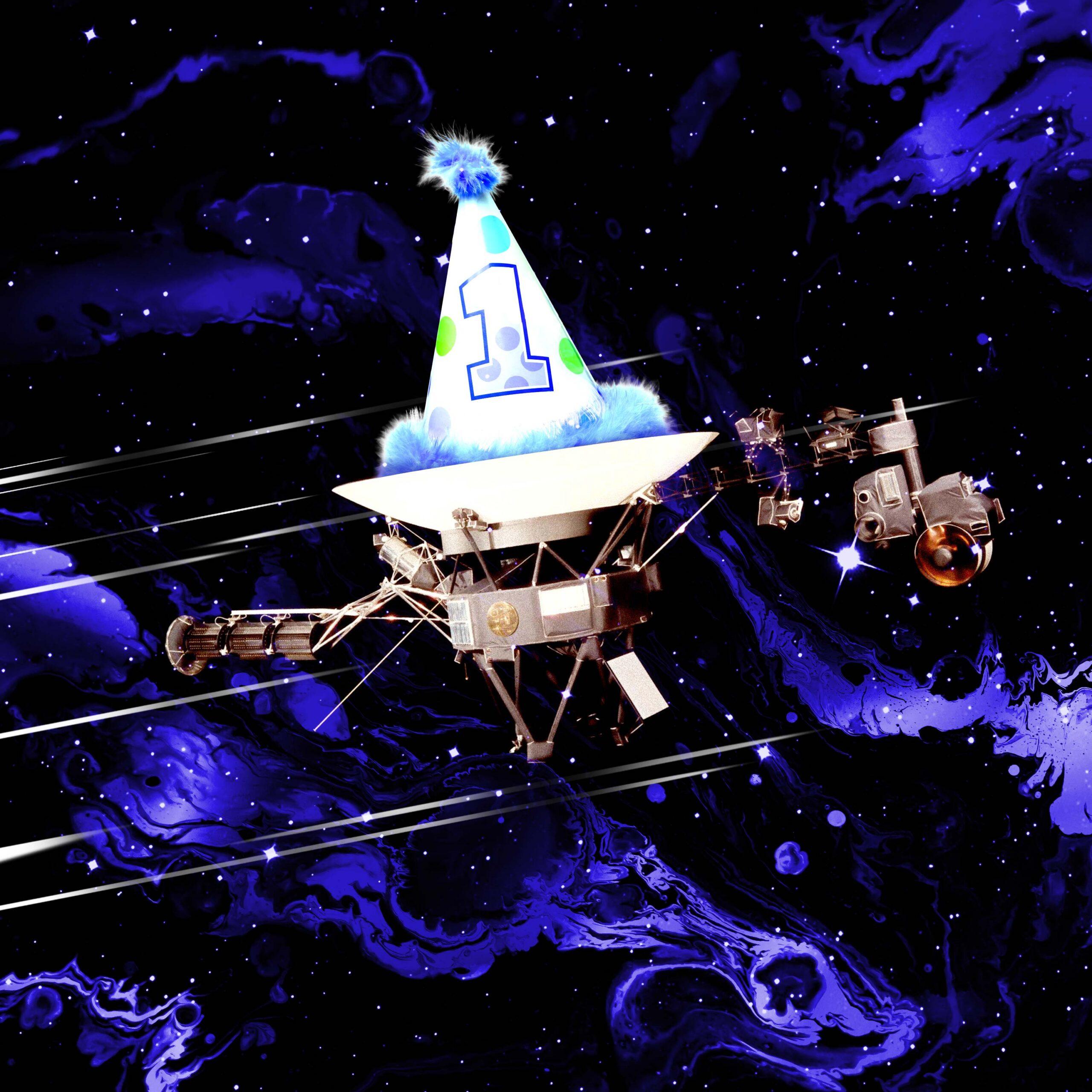

The concept of “Wednesday,” let alone “Thursday,” doesn't have much meaning in interstellar space. Here on Earth, though, we do have hump day, and as this week’s midpoint approached, humanity recognized a remarkable milestone. For the first time, our species can say that something we built has traveled a full light-day from Earth.
That thing is a roughly car-sized hunk of formerly high-tech equipment called Voyager 1. Launched on September 5, 1977, Voyager 1 was the product of a carpe diem drive to capitalize on a rare alignment of the outer planets that made it possible for a probe to explore the solar system speedily. In just a few years, the gravity-assisted spacecraft carried out its main objective of flying by Jupiter and Saturn, snapping pretty pictures, and doxxing several unsuspected moons. Then it transitioned to its continuing mission: To keep on truckin’, and to phone home for as long as possible.
The plucky probe aced that objective, too. Voyager 1 is a marvel of NASA ingenuity. For 49 years, groundbound engineers have sent signals into deep space and listened for answers as Voyager 1 has left Earth in its space dust, one astronomical unit at a time. Voyager 1 entered interstellar space—beyond the boundary where the solar wind dies down—almost 15 years ago, and it's sent back valuable readings from a remote region whose thin soup of particles can’t be measured without an emissary on site. As the probe’s plutonium power supply has dwindled to less than half its life at launch, the Voyager team has waged a doomed but brilliant campaign to extend its instruments’ lifespans, playing Sid Meier’s Spacecraft and watching their watts as they use NASA know-how to eke extra juice out of disco-era hardware. Of course, you can’t fight physics forever. Despite JPL’s valiant efforts, Voyager 1 is gradually losing its senses, and has, at the outside, 10 years to live.
However, Voyager 1—and its slightly slower and less distant (though also interstellar) sister spacecraft, Voyager 2—are still doing science, almost half a century after their fiery flights from Cape Canaveral. Voyager 1 has been Earth’s most outlying ambassador for more than a quarter of a century, ever since it surpassed Pioneer 10 in the late 1990s. And on Wednesday, Voyager 1 went far enough that a signal sent to or from the spacecraft, observing the universe’s speed limit of 186,282 miles per second, would take 24 hours to arrive. NASA cut it close, but we got a human-made object a light-day away before GTA VI.
Most of the coverage of this feat focused on how far away a light-day is. Which is understandable, because it’s really frickin’ far. So far, in fact, that it’s difficult to convey in human terms. In the lexicon of Stephen King’s Dark Tower series, there’s a word, delah, that essentially means “too numerous to know.” Voyager 1’s distance isn’t delah, literally: NASA updates its odometer down to the mile multiple times a second. But it might as well be delah, for all we can comprehend it. I can tell you that a light-day is equivalent to about 16 billion miles. But what does 16 billion miles mean to members of a species accustomed to trek of thousands of miles, at most?
Let’s stipulate that Voyager’s journey is amazing. But there’s a glass-half-empty take, too. What should be a triumphant moment for mankind is a humbling one as well. Because the only thing more mind-blowing than how far we humans have come is how far we have to go.
As Isaac Newton knew, objects in motion remain in motion unless something makes them slow down. The vacuum of space is famously frictionless, and thus Voyager 1 has been booking it ever since it sped up. Unless it happens to hit something sizable—which is (so to speak) astronomically unlikely—it will keep whizzing away for millions, maybe billions (or trillions), of years. Which it will need to, to truly see the sights, because cosmically speaking, it’s still next door.
Have you ever seen a scale model of the solar system? Not a baby mobile, with its comforting closeness, but one where a marble-sized Earth sits miles from its farthest neighbors. If you’ll indulge me, I’d like to show you something spiritually similar: almost certainly the tallest chart in Ringer history.
The closest star to Earth (aside from the Sun), Proxima Centauri—“proxima” as in “nearest”—is 4.25 light-years, or roughly 1,551 light-days, away. Voyager 1 isn’t aimed toward the triple-star Alpha Centauri system, but it’s still eye-opening to consider how long it would take to get there if it were. Take a moment to admire the single sliver of a light-day that Voyager has voyaged, on the left-hand side of the graph here. Then keep scrolling. And scrolling. And scrolling some more.
Let’s take a moment to remember how fast Voyager 1 is moving: 37,844.49 miles per hour. Again, the mind staggers, so let’s try to translate for our puny primate brains. That’s a little more than 1.5 Earths per hour (as in, the planet’s circumference), or two round trips to the Moon per day. Still too abstract? Try this on for size: It’s upwards of 10.5 miles per second. That’s roughly 50 times faster than a 9mm bullet fired from a handgun. For a person of average height, on level ground, the horizon is approximately 3 miles away. Put yourself in that person’s place, and imagine something flying so swiftly that it zips from the horizon behind you to the horizon ahead of you in a little more than half a second (or about the time it takes to read “half a second” silently). Alternatively, picture (or don’t picture) this: If you were floating in space and Voyager 1 blew right by you, you wouldn’t even notice. It’s moving so fast that it would basically be invisible to the human eye. And it's kept up that pace for almost 50 years.
Yet even making great time, without running into traffic, Voyager 1 has barely made a dent in the distance to the closest star. At its current speed, Voyager 1 would take 76,000 years to cover the long haul to Proxima Centauri. Which is only the least far-flung of the, oh, 200-ish billion stars in the Milky Way (give or take a hundred billion). Which is one of about 2 trillion galaxies in the observable universe. (To say nothing of the portion that’s so far away we can’t see it.) I’m not even going to try to express that in more relatable terms (though one could do worse than the old standby about grains of sand on all of Earth’s beaches). I mean: My god, it’s full of stars. And so much more full of nothingness too vast to traverse.
I’m not here to neg NASA. (No, I would never.) I love Voyager. A light-day is a long way: It takes a lot to make me leave Manhattan, much less the heliopause. And while Voyager 1 is far from the fastest human-made object, it’s hauling ass by terrestrial standards. Yet it’s moving at all of .006 percent the speed of light. Voyager 1 may technically be cruising through interstellar space, but at this rate, it won’t reach the Oort cloud—the enormous collection of icy bodies thought to be chilling thousands of astronomical units from the Sun—for hundreds of years, and it won’t actually exit the solar system (that is, escape the Sun’s gravitational influence) for something on the order of 30,000 years. Suddenly, a light-day seems like light work.
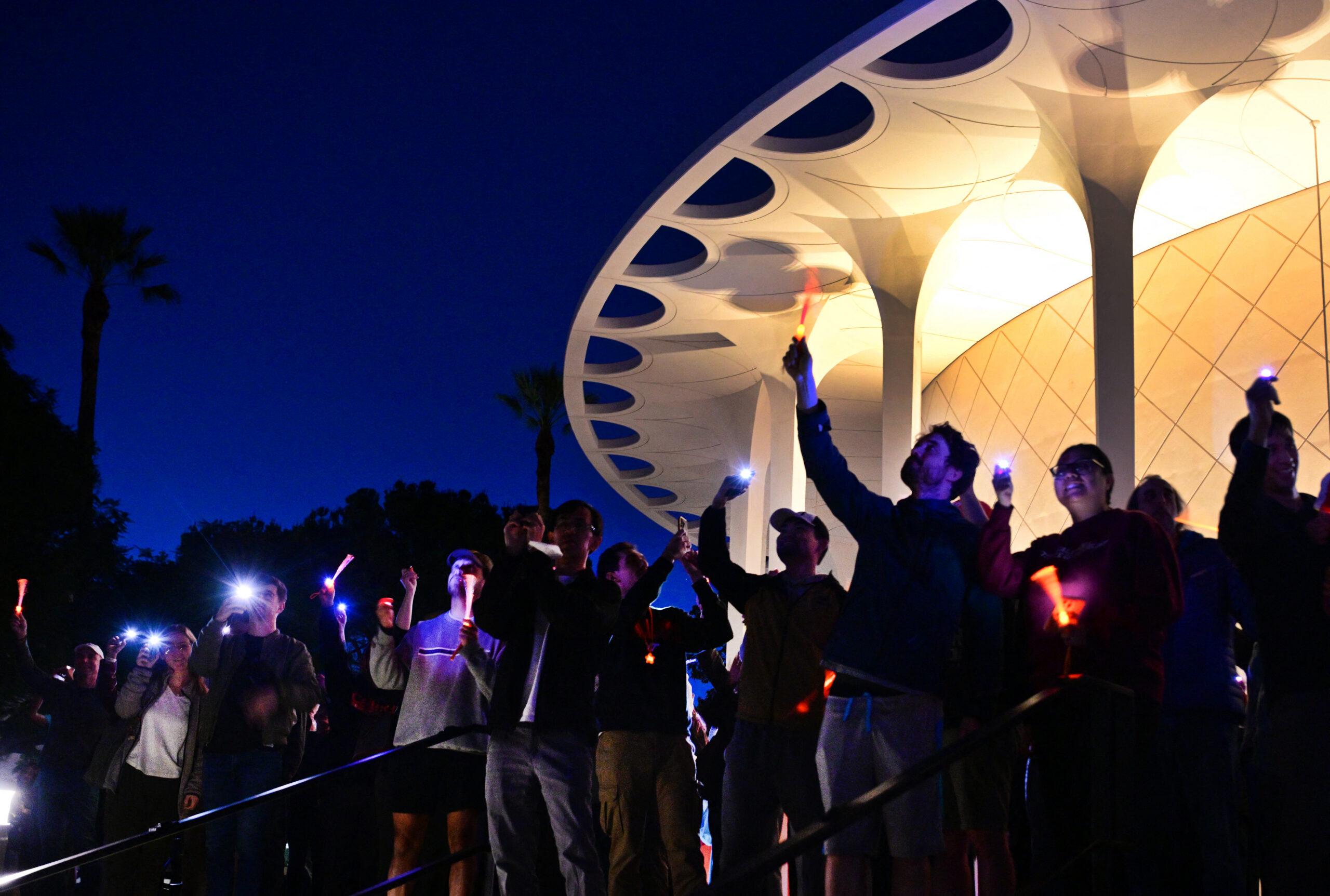
The Shine Bright for Voyager’s Light-Day celebration, marking Voyager 1 reaching one light-day from Earth, at the California Institute of Technology
Sometimes I catch myself thinking, what a waste of space. All the stuff in this stupid, awe-inspiring universe is so far apart. What’s the point of persisting in a place so stocked with wonders we can look at, but can’t touch? Soon, new generations of telescopes—some already launched, some merely proposed—will train their massive mirrors on intriguing targets and directly image exoplanets and other celestial bodies that once would have been too distant to detect, let alone resolve visually. Which will lead to lots of excellent science, and lots of wistful sighs from sci-fi fans who wish that going on galaxy tours were as easy as jumping to hyperspace or saying, “Set course for [wherever], Warp 9.” We’re about to be able to see so many tantalizing tourist spots that—unless we’ve dramatically misinterpreted the rules of the road—we will never be able to visit. It’s really kind of cruel.
Then I remember that we probably aren’t being pranked by an omnipotent power. It’s just that the universe wasn’t designed with humans in mind. Granted, opinions on that point vary—he says, yada-yada-ing millennia of ontology, teleology, theology, and the like—but if you ask me, we’re an accident. A happy accident, to be sure, at least from our perspective. But still something like a 100-pick parlay that improbably paid out. (Your mileage, or light-dayage, may vary. I’m just saying, geocentrism has a pretty poor track record.)
The pessimist’s spin is that we’re strangers in a stranger land, ill-suited to all but our most immediate surroundings and, on a cosmic scale, confined to them. The vinyl revival may be in full swing, but Voyager’s Golden Records are going to go unplayed, even if countless willing listeners are out there, somewhere.

The optimist’s take is that we’re tenacious survivors. Some scientists believe that 70-something thousand years ago—as far in the past as a Voyager-speed appearance at Proxima Centauri would be in the future—Homo sapiens may have been reduced to a few thousand strong. Now we number 8 billion. The odds of transcending our constraints are steep, but we’ve beaten long odds just to be here. And like Mr. Scott, we’re giving them all we’ve got.
Walt Whitman once wrote this two-line poem and called it a (light) day:
The untold want by life and land ne’er granted
Now, voyager, sail thou forth, to seek and find.
By which he meant, more or less, that no one’s going to hand us our heart’s desire. We have to go get it, or try to. You and I, and untold (delah) descendants, won’t live to finish the finding. Neither will Voyager. But the search is still inspiring.
In September, a U.S. nonprofit announced plans to launch a small, inexpensive, solar-powered spacecraft called Fermi Explorer to Alpha Centauri. ETA: 77,000 years. The payoff might be smaller than the payload, but there’s some symbolic value in actually setting our sights on (and setting sail for) a faraway star. More ambitious, speculative initiatives, like Project Dragonfly or the Stephen Hawking- and Mark Zuckerberg-backed Breakthrough Starshot, dream of reaching the same destination in decades. Advanced designs such as NASA’s Interstellar Probe (once dubbed “Voyager on steroids”) could catch up with Voyager despite the older craft’s half-century head start. And someday, more exotic modes of transportation could enable us to break the bonds of the solar system, and even rendezvous with Voyager, just as the same-named Star Trek ship retrieved a Voyager-inspired probe.
In 40,000 years, if left undisturbed, Voyager 1 will pass within 1.6 light-years of the M-type star Gliese 445. In 300,000, it will make a “close” approach (less than one light-year) to another red dwarf, TYC 3135–52–1. In roughly the same time frames, Voyager 2 will scoot within a few light-years of the stars Ross 248 and Sirius. Pioneer 10 is only about 90,000 years away from coming within one light-year of HIP 117795.
So, set your alarms. Like the song says: Tomorrow, tomorrow, I love ya, tomorrow. You’re always a light-day away. Or, in Voyager 1’s case, a light-day plus several light-seconds—and counting.