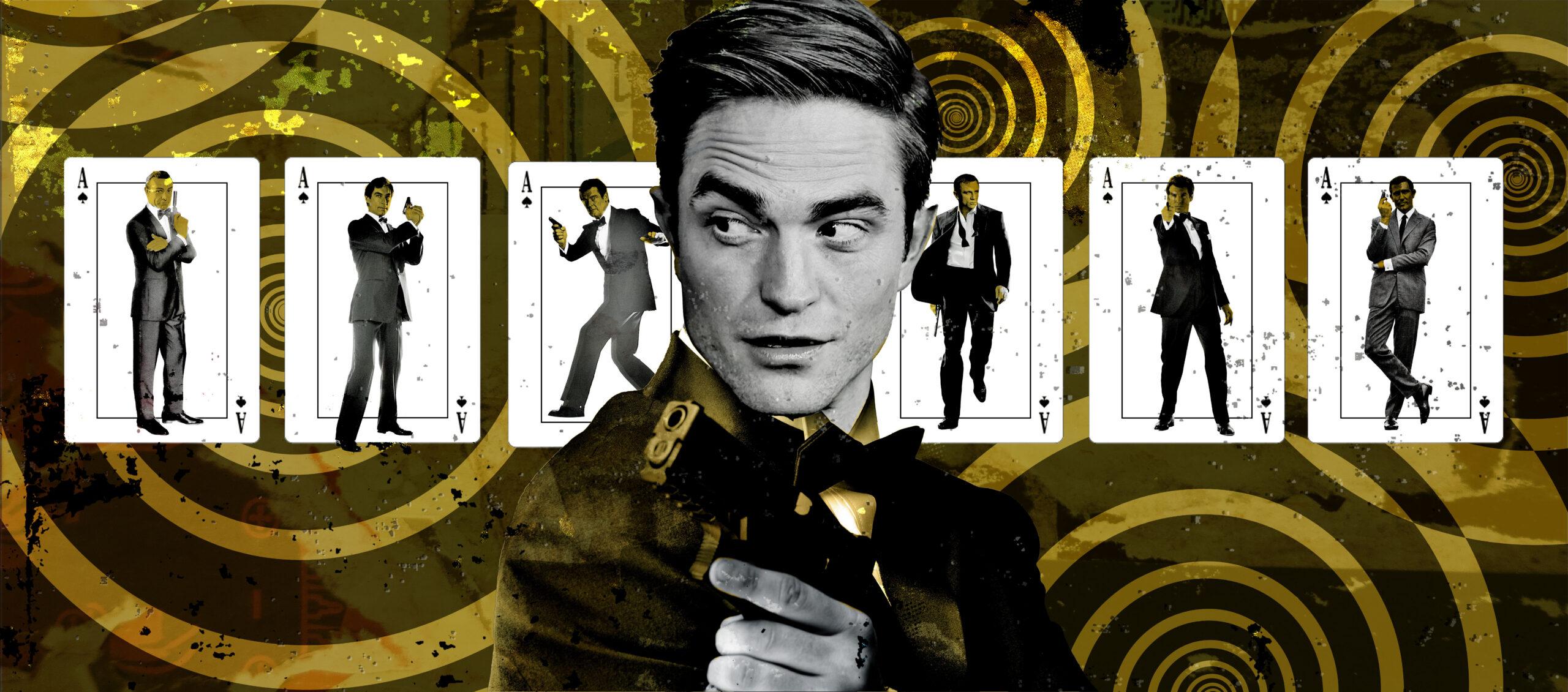

On Monday, long-awaited word came down about cinema’s most famous spy: The next James Bond will be Robert Pattinson. An outpouring of publicity followed, befitting five years of pent-up demand for a decision. Some celebrated the advent of a “freaky,” “weird” 007. Others lamented the prospect of an “angsty,” “sensitive” Bond. Still others wondered whether Pattinson’s talents would be wasted on such a time-honored, well-constrained character, or marveled (or fretted) about him hogging every franchise (or every other job).
The point is, people had opinions about Pattinson’s suitability as Bond … because people had opinions about Pattinson. Love him or loathe him, you’ve probably seen him in something—maybe many things. And historically speaking, that does make him an odd fit for the part, even if he ends up playing it stereotypically suave.
In some respects, Pattinson is a standard-issue Bond. In the time since Daniel Craig completed his on-screen stint in Her Majesty’s Secret Service—make that His Majesty’s, now—in 2021’s No Time to Die, rumors of a gender-, race-, or nationality-swapped Bond abounded. But the British Pattinson, like everyone else who’s played 007, is a straight, white man from the U.K.—or, at least, an anglophone, Commonwealth (or former Commonwealth) country. If we round up to the nearest half inch and half year, his height (6-foot-1) and age when his first Bond film comes out (42, assuming Denis Villeneuve’s 2028 movie, like every Eon Productions Bond film, hits theaters after May) will be bang-on the average of the past four actors who’ve been Bond. Pattinson certainly looks the part.
But Pattinson isn’t quite from central casting because his résumé makes him an extreme outlier among the seven men chosen to bring Bond to life in at least one official franchise film. Unlike the preceding six, he was a world-famous film star before becoming Bond.
Amazon MGM Studios announced Pattinson’s selection via a short Instagram video that featured his face emerging from and disappearing into shadow, accompanied by the caption “Identity Confirmed.” An instant later, another post spelled out said identity more explicitly, via the caption “Robert Pattinson is James Bond.” After you took in the face, the name seemed almost superfluous. The new embodier of Bond is also the face of Cedric Diggory, Edward Cullen, Bruce Wayne, Antinous, and, soon, Scytale in Dune: Part Three.
Pattinson has been very visible almost from the start: His first credited film role was a prominent part in a movie that grossed almost $900 million worldwide (in two-decades-ago dollars). Five Twilight movies made him a megastar. A subsequent pivot to less mainstream fare established his chops as a character actor and turned him into a critical favorite, even as it diminished his box-office appeal. (“My career has basically been like, no one sees my movies,” Pattinson joked in September.) But Pattinson also found his way back to blockbusters, via two Christopher Nolan movies (Tenet and The Odyssey), The Batman, and Dune. About The Lighthouse, he said, “I just want[ed] to do something weird.” About Tenet and The Batman, he said, “I really want to do a big thing.” His approach to picking projects might best be summed up by this mission statement: “I guess I was trying to do the opposite of what I’ve been doing.” He prefers his filmography shaken, not stirred.
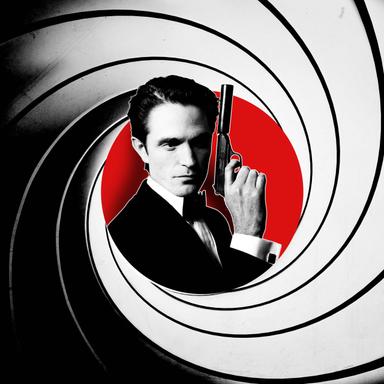
In short, Pattinson’s credits contain multitudes. And that sets him apart from the (MI)6 men anointed as Bond before him, none of whom had starred in a multitude of movies before wielding the Walther PPK. “I felt that we had to have an unknown actor, not a star; above all, a man you’d believe could be James Bond,” Eon cofounder and longtime producer Albert R. “Cubby” Broccoli, who contributed to every mainline film from Dr. No to GoldenEye, once said of his casting philosophy. “Our theory was that if we cast a virtually unknown actor, the public would be more likely to accept him as the character.”
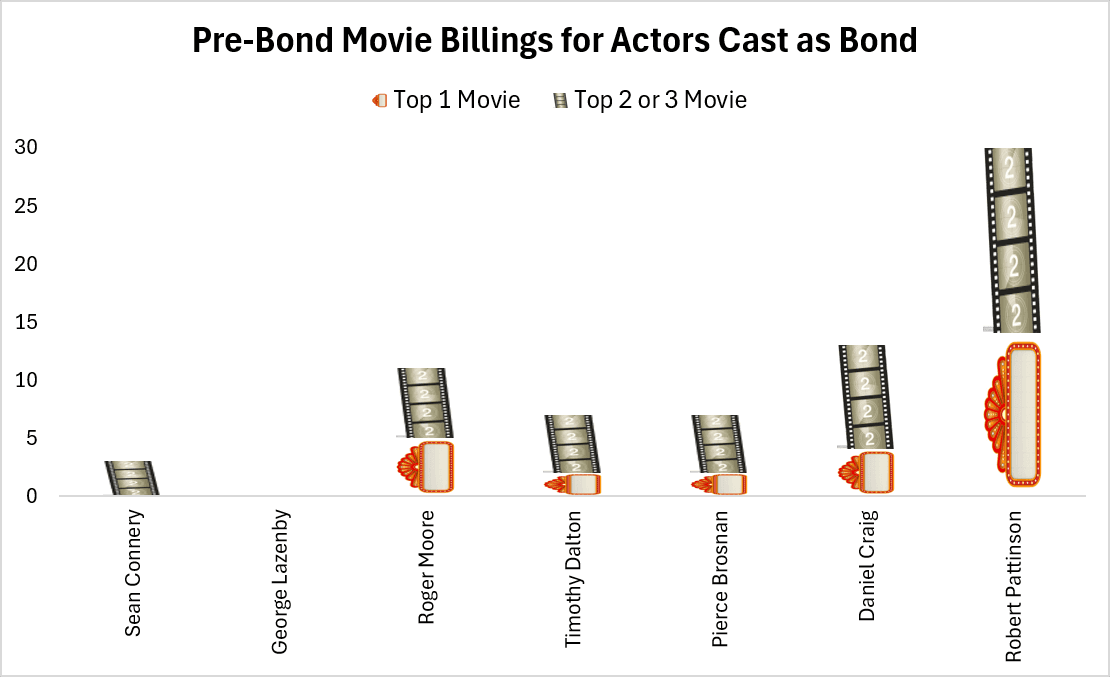
But the Broccolis are out—Eon sold the franchise to Amazon last year—and so, it seems, is the notion that new Bonds should be blank slates. Let’s break down the pre-Bond credits of the first six stars of the mainline movies—Sean Connery, George Lazenby, Roger Moore, Timothy Dalton, Pierce Brosnan, and Daniel Craig—and compare them to Pattinson’s. The charts below are based on billings on The Movie Database (TMDB), double-checked against IMDb and other sources. The first image displays the number of pre-Bond TV (mini)series, TV movies, and movies (not shorts) in which each actor is listed as one of the top three names. Pattinson’s parts in the upcoming Dune, The Take, and The Batman Part II are included.
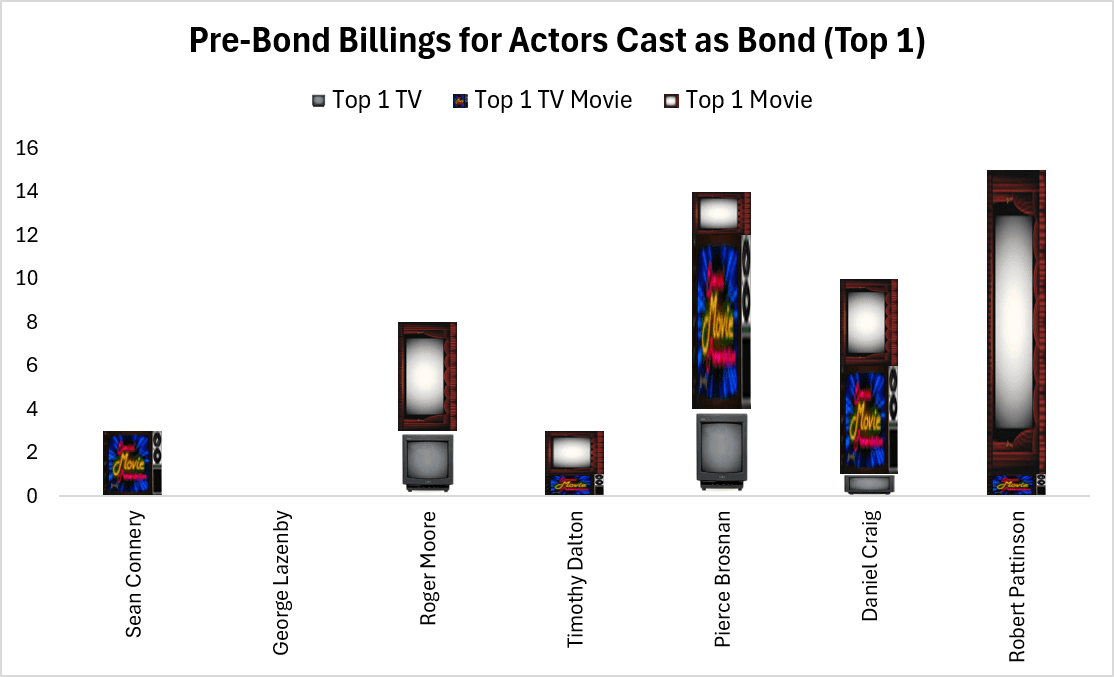
That blank space above Lazenby (who welcomed Pattinson to the Bond fraternity via video on Monday) isn’t a mistake; Connery’s successor had modeled and acted in ads before starring in 1969’s On Her Majesty’s Secret Service, but he had no screen credits to speak of before a fortuitous encounter with Broccoli in a barbershop led to an audition, and then the part. The other five Bonds before Pattinson were much more experienced than Lazenby—low bar—but significantly less experienced than Pattinson, in terms of top-three screen credits. Although some of them had acted for decades before becoming Bond, debuting as 007 was the big break for all of them. For Pattinson, the 26th “official” Bond flick will be the latest in a line of blockbusters. Like Bond, he travels, as sort of a licensed troubleshooter.
As former casting director Debbie McWilliams, who cast 14 Bond films over 40 years, summarized in 2023, “Timothy Dalton was known, but he was known as a Shakespearean actor, really. Pierce was known, but that was basically from television. Roger Moore was known from television. Sean Connery wasn’t [known]—nobody had ever heard of him. A certain audience had heard of Daniel Craig, but much more the kind of independent cinema audience. He hadn’t done any huge commercial film at all, really—Layer Cake I suppose was the most popular of the things he had done prior to Bond, but he wasn't a hugely well-known actor.” McWilliams didn’t even mention Lazenby, the ultimate unknown.
Moore and Brosnan attained some measure of fame by starring in several seasons of The Saint and Remington Steele, respectively, in the ’60s and ’80s, but in the pre–prestige TV era, small-screen stardom didn’t carry quite the cachet it does today. If we narrow our display down to starring roles—cases where an actor was first on the call sheet—Pattinson’s pre-Bond credits only narrowly edge out Brosnan’s, with Craig’s not terribly far behind. But the makeup of the projects Pattinson led stands out.
Pattinson is, specifically, a movie star. He’s amassed more than twice as many pre-Bond, top-three movie credits as any of his predecessors. In fact, he’s on track to have more starring film roles to his name before his Bond debut (14) than the first six Bond actors combined (13). To paraphrase a Lazenby line from the beginning of his lone Bond film, “This [rarely] happened to the other fellow[s].” And this count considers only quantity, not quality or salience, which probably undersells Pattinson’s relative prominence, considering how high-profile some of his star turns have been. To put the disparity in perspective, Brosnan’s only 1995 role before GoldenEye was the lead in a TV movie called Detonator II: Night Watch, whose producer said it would “cost less to make altogether than Pierce’s fee for appearing as James Bond in his next film.” Pattinson is about to appear in his fourth major motion picture this year.
Although Pattinson was asked almost 15 years ago about playing Bond down the road, he wasn’t really on the radar in recent years, until about 10 days ago, when a positively shocking report revealed that he’d done a screen test in late October. The trio of finalists whose names were known before Pattinson swooped in—Josh O’Connor, Jack Lowden, and Callum Turner—had credentials that resembled those of earlier Bond debutants. They’re budding headliners, but not yet full-blown A-listers. O’Connor rose to recognizability by playing Prince Charles in Seasons 3 and 4 of The Crown, which served as a springboard to major movies such as Wake Up Dead Man and Disclosure Day. Lowden stars in the revered but not especially well-watched spy series Slow Horses; he’s soon slated to take the lead in another thriller whose reach may be limited by Apple TV’s subscriber base, Berlin Noir. Turner, like Lowden, is a multi-time Apple TV lead (Masters of the Air, Neuromancer). He’s starred in more movies than Lowden, but he may be most famous for marrying Dua Lipa.
If I had my druthers, they could all be Bond, because actors could simply sign on to play Bond once. That way, we could watch a wide variety of portrayals, by a broad range of actors, and no one would inevitably grow to resent the role because they were tethered to it for so long. As I noted in 2016, playing Bond often doesn’t bode well for the quality or quantity of an actor’s work beyond Bond films. But Craig has kept himself in the spotlight, sans Bond, by playing Benoit Blanc. And per one report, Pattinson is no longer contracted to play Batman after Part II, which might free up some space on his shooting schedule, which he’s kept fairly fluid after Twilight. If anyone can manage to maintain a “one for them, one for me” model while playing one of the medium’s most iconic characters for one of the world’s biggest corporations, it’s Pattinson.
Perhaps Pattinson’s casting says something about the shortage of young actors with the fame to carry a franchise—or the franchise fever that all but forces aspiring stars to lash themselves long-term to already popular IP. And in light of this latest booking, the headline on a 2024 profile of Pattinson in The New York Times Style Magazine—“Is Robert Pattinson the Last True Movie Star?”—might seem like a self-fulfilling prophecy: If Pattinson swallows all the starring roles, it’ll be harder for other actors to attain true stardom. In the past, playing Bond has minted movie stars. This time, the Bond casting star search produced a preexisting celeb.
Picking Pattinson over an up-and-comer would seem like the safe choice, if he weren’t a guy who gets his jollies by disappearing into offbeat parts and playfully, prolifically lying in interviews. Still, I believe in his Bond. I don’t remember much about Tenet, but I know the debonair, besuited, irreverent Neil proved that Pattinson could portray a magnetic, convincing spy. If he plays Bond straight, he might be great; if he plays him off-kilter, with a hint of eccentricity, he could be even better. With Pattinson starring, Villeneuve directing, Steven Knight writing, and money not much of an object for Amazon, the ingredients for a satisfying resurrection appear to be in place. And if the whole adds up to less than the sum of those parts, well, it’s not as if there haven’t been bad Bond movies before.
Either way, the Bond brand will endure; until No Time to Die, at least, Bond had been a stubborn survivor. And in all likelihood, the series’ new star will likewise live on to die another day. If there’s any performance we know Pattinson can pull off, it’s rebranding after extricating himself from a famed film franchise. Pattinson may be Bizarro Lazenby on IMDb, but he has something in common with Lazenby’s Bond: a bachelor’s taste for (professional) freedom.