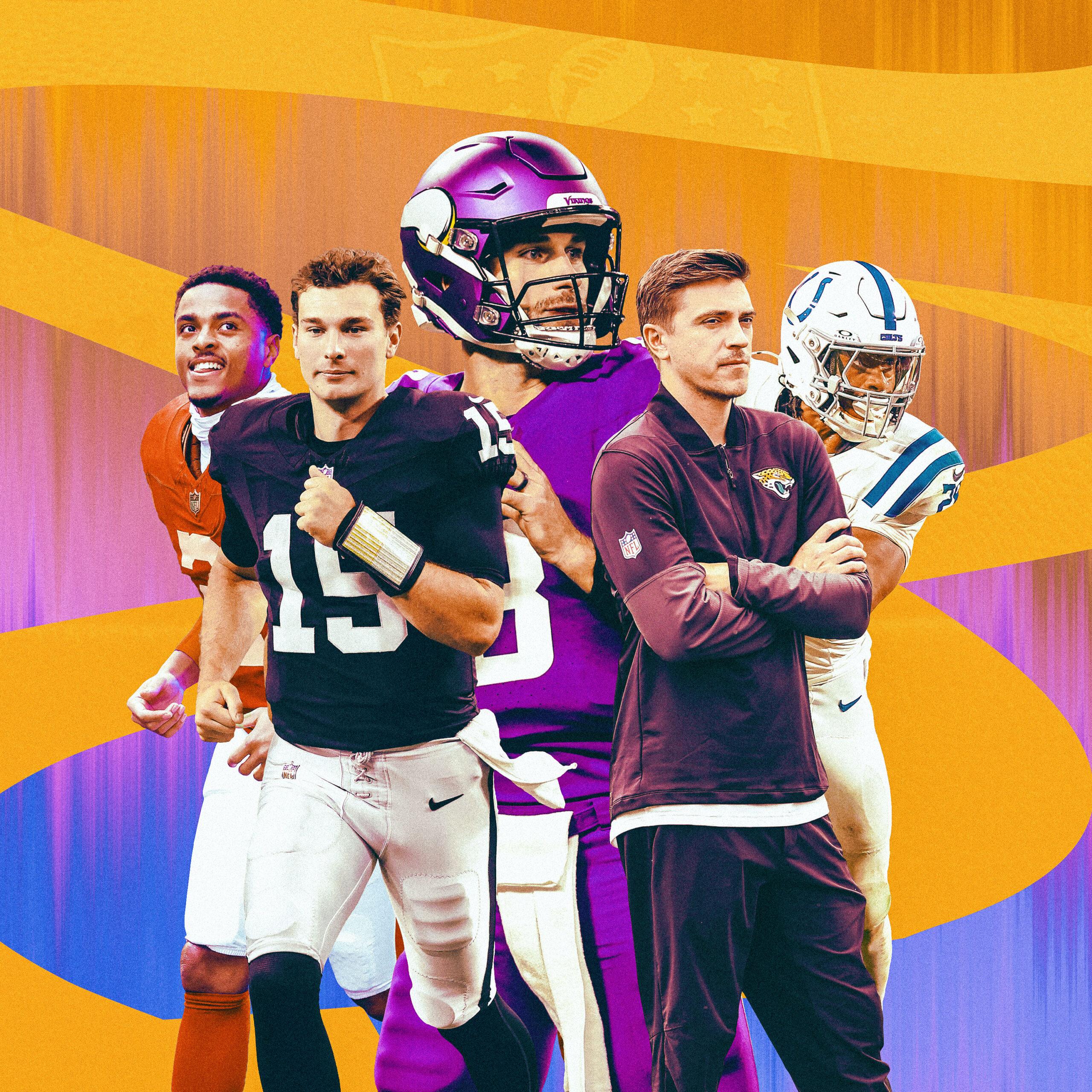

The 2026 NFL trade deadline delivered some drama: There was a big quarterback move, with the Vikings bringing back Kirk Cousins to (hopefully) rescue a struggling offense; the Colts dealt away two wide receivers (but held on to running back Jonathan Taylor); the Jags fully embraced the “fuck them picks” lifestyle; and more. These are the winners and losers of the trade deadline.
Winner: The Vikings’ Super Bowl Hopes
Desperation plus a deadline led to the biggest trade of the season.
Half a day after Carson Wentz put up one of the one worst quarterbacking performances of the season in a Monday Night Football loss to the Bills, the Minnesota Vikings traded a third-round pick to the Raiders to re-acquire veteran Kirk Cousins. The Vikings are seemingly hoping that Cousins can raise the floor of a struggling offense just enough to enable a playoff run behind one of the league’s scariest defenses. The Vikings simply had to do something—and Cousins was by far the best available option.
The 38-year-old QB threw 171 touchdowns during his eight seasons in Minnesota, 47 of which came during his two seasons playing under current Vikings head coach Kevin O’Connell. Cousins left Minnesota after tearing his Achilles tendon during the 2023 season and signed a massive deal with the Falcons. It didn’t work out in Atlanta, who used a first-round pick on Michael Penix Jr. shortly after bringing in Cousins, and he signed with the Raiders as a free agent in April to be a mentor and bridge QB to no. 1 pick Fernando Mendoza. (A Business of Football Hall of Famer, Cousins is getting paid this year by three teams, with the Falcons still on the hook for part of that contract.)
The Vikings, meanwhile, have cycled through QBs since Cousins’s departure—getting one (surprisingly great) year from Sam Darnold in 2024, a dud from first-round pick J.J. McCarthy in 2025, and a woeful half season from Kyler Murray (and Wentz) so far in 2026. The Vikings currently rank last in the league in success rate and are second-to-last in expected points added per play, ahead of only the feeble Chargers. They are 31st in yards per game, and in the bottom five in scoring. And yet, those stats can’t even fully convey just how unwatchable the Vikings’ quarterbacks have been for most of this season. Of the 275 individual quarterback performances by qualified passers in 2026, Murray’s Week 3 (15-of-29 for 168 passing yards) in a win (!!!) against the Bucs ranks dead last by success rate. Wentz’s miserable Monday night—when he completed just 32 percent of his passes and threw two interceptions—comes in at no. 273. (In the middle of that QB shit sandwich is the Ravens’ Joe Fagnano’s Week 9 performance against the Jaguars. That makes sense for Fagnano, an undrafted rookie who was making his first start against one of the AFC’s best teams. There’s no such excuse for veterans like Murray and Wentz, both former high first-round picks.)
Murray is currently sidelined with a Grade 2 hamstring strain, and Wentz—well, the idea that he can be a functional backup is dead after Monday night. The Vikings might not have been eager to make a move for a quarterback at the deadline, but they simply had no other choice. They’ve got a championship-worthy defense, and the terrible quarterback play from both Murray and Wentz was going to torpedo their season.
Cousins was the only option that made real sense. He was available for a reasonable price—they are giving up only a third-round pick, and they are on the hook for only the remainder of Cousins’s veteran minimum salary this season. (They’ll have to pay Cousins a $10 million bonus if he’s on the roster after the new league year begins in March.) The Colts were unwilling to listen to offers for Daniel Jones, who spent 2024 as the Vikings’ backup behind Darnold. The Chargers were not going to deal Justin Herbert (who has a no-trade clause anyway). Minnesota probably could have gotten Geno Smith from the Jets, but Cousins has the experience in O’Connell’s scheme and established chemistry with star receiver Justin Jefferson, who has clearly been frustrated by the ineffective quarterback play this season.
The Vikings probably shouldn’t expect Cousins to play like he did at his Vikings peak—he had three straight seasons of at least 4,200 passing yards and 29-plus touchdowns from 2020-2022—but they don’t need him to. Cousins simply needs to be competent. Minnesota needs him to look for—and hit—Jefferson, whose all-world talent was being wasted this season. Cousins was comfortable constantly feeding the Raiders’ best receiving option, tight end Brock Bowers, and he’ll surely know that the quickest path to success for the Vikings is to funnel targets to Jefferson. That duo connected for 28 touchdowns during their four previous seasons together.
The Vikings would have been the biggest loser of the trade deadline if they had passed on the opportunity to bring Cousins back to Minnesota. Instead, they’ve given themselves a chance to be a real contender. —Lindsay Jones
Winner: Fernando Mendoza
Last April, the Las Vegas Raiders signed 38-year-old quarterback Kirk Cousins to what was essentially a one-year, $11.3 million deal to be both the starting QB and mentor for no. 1 overall pick Fernando Mendoza. Though most quarterbacks drafted first in the past two decades have started Week 1 of their rookie seasons, Raiders first-year head coach Klint Kubiak (and minority owner Tom Brady) has been adamant that a better development plan for Mendoza was to have him ride the bench till he’s ready to play. Brady’s thesis on quarterback development is that starting rookie quarterbacks too early, and having them play in a dumbed-down offense, doesn’t make them better, and that throwing young QBs into the fire early is more likely to destroy a quarterback’s confidence and force them into bad habits.
The only habit Mendoza has formed through the first half of the season is to wear his helmet on the sideline in order to hear Kubiak’s play calls, but now that Cousins is headed back to Minnesota, Mendoza will get the chance to wear it for real when he makes his first career start Sunday against the Seattle Seahawks.
It was time. Cousins has been efficient, but he played his worst game as a Raider last week against San Francisco, throwing three interceptions, including a pick on his only red-zone passing attempt of the day. His old-man mobility and underwhelming arm talent put a low ceiling on Las Vegas’s offense. Yes, the advanced analytics are good: Cousins ranks ninth in EPA per dropback and 12th in success rate, and only he and Joe Burrow have 20-plus touchdowns. But the tape has had Raiders fans like me calling for Cousins’s benching for weeks.
Turning Kirko’s contract, which includes a $10 million team option in March, into a 2027 third-round pick is good business—even if it means Mendoza’s first two starts will come against Mike Macdonald’s Seattle defense on Sunday and the Broncos defense at Mile High the following week. Mendoza has a much stronger arm, and even though he wasn’t known for his rushing ability as a college QB, he’s far, far more mobile than Cousins, who ranks dead last in EPA per dropback on scrambles. Compared to Cousins, Mendoza is going to look like Steve Young when he breaks out of the pocket. Cousins can still put the ball in the right places when he’s throwing within 20 yards of the line of scrimmage, and he’s a tough sonofagun who has earned locker room respect everywhere he’s played. But he doesn’t have the juice in his arms or legs necessary to level up the Raiders offense like Mendoza possibly can. If that means more mental mistakes because Mendoza doesn’t have over 170 career starts, it’s a worthwhile trade-off to get Mendoza’s growing pains out of the way now rather than in 2027.
It was unrealistic to believe that Mendoza would spend his entire rookie year on the bench. I’ve said since July that the best plan would be for the Raiders to have Mendoza in the lineup after their Week 13 bye, for home games against the Chargers, Broncos, and Chiefs, and road games against the Titans and Cardinals. That the Raiders are able to start that process sooner—and pick up a third-rounder in the process—made this deal a no-brainer. —Austin Gayle
Winner: The All-in Jaguars
No franchise has ever hung a banner for being the most protective of future draft picks. Jaguars GM James Gladstone recognized that, and took advantage in the trade market by dealing for Falcons safety Jessie Bates, Saints defensive tackle Davon Godchaux, and Eagles defensive tackle Jordan Davis. Jacksonville was the most active at the deadline, and acquiring these three players cost the Jaguars a total of five picks over the next three drafts: a 2027 second-rounder and a 2028 fifth-round pick for Bates; a conditional 2028 sixth-round pick for Godchaux; and a 2027 first-rounder and a 2029 second-rounder for Davis.
That’s a hefty price the Jags are paying to maximize their team right now. But not only do I respect Gladstone’s belief (bordering on hubris), but I also think he has the right read on his team and where the league is as a whole. Jacksonville is 6-2 through the first half of the year, and they're the only team in the league ranked top-five in scoring offense and defense. One of their losses was thanks to a walk-off field goal in London, and that was the second of two straight weeks of playing overseas. They’ve won their last two games by a combined score of 75-17, quarterback Trevor Lawrence has a legitimate shot at MVP, and defensive coordinator Anthony Campanile might become the league’s most highly sought after head coaching candidate after the season. This might have been the best team in football before the trades were made, and now everything seems to be in place for the Jaguars to make this year theirs.
If the Jaguars aren’t good enough to justify this kind of aggression, then nobody should ever make win-now moves. We speak too often about championship “windows,” as if it’s some amorphous opportunity teams should wait around to come their way. In reality, it’s like a coin-operated telescope, the kind you’ll see on a pier or at an observatory. Anyone can stand by, stare into the sky or the sea and be satisfied with taking in the widest and longest view. But to make the most of the moment comes at a cost, and requires a belief that the only way to get the best view is to go all in.
And this is where Jacksonville hopes to separate themselves from the rest of the AFC’s contenders—most of which spent Tuesday making marginal gains or no gains at all. The addition of Davis gives the Jaguars two starting defensive tackles that are over 6-foot-6, and Davis will complement defensive tackle Arik Armstead’s pass rushing by eating gaps. And when we factor in edge rushers Travon Walker and Josh Hines-Allen (both 6-foot-5), Jacksonville might have the most physically daunting defensive front in football. Bates is 29 and might not be the same playmaking force that he was at his peak, but having him keeps the Jaguars from having any obvious weaknesses to attack in their secondary.
Gladstone is totally committed to this iteration of the Jaguars. In just two years as a general manager, he’s traded away two first-round picks and three second-round picks to acquire Davis, Bates, and 2025 draft pick Travis Hunter. None of these guys play quarterback, block for quarterbacks, or rush quarterbacks (Davis has just 9.5 sacks in 73 career games). When Gladstone was working for Rams GM Les Snead, he witnessed Snead trade away five picks to acquire players like Marcus Peters, Brandin Cooks, and Dante Fowler en route to a Super Bowl LIII appearance—then send away more first-round picks to bring in Jalen Ramsey and Matthew Stafford. And when the Rams won Super Bowl LVI, everybody was smiling and printing “fuck them picks” T-shirts. Nobody even talks about the disappointing 9-7 campaign in 2019 or the nightmare 5-12 season in 2022 anymore. As ESPN’s Brian Windhorst says, winning a championship means never having to say you’re sorry. That’s not just a team-building model Gladstone believes in, it's the only world he’s known in his career as an executive.
If nothing else, I applaud teams who care more about winning in the present than they do about competing in some future year. If there’s a chance to win it all now, there should be an imperative to take full advantage. And should the Jaguars cash in with a championship, diamond-encrusted rings will comfort Gladstone and the Jaguars when the bill on all their lost draft capital comes due. Right now, they’re the team who’s championship opportunity I’m most excited about, and that’s the biggest win of the trade deadline. —Diante Lee
Loser: Indianapolis’s Roster Reset
Indianapolis’s approach to the deadline wasn’t a total mess, but an “incomplete” grade is still a failing one. The Colts have known from the moment they fired GM Chris Ballard in October that this team needed as hard a reset as any in football. The money spent to retain quarterback Daniel Jones and receiver Alec Pierce ($72.5 million per season) represents some of the worst contracts handed out last offseason, and the two first-round picks traded away to acquire cornerback Sauce Gardner last season are harder to stomach by the week. There’s no delicate way out of the corner Indianapolis is painted into; all they could do before the deadline was take draft picks back for their best veterans and start positioning themselves for the future.
To that end, most of what they did in the weeks preceding the deadline was a huge win. No team ever wants to trade away players like guard Quenton Nelson or defensive tackle DeForest Buckner, but they were able to get back third-, fourth-, and fifth-round picks by sending their expiring contracts to the Seahawks and 49ers, respectively. The same is true of receiver Josh Downs, who is on an expiring deal and was dealt to the Chiefs for a fourth- and fifth-round pick. Plus, they sent receiver Keenan Allen to San Francisco for a sixth. All four players will be more valuable to the teams that just acquired them, and Indianapolis can use its $47 million in cap space this spring to seek out short-term veteran help while it works through its roster pivot.
The final piece to this teardown that could’ve made this a true victory for the Colts would’ve been a Jonathan Taylor trade. Making the painful, necessary decision to move the running back could’ve netted them a second-round pick and given Indianapolis more than enough draft capital to trade back into the first round of the upcoming draft next spring. Instead, the Colts decided the market for Taylor wasn’t rich enough and will more than likely wait until the offseason to reengage in trade talks.
This decision throws me for a loop—I just can’t wrap my head around the decision to hold on to Taylor. Unless they plan to put him on the shelf for the year, every carry he gets from here will negatively impact his trade value for prospective teams. The Colts will be trying to make a move with Taylor while free agency or the draft is happening, trying to convince teams with money tied up elsewhere that they should give up resources for a running back with a $15 million base salary in 2027. And while Taylor is a marquee player, I don’t know how many Colts fans want to watch him run behind a below-average offensive line, especially into loaded boxes now that the Colts don’t have any active receivers worth fearing.
The Colts wanted the equivalent value of a first-round pick, and The Ringer’s Tom Pelissero reported that the offers being floated were centered on second-rounders. It’s a misread of Taylor’s market. 49ers running back Christian McCaffrey was dealt for a second-, third-, fourth-, and fifth-round pick in 2022, and that was likely the bar the Colts set for Taylor, but we haven’t seen a deal like that for a running back since then. The Giants’ offer of second- and fifth-round picks was probably closer to market value for Taylor, and I don’t imagine anyone will offer much better in the future.
I don’t think any Colts fan should be mad to watch Taylor for the next two months, because he’s awesome and seems to genuinely love playing for Indianapolis. But for Carlie Irsay-Gordon, I do wonder why the job of trading Taylor needs to wait for the next GM she hires in the offseason given they already had fair-market deals on the table now. —Lee
Loser: The Wide Receiver Market
Fantasy football managers, despair. Which wide receivers would move at the trade deadline was one of the hottest questions coming into Tuesday. Several teams—including the Chiefs, Steelers, 49ers, and Rams—all were reported to be looking for pass catchers coming into this week, while a number of receivers were available or drawing interest from teams, including Brian Thomas Jr., Josh Downs, George Pickens, Calvin Ridley, and Jauan Jennings.
In the end, though, just two receivers moved teams at the deadline. First was Colts receiver Keenan Allen, whom Indianapolis sent to the 49ers for a sixth-round pick. At 34, Allen is far from being the perennial Pro Bowler he was earlier in his career, but he still has some juice. He’s second on his team in receiving yards and first in receptions, with 351 yards and a touchdown in eight games. The 49ers are thin at WR because of injuries this year to receivers Ricky Pearsall, De’Zhaun Stribling, Christian Kirk, Mike Evans, and Deebo Samuel. Allen will provide a significant boost to that hobbled pass catching group—at least until the substation claims him as another victim.
A couple of hours later, the Colts traded another receiver, Downs—the player who actually leads the team in receiving yards. The Chiefs swooped in to grab Downs in exchange for fourth- and fifth-round selections, while also netting a seventh-rounder in return. Downs is a serviceable playmaker who posted excellent separation numbers while primarily working out of the slot for the Colts. And while he hasn’t exactly been a star—he’s got a career average of 44.5 receiving yards per game—he could see a huge boost in going from Daniel Jones to Patrick Mahomes. Here’s how Downs feels about that transition:
After the deal, the only healthy receivers on the Colts roster are Laquon Treadwell, Ashton Dulin, Anthony Gould, and Deion Burks. Those four have totaled just 375 receiving yards this year, so pour one out for Jones, who has already struggled mightily this season and now will have arguably the worst group of pass catchers in the league. Prepare for 30 targets per game split between Tyler Warren and Jonathan Taylor, and a lot of three-and-outs.
It seemed like there was no shortage of demand for receivers among this season’s contending teams, so we were hoping for more from the receiver market than just the Colts passing off some of their misfits. But the Jaguars and Cowboys made it clear early that they didn’t intend to trade the little-used Thomas and injured Pickens, respectively, and that took the big fish off the board, leaving the trade deadline feeling anticlimactic. —Riley McAtee
Winner: Tennessee Titans’ Draft Capital
The Tennessee Titans seemingly stole a second-round pick from the Buffalo Bills for a 28-year-old safety, Amani Hooker, who wasn’t even viewed as a top-15 player at his position by ESPN’s poll of league executives and coaches back in July. Hooker, who is under contract through 2028, is currently tied for the league’s interception lead, with five—a total that’s inflated by his three-pick performance against the Bengals—and the Titans got a premium from a Bills team desperate for secondary help.
And that’s after the Titans got two first-round picks for star defensive tackle Jeffery Simmons last week. The present situation in Tennessee feels dire. They’ve got two failed New York head coaches, Robert Saleh and Brian Daboll, calling the shots and a no. 1 overall quarterback experiment in Cam Ward failing to develop in year two. The only way for the Titans to return to relevance soon is to convert aging veterans into future picks, and use that capital to either surround Ward with more talent or swing the bat again on another first-round pick for a quarterback. Turning Hooker and Simmons into two firsts and a second puts them on that path. —Gayle
Winner: Howie Roseman
Over the years, every time the Eagles have made a move—no matter how insignificant—the “HOWIE SZN!!!” posts on social media most likely appeared in your timeline. Sometimes it's been warranted. Other times it hasn't.
The Jordan Davis trade falls into the former category. Davis has been a nice player for the Eagles, but he has played only 52 percent of the snaps this season. That's because he is on the sideline for almost every passing situation. To get a first- and a second-round pick for a run-stopping defensive tackle is a minor miracle in 2026.
The Eagles have been horrible this year, but they are now positioned to reload with five(!) first-round picks and five(!!) second-round picks in the next three drafts. Roseman's greatest strength might be realizing when his roster is a mess and figuring out how to escape it. That was the theme for the Eagles at this trade deadline. —Sheil Kapadia
Loser: The Bengals’ Trade Deadline Preparation
The Eagles were ready to do another deal ahead of the deadline, agreeing to send outside linebacker Arnold Ebikete to the Bengals in exchange for a 2027 sixth-round pick. The impending deal was reported by ESPN’s Ian Rapoport, and then came the trade-altering social media post from Nick Korte, a contributor to Over the Cap who is an expert on the NFL’s compensatory draft pick process:
Somehow, the Bengals—of course it was the Bengals—didn’t understand the comp pick formula, and they backed out of the deal after Korte’s post on X took off. Note to Cincinnati: Next time, do a bit more research before answering Roseman’s call. —Jones