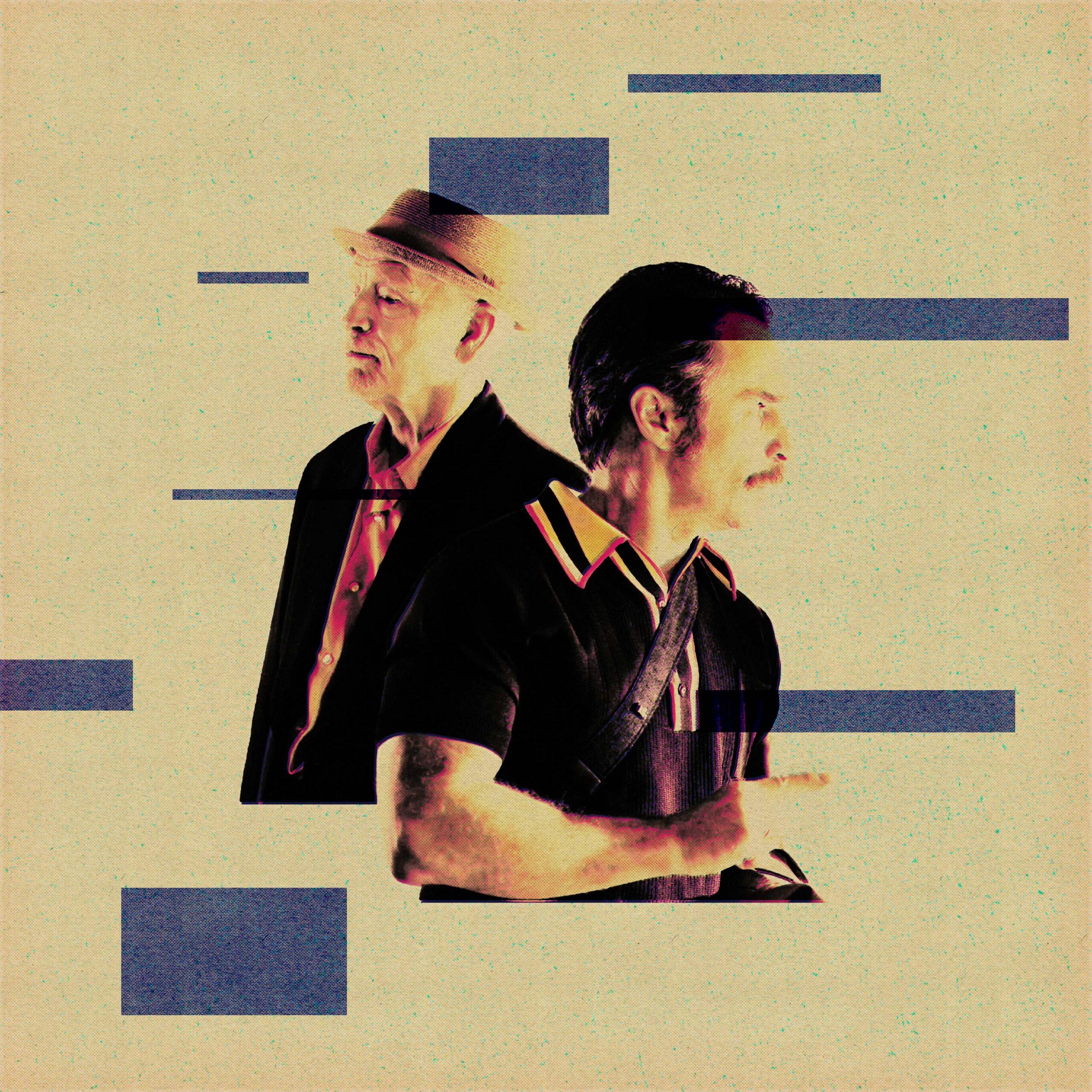
What does it mean that three of John Malkovich’s finest performances have him playing CIA agents? Probably something about the 72-year-old actor’s ability to convey a malevolent feeling of secrecy—the covert glee of a private joker who knows exactly what he’s packing up his sleeve. The same sense of rueful interiority that once prompted Charlie Kaufman to use Malkovich as a portal to the theme of psychic compartmentalization makes him perfect for characters who contain multitudes, who are inured to living and working in deep cover. It’s a fine line between tradecraft and sociopathy; if there’s a common denominator between the unhinged sniper in In the Line of Fire and the disillusioned spooks of Burn After Reading and Wild Horse Nine, it’s their alienated patriotism—an all-American sense of duty bound up in soul-deadening bureaucracy and defined by a license to kill.
“Don’t pull rank on me,” snarls Malkovich’s veteran ratfucker, Chris Carlisle, to partner Lee Chesterfield (Sam Rockwell) during one of the many spats dotting Wild Horse Nine. “I’ve killed people in countries you can’t even spell.”
That punch line—pithy, misanthropic, and defined by a prideful sense of one-upsmanship—is vintage Martin McDonagh. With this in mind, Wild Horse Nine, which earned Malkovich the Best Actor prize at this year’s Venice Film Festival and is being touted as a possible vehicle for one of those unofficial lifetime achievement Oscars, is a victory lap over familiar territory for both its maker and its headliner. McDonagh’s movies are filled with words and focused on characters who are always trying to get the last one in—sometimes by shouting the loudest, sometimes by bumping off their conversation partners before they get a chance to retort. His best mixture of verbal and literal pyrotechnics remains 2008’s In Bruges, about a pair of tetchy hit men—Colin Farrell and Brendan Gleeson—bickering their way through various standoffs in a remote and self-contained location. 2022’s The Banshees of Inisherin repeated its predecessor’s setup and casting, minus the gunplay and with a surfeit of glistening and gloomy Emerald Isle melancholy. The film was slight and familiar but affecting all the same, buoyed by the marvelous rapport between its leads. Farrell and Gleeson are nowhere to be found in Wild Horse Nine, but aspects of both Bruges and Banshees hover over its tale of far-flung frenemies hashing out matters of life and death; it effectively completes its creator’s Dudes Talk trilogy.
No less than Quentin Tarantino or Aaron Sorkin, McDonagh has cultivated an idiosyncratic syntax; he’s a master of dialogue in love with the sound of his own voice. Sometimes, it’s a justifiable infatuation, as in In Bruges, with its Pinterish scattering of profanities. (“It’s an inanimate fucking object!” “You’re an inanimate fucking object.”) Sometimes, as in Three Billboards Outside Ebbing, Missouri, it’s a bad romance. I can’t possibly improve on Wesley Morris’s assessment that the film, which won Frances McDormand and Sam Rockwell his-and-hers Oscars, resembles “a set of postcards from a Martian lured to America by a cable news ticker and by rumors of how easily flattered and provoked we are.” The wild cycle of acclaim and backlash around Three Billboards was suggestive of an artist working boldly, if maybe ill-advisedly, outside of their comfort zone. “If someone’s calling your film racist, and you wrote and directed it, that means they’re calling you a racist ... yes, it’s hurtful,” McDonagh told The Guardian in response to claims that he unduly humanized Rockwell’s white-supremacist deputy, forcibly transforming a villain into a hero.
Provocation is very much a part of McDonagh’s vocabulary. He likes to use his characters as mouthpieces for a preening form of political incorrectness and then let us decide whether they’re telling it like it is or clinging to outdated prejudices. The flip side to this trolling is a sudsy, last-call sentimentality—when McDonagh’s characters aren’t putting each other down, they’re blubbering together in solidarity. The Banshees of Inisherin was drenched in such stuff: It wrought tears out of Farrell’s lonely knucklehead act and also his tragic friendship with an ill-fated miniature donkey, dragged into the story as an innocent casualty of a petty feud spiraling out of control. Wild Horse Nine takes these elements—male self-pity and symbolic livestock—and gallops with them all the way to Easter Island circa 1973. That’s an even farther-flung outpost than Belgium, and an admittedly striking backdrop for a portrait of a man who’s grown weary of rattling around inside his own balding, elongated head.

More in Movies
As Wild Horse Nine opens, Chris and Lee are heading on an all-expenses-paid furlough to Rapa Nui, courtesy of their Washington-based handler, MJ (Steve Buscemi in cartoon-Coen mode). The reason they’re in the southeastern Pacific in the first place is to keep tabs on Chile and its newly elected socialist president, Salvador Allende, whose days, according to the Nixon administration’s private calendar, are numbered; the cause for the vacation is that Chris can’t seem to keep his mission to himself. Seated near a pair of attractive female Chilean college students, Monica (Mariana di Girolamo) and Alicia (Ailín Salas), in the Santiago airport lounge, the veteran regime changer can’t help himself. He flaunts his status as a khaki-clad foreign operative, warning these self-identified left-wing do-gooders that they should think twice about returning home—or supporting their government—lest they wind up collateral damage in an impending coup. The women are horrified by the ugly Americans in their midst. Lee is mortified by his colleague’s lack of decorum insofar as it justifies his own extracurricular assignment: to silence his longtime partner before he says too much to the wrong party (or, worse, writes a “memwah”).
Chris wouldn’t mind being put out of his misery: Decades into a dubious career with an untold body count, he’s a dead man walking, sneaking injections of heroin to manage the pains of swiftly encroaching cancer. No wonder he’s drawn to the feral stallions stalking the landscape—he’s staring down the proverbial glue factory himself. A bullet in the skull would be a blessing. After all, they shoot wild horses, don’t they? The setup of a hardened killer going soft is compelling enough, and McDonagh’s plotting converges around a nifty bit of dramatic irony that Lee is being asked by two different parties (Chris and the CIA) to do the same thing—take out Chris—for different reasons: as an act of personal mercy and a professional knotting of loose ends, respectively. His reluctance to pull the trigger on behalf of either side is rooted equally in an exasperated affection for his increasingly addled partner and a dawning lack of belief in the larger institutional mission he’s aiding and abetting. To the extent that Wild Horse Nine has a moral center, it’s occupied by Rockwell, who’s surely subtler here than in Three Billboards; he has to be because Malkovich has been given the green light to go big, tossing off jaunty, jaundiced line readings with aplomb. “Don’t you think there should be more songs about suicidal birds?” muses Chris at one point, doubling down on the motif of interspecies communion while paying tribute to the lyricism of Hank Williams; in this scene, the bluster and bravado get swapped out for something authentically vulnerable.
Chris is so lonesome that he—and we—could cry. But are they crocodile tears? The pleasure of Malkovich's acting in Wild Horse Nine is undeniable. The question of why McDonagh has centered his latest on a seductive—and, at times, halfway persuasive—avatar for U.S. imperialism is worth asking. Not that Chris is supposed to be the movie’s hero, exactly: His self-loathing is apparent, all-consuming, and seemingly justified by his lethal résumé. Beyond his meddling in various African and South American countries, it’s implied he had a hand in toppling JFK; it’s telling that this is seen as the grandest transgression of all. But because McDonagh is such a skillful, preening screenwriter—and Malkovich is so up to the task of wrangling his dialogue—there’s a sense in which Chris becomes positioned in the film as a duplicitous but dyspeptically eloquent voice of reason. He’s more worldly than Lee and less hypocritical than MJ; his desire for a dignified death—more dignified than any of his victims—is taken seriously. In a rhetorical move that scans dually as deliberate and disingenuous, McDonagh expects us to believe that an aging apex predator given to scolding woke kids is still capable of idealism, even if it’s by proxy. After doing so much harm under the pretense of necessary evil, Chris can still access grace and instruct a younger generation, embodied by Monica, to do the right—which is to say the left-wing—thing.
Taken on its own terms, the scene where Chris offers up an anti-fascist pep talk to a woman who despises him hits its marks as fatalistic rabble-rousing. “At least you’ll die with the wind in your hair,” purrs the faltering Cold Warrior to Monica, with a smile. But those terms are dubious, bordering on dishonest: McDonagh is as much a tourist in Chile as his protagonists, and the obvious intention of using the past to contextualize the present with the material’s resistance politics feels more plug-and-play than stand-and-deliver. The last thing a movie about the legacy of American interventionism in the Global South should be is tidy, but McDonagh is such a neat freak as a dramatist that this ostensibly sticky meditation on complicity and regret leaves no residue, no matter how much blood gets spattered in the drawn-out climax. It’s less that Malkovich deserves better than Wild Horse Nine and more that he’s good enough to make the meandering, schematic, and unconvincing movie around him feel like more than the sum of its parts; people have been given statuettes for less.