We Got a Record Gaming Blitz Before ‘GTA VI’
As they made way for ‘GTA,’ game makers created an unprecedented pileup of quality titles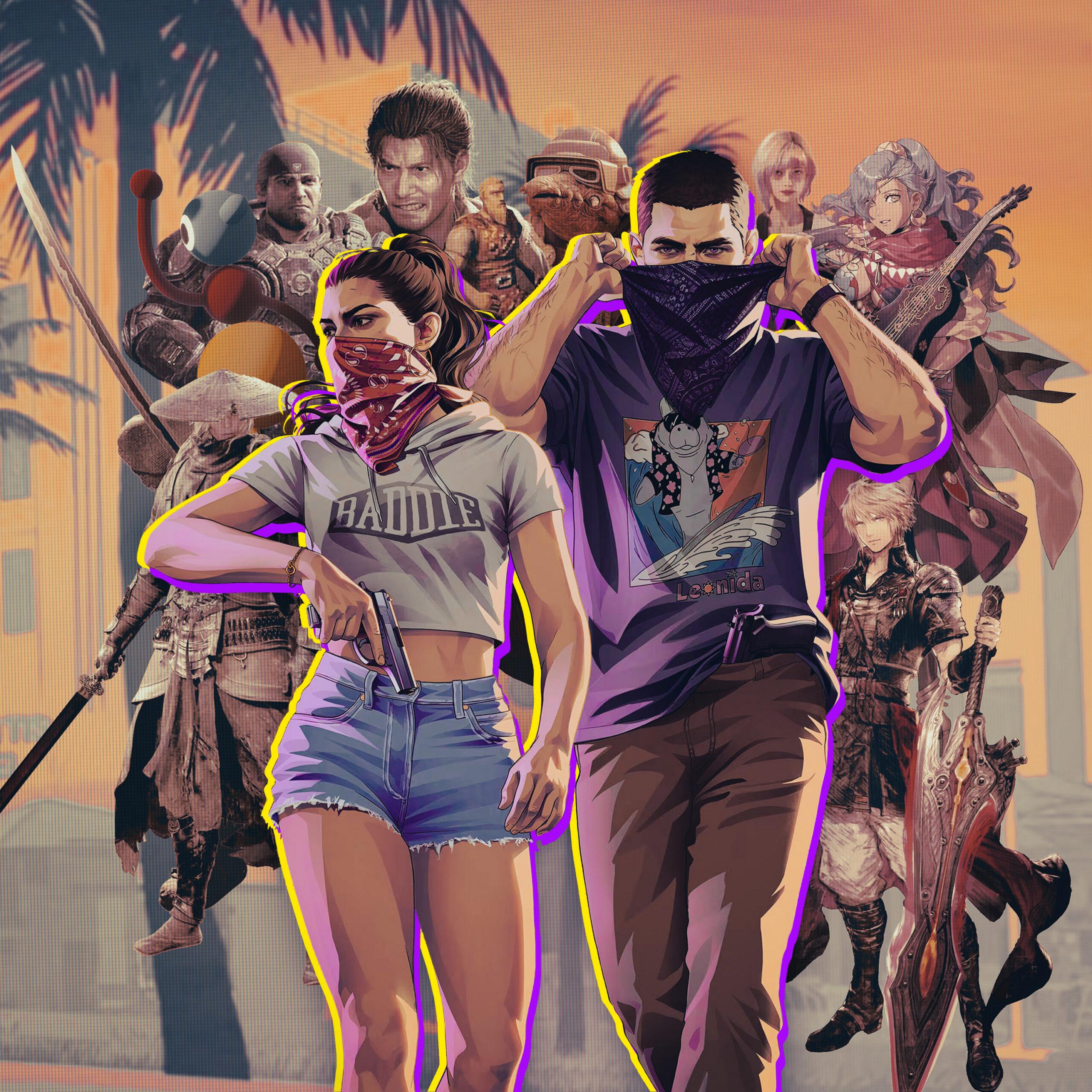

On June 23, Marek Tyminski, founder and CEO of Polish video game developer and publisher CI Games, announced that his studio’s next game, Lords of the Fallen II, would not be arriving this fall as previously planned. Instead, the sequel to the 2023 reboot of the original Lords of the Fallen would be shifting to the first quarter of 2027. Some of the reasons sounded standard for a video game delay: The “additional integration, iteration, and polishing time” would help “refine and strengthen the overall experience” to “deliver the highest possible quality at launch.” But Tyminski cited another factor outside of his company’s control: “This updated release window also strategically positions Lords of the Fallen II outside of a highly competitive holiday period, ensuring the game receives the dedicated attention it deserves.”
Tyminski didn’t have to specify why the holiday period would be highly competitive, or why Lords of the Fallen II might have trouble seizing the spotlight this fall. Everyone knew what he was referring to: Grand Theft Auto VI, as well as the prodigious pileup of other big games that have already scrambled to get out of GTA’s way.
GTA VI, the latest in Rockstar Games’ sensational series of open-world crime epics and a direct sequel to the third-bestselling game of all time, will arrive on PlayStation 5 and Xbox Series X/S on November 19. Thirteen years of pent-up demand for a new numbered GTA, along with glimpses (Rockstar-sanctioned and otherwise) of the game’s gorgeous vision of Vice City, have fueled record hype for the holiday behemoth. Rival publishers have long anticipated that GTA would monopolize gamers’ money, time, and attention late this year. Some, such as Tyminski’s CI Games, chose to bail on 2026 altogether. But many others resolved to get their games out early enough to make hay before GTA. Consequently, a wave of great games has already crested. We got a record gaming blitz before GTA VI.
When GTA VI was delayed for the second (and, it turns out, final) time in November 2025, the gaming gauntlet was thrown down. Rockstar had essentially licked this whole holiday season to claim that time as its own. As Bloomberg’s Jason Schreier wrote after the first delay last year, “Grand Theft Auto VI promises to be a thermonuclear bomb on the product release calendar, leveling whatever games happen to be anywhere in its vicinity at the time of detonation. It is expected to be the biggest entertainment release of all time and will suck up player attention and media coverage for days if not weeks. Other game companies want to stay as far away as possible.” Schreier, a plugged-in reporter who frequently breaks news about game development, emphasized, “Competing game-makers don’t want to risk being anywhere near GTA VI and will do everything they can to avoid it.”
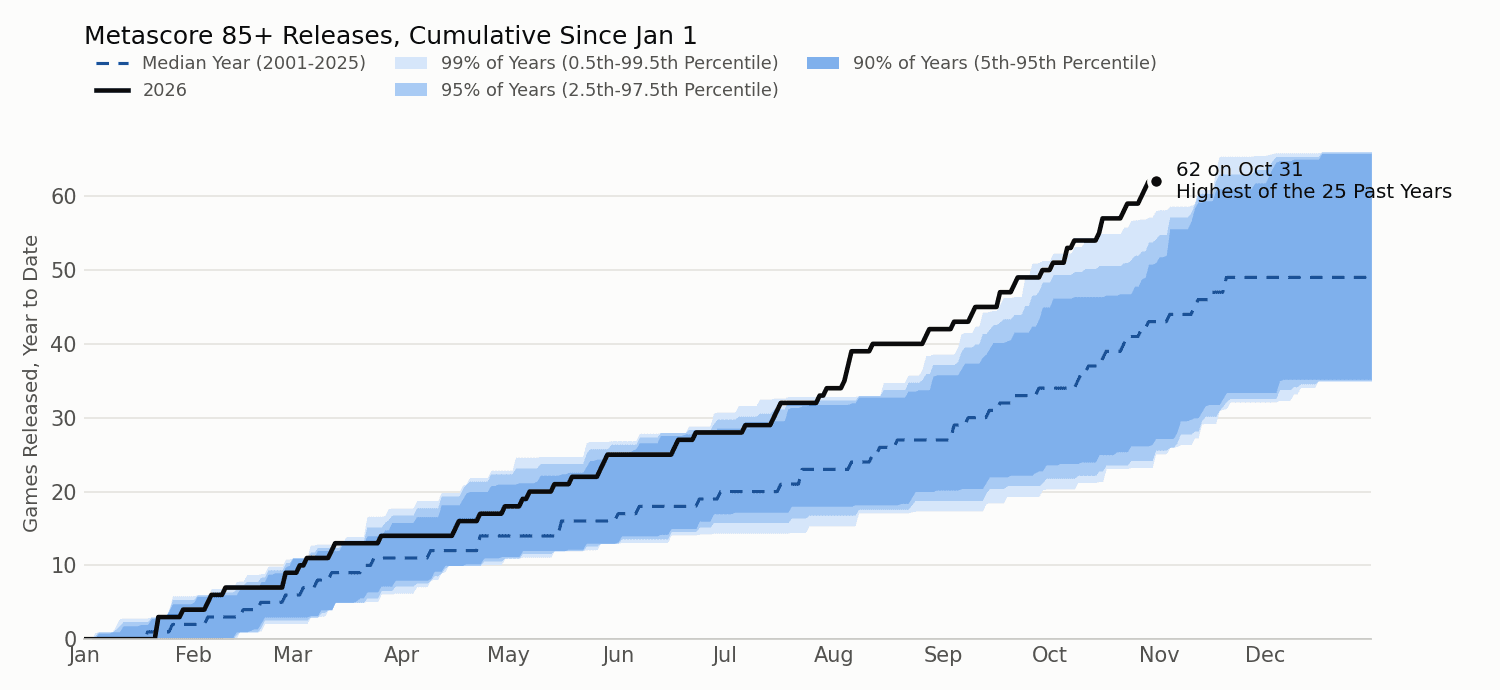
It’s probably no coincidence, then, that this year’s release schedule has been historically front-loaded—and crowded. The chart below shows the number of games that received a Metascore—Metacritic’s weighted average rating of the critical consensus—of at least 85 out of 100 through October 31 of each year dating back to 2001. This year’s tally of 62 such games is the highest on record, well above the median of 43. And this year’s pace has only accelerated over the past few months, as indicated by the black line’s separation from the blue mass composed of the preceding 25 years. August, September, and October of 2026 were packed with good games as companies collectively cleared the decks before GTA’s debut.
Like a stampede of forest fauna fleeing an advancing wildfire, game publishers have engaged in a headlong rush to leave a sizable buffer on both sides of November 19. The past few months have featured a succession of blockbuster bangers, such as Big Walk, Onimusha: Way of the Sword, Valheim, Fire Emblem: Fortune's Weave, Ace Combat 8: Wings of Theve, Star Wars: Galactic Racer, Gears of War: E-Day, Final Fantasy Resonance, Call of Duty: Modern Warfare 4, and Phantom Blade Zero, in addition to other well-regarded indies like Well Dweller, Enshrouded, and Dressmaker. From midsummer through late fall, hardly a week went by without a buzzy new game. And immediately before and long after GTA’s arrival, hardly a week will include one. To invoke a song that once appeared on a Grand Theft Auto soundtrack, every date from mid-November on has unofficially been designated (Don’t) Fuck Wit GTA Day. And almost everybody’s celebratin’.
“Just about everyone got out of the way of Grand Theft Auto VI’s launch,” confirms Mat Piscatella, senior director and video game adviser at market research company Circana. Piscatella adds, “A big chunk of games shifted into September and October, and a bunch of others into 2027. Even games that are on platforms Grand Theft Auto VI won’t release on, and in genres where the cross appeal to a Grand Theft Auto VI would be hard to find. … As soon as the Big Gorilla pounded its chest with its announced release date, everyone scattered.” Piscatella calls the pre-GTA scheduling frenzy “wild to see, to be honest.”
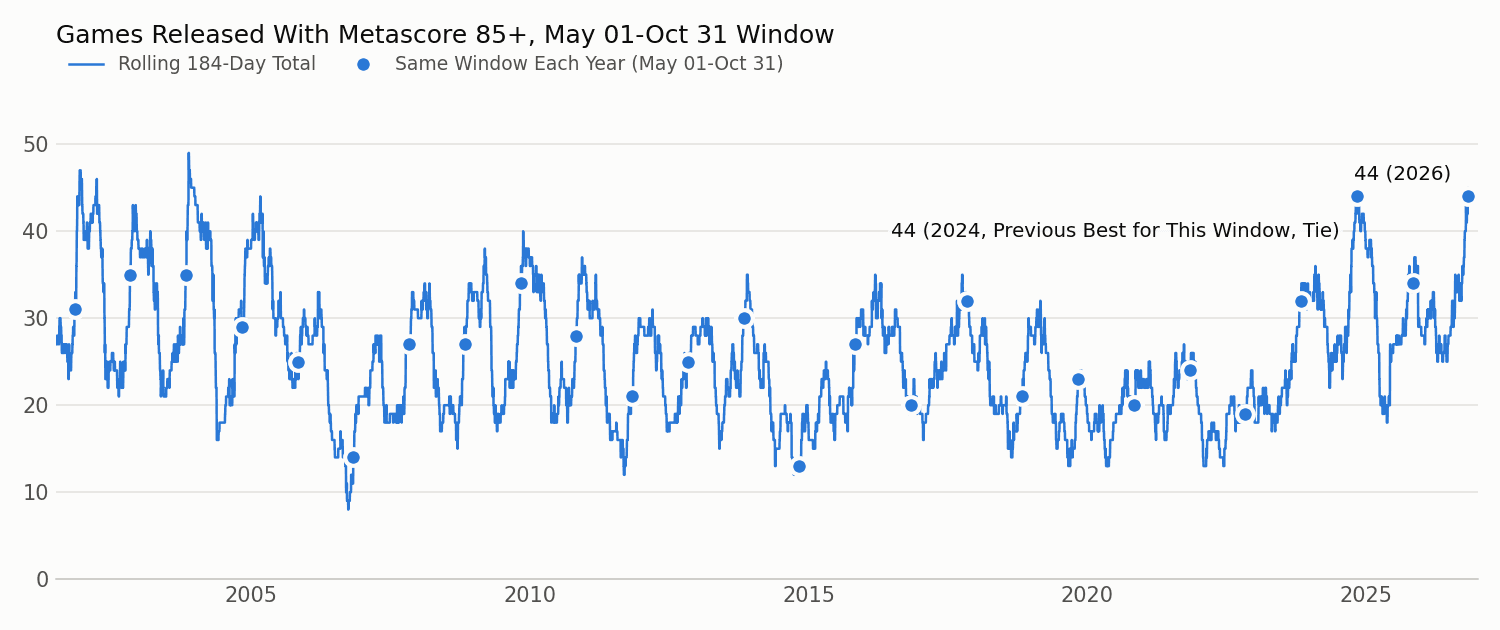
This year’s combination of quality and quantity stands out when we compare the count of games with 85-plus Metascores from the past six months (May through October) to the count in the same period on the calendar in each of the past 25 years, as well as every rolling span of equivalent length.
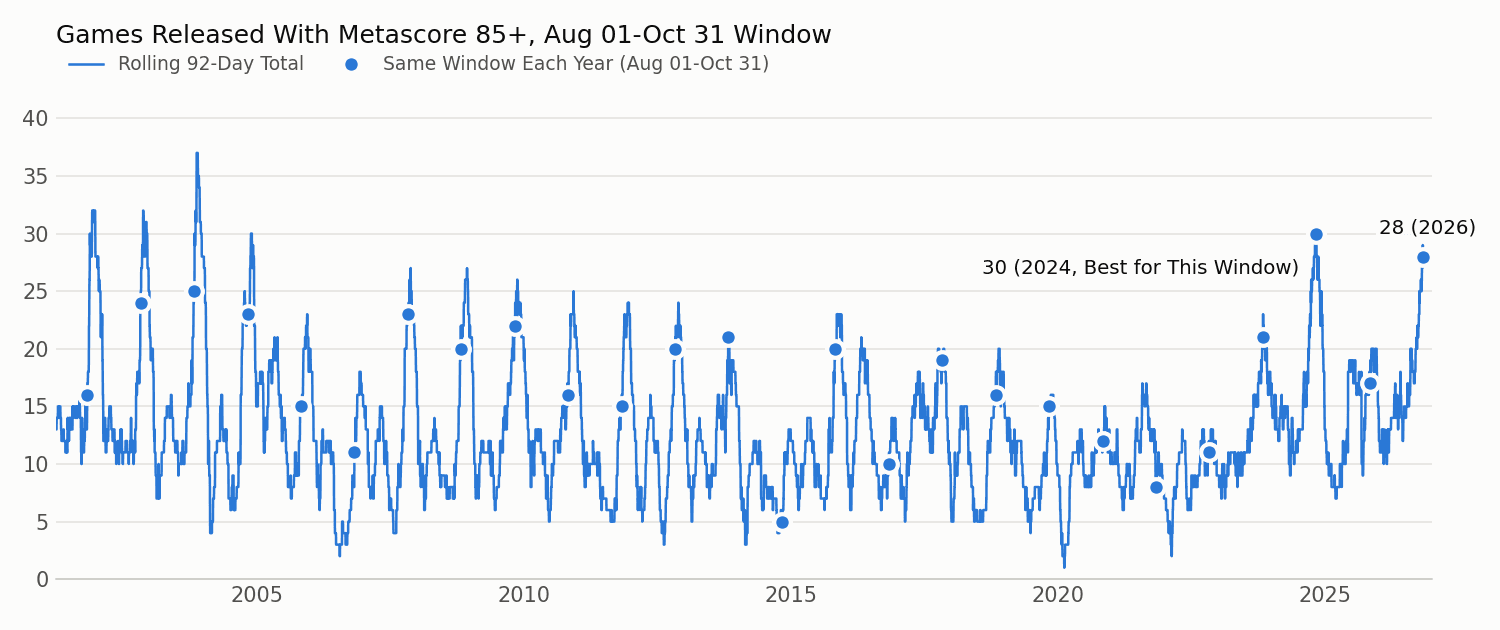
This year’s cadence also ranks high if we look at three-month samples (August through October):
Unsurprisingly, the graph of two-month samples (September through October) also shows a 2026 spike:
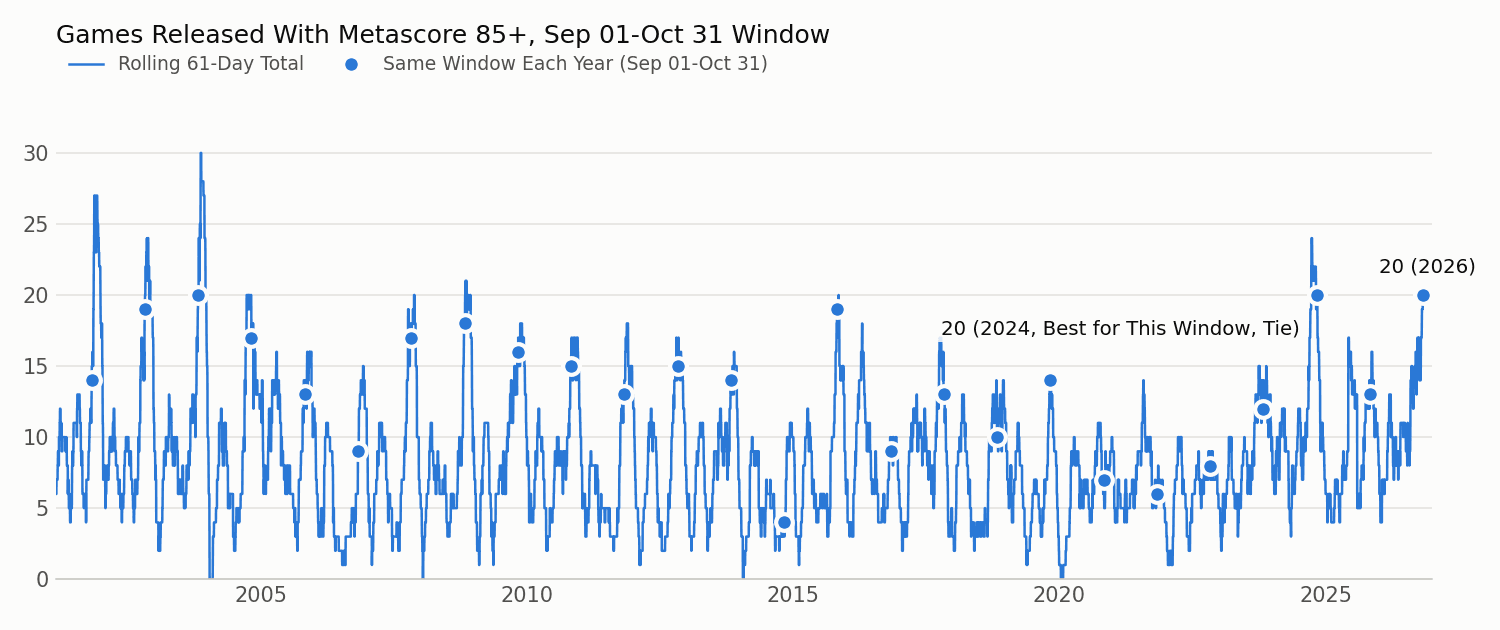
Because 2026 comes in near or tied for the record within each of those windows, it’s unequaled overall. The game industry may, in some ways, be broken. But the games have been good.
Admittedly, many more games come out per year now than in decades past, though that doesn’t affect this data that much. Even on a rate basis, 2026 has been special. All in all, 9.4 percent of qualifying games this century have achieved an 85-plus Metascore. But the rate to date in 2026 is 15.2 percent, tied with 2001 for the loftiest figure. And the vast majority of the thousands of games released annually—more and more of which are low-effort, vibe-coded clones—on storefronts such as Steam and itch.io don’t meet the minimum of seven reviews required to appear on the yearly Metacritic lists we’re drawing from.
More relevant is the number of non-original games that meet the Metascore standard. There are more remasters, remakes, collections, and so forth than there used to be—and many of the games that are being upgraded and recycled now hadn’t yet come out for the first time in the earlier windows we’re considering. If we filter out all titles with keywords that often denote rereleases, 2026 still ranks high, but not highest.
Of course, collections, remasters, and remakes, such as Metal Gear Solid: Master Collection Vol. 2, The Witcher 3: Wild Hunt—Remastered, and Trails in the Sky 2nd Chapter (or, for that matter, this week’s The Legend of Zelda: Ocarina of Time and World of Warcraft: Forever), respectively, do contribute to how stacked a year’s gaming lineup looks. And these charts of games with 85-plus Metascores don’t include such near misses as 2026’s Star Wars Zero Company, Control Resonant, Order of the Sinking Star, Silver Pines, Castlevania: Belmont’s Curse, The Blood of Dawnwalker, Zero Parades: For Dead Spies, LEGO Batman: Legacy of the Dark Knight, Assassin’s Creed Black Flag Resynced, and MIO: Memories in Orbit—or the critically disappointing but nonetheless bestselling (and system-selling) Marvel’s Wolverine.
By any permutation of Metascore thresholds and time spans, 2026 has been a relatively loaded year—even before the trifecta of Zelda, WoW, and the main event, GTA. But the rapid pre-Halloween pace of good-game releases owes a bit to the pressure publishers felt to cram their releases into the period preceding GTA’s discourse-dominating debut. And that pace is about to slow down dramatically—partly because some games that could have joined the autumn hit parade have, perhaps prudently, thrown in the towel for 2026.
The pre-GTA traffic jam was so bumper-to-bumper that games faced stiff competition no matter where they positioned themselves. Take Onimusha: Way of the Sword, which revitalized a third-person samurai swordplay franchise that had lain dormant for decades. At Sony’s State of Play presentation in early June, Capcom announced that Onimusha would come out on September 25. Unfortunately for Capcom—which developed and/or published a multitude of titles this year—virtually every big game that got a target date during summer showcase season was lined up in close proximity to others.
Way of the Sword’s original date put it one day after Control Resonant and Silent Hill: Townfall and one week before Ace Combat 8 and Minecraft Dungeons 2. So Capcom took the unusual step of moving the game forward, to September 4 … which was one day after The Blood of Dawnwalker and Orbitals and one week after Zero Company and Resonance: A Plague Tale Legacy. If November was the rock, September was the hard place. Schreier wrote that the overlap in late summer and early fall would “inevitably lead to some losers, but game publishers around the world are making the calculation that releasing in a crowded month is less risky than trying to come out anywhere near Grand Theft Auto VI.”
Rather than opting for the “damned if you do” or “damned if you don’t” paths to competing with GTA in 2026, some companies opened door number three: kicking the can to 2027. Although Tyminski didn’t single out GTA in his explanation for Lords of the Fallen II’s postponement, the makers of a few other prominent titles—including Fable, Squadron 42, and Danganronpa 2x2—did mention the calendar’s big bully by name when disclosing a delay. Danganronpa 2x2 writer Kazutaka Kodaka even joked(?), “I wouldn’t have time to make the game while playing GTA VI, so it was inevitable that we moved the release time.” Other games—including At Fate’s End, No Rest for the Wicked, Emberville, Witchbrook, Tomb Raider: Legacy of Atlantis, and The Duskbloods—shifted from late 2026 to early 2027 without publicly playing the GTA card.
Granted, games get delayed all the time, and some of these titles probably would have slipped even if GTA weren’t sucking up all of the industry’s oxygen. In fact, GTA makes a convenient bogeyman to blame for a further delay if, like Squadron 42, you’re already more than a decade overdue. To the extent that developers and publishers did push the postponement button based on GTA, though, some may have overreacted to the risk the tentpole poses. Lords of the Fallen, for one, isn’t a direct competitor to GTA; it’s a dark-fantasy action RPG/Soulslike, and it’s coming to all platforms, including some (PC and Switch 2) that won’t initially support GTA VI. Piscatella says some publishers shifted their on-sale dates “even when the decision to do so seemed more emotional than rational,” and he calls the scattering of releases “much more vibes- than data-based.” For instance, he adds, “I’m not sure why a PC cozy sim would have to move for Grand Theft Auto VI.”
Regardless of the wisdom of ceding so much territory to Rockstar—much as some game makers (maybe misguidedly) gave a wide berth to last year’s Hollow Knight: Silksong—Piscatella concludes, “The result is a completely wide-open, aircraft-hanger-sized window for the few big games launching in November.” Namely, GTA VI, Ocarina of Time (a remake of the classic 1998 Nintendo adventure), and WoW: Forever (a new branch of Blizzard’s beloved 2004 MMORPG that largely returns the ever-evolving game to its original state).
Zelda and WoW make some sense as GTA counterprogramming: They’re established, throwback brands in non-GTA genres that appear on platforms where people can’t play GTA this year. But beyond that duo, publishers are acting as if Rockstar has been broadcasting Dave Bowman’s warning about Europa from 2010, but about the last six weeks of the year: “Attempt no landing there.” After this week, the calendar for the remainder of 2026 will be bereft of big-name games other than GTA.
Then again, the tumbleweeds blowing through this year’s December slate don’t look quite as out of place as they once would have. The graphs above displayed some impressive peaks in the early 2000s, because back then, the holiday season was supreme. Over the past quarter century, though, the share of annual releases with 85-plus Metascores that come out during the last three months of the year has fallen from about 40 percent to roughly 25 percent—or what we would expect if such titles were distributed evenly throughout the year. The industry has weaned itself off its dependence on stocking stuffers.
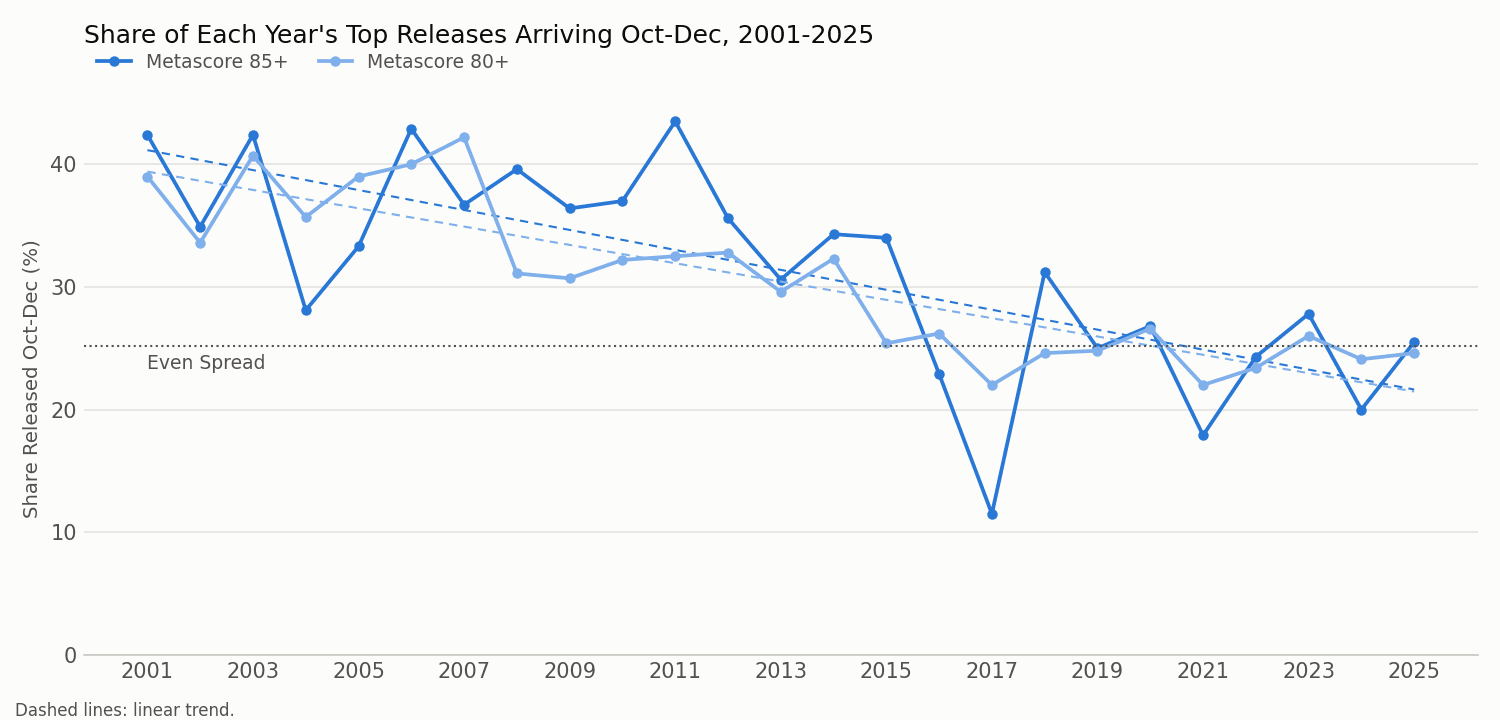
As the medium has matured and gamers have gotten older, the disposable income consumers can lavish on gaming might correlate less closely to how close Christmas is. And perhaps publishers have learned that there’s a virtue to spreading out marquee games—which is ironic, in light of this year’s blockbuster boss rush. At least the post–November 19 slowdown will allow gamers who haven’t set up permanent residence in Vice City to whittle away at the backlogs they built up this summer and fall—until February 2027, which, thanks to GTA-induced delays, is shaping up to be the new October 2026.
If there’s one thing the 2026 lineup lacks so far, it’s a consensus leader in the clubhouse for Game of the Year. A long list of games with Metascores of 85 and up dropped before the midyear onslaught, including but not limited to [deep breath] Resident Evil Requiem, 007 First Light, Mina the Hollower, Pragmata, Pokémon Pokopia, Cairn, Mewgenics, Mixtape, Forza Horizon 6, Denshattack!, Sektori, Saros, Esoteric Ebb, Nioh 3, Titanium Court, And Roger, Monster Hunter Stories 3: Twisted Reflection, and Marvel Tokon: Fighting Souls—plus huge hits with lower Metascores, such as Crimson Desert and Tomodachi Life: Living the Dream. [Gasps for air.] None of those would be a prohibitive front-runner in a normal year, as Clair Obscur: Expedition 33 was last year. But maybe that’s moot, because GTA VI will be eligible for the Game Awards, and prediction markets call it an 85 percent favorite for GOTY.
GTA VI is grand not only in anticipation and title but also in price and size. No wonder it’s turned into a totem of fear and hope for an entire industry. Maybe, as some optimistic publishers believe, GTA will be a rising tide that lifts all titles by selling more consoles and bringing greater attention to gaming. Or maybe it will box out and drown out everything else. However Rockstar’s grand opening pans out, 2026 has already been a stacked year for games—and gamers who’ve gorged on tasty appetizers for 10 months may be running out of room for dessert. But come November 19, even players who’ve been feeling fairly sated will likely loosen their belts, pick up their controllers, and greet GTA with a familiar refrain: Ah shit, here we go again.