

Eric Bauza, the voice of Bugs Bunny, Daffy Duck, Tweety Bird, and many more iconic Looney Tunes characters, died suddenly on Sunday due to hypertensive cardiovascular disease. He was 46 years old. His family announced the news on Sunday night in an Instagram post.
For an oral history of Coyote vs. Acme this summer, I interviewed Bauza about the movie, his life, and his work as an Emmy-winning voice actor. Bauza spent our time together casually slipping in and out of all sorts of characters—both real and fictional. It was hypnotic and hilarious. Here is a portion of our conversation about his background, some of which didn’t make the article.
How are you doing, Eric?
Eric Bauza: [As Bugs Bunny] “I’m fine now, Doc. Now that we’re in a nice temperature-controlled room.” I’m good, man. How are you?
I’m good. OK. So what you just did.
Yes.
Do you enjoy breaking out the voices?
It’s a bit of an out-of-body experience. … I mean, I owe it all to Mel Blanc. If it weren’t for Mel Blanc, I often say I would be driving into the airport in my Uber [as a driver]. But I would also be going [as Daffy Duck], “Hey, do you like techno music? I wrote a script. It’s in the back there if you want to read it.” That’s my Uber persona: the Looney Tunes asking you what kind of music you like.
Mel Blanc was the originator of these, I don’t want to say voices. They’re like personalities. Over 90 years now, we’ve been with these characters, like our oldest relatives. These are characters that you would find sitting across the table from you at Thanksgiving. “Pass the gravy. Yeah, you idjiot.” My mom sounds like Yosemite Sam.
I’m 43. So I got into Looney Tunes by watching on Nick at Night. How did you get into Looney Tunes?
I’m 46, 47. I don’t know how old I am anymore. It’s Filipinos for you. I could be 12. I could be 89. I don’t know. I would watch the Looney Tunes in syndication in the ’90s [and] The Bugs Bunny and Tweety Show in Toronto, Canada. That’s where I’m from originally. Along with other greats like Mike Myers, Jim Carrey, the entire cast of SCTV. John Candy went to high school a few blocks down from where I went to high school. I went to Cardinal Newman. And people always go, “What’s in the water in Toronto?” And I say, “Schizophrenia.” Because all the characters that come out of those comedians. It’s great.
I’m sure you’ve gotten this question a lot, but how did you learn that you can do voices?
Well, that’s a question for my parents, who probably heard me in my room as a kid talking to myself and [then were] calling the priest, getting the holy water ready, performing an exorcism. But it’s Saturday morning. Watching those cartoons was my introduction to voice characterizations by Mel Blanc. He was, like, the first guy to get on-screen credit as a voiceover artist. He fought for that. And rightfully so, because he created characters that, again, 80, 90 years later, we’re still celebrating and pining for. We want to see them on the screen and not on a shelf collecting dust somewhere. That was it, comedy-wise.
So were you doing Daffy and Bugs back then, too?
Trying. I mean, you just sound like a kid doing the voices until you hit puberty and then your voice changes. And all of a sudden, you sound like Richard Dreyfuss with a lisp. That’s my Daffy: Richard Dreyfuss with a lisp. [As Daffy Duck] “Mayor Vaughn, what we’re dealing with here is a perfect eating machine. OK? And all he wants to do is eat tourists on the Fourth of July.” I don’t know how the speech goes.
It’s good improv.
Yeah. Got to get off script sometimes. It was definitely high school when I discovered making fun of teachers will get you in trouble but will win over the classmates. You slowly become the more popular kid because you can make fun of all your teachers. But the teachers at my school were very encouraging. They knew that there was something going on there, and they wanted to encourage it, but they’re like, “Look, you have to get your work done. And once you get that done, you can go to the office tomorrow morning and do the morning announcements.”
And that’s basically where I was like, “Oh, OK.” If I do impressions of like, [as Homer Simpson] “Ooh, Marge, there’s a sale on hot dogs in the cafeteria.” [As Marge Simpson] “Oh, Homer, that’s just going to add to your cholesterol.”
I would do Marge Simpson and Homer and Beavis and Butt-Head. [As Hank Hill] “I’ll tell you what, there's a basketball game after school today sponsored by the propane company.” And then people would be like, “Was that you?” And I’d be like, “Yeah.” And they’re like, “Man, that’s great.”
That's your origin story.
Yeah. The morning announcements. Who’d have thought?
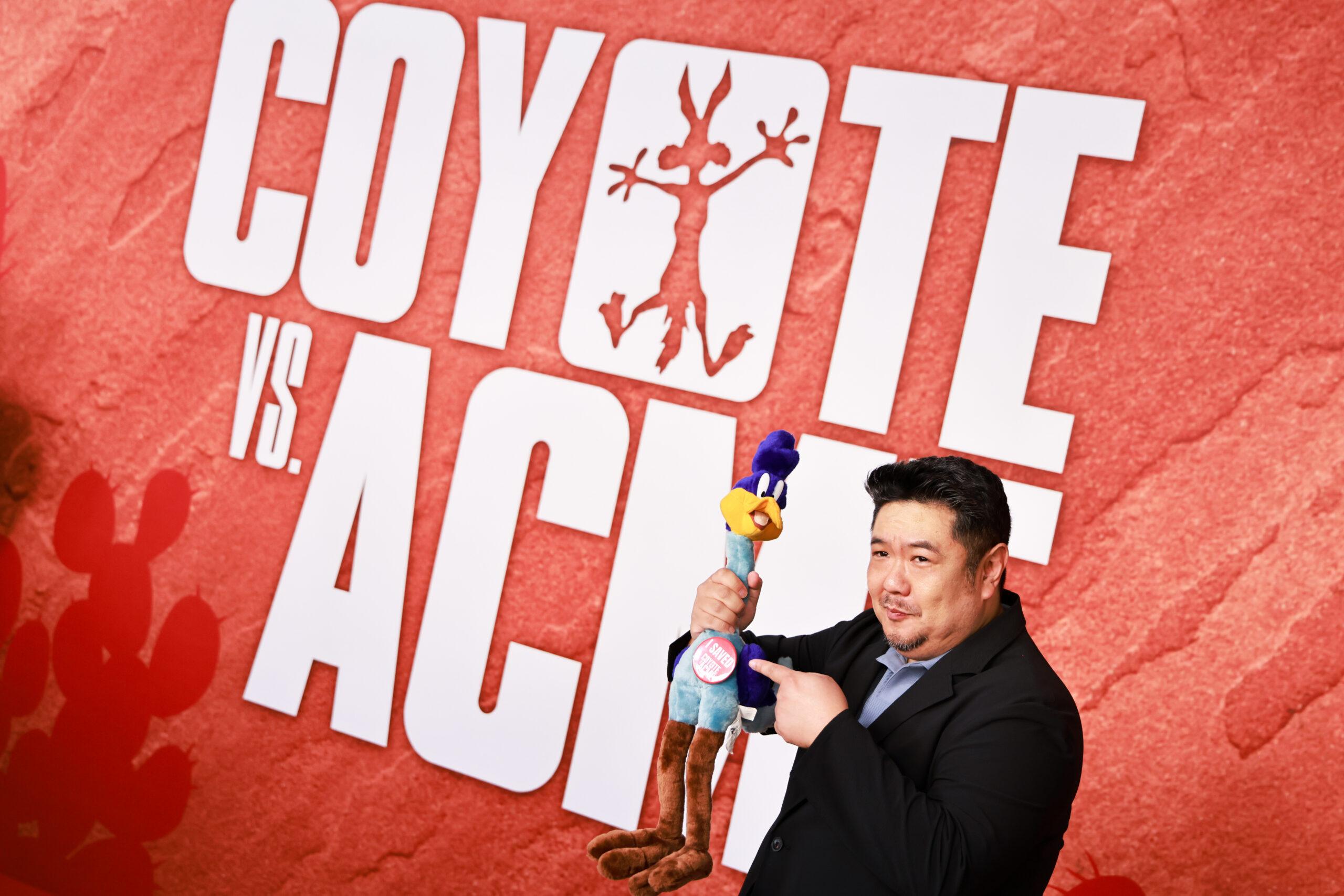
Eric Bauza attends the Los Angeles Premiere of ‘Coyote vs. Acme’
So fast-forward, how do you get a job as the—
Well, that’s the thing. I didn't know the entry point for a voiceover artist. Because at that point even, I think voiceover, [and I’m] like, “Ugh. Be a real actor.” I didn’t go to school for dramatic arts. I went to school for radio, television, and film production at the Bell Centre in Toronto, which is exactly where they shot Degrassi Junior High. I don’t know if you remember that show. It’s my Canadian showing. [As Donald Trump] “These Canadians, they’re stealing all the American voice work. OK? We got to get them out of there, all right? Too good at voices. They’re chameleons. They might be polite, but they also eat French fries, cheese, and gravy. That’s weird. ‘Putin,’ I think is what they call it. I love Putin.” I always say I should probably stop doing that impression. Because my green card hasn’t been approved yet.
I went to school for technical broadcasting and found my way into animation, just doing an internship. And it was here. I did my internship here in 1999 in L.A. So I was walking the streets. I was going to the Viper Room. All the things that they tell you to do. And that’s where all the cool kids hang out. I’m totally not a Viper Room guy. People were like, “You lost little boy, where are your parents?" I made very good friends at that internship. The best thing you could do at an internship is you learn what to do, but especially what not to do. And some of the people that I made friends at that studio, I’m still friends with today. And they all spread out.
They all started working at Nickelodeon [and] Disney. And that’s kind of how I got in. I was a cartoonist first. And then they’re like, “Hey, I’m making a pilot for Disney or for Nick. Do you want to do a voice on it?” I’m like, “Yeah.” That was kind of the launching point.
So in terms of getting involved with Looney Tunes and Warner Bros., how’d you get pulled into that?
As time goes on, you start getting these emails and these auditions for these classic characters. And it is like getting a ticket to the Wonka Factory. You’re like, “Oh my Lord, they’re doing another Looney Tunes? I’ll try.” And then I didn’t really get any of the main characters in 2009, but I did get Marvin the Martian. [As Marvin the Martian] “Isn’t that lovely? Oh, wow. I do love your podcast, but it blocks my view of Venus. Therefore, I shall have to blow it up.” So he was that nebbish alien in the Looney Tunes universe that really only had seven shorts. And everyone else got over a hundred or 200, 300 cartoons. But he sells the most air fresheners, is what I’ve been told.
When did that grow into a wide range of characters?
You start doing other voices in the booth, and they go, “OK, do that one.” After Marvin, I was also Pepé Le Pew. [As Pepé Le Pew] “But of course we don't talk about Pepe anymore, sadly.” But if you are Pepé Le Pew, then clearly you lose the French accent and do like a Southern voice. [As Foghorn Leghorn] “And I say, pay attention, Alan. The lights are on, but nobody’s home. I say, Foghorn Leghorn.” Yeah. “I burned my tongue on your coffee. I’m going to have to sue you guys.” That’s what he’d say in [Coyote vs. Acme]. I mean, I say they all live in the house of Mel Blanc.
[As Tweety Bird] “Some of them live in the attic like Tweety Bird,” and they would still even pitch this up. I’m doing a self-pitch. “And when you woose the baby talk …” [As Bugs Bunny] “And you start talking with a New York accent, Doc, it becomes Bugs Bunny.” And he’s a bit more of a “foist-floor character.” And the people that live, I’d say on the main floor, are Sylvester. [As Sylvester] “Ooh, am I going to eat that canary if it’s the last thing I do!” And when you change the hungry cat to a more of [as Daffy Duck] a greedy kind of duck, that becomes Daffy. Then they pitch that up, and it becomes what we know of Daffy. But when Mel Blanc was performing it, he was using his regular timbre. What I’m saying is I have a lot of time on my hands.
This interview has been edited for length and clarity.