The Contagious Delusion of ‘You Can See Everything’
What is shared reality to a scammer like Elizabeth Holmes?

From 2017 to 2019, I maintained a steady diet of pure, unadulterated scam. I was diligent in my media feasting until there was no article, book, podcast, or docuseries left unturned about Billy McFarland, Anna Delvey, Dr. Death, Dirty John, and most especially, Elizabeth Holmes. As I went about cracking these cases wide open, getting to the bottom of the frauds, scams, and grifts, I drafted an idea in my mind of the type of person who could so easily persuade others out of their money, their homes, their health. Thoughts of Frank Abagnale Jr. and Jennifer Lopez in Hustlers danced through my head, but when I would eventually encounter each real-life fraudster in the digitalized flesh, I could only think: “I’m sorry, this is literally the least charming person I’ve ever seen in my life. What the hell is everyone going on about?”
No podcast, no documentary, no fictionalized version of Holmes has ever been able to convince me that she is charming. That it was her delightful nature and attractive, not-at-all off-putting aura that raised $1.3 billion in equity funding for a blood-testing device that not only couldn’t run hundreds of medical tests from a single drop of blood, as promised to its investors and patients, but also sometimes simply exploded. Did she appear confident? Sure, if that’s what you’re seeing there. Compelling? Yes, she certainly knew—and still knows—how to weave an arresting narrative.
But mostly, I think it was the lying, the manipulation of reality that got Theranos to a $9 billion valuation before she and Theranos president and COO Sunny Balwani were exposed by whistleblowers and journalist John Carreyrou for perpetrating a massive corporate fraud. The tech didn’t work; the blood samples were too small; and the results provided to journalists, patients, and regulatory institutions were fake. But cloaked in the turtlenecked image of Silicon Valley, Holmes still managed to draw people in. Is a snake charmer charming? Or are they simply skilled in executing a series of precise and repetitive movements to lure the snake out of its basket, put it in a defensive stance, and create the illusion that it’s dancing to the music as it dodges the stick being dangled right in front of its face?
You Can See Everything, the result of a documentary pitch by Holmes and her partner, Billy Evans, that was ultimately picked up by codirectors Nathan Fielder and Lance Oppenheim, is not a movie about how the world misunderstands Elizabeth Holmes. There is not some hidden truth about her crimes waiting inside the sheetless guest cottage where she and Evans have (not exactly) set up shop for Fielder to encamp with them in the 34 days before she goes to prison. Instead, Fielder and Oppenheim spend three breathless hours exploring the messy realities that create our perception of what truth is in a post-truth world, and the futile lengths we go to to try to know another person. Evans and Holmes invited Fielder and Oppenheim into their beachfront rental near San Diego to show the world the real Liz. The idea was that by exposing herself fully (although certainly not as fully as Billy), they could overcome the narrative they believed had been painted by the media.
Here, we are invited to “see” everything—yet Holmes consistently frames her most committed fictions within malleable language. The movie begins and ends with quibbling over a quote in a New York Times profile of Liz. Holmes and Evans insist that they have recordings of the interview with the Times reporter that would refute the incorrectly attributed words. But they never produce the tapes. “Why would I deceive you?” Holmes asks Fielder calmly as he spins out, trying to figure out why she wants them there. “There’s no reason for me to do that.”
Whenever I think of the Holmes brand of grifter that was so prevalent in the 2010s—the kind with no actual talent to back up their big ideas, but who cannot seem to stop, no matter how many times they fail to make their ideas a reality—I’m reminded of an anecdote from the Dr. Death podcast. The narrative pod tells the story of Christopher Duntsch, a “charming” neurosurgeon who was so incapable of performing neurosurgery that, between 2011 and 2013, he maimed 33 patients, killed two, and paralyzed his best friend. The bit that’s stuck in my head all these years later is from Duntsch’s former Colorado State football teammate Chris Dozois. Dozois recalls that Duntsch wasn’t a particularly gifted athlete, but he displayed such a strong work ethic and desire to play football that he was able to walk on to a Division I team. From there, he ran himself ragged trying to learn basic drills and techniques that he was absolutely incapable of executing, and he begged his coaches for more chances to run plays, even after practice was over. Over the years, Dozois often reflected on Duntsch’s refusal to accept that he’d never be a great linebacker, and he believed that display of determination was inspirational …
Then Duntsch became a neurosurgeon. Scammers like Duntsch or Holmes rarely run a deception because they simply love fraud. It’s not the Bling Ring. They do it because they believe they’re destined for greatness, prestige, and esteem, even when they don’t possess the aptitude, talent, or skills to really reach it. So they find ways to bend the world to their will—staring reality in the face and saying, “Unsubscribe.” And so help you if you get close enough to have to contend with their delusion. Because they will not stop running the drill. Even when the machine explodes. Even when the body is open on the table.
One week before she’s set to go to prison in You Can See Everything, Holmes is busy making calls to potential new investors for what she and Evans have conceived of as the next iteration of Theranos. While Evans watches “Introduction to the Mitochondria” videos on 2x speed, Liz pitches “some of the best algorithms” and “a new type of sensor” and excitedly touts that they “have a laser” for the theoretical new device. If these sound like quotes from President Donald Trump, well, they might as well be. Among other things, this movie functions as a three-hour synecdoche about combing our way through a post-truth world, as Fielder watches Holmes excitedly insist that she has the pertinent experience to launch a revolutionary new medical tech company—experience for which she has been awarded an 11-year prison sentence. When Fielder asks why she’s so energized after these calls, she tells him that she feels like this is what she was born to do. Born to have an idea about lasers that she has neither the skills nor the resources to make a reality.
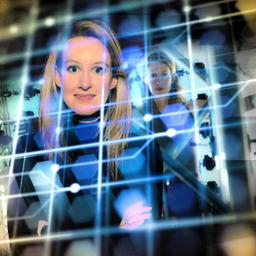
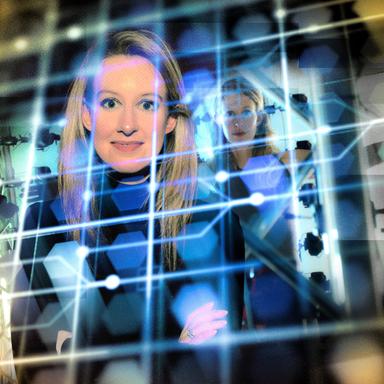
It’s clear that Elizabeth Holmes will never stop running the play, even after a line of investigative journalists, internal Theranos whistleblowers, the SEC, the Department of Justice, and the walls of a minimum-security federal prison in Texas have attempted to mitigate her path of destruction. Certainly, this documentary will not stop her, either. People like her are either unwilling or unable to acknowledge their own limitations, and so instead they invite you to enter into their delusion—a topsy-turvy world where they will honest to God say they’ve never intentionally told a lie … when it has been proved in a court of law that Holmes told investors that her company would make $100 million in a year when it was projected to make only $100,000 … that she put fake Pfizer logos on lab reports and sent them around to potential investors … that she told journalists that Theranos’s blood-testing device was being used in active combat zones in the Middle East when it absolutely was not.
This isn’t a movie about Holmes’s guilt; this is a movie about humanity’s capacity for self-delusion and how, both intentionally and unintentionally, that delusion can become contagious. Throughout You Can See Everything, we watch Fielder, who’s normally the commander of the on-screen human machinations, be gaslit into interrogating tiny nuances of language to establish some semblance of a shared reality with his subject.
After hundreds of docuseries and podcasts, long-form articles and books on scammers, this documentary finally puts to the record what it feels like to be in the orbit of someone like this. And it feels fucking disorienting! Whether it's an act in service of the story, or because Fielder’s psyche is genuinely being torn asunder the more invested he becomes in figuring out whether Holmes is being honest with him, watching him go toe to toe with her is electric.
Fielder has said that he and Oppenheim knew they had to keep pushing this project along when the two of them would gather after filming all day with Holmes and Evans and each realize that they’d walked away from their interactions with completely different opinions on what they’d experienced. They became fascinated, as many of us would, by a person who, even when their back is up against a wall, still finds a way to make themselves the hero of their own story; to start a new scheme basically on the car ride to jail; to invite a film crew into their home because they genuinely believe that the power of their delusion can hold up to the scrutiny of two filmmakers who are uniquely experienced with documenting weirdos.
The current narrative that we find Liz and Billy slinging is that Liz’s mind just works differently. The clear implication is that she’s neurodivergent, and that could very well be true. But nearly 20 percent of the world’s population is neurodivergent. The idea that Liz’s brain works so differently that she could have accidentally conned a bunch of old guys out of $700 million because she’s simply not so good at words is laughable. Fielder’s greatest strength as a storyteller is that he does not laugh, even when the situation begs for it. Instead, he seems desperate for Liz to admit that she understands the ways in which she’s manipulated language in the past to cover up her fraud. He plays a 2014 clip for her wherein she tells a Fortune journalist that Theranos created a single device that can run any test. To Fielder, she stands by that statement. It’s not a lie, she says. The device could run hundreds of tests if it had the correct “chemistries” for each one. Because it’s a "platform,” she says. It “calls the cloud,” she says.
So what she meant, Fielder tries to assist her in clarifying, is that the device was capable of running any test they touted it could. She’s unclear on where she was unclear.

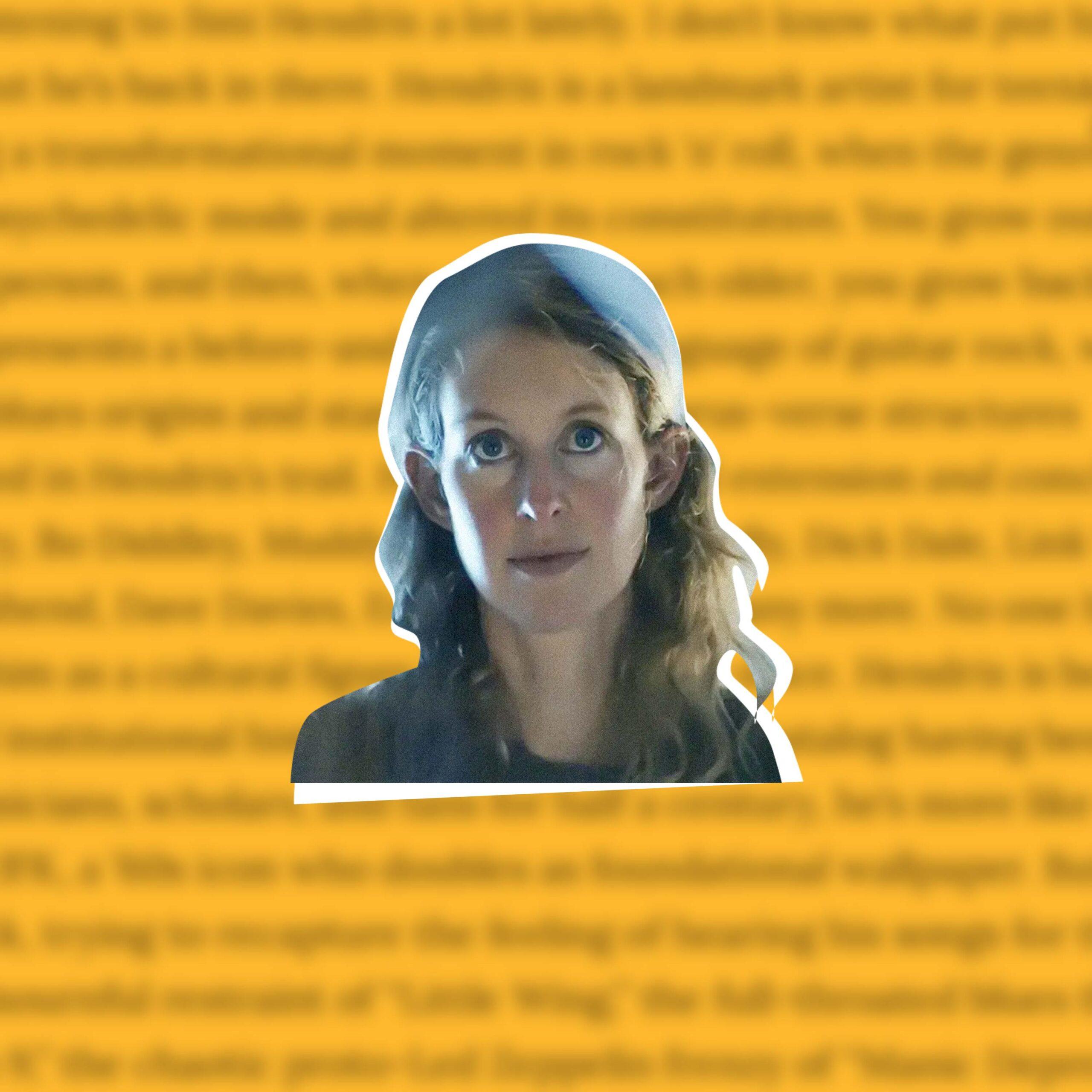
Even when Fielder tries to tell her that saying the machine can run any blood test implies that the machine was currently running any test, which would suggest that her word choice was misleading, she seems confused by the correlation. She was trying her best to communicate clearly, she says. Which is interesting, given that (1) the precise wording Fielder brought up had already been litigated for years throughout her deposition and trial, which you would never guess by her deeply confused reaction, and (2) as original Theranos whistleblower Tyler Shultz pointed out after seeing the movie, the device Nathan and Liz are discussing at the breakfast table isn’t even the machine that gave patients incorrect medical data. It's vaporware: a future version of the device that was never rolled out to patients.
This is all so exasperating that for the first time ever, I actually supported a man showing a woman an unsolicited comedy clip. Fielder attempts to use the Abbott and Costello “Who’s on First?” bit to try to impress on Liz how absurd it sounds when she says she was trying to communicate as clearly as possible, all while using a statement that everyone but her believed to mean something else. But Holmes doesn’t understand the language of comedy, either. She nervously laughs until she looks like she’s going to cry, telling Fielder that she can see that it’s a funny bit of comedy because there’s a misunderstanding between the two men, but she seems unable to identify what the misunderstanding might be (the first baseman’s name is Who, if you, too, are unfamiliar).
Despite Holmes and Evans’s intention to use this feature to clarify Holmes’s persona, “I don’t know” is perhaps the most common refrain of the film. (By both subject and directors, honestly; everyone is equally and oppositely bamboozled.) Holmes cries ignorance anytime reality seems to seep into her carefully maintained delusion, and she recognizes that she actually doesn’t understand the situation enough to choose the “right” answer. We may be invited to see everything in the doc, but it becomes clear early on that we’ll only ever hear what she wants us to hear. She is a cipher unto herself, obfuscating and evading the very project that she’s set up to tell her story.
“FYI you can totally see everything,” she texts Fielder from the beach moments after she’s left him nearly swallowing his tongue because she told him she genuinely believes she’s never told a lie. Fielder stares out into the distance, where he can, in fact, see her, and gives the message a thumbs-up. A scammer’s true gift isn’t charming people—it’s creating their own reality and convincing other people it’s real.


Thank goodness, then, that Fielder was allowed a buddy pass into the abyss. Amanda Seyfried, A-list actress and famous Holmes reenactor for the Hulu show The Dropout, arrives in a flurry of energy in Act 3 to show him how the big dogs are professionally muddying fact, fiction, and subjectivity. Just as Fielder has begun to get a little too comfortable trying Holmes’s psyche on for size, Seyfried is able to come in and remind him that he’s dealing with a grifter. That “I don’t know if I knew” is not a reasonable response to a simple, straightforward question. In a film full of people trying to define the truth, Seyfried is basically the only person who ever grapples with any amount of guilt or acute consternation over the ways in which she’s toyed with fact and fiction while playing Holmes on-screen. Most importantly for the documentary, she’s grappling out loud and in front of us because she’s not afraid to seem human—or a little shitty—at times, even when that means getting drunk and calling out Evans's deceptive tweets while he tries to alpha her for getting “dragged” on social media, conveniently after she didn’t laugh at his sex joke. I’m obsessed with this woman.
Seyfried wasn’t just cast as the Hollywood version of Holmes in You Can See Everything’s reenactment sequences; she also takes on the role of a more beautified us, the audience. Every time that Seyfried and Fielder find themselves litigating another bit of language or behavior to try to ascertain whether Holmes is a victim of Evans’s coercion and control, or whether they’re victims of hers, they’re forced to reckon with the much stickier reality that while Evans might be a domineering asshole, that doesn't absolve Holmes of being a fraudulent manipulator. And if you really wanna get messy with it—Seyfried does, always—Holmes may be using Billy as a smoke screen to make it seem like she’s more clueless than she is, another part of her manipulation.
After spending so much time in the head of Holmes, Fielder makes his own stab at retroactively adjusting some language to suit his own perceptions. When he first writes a script for Seyfried to reenact his time visiting Liz in prison, he recalls that he asked Liz whether she knew Evans had privately negotiated a deal with A24 to profit from the documentary while she was out of the room, and she answered, “I knew he was talking to you about it.” But when Fielder hears her response back, he doesn’t think that sounds right. He doesn’t remember the line sounding deceitful, as if she was using Evans to keep her hands clean. Because knowing that Evans had negotiated the deal would mean that Holmes was complicit in trying to profit from telling her story with A24, when she’s been adamant that she’s never done any of this to make money. It’s just what she was born to do: have an idea for a blood-testing machine, fail spectacularly at making that idea a reality, be indicted for fraud, pick the mantle back up on that big idea, make some calls about lasers, commission a documentary to show the real her, mostly say “I don’t know” a lot in that pursuit, and maybe convince the documentarian that she’s the victim of a world that doesn’t understand her. It’s as simple as that.
Fielder asks Seyfried to change “it” to “something.” Liz knew that Billy was talking to the production team about something.
Seyfried finishes performing the scene as Holmes and wonders out loud whether there’s anything Fielder might not be relaying from his conversation with Liz because it would have made her sound more manipulative or deceitful. Seyfried wonders whether it’s become his instinct to protect her because, over time, perhaps he’s grown to care for her. And listen, we’ve all dated a terrible person in our 20s, right? One that we felt like, if we could just understand them better, then maybe they’d stop lying to us? Instead of demanding that they understand themselves better to tell us the truth? This ultimately isn’t a movie about unraveling lies. It’s about interrogating the truth even when the world around you is begging you not to. There is a unique pain that comes from being lied to by someone who is perfectly content to let you struggle to keep your head above water while you’re stuck inside their delusion.
“I’m just trying to be accurate,” Fielder tells Seyfried, sounding very much like Holmes. However, the movie ends not with the language of a lie, but with visual confirmation that perhaps you can see everything—but only if another person lets you. Even though Fielder had led us to believe earlier in the film that he’d rejected Holmes’s invitation to go swimming with her before she went to prison, we see that he did, in fact, frolic in the chilly waters of the Pacific Ocean with Elizabeth Holmes. Because ultimately, the movie doesn’t seek to deceive us. But it does want us to know that it could.