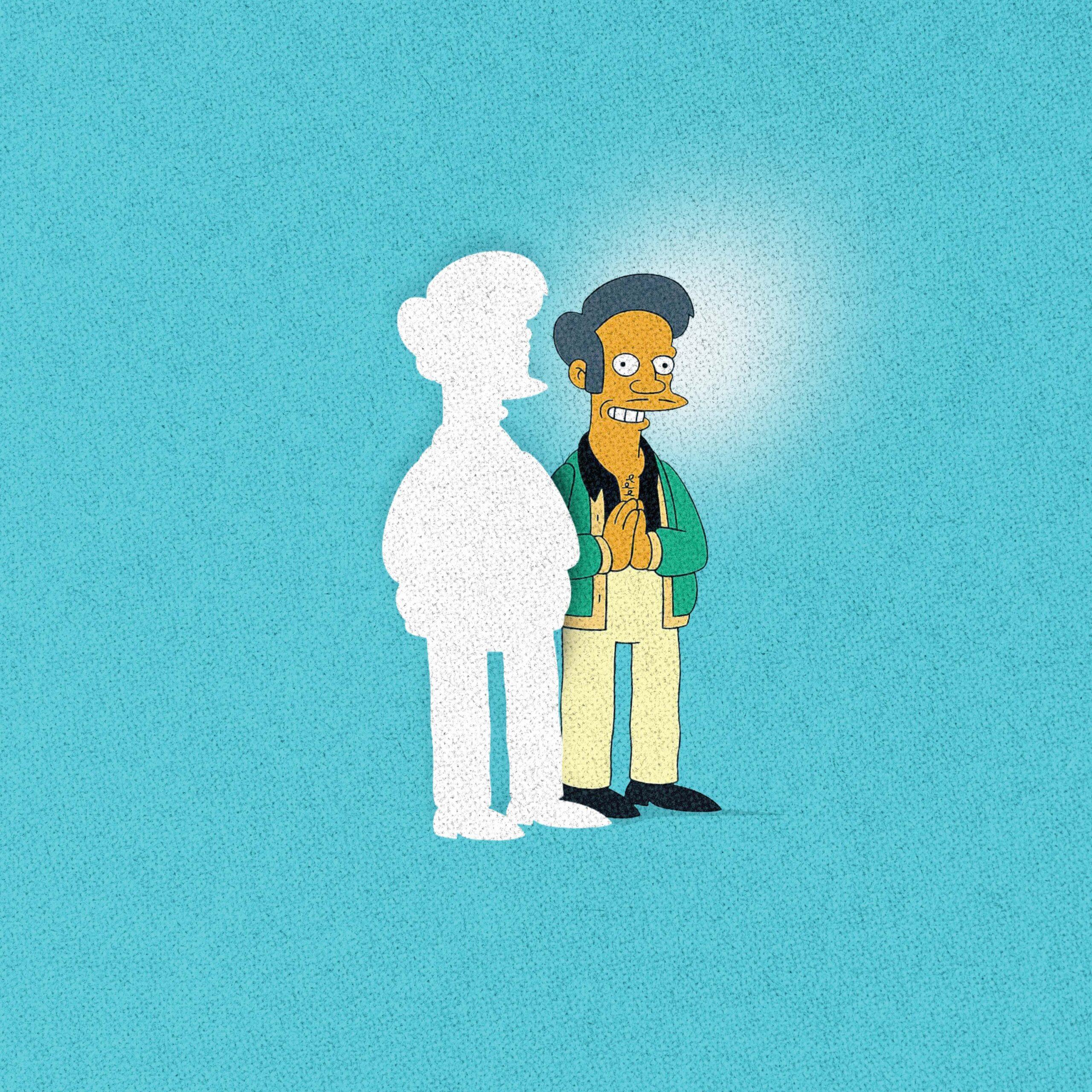

Like countless Indian American kids growing up in the 1980s, Sunil Malhotra rarely saw his culture reflected in movies or on television. And when he did, it wasn’t a pretty—or accurate—picture. As an example, he points to a particularly infamous meal served in Indiana Jones and the Temple of Doom. “I didn’t have monkey brains for dinner,” he says.
Malhotra wondered whether maybe things were changing in 1990, when Apu Nahasapeemapetilon made his first appearance on The Simpsons. The immigrant manager of the Kwik-E-Mart was a welcome sight. Malhotra, a huge fan of the animated series, remembers thinking, “Oh cool, that’s like my uncle.”
The good feelings didn’t last long. At Malhotra’s high school, some classmates started making fun of him by imitating the character’s stereotypically exaggerated accent. “It quickly was not cool,” he says. “And so that was my experience. Apu quickly became a dirty word.”
Three decades passed before his opinion of Apu shifted again. Malhotra’s an actor now. And recently, his agent called to tell him that The Simpsons wanted him to audition. “I totally knew what it was before she even told me the role,” he says. “I knew exactly what it was.” He recalls having two conflicting thoughts:
“Oh my God, it’s The Simpsons!” and “Holy shit, it’s The Simpsons …”
“I had a stomach full of acid because so much cultural baggage is attached to Apu and my own negative experience with the character,” Malhotra says. “Of course, I was aware of all the controversy that was going on with the character.”
In 2017, comedian Hari Kondabolu’s documentary The Problem With Apu explored whether there should still be a place in pop culture for racially insensitive caricatures. A deeply apologetic Hank Azaria, who’s white, announced three years later that he would stop voicing Apu. By then, the character had been all but written off the show.
To Malhotra, there was something sad about Apu being relegated to the background. “It’s not like Apu has left Springfield and moved on to better opportunities in the world,” he says. “He was still in Springfield, but he was mute.”
After thinking it over, Malhotra made a decision. He wanted to try to give Apu his voice back.

More on ‘The Simpsons’
Malhotra’s first Simpsons audition led to a callback and a conversation with co–executive producer Cesar Mazariegos and writer Nick Dahan, who pitched him on an episode about Apu’s return. He loved their idea. He was even offered the gig. But he still wasn’t convinced he should take it.
So Malhotra asked for a second meeting. It was a bold request for a relatively unknown actor. But he had to know whether he and the people who made the show were on the same page about Apu. “I needed to feel good about it,” he says.
Sure enough, the producers agreed to sit down with Malhotra. “He was just a smart dude, a caring dude, and a funny, great actor,” says Simpsons showrunner Matt Selman.
The meeting put the actor at ease. “The biggest thing was that they were acknowledging the missteps that the show had made in handling the character, both during Hank’s tenure in the character, in the role, and then even more so after he [stopped voicing him],” Malhotra says. “So that level of self-awareness was huge.”
It was important to be like, ‘I understand that I’m going to sound like Apu, but I don’t want to sound like Hank doing Apu.’Sunil Malhotra
Azaria had based Apu’s voice on real-life Indian and Pakistani store clerks. He was also inspired by what he saw in The Party, which stars Peter Sellers in brownface. Azaria has said that he didn’t realize what he was doing was offensive. “That accent trained the ears of generations of people to be like, ‘That’s what Indian people sound like,’” Malhotra says.
In 2018, the show clumsily addressed the Apu issue. In a moment that alludes to Kondabolu’s documentary, Lisa looks straight into the camera and says, “Something that started decades ago and was applauded and inoffensive is now politically incorrect.” Then she peeks over at a framed Apu photo—that the Hindu man has signed, “Don’t have a cow”—and asks, “What can you do?”
The answer wasn’t to make Apu disappear. After all, he’s always been one of Springfield’s smartest, hardworking, caring, and patriotic citizens. As Homer puts it in a terrifyingly prophetic 1996 episode in which Mayor Quimby tries to get the town’s immigrants deported: “You must love this country more than I love a cold beer on a hot Christmas morning.”
Baggage aside, Malhotra wanted to carry on Apu’s legacy. But he knew that some things about the character had to change. Including his voice. His new bosses agreed. “It was important to be like, ‘I understand that I’m going to sound like Apu, but I don’t want to sound like Hank doing Apu,’” Malhotra says. “And they were fully on board with that.” (Malhotra also said this about Azaria: “Hank infused the character with so much humanity, and I have a lot of respect for him. … I [also] have a lot of respect for him for stepping down, and he did so on his own, fully unsupported. And that was a big level of responsibility he took on for himself.”)
Malhotra had a very specific idea of what Apu should sound like. “I mean, I’ve done so many characters with some version of an Indian accent. And they’re all modeled after people I know,” he says. “Yes, he’s Indian. Yes, he has an accent. Yes, he’s a convenience store manager. By the way, all of those things I have no problem with because I grew up with exactly those people. Those are uncles of mine that I know as people, and that represents a large part of the community.”
But Malhotra knows what longtime Simpsons fans have always known: There’s more to Apu than his cultural identity. Just ask Selman. “We want to tell great stories about a nuanced, flawed, but kind, funny character who’s part of Springfield,” he says. “The same way we would with Flanders or Moe, who also are some of the big non-family members. Guys with an inner life. They’re not perfect and they’ve had a hard time and they’ve suffered.”
Bringing back Apu wasn’t easy. The show’s producers and writers had talked about it for a few years, but they couldn’t settle on a workable idea. Then Mazariegos and Dahan pitched one that Selman thought was brilliant.
It was an I Know What You Did Last Summer–inspired murder mystery timed to Halloween. The serial killer was a guy in a brown robe and an electronic helmet. (“I’m Daft Monk,” he angrily explains when no one seems to get his costume.) Late in “Treehouse of Horror Presents: The Revengening,” the assailant removes his mask and reveals himself as … Apu. He goes on a rampage for a reason: “I am the man you left for dead. I am the shame you tried to bury. I am the one you pretended never existed!”
Thirty-eight seasons in, it’s almost impossible for The Simpsons to shock its audience. But Selman figured Apu’s return might do the trick. “It’s really hard to surprise people these days,” Selman says. “And yet surprise is one of the greatest tools in the writer’s toolbox. So if you can try to hit some people with stuff they really don’t know is coming, yet when it does come, it feels right—that’s a big deal. All the creative credit goes to Cesar and Nick. I just sort of didn’t chicken out.”
This was a big secret. Big enough that Selman says that the Simpsons staff consulted with Marvel Studios’ security team about how to keep it under wraps. “It could have gotten out a million ways. I mean, a million animators saw this and worked on it. … The fact that one person who wasn’t quite thinking the right way didn’t accidentally blow it is kind of stunning.” Even after the table read—that happened before Malhotra was officially on board—there were no leaks.
The secret survived more than a year. Then last Sunday afternoon, Selman, Mazariegos, and Dahan attended a “Treehouse of Horror” tribute at Vidiots, a beloved movie house and video store in Los Angeles. At the event, the trio surprised the crowd with a screening of the new Simpsons episode Fox was about to air on the East Coast.
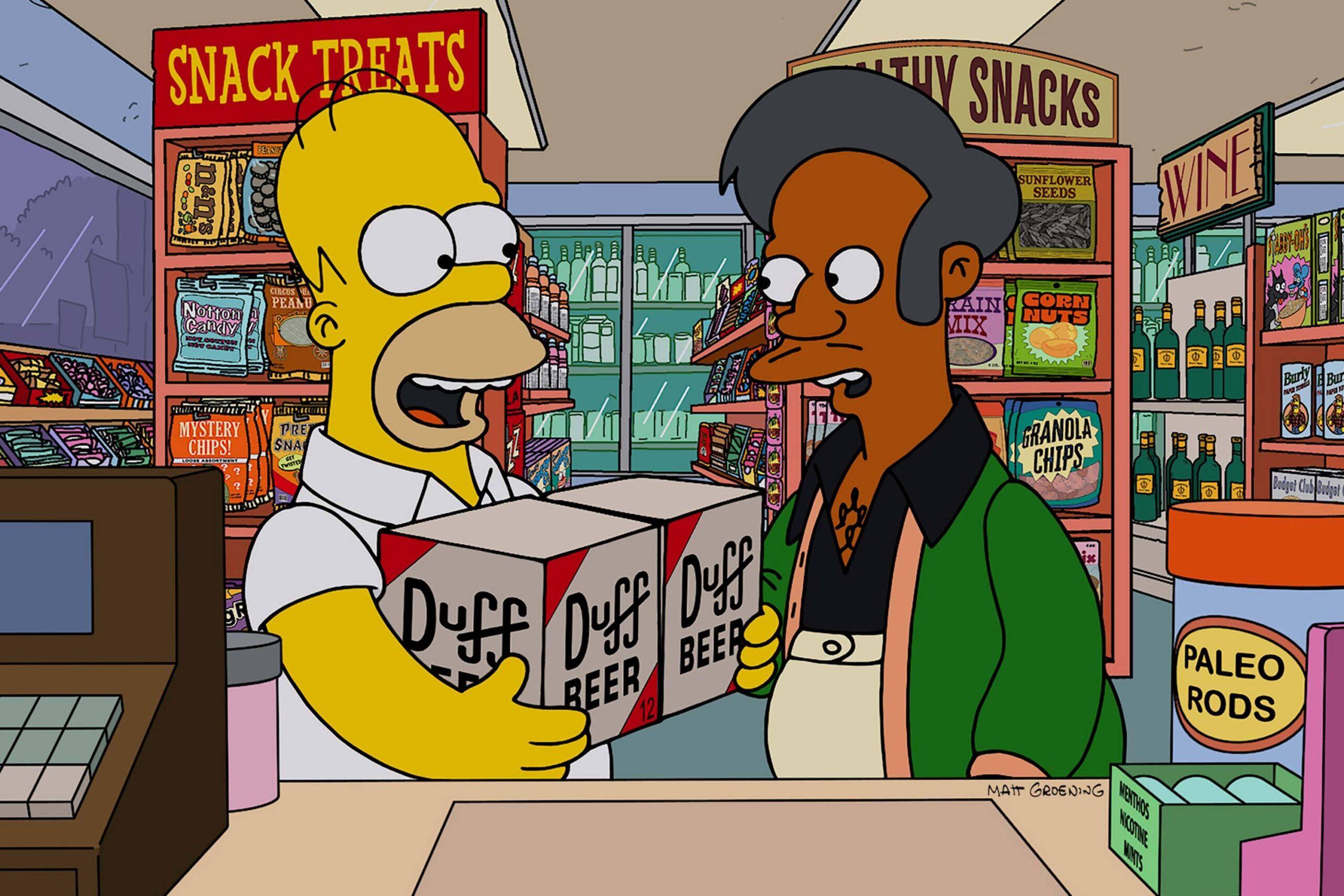
Homer and Apu in “Treehouse of Horror Presents: The Revengening”
After a few minutes of panic—the theater’s projector overheated and had to be rebooted—the opening credits rolled. “Our hearts were pounding,” Selman says. When Apu popped up on the big screen, the audience exploded. The timing, Selman says, was finally right. “You just felt that this is a beloved character, and let’s just evolve him a bit and people will be happy. And that’s what kind of happened.”
During the climax of “The Revengening,” Apu describes how he got stranded for eight seasons on “The Island of Forgotten Garbage,” where “all the junk Springfield gets rid of winds up.” That includes Mr. Plow’s jacket, a Springfield monorail car, and Dr. Nick Riviera—who’s now voiced by Eric Lopez. Dr. Nick eventually helps Apu heal. Then he makes it back to Springfield, which proceeds to ignore him. “If it’s any consolation, we had so many internal conversations about it,” Lenny says, speaking for the show. In the end, Homer prepares to sacrifice himself to a vengeful Apu for the town’s sake and says, “I’m just doing what the old Apu would’ve done.”
Soon, the whole thing is revealed to be Apu’s daydream. And all of a sudden we’re inside the Kwik-E-Mart. Apu’s wife, Manjula, who’s now played by Janina Gavankar, even shows up with their octuplets.
That evening, Malhotra had friends over to watch the episode. “They didn’t know what was coming,” he says. “And then the second Apu is revealed, it was absolute pandemonium.”
This week, Malhotra has heard from South Asians who live around the world. They all seem to be excited to get back into The Simpsons. “Apu isn’t a dirty word anymore,” he says. “It’s a reclamation.”