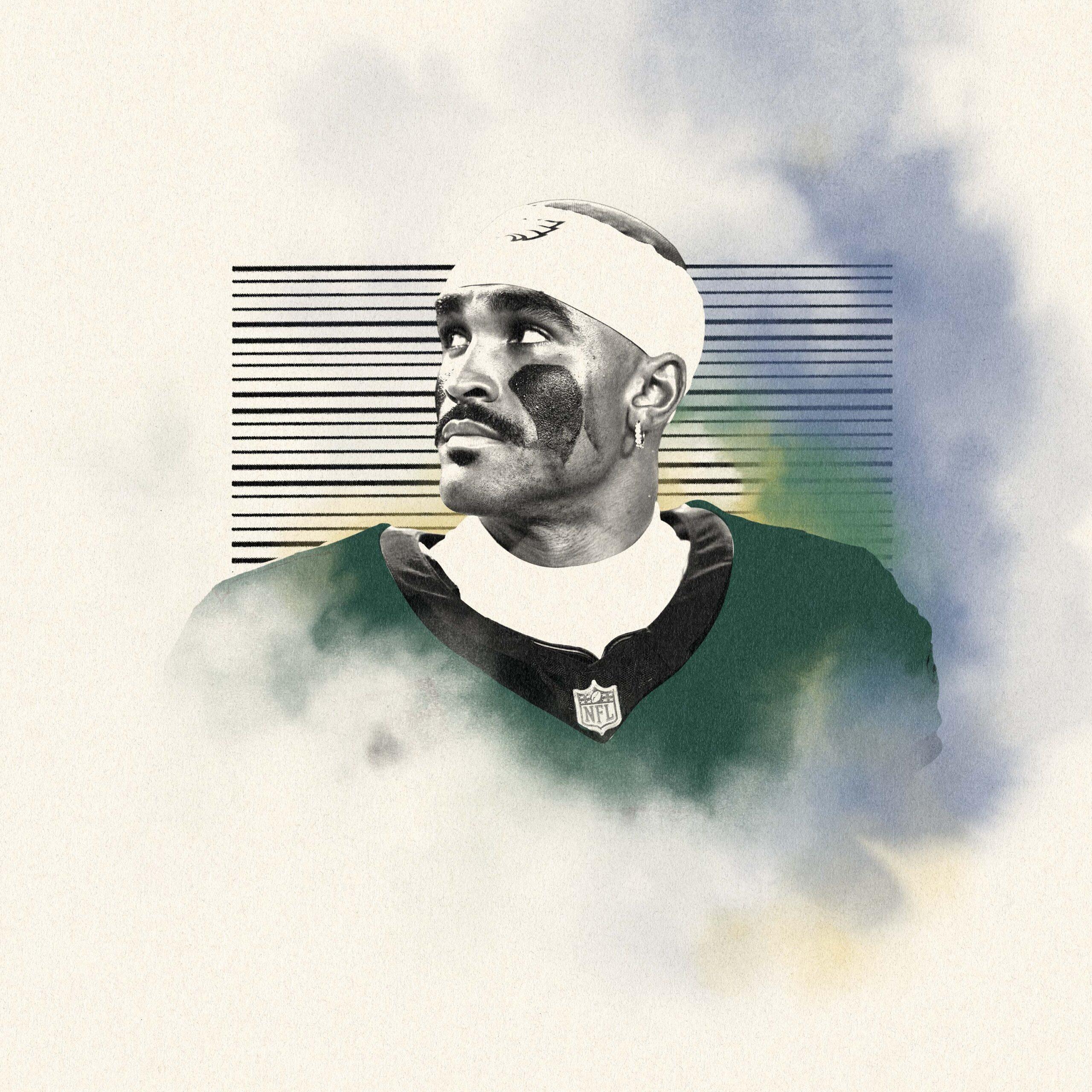

Ten days ago, Philadelphia Eagles quarterback Jalen Hurts popped up on the team’s final injury report of Week 5—a seemingly innocuous addition as they prepared to fly to London for a game against the Jaguars. The report mentioned that Hurts was suffering from a calf injury, but that weekend, Hurts played 59 snaps in the Eagles’ last-second loss to the Jags. He then boarded the plane to take the trans-Atlantic flight home with the team.
It turns out, though, the calf injury wasn’t so minor after all. What was initially diagnosed in London as a superficial blood clot was far more serious: deep vein thrombosis and bilateral pulmonary emboli—meaning blots were found in his lungs as well as his leg. The quarterback, who was placed on injured reserve on Saturday, will not be cleared to play football as long as he’s on blood thinners to treat the clots.
In a joint statement announcing the diagnosis on Monday, the team and Hurts’s agent didn’t give a specific timeline for his return, but the expectation is that Hurts will not play for the Eagles again this season. The statement, along with subsequent reporting from NFL insiders, revealed a scary medical situation for the former Super Bowl MVP, and opened up plenty of questions about the timing of the diagnosis, and why Hurts was cleared to practice, play, and travel internationally all while dealing with blood clots. Here’s what we know so far, and what questions remain.
How did this happen?
Sometime during the Eagles’ Week 4 loss to the Rams, Hurts took a cleat to his left calf. He didn’t miss any time in that game, nor was he limited in practice in the days that followed, but according to a statement released by the team last week, he received treatment on the calf on both October 8 and October 9 ahead of the game against Jacksonville. It wasn’t until he underwent an ultrasound on the calf—“out of an abundance of caution,” the team said—after the Eagles’ arrival in London that Hurts was diagnosed with the superficial clot, meaning one that was closer to the skin. He played in the Week 5 game, and then on October 15, the team publicly announced the diagnosis when it ruled Hurts out for Week 6 against the Panthers.
Let’s back up. Hurts was diagnosed with a blood clot while in London and was still allowed to play?
In the Eagles’ statement on October 15, the team said its medical staff determined that not only was it safe for Hurts to play, but that “activity and mobility were important” to the quarterback’s recovery. Hurts took all 59 snaps for the Eagles offense against Jacksonville, completing 21 of his 40 passing attempts for 220 yards, with one touchdown. He rushed only two times for just 2 total yards, and notably did not keep the ball on a tush push opportunity on the Eagles’ opening drive, instead handing the ball off to running back Jordan Shipley.
Not included in the team’s initial statement was a reported recommendation from Hurts’s doctors that he should try to stay awake on Saturday night, because a long period of immobility could be “a risk.” Even if mobility is typically prescribed as part of a treatment plan for a superficial blood clot, knowing what we know now, it is hard to reconcile Hurts being told that playing full game in a physical, violent sport was safe, but sleeping was not. (For what it’s worth, Hurts’s agent, Nicole Lynn, told The Ringer’s Tom Pelissero that the Eagles set aside a room at the stadium for Hurts to sleep in the hours before kickoff.)
What happened when the team returned to Philadelphia?
The team returned to practice last Wednesday, and Hurts took his full allotment of first-team reps. He remained on the injury report, though, an indication that he was continuing to get medical treatment on his calf. At that point, his availability for the team’s Week 6 game against Carolina was not in doubt.
That changed on Thursday, when the team ruled him out for the upcoming game following another ultrasound that revealed “movement in the small clot,” per the team’s statement. But even then, his long-term status was unclear. ESPN on Saturday morning reported that Hurts would not be placed on injured reserve—a signal that the team believed the condition could be managed quickly. But by later that afternoon, the team had moved Hurts to the injured list, meaning he would miss at least four games. And on Monday, the big news dropped that Hurts would be sidelined indefinitely.
What changed between Saturday and Monday?
A superficial blood clot can be treated, well, superficially, with rest, mobility, and pain management. It wasn’t until further tests revealed that clots had traveled to both lungs that the team and Lynn jointly announced the quarterback was being shut down.
According to Monday’s statement, Hurts cannot participate in football activities as long as he is taking blood thinners, a process that reportedly could last about three months. At this point, there are no indications that this will be a career-threatening issue for Hurts.
Who was looking out for Hurts through all this?
That was my first question after the news came out Monday morning. There is no doubt that Hurts was going to push to play after the initial diagnosis. Philadelphia was coming off back-to-back losses, and their season was hanging in the balance. With other key offensive players already out for that London game—running back Saquon Barkley and wide receiver DeVonta Smith were both dealing with injuries, and right tackle Lane Johnson had just announced his sudden retirement—it’s understandable that Hurts would want to shoulder the burden for his teammates.
Hurts was in a difficult spot after the initial diagnosis. Perhaps he was worried that if didn’t play, people would question his toughness. (It’s certainly been a hot issue this year: Chicago QB Caleb Williams took plenty of online abuse after his emotional reaction to suffering a hamstring injury and being driven to the locker room on a cart.) But that doesn’t mean someone—from the coaching staff, the medical staff, the front office, or Hurts’s personal life—shouldn’t have asked whether playing with an atypical medical diagnosis was the right move, or even stepped in and told the quarterback he couldn’t play. Even if the decision was deemed to be safe and medically sound in the moment, the process that let Hurts into the starting lineup deserves scrutiny now. Asked on Monday why Hurts was allowed to play against Jacksonville, Eagles coach Nick Sirianni said he deferred the decision to the medical staff.
This surely won’t be the last time Sirianni is asked about this. The NFL and NFL Players Association should be answering questions about the timeline of Hurts’s diagnosis, his international travel, and the clearance process as well. Among the biggest unanswered questions: Were there independent doctors consulted in the process, both in London and upon the team’s return to Philadelphia? And why was Hurts cleared to play at all if there was a chance the clots could spread to his lungs?
What does this mean for the Eagles for the rest of this season?
It’ll likely be the Tanner McKee Show for the rest of the way. McKee made his third career start on Sunday against Carolina, but his first in true relief of Hurts. His previous two starts came in Week 18 games during the 2024 and 2025 seasons, when starters rested ahead of the playoffs. Both McKee and the Eagles offense as a whole were unimpressive against the Panthers. McKee completed 26-of-45 passes for 215 yards and a touchdown, but averaged just 4.8 yards per attempt. He ranked 11th in passer rating and 19th in expected points added per dropback among qualified passers in Week 6 (ahead of Monday Night Football)—not the type of performance that suggests he’s capable of elevating a depleted offense.
McKee is in the final year of his rookie contract. He’s been a buzzy name as a potential trade piece in recent years due to the Eagles’ reputation for drafting and developing quarterbacks, and now he has a chance to audition for the rest of the league. If he plays well, maybe he could be the 2027 version of Malik Willis and get a shot at a starting job with another team next season. Perhaps he’s playing to be someone’s high-end QB2. Or if things go poorly the rest of the way, his dreams of a nice second contract could vanish completely.
What does this mean for Hurts’s future with the Eagles?
Hurts was likely going to be one of the main characters of the 2027 offseason even before this blood clot issue. He’s under contract through 2028, but the bulk of the guaranteed money from the deal he signed in 2023 has already been paid out, and the team could get out of his contract after next season for just a $54.5 million dead cap hit. It’s also possible that Hurts could have been a trade candidate next spring, if the Eagles were interested in moving on, or, if this season had gone well, they might have considered extending him early, before the QB market explodes. Lamar Jackson, C.J. Stroud, and Bryce Young will be among the passers looking for new deals next offseason, just as the quarterbacks from the 2024 draft class—including Caleb Williams and Drake Maye—become eligible for second contracts.
The Eagles often try to be ahead of the market—that was the case in 2023 when they got Hurts’s last extension done before Jackson’s new deal with Baltimore. Now, though, it’s not simply a question of timing or cost to keep Hurts, but Philadelphia needing to decide if he’s even still their long-term quarterback. The Eagles are currently on their third offensive coordinator/play caller in the last three years; the most recent change, from Kevin Patullo to Sean Mannion, a Matt LaFleur protege, brought an entirely new scheme for Hurts, one with increased time under center and more frequent use of play-action. The early results haven’t been great—though the injuries, particularly Barkley’s, and personnel changes along the offensive line have made it difficult to give the system a true evaluation. Siranni signed a contract extension in 2025 within months of the Eagles’ most recent Super Bowl title, but it’s hard to imagine that his job is super secure as yet another season spirals away. Playing the rest of this year without Hurts just makes all of those offseason questions more difficult to answer.
This season was always going to be an inflection point for the Eagles, but especially for Hurts. When he’s at his best, like he was in the Eagles’ Super Bowl run two seasons ago, he deserves to be in the conversation for the league’s best quarterbacks. When he’s not, he’s gotten criticism for his leadership and personality—and having friction with teammates like A.J. Brown as well as coaches. But all of that is trivial Football Stuff now, and far less important than his immediate health—or getting answers about the medical process that may have failed him.