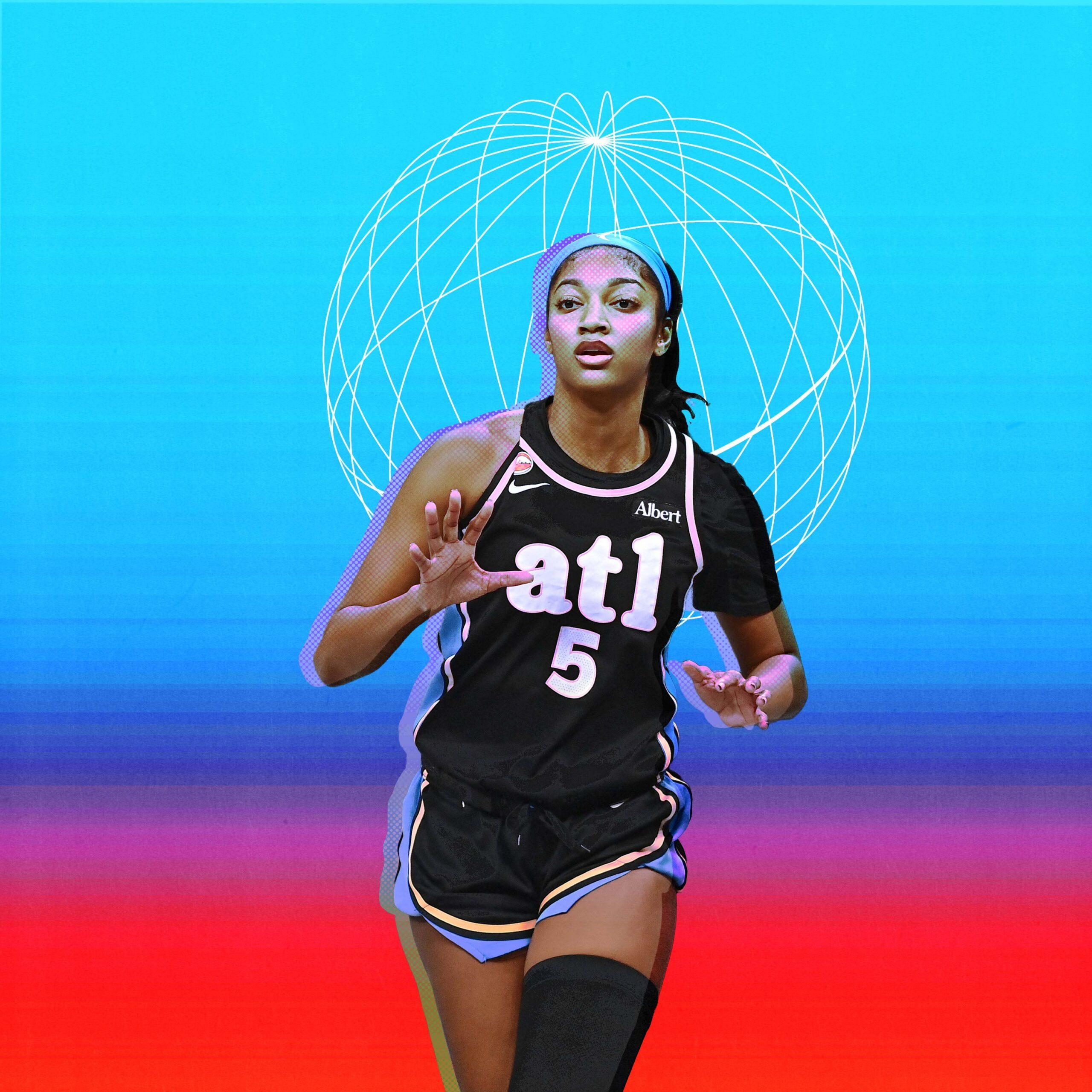

It is a common, effective rhetorical trick to start a story about an athlete by highlighting a singular play that affirms their on-court value: one moment in which their singular ability changes the outcome. But it’s impossible—and counterintuitive—to try to distill Angel Reese’s impact into one play.
Her dominance is best understood through the lens of accumulation: Dozens of mundane moments of hustle—a tipped ball here, a rebound there, a steal and a look-ahead pass—add up and render the sublime moments, the clutch, do-or-die buckets we treat with great reverence, less relevant.
Some stars make plays; others save them. Being her teammate means you can miss a momentum 3, a driving layup, or even a free throw and not have to fret. “‘If you miss,’” Atlanta Dream guard Rhyne Howard recalls Reese telling her, “‘I’m gonna be there to get it.’ That gives me confidence.”
Having Reese on your side simply increases your margin for error. If you’re her opponent, you can nail shot after shot and still find yourself behind. The New York Liberty, for instance, averaged a true shooting percentage of 60.6 in their semifinal series—a figure that would tie Indiana’s historically potent regular-season offense—and still got swept. The Dream took, on average, 11 more shots per game than New York. In a series that was decided by just 15 points, Reese’s 14 offensive rebounds created … 15 extra points.
Few people have been as scrupulously observed and willfully misunderstood as Reese. The pinnacle of her athletic career, the national title she won at LSU in 2023, was her simultaneous entry into fame and infamy, via the taunt—a hand wave in the face of Caitlin Clark—morally legislated around the country.
Her very existence as a Black woman—one who is bold, passionate, and, as she puts it, unapologetic—triggered deep racial animus in the American psyche, revealed in the disproportionate hate she received for regular athletic follies. Entire creator economies were fueled by finding glib, perverse joy in her setbacks.
The importance of her greatest strength—rebounding—was endlessly debated. Her flaws, like finishing at the rim, were relentlessly clip-farmed. Put all of this together, alongside an array of on-court skills that made her a bit of a WNBA curio, and it’s not hard to understand how she came to occupy this strange nexus of celebrity unique to women’s basketball in the 2020s: overexposed but underestimated, reviled by haters while overprotected by supporters.
In her final days with the Chicago Sky, she publicly critiqued the direction of the franchise, triggering a public spat with teammate Courtney Vandersloot and a mystifying half-game suspension. Her own team, after trading her away for two late-first-round picks after just two seasons, insinuated she was a culture killer.
She is coming off an All-WNBA season and a Defensive Player of the Year award and capping off her first playoff appearance with a trip to the WNBA Finals. If Atlanta wins, she will become the first star since Breanna Stewart to win a title within her first three years in the league. We are reaching, in other words, heretofore unseen levels of Proving the Haters Wrong.
All the while, one coach saw Reese’s value through all the noise and had the system to unlock it.
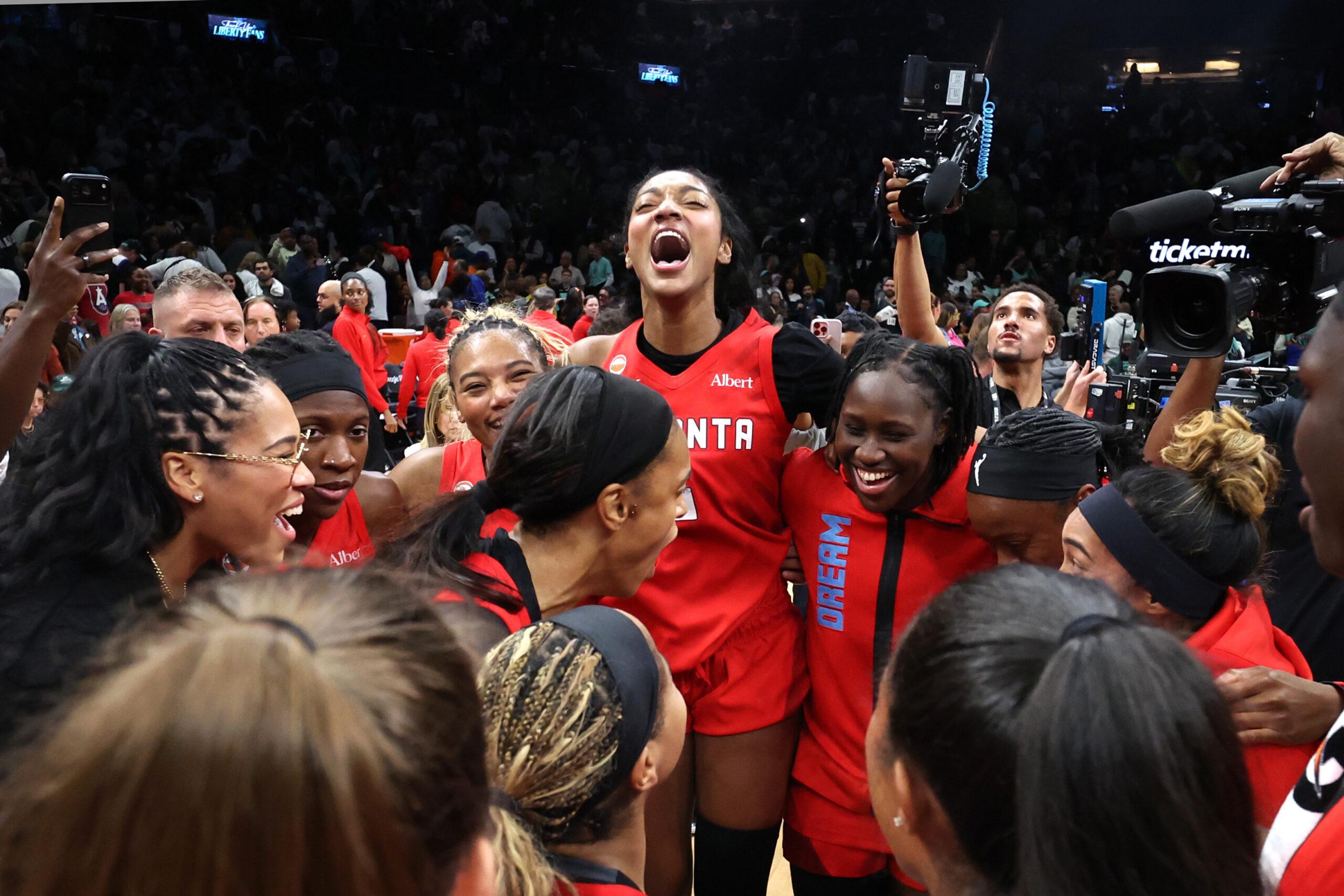
The Atlanta Dream celebrate after defeating the New York Liberty in Game 3 of the semifinals
Karl Smesko came to Atlanta by way of Florida Gulf Coast University, a Division I mid-major that overperformed year after year by consistently shooting more 3s than just about any team in the nation for a decade, preaching the gospel of analytics long before it was popular. “Smeskoball,” as it has come to be known, prizes taking efficient shots beyond the arc and in the paint, playing with pace, and winning the possession battle by crashing the offensive glass and forcing live-ball turnovers.
In 2025, Smesko’s first year at the helm of the Dream, Atlanta led the WNBA in offensive rebounds and shot more 3s than all but three teams in WNBA history. But Atlanta flamed out in the first round against Indiana, as plodding veteran bigs Brionna Jones and Brittney Griner proved unplayable.
Enter Reese, a fast-moving answer to the gap between Smesko’s mathematical vision and its execution.
“When we found out Angel was available, it’s like, well, this is really going to make some of these goals a lot easier to attain,” Smesko said after the Dream closed out the Liberty in Game 3. “We added the perfect piece to really bring that plan to life, and Angel’s been, you know, everything that we could have hoped for.”
The Dream, entering the WNBA Finals after going undefeated in the postseason, are a team built in Reese’s image: Their regular-season offensive rebounding margin, 4.3 per game, was the best in WNBA history. Their defense, fueled by steals and deflections, has generated more points off turnovers than any other team in the WNBA this season.
Rebounding has always taken up a contradictory place in the imaginations of basketball fans. Ending a defensive possession with a board has been treated as both highly important and somewhat perfunctory—more of a chore than a skill. The argument against treating Reese’s rebounding ability, which is the best in WNBA history, with more reverence is built on two ideas:
- If she didn’t clear the boards, someone else would.
- She misses so many shots that it’s only natural for her to be in position to rebound them.
Both arguments bury her impact. Reese creates extra opportunities on a historic level: She is the biggest reason the Dream’s offensive rebounding margin is the best in WNBA history. And even if she never cleared her own misses off the glass, she’d still be the best rebounder in WNBA history.
To understand the value of her offensive rebounding prowess, I hand-tracked a small sample of Reese’s offensive rebounds through the playoffs. The 18 offensive rebounds Reese has snagged have generated 22 extra points for her teammates. She also leads the postseason in combined steals and blocks. When Reese has been on the floor in the postseason, almost a quarter of the Dream’s opponents’ possessions have ended in turnovers. In Smesko’s system, Reese has become more than the best rebounder of all time. She might be the greatest possession generator the women’s game has ever seen.
Smesko has also worked with Reese on improving her 3-point shot, becoming her personal shooting coach—a rare occurrence among head coaches. “We shoot together every day, and that kind of puts confidence in me. When somebody shows up for you, it means everything to me,” Reese says.
Smesko stopped one of Atlanta’s first practices until Reese made two 3s with her teammates watching, forcing her to endure the necessary growing pains of public failure. After rebuilding the mechanics of her jumper, Smesko told her she would miss a lot before the makes started rolling in.
The vision proved true. While Reese shot just 19 percent on 1.3 attempts per game during the regular season, she’s now hitting 39 percent on 2.6 attempts during the postseason, a sudden leap that has unlocked the Dream’s offense and been reflective of her progress this season.
Her overall efficiency has also improved. After missing a potentially game-winning layup against the Indiana Fever in August, Reese has gone from shooting 49.7 percent in the restricted area to 66.9 percent in the 14 games since, including the postseason.
Her early turnover struggles, the result of a since abandoned point forward experiment, also flipped; she was making 3.5 per game prior to the All-Star break but has made 2.6 per game since.
Reese spent college and her first two years in the WNBA at the forward position, but in light of Brionna Jones’s season-ending injury, Reese has now adjusted to playing center, where she has notched more steals than anyone since Alyssa Thomas—another physical, unorthodox big who found a creative coach to maximize her skills—in the 2020 Wubble season.


Watching Reese, the outgoing ATL Barbie, do her pregame handshake with Smesko, the introverted wonk, is like watching the popular girl in high school with her nerdy best friend—the one person she trusts because he couldn’t care less about status and, more importantly, sees through it. Smesko saw something in her that others didn’t and worked hard to cultivate it. While the world wondered whether Reese’s rebounding mattered less because of her misses, Smesko knew her misses mattered less because of her rebounding.
Reese is no stranger to the power of the reframe. She took “mebounds,” a derisive internet meme suggesting her misses inflate her rebound total, trademarked it, and put it on merchandise. She sees the first two years of her career, spent with the perennially dysfunctional Chicago Sky, who went 23-61 during that stretch, through a lens of gratitude. “Going through adversity builds character,” she says.
Nearly a third of the league once passed on Reese, who was taken with the no. 7 pick in the 2024 draft. Dallas took Jacy Sheldon over her. The Sparks passed on Reese twice. Even Chicago, the team that traded for her on draft night, chose Kamilla Cardoso over her with the no. 3 pick.
But if she hadn’t ended up with the Sky, she likely never would have found her way to the Dream, who didn’t have a pick until later in the draft. The only player whom she wouldn’t go ahead of in that draft now is the one her name will be tied to forever: Caitlin Clark.
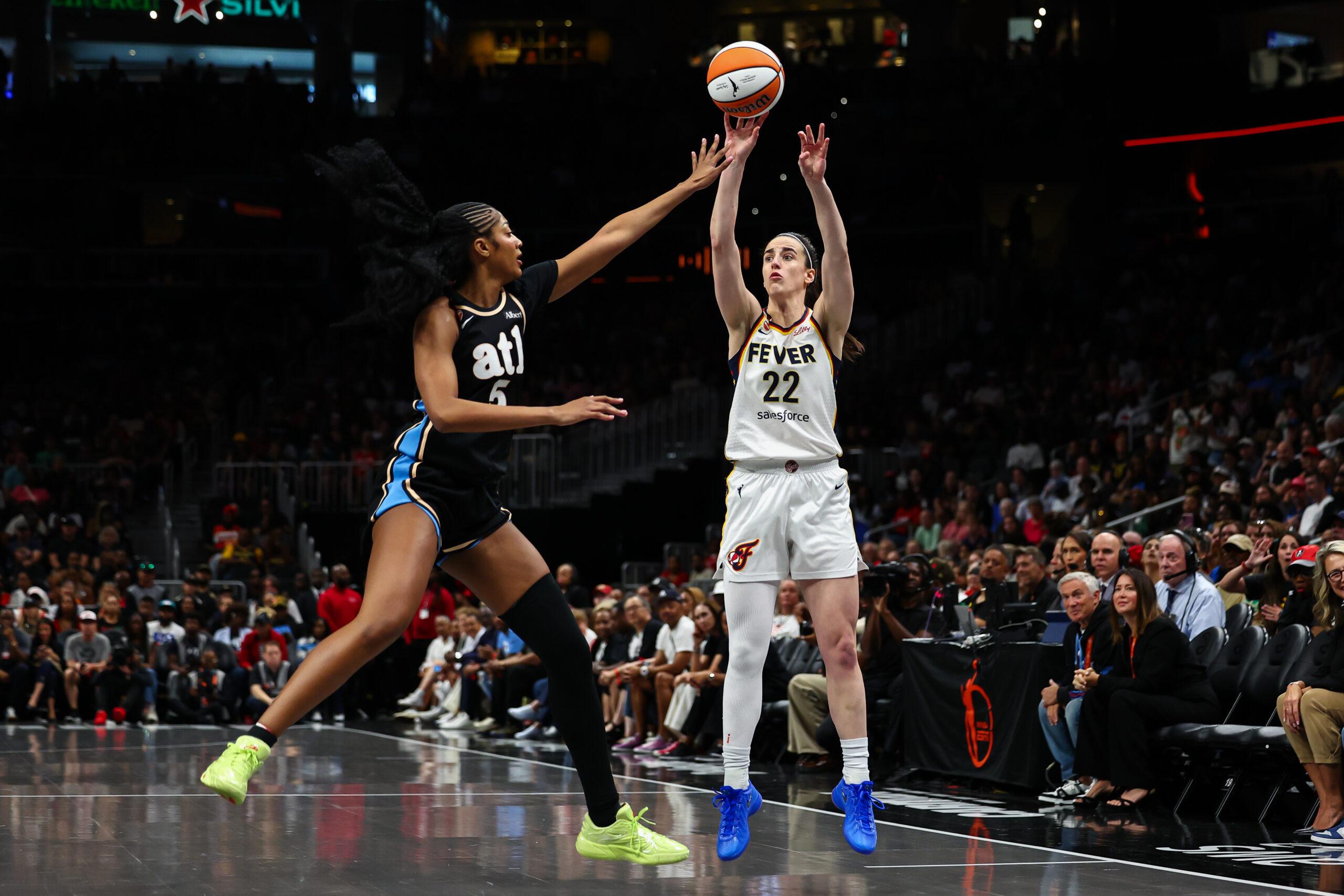
Caitlin Clark shoots against Reese
Clark and Reese have always been fascinating foils. Their on-court fit, evident in their chemistry on Team USA, is resplendent, representing two complementary polarities in the same movement toward pace and space. The regular season was headlined by Clark and a golden generation of young guards who are benefiting from the WNBA’s emphasis on freedom of movement in officiating. The postseason, though, has remained the mucky domain of defense and size where bigs like Stewart, Kiah Stokes, and Reese, who can both create and weather physicality, have thrived.
The Finals, which will feature the league’s top two defenses, will inevitably produce a lot of missed shots for Reese to fight for. You don’t exactly need complicated regression models to unearth the value of rebounding in the playoffs. It’s so simple that it sounds stupid to even point out, but it’s so intuitive that it often goes ignored: The team that has the ball has the best—no, the only—chance to score. Reese is not likely to hit the shot that everyone remembers but is likely to grab the one that ricochets off the rim, winning all the little moments that everyone forgets until they accumulate into something we remember forever.