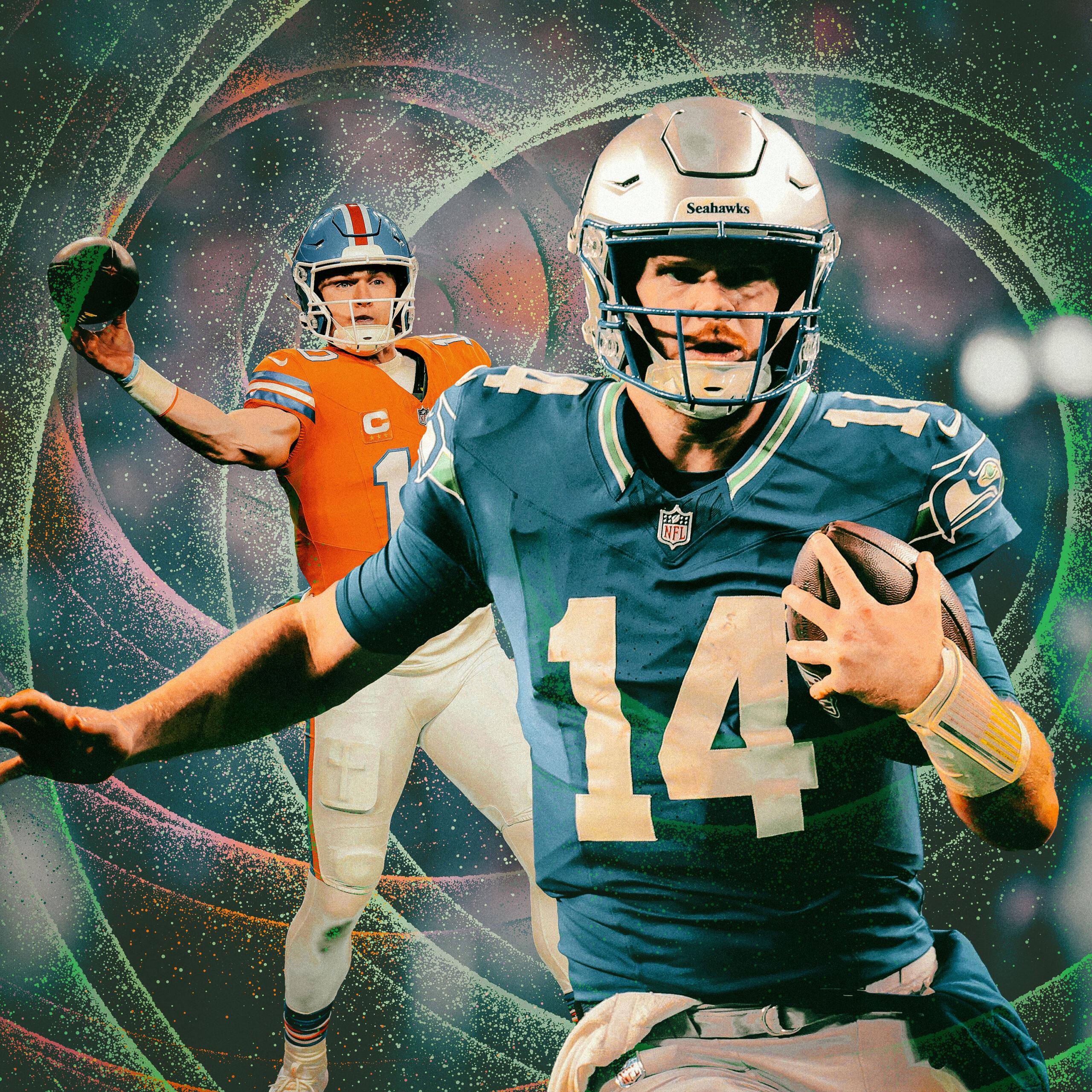

Thursday night’s clash between the Seattle Seahawks and Denver Broncos should have been a Super Bowl preview. It should have been a classic coaching chess match between Seattle’s Mike Macdonald, one of the league’s best defensive schemers, and Denver’s Sean Payton, who recently yanked back play calling duties to try to fix his struggling offense. It should have been a night to marvel at two elite defenses as they landed punch after punch.
Instead, it was a showcase of epic quarterback failures, with a pair of passing performances so dreadful that it’s hard to imagine either of these teams being real contenders unless the quarterbacks start playing significantly better.
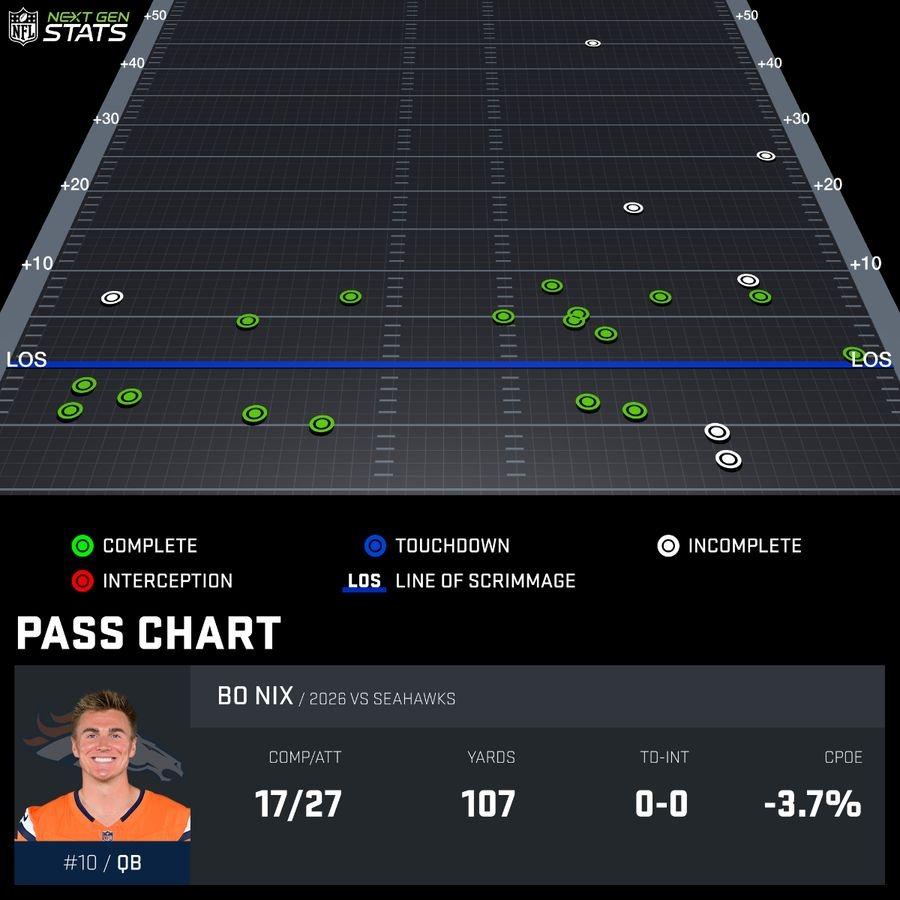
The Broncos ultimately won, 17-14 in overtime on a walk-off field goal from Wil Lutz. But they seem even further away from finding answers for what’s troubling Bo Nix than they did before Payton made the power play to usurp control of the offense 10 days ago. Nix threw for just 107 yards against Seattle—the second-lowest total in his career—and finished with a negative expected points added per dropback for the fourth time in six games and a season-worst 3.2 yards per dropback. It was a passing performance so bad that it inspired former NFL quarterback turned Amazon Prime analyst Ryan Fitzpatrick to go on an intense postgame rant on the field, saying that Nix was “not playing competitively” and was “almost disrespectful to the quarterback position.”
And that was the commentary about the game’s winning quarterback! At least Nix could leave Empower Field at Mile High on Thursday night knowing that his team had survived the hardest stretch of its schedule at 4-2, with wins against four playoff teams from last season—including the defending Super Bowl champion Seahawks; “4-2 is a really good spot,” Nix said. “The offense will find ways to improve.”
Seattle, meanwhile, has to fly home at 3-3, with losses to Denver, which is fielding a barely functional offense; Washington, which is in disarray; and their division rival, the 49ers, who could take a three-game lead over Seattle in the NFC West by the end of this weekend. And there’s a clear reason why the Seahawks are losing: Sam Darnold simply hasn’t been good enough when it counts. Darnold threw two interceptions on Thursday night, both at critical moments late in the game. The first pick came with just 91 seconds left in the fourth quarter, with Seattle trailing 14-11 and already into field-goal range. (The Broncos offense, however, couldn’t capitalize on that turnover—more on that in a minute.)

More on the NFL
Darnold’s second pick proved to be the true backbreaker in overtime. He was looking for Rashid Shaheed on the left sideline when Denver cornerback Ja’Quan McMillian jumped the route and came down with the ball inbounds at Seattle’s 43-yard line, right in front of the Seahawks bench. The Broncos offense called three safe run plays—they didn’t risk any Commanders-esque end-of-game shenanigans—and won the game on Lutz’s 53-yard field goal.
That interception was Darnold’s seventh in the past four games, and he now leads the NFL with 21 picks since the start of the 2025 season.
“There’s no way to sugarcoat it. That one sucked,” Darnold said. “Can’t turn the ball over. Obviously that’s forefront in my mind.”
Teammates said that Darnold broke down the team huddle in the visitor’s locker room after the game and took ownership for the loss—and while his interceptions were the game-swinging moments, it was Seattle’s inability to handle Denver’s pass rush that probably doomed the Seahawks from the start. The Broncos hit Darnold a staggering 17 times Thursday night and sacked him five times. Four of those sacks came on third downs, and two of them took the Seahawks out of field-goal range, essentially taking points off the board in a close game. According to TruMedia, the Broncos blitzed Darnold 18 times, and he had just a 33.3 percent success rate and averaged just 2.3 yards per dropback when Denver sent five or more rushers.
“Our quarterback got hit too much today … and we’ve got to be more decisive with the football,” Macdonald said.
That’s about as close as Macdonald would come to placing blame squarely on Darnold, but from the way the coach carefully chose his words throughout his seven-minute press conference, it was clear that he knew where the finger would be pointed. It would be one thing if this were an uncharacteristic night for Darnold, but this has always been the knock on him. For every dime he throws—and there were a few of them Thursday night—there’s always the threat of a bafflingly bad breakdown. Or, in this case, multiple breakdowns.
The lesson from Seattle’s Super Bowl win in February was that you can win a championship without elite quarterback play—with Sam Darnold, for goodness’ sake—as long as the defense and coaching are truly elite. To pull it off, you need a consistent rushing attack, an offensive line that can protect the passer, a receiver who can beat any coverage, and a quarterback who can manage it all.
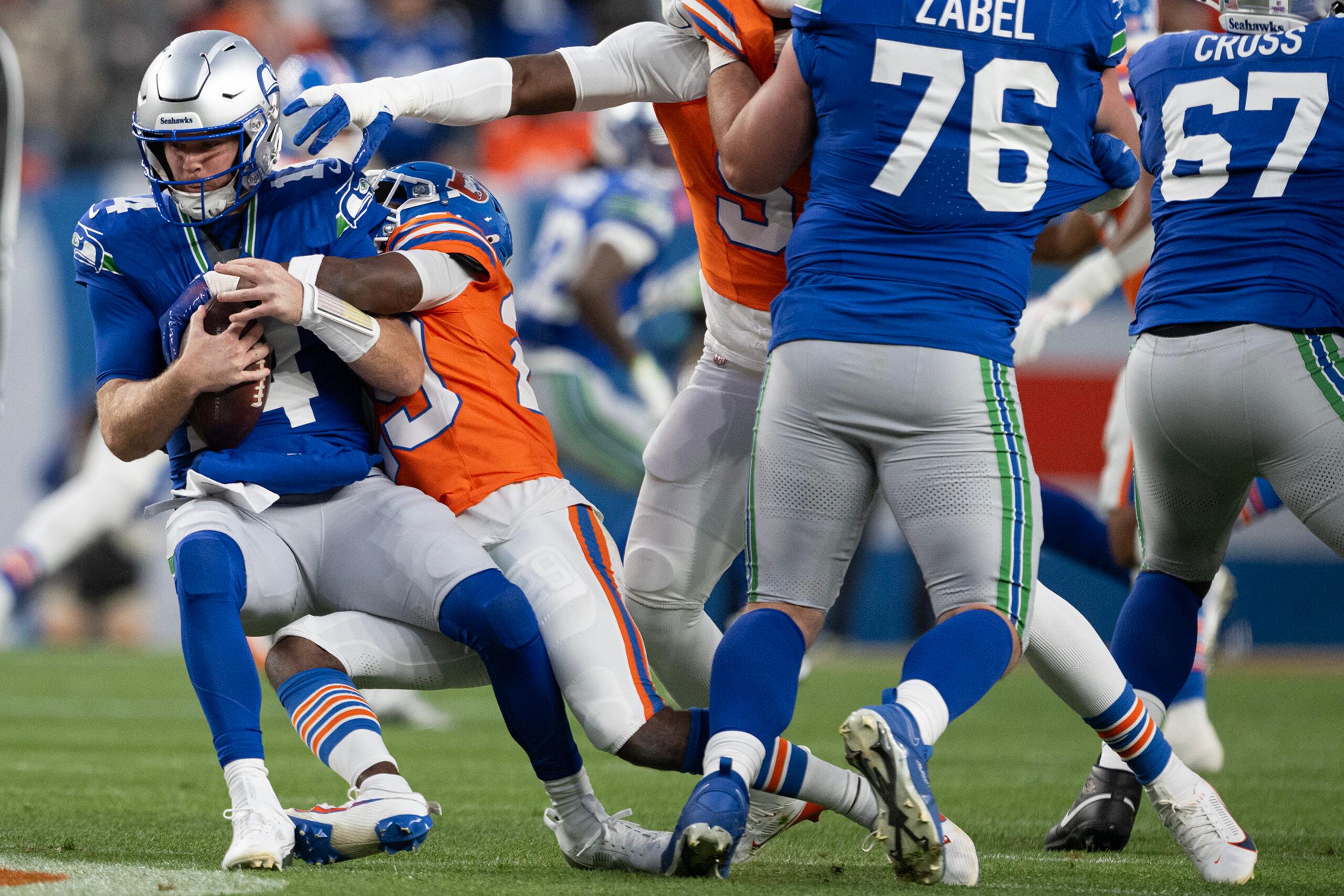
Ja’quan McMillian sacks Sam Darnold during the first half
Right now, that formula is failing because Darnold is failing. Seattle still has the elite defense, and that group was truly exceptional against the Broncos in the second half. But the running game is nonfunctional, and the offensive line cannot hold up against strong fronts like the ones it’s faced in back-to-back weeks against San Francisco and Denver. Darnold was sacked 10 times in those two games, after taking just four total sacks in his first three games of the year.
“It wasn’t a performance that was good enough to win the game,” Macdonald said, pausing for a moment before continuing his thought, “by our team. But the quarterback leads the team … I bet you Sam will be the first one to tell you that. We love him, but that’s what it is.”
What has to be even more frustrating about this loss, for Macdonald and Seahawks fans alike, is that despite all of Darnold’s very real issues on Thursday night, he was the better quarterback in the game, by a considerable margin. If not for Darnold’s overtime interception, Nix’s complete face-plant would have been the only story line of this game—and one of the biggest stories of this season.
Nix entered Thursday’s game with an edict from Payton to “let it rip.” Essentially: Stop overthinking the play calls and coverages, move quickly through the reads, take deep shots when they’re open, and make smart choices if they’re not. The Broncos hoped that one of the benefits of Payton regaining control of the play calls would be simplifying things for Nix, lightening the burden on a quarterback who too often has seemed overwhelmed. The Broncos were rarely an explosive or highly efficient offense in Nix’s first two seasons with Payton calling the plays, but Payton’s superpower had been crafting the offense in a way that would help protect against Nix’s limitations. Payton schemed up plenty of short throws, got Nix on the move to throw from outside the pocket, and encouraged the quarterback to scramble for extra yards. In theory, Payton as the play caller would provide Nix with some easy buttons.
But Nix continues to play the position like everything is hard. It’s understandable if the game feels heavy for the 26-year-old right now, given everything that’s transpired in 2026. He broke his ankle at the end of the biggest win of his life in January and missed getting a chance to play in the AFC championship game, a contest the Broncos very likely could have won with their starting quarterback. He had a second surgical procedure on his ankle in the spring, pushing back his rehab timeline and keeping him off the field for most of the offseason. He got a new play caller in Davis Webb and an exciting new receiving target in Jaylen Waddle. But he also started getting questions about earning his next contract, as he and his fellow members of the 2024 draft class are extension eligible after this season. It’s a lot of change, and a lot of pressure.
It looks like all of that is weighing on him, and he’s regressing in the process. He was a decent quarterback last season—ranked 11th by EPA per dropback but only 26th by passer rating, as his advanced stats were buoyed by his penchant for fourth-quarter magic. He’s been worse this season by nearly every metric, with significant drops in EPA per dropback, success rate, and completion percentage, to go with an increase in pressure rate. And he’s ranked last among all starters in air yards per attempt, at just 5.4—that’s half a yard worse than Aaron Rodgers’s average last season in that feeble excuse of a Steelers offense.
“I don’t understand why we can’t really push the ball vertically right now. Defenses are just sitting back there hanging out,” Nix said Thursday night.
Against a stingy Seattle zone defense that blanketed the Broncos receivers, Nix barely even tried to throw over the middle or deep. He attempted only three passes over 10 yards—and didn’t complete a single one. This passing chart is grim.
This is what it looks like when Nix is trying to let it rip? No wonder Fitzpatrick was so offended.
Nix did lead the Broncos on two first-half touchdown drives—and the first, a 16-play series that featured a nice mix of runs and passes and a creative goal-line wildcat play for running back RJ Harvey, who rushed in for the score, was arguably the Broncos’ best possession of the season. But that early production was a mirage. The Broncos managed just 38 yards after halftime and didn’t convert a single third down in the third or fourth quarters or overtime.
Those late-game scenarios are typically when Nix shines and plays like he’s letting it rip. Against Seattle? It was like he was playing tied to an anchor. When Seattle scored a touchdown and two-point conversion to cut Denver’s lead to 14-11 in the fourth quarter, Nix responded with his worst series of the game. He scrambled to his right on first down, stepping out of bounds for a 3-yard loss—and stopping the clock. Two plays later, he took a 10-yard sack on third down. One of Nix’s strengths throughout his young career has been his ability to create yards with his legs and avoid the big negative play—and he failed at both of those things in this doomed sequence.
Just a few minutes later, with a chance to ice the game after Darnold’s interception in the waning minutes of regulation, the Broncos mustered only 2 total rushing yards—and Nix’s throw on third-and-long fell incomplete. Denver amassed just 74 rushing yards—and averaged a dismal 2.6 yards per carry.
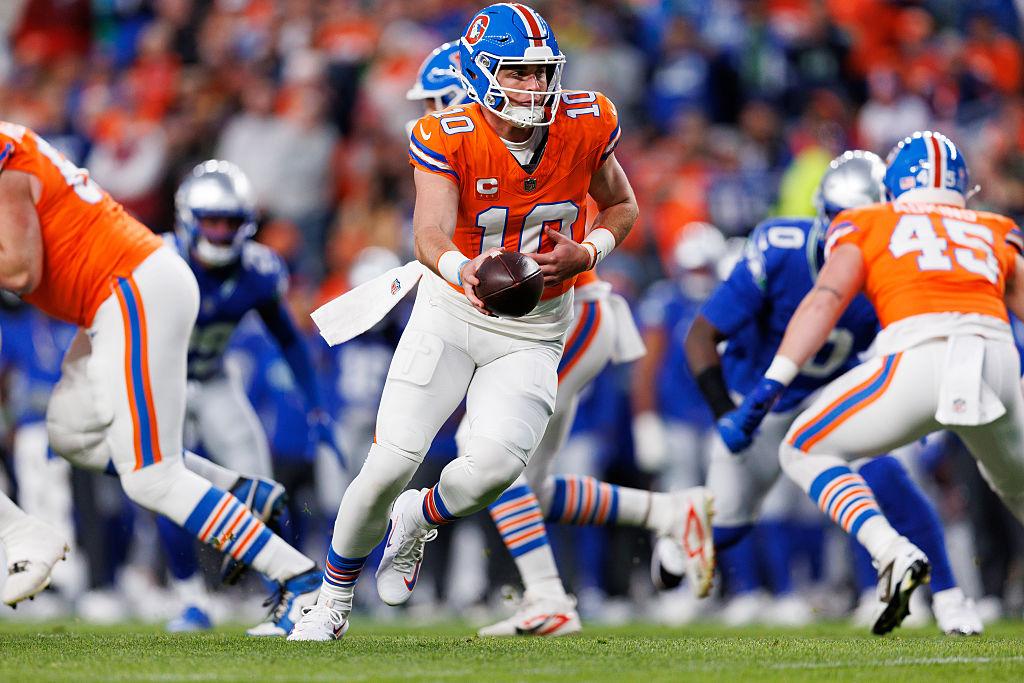
Bo Nix hands off the ball during the first quarter
“We’re definitely capable. We’ve shown it. I don’t know where the disconnect is right now, to be honest with you,” Nix said.
The Broncos have already pulled one lever—the big one, Payton’s return to play calling—as a means of figuring it out. That hasn’t produced immediate effects, and in many ways, the Broncos have been worse since Payton made the change, as two of Nix’s three worst statistical performances have come in the past five days, against the Chargers and Seahawks.
The Broncos already have an experienced offensive line—the same group of five starters who were widely considered one of the league’s best lines a year ago—and outside of rookie running back Jonah Coleman, the offense is healthy. So there’s no one coming to save them.
Seattle, at least, will get running backs Zach Charbonnet and Jadarian Price back from injury at some point, and having even a semi-functional run game could help take the burden off Darnold and the passing attack. But both Seattle and Denver appear to be pushing the limits of how much heavy lifting a defense can do. The Broncos defense was on the field for 82 plays against Seattle; that’s an unsustainable load, especially for a group that’s already without its best player, cornerback Patrick Surtain II; that’s missing starting safety Talanoa Hufanga; and that has CB2 Riley Moss on a pitch count. Seattle’s defense held Denver to just 2.9 yards per play—the lowest average in a single game this season—and lost. This could have been a Super Bowl preview. The two defenses were up for the task. Bo Nix and Sam Darnold showed us how they just might crush their teams’ championship dreams.