
Back in 2012, during a press junket for The Newsroom, Aaron Sorkin traded barbs with an interviewer who dared to fight smarm with snark. Rattled by his interlocutor’s apparent lack of deference—and trying his best to seem like he was just kidding around through clenched teeth—the Studio 60 on the Sunset Strip mastermind sardonically referred to Sarah Nicole Prickett, the Toronto-based journalist who’d gotten under his skin, as an “internet girl.” As in: “Listen here, internet girl … it wouldn't kill you to watch a film or pick up a newspaper once in a while."
Watching The Social Reckoning won’t kill you, but it won’t make you stronger, either. The best-case scenario, perhaps, is that it prompts you to pick up a newspaper or listen to a podcast. For all its predictably voluble verbiage, Sorkin’s latest doesn’t articulate much about its subject matter—the 2021 internal document leak revealing that Facebook and its overlords had ignored warnings about the harmful societal effects of their own platform, including the rabble-rousing algorithms that helped facilitate the U.S. Capitol attack—that you couldn’t glean from Jeff Horwitz's Pulitzer Prize–winning reportage. (Or, in a pinch, from scanning Wikipedia.) It also doesn’t exactly sparkle as glossy prestige-season entertainment. The film’s boldness as a shot across the bow at Meta and its social media empire (“Mark Zuckerberg will love The Social Reckoning,” blares one ad placed on Instagram) is compromised, if not canceled out, by the blandness of its presentation. As a provocation–slash–conversation piece about big-tech power players trying to control the narrative, it’s no Digger.
With this in mind, a well-circulated X post by critic Joshua Rothkopf during the New York Film Festival claiming that Luca Guadagnino “ate Sorkin’s lunch” in the anti–tech mogul sweepstakes with his reportedly scabrous Sam Altman hit job, Artificial, is believable. The evidence suggests that the director of Bones and All and After the Hunt has a healthier appetite for controversy (and a stronger artistic constitution) than the maker of Being the Ricardos. But to paraphrase Desi Arnaz: When there’s some explaining to do, Sorkin is your man. Ditto if you need a preacher willing and ready to evangelize to the choir. Sorkin’s influence on American popular and political culture over the past 30 years is not insignificant; when The New York Times asked, “What Did The West Wing Do to Us?” in 2024, it was a good, pointed, rhetorical question about the upshot of all those episodes of pandering, precise, Emmy-winning wish fulfillment. Case in point: Sorkin had taken to the paper of record himself a few months before to propose a thought experiment of his own—that the Democrats could run Mitt Romney against Donald Trump in what he called “a break glass plan.” (Something was broken, all right: Sorkin’s brain.)

For better or worse, The West Wing endures on the strength of its acting and craftsmanship, which hold up. The Social Reckoning, meanwhile, is a movie of the moment because it’s hard to imagine anybody watching it again after the end of the year. If you’re hoping to see talented actors doing their best to seem mortified while scanning the contents of USB keys—or trying to transubstantiate run-on monologues about ethics and responsibility into acceptance speeches—you’ll probably like it just fine. Like many sequels, spiritual or otherwise, the film is light on invention and heavy on obligation; Sorkin’s commitment to telling truth-to-power narratives competes with his struggle to render them authentic.
That brazen, phony showmanship is a brand, and it can be exhilarating when it hits just right, like when Jack Nicholson calls Tom Cruise a snotty little bastard, or Alec Baldwin waxes philosophical about being God. Tweak it a few degrees in the wrong direction, however—i.e., toward the real world, past or present—and the shtick becomes unbearable. The revolting twist of history at the end of 2020’s The Trial of the Chicago 7, which concludes with Eddie Redmayne’s Tom Hayden reading out a list of American soldiers who died in Vietnam while the witnesses offer up a slow clap (that sound you hear is William Kunstler rolling in his grave), belongs on any list of the worst movie sequences of the 21st century.
There’s nothing nearly so egregious in The Social Reckoning; there’s also little that really registers either way. Sorkin’s depiction of the caustic, platonic situationship between principled investigative reporter Jeff Horwitz (Jeremy Allen White) and whistleblowing data scientist–slash–internet girl Frances Haugen (Mikey Madison) never transcends its own schematic, seriocomic setup. He’s an analog man who doesn’t know how to work a GPS; she’s Lisbeth Salander without the dragon tattoo. He mumbles, she drones; their screwball dialogue keeps missing the strike zone. The script cuts back and forth in time between 2019, when Jeff, who’s new in town, carefully cultivates friendless, conscience-stricken Frances as a potential informant, pushing her to violate her NDA in the name of public safety, and 2021, with Mark Zuckerberg (Jeremy Strong) raging with his inner circle about how and why their informational firewall has been compromised. Because the outcome is a foregone conclusion—the story will come out—suspense is at a premium. Sorkin victory laps his way through pavement-pounding newspaper-movie conventions—secret meetings and tense depositions, sinister ultimatums and explosive closed-door testimonies—en route to re-creations of January 6 that feel engineered for lurid spectacle and not much else.
The muckraking on-screen is less compelling than the motivations of a filmmaker seemingly caught between trying to get his fingernails even dirtier and washing his hands clean of getting the story of Facebook wrong the first time. “If you're going to write about something, you have to look at it more than once,” Prickett told Sorkin during their intergenerational face-off, and from its title on down, The Social Reckoning suggests that its maker took the “internet girl’s” advice to heart. Yet Sorkin has denied that the project represents an attempt at penance or a strategic revision of the narrative that won him an Academy Award. “[It’s] a new movie I wrote pretending I had never written The Social Network,” he told The Hollywood Reporter. “[It wasn’t] because I was worried about backlash, and I really didn’t think of it as re-centering or changing anything.”

Forgetting The Social Network is a pretty big ask. There are many ways in which David Fincher’s 2010 film has aged awkwardly (an occupational hazard for all zeitgeist-surfing artists), but for all its flaws, The Social Network remains perceptive, persuasive, and entertaining. It’s not just that the film is brilliantly made, but that its form follows and fuses with function; it’s a cautionary fable about technological acceleration in which velocity trumps veracity. The screwball dialogue isn’t an affectation so much as an angle of approach; the best thing about Sorkin’s Social Network script (his best) is its willingness to play as fast and loose with facts and feelings as the Ivy League hustlers at its center. The intricacy of the film's flashback structure, devised by Sorkin and put across brilliantly by Fincher and his editors Angus Wall and Kirk Baxter, simultaneously belies and heightens the sense of forward momentum. The sensation that bleeds through Fincher’s gleaming early-millennial surfaces is dizzy anticipation: a grim future rushing up to meet us.
The Social Network is probably the only truly great movie made from a Sorkin script; it should be said that there are also a Few Good Ones—and a great piece of designer early-’90s trash—but the truth, which by now should be pretty easy to handle, is that his writing needs decisive, accomplished directors to shape and finesse it. Sorkin’s cinematic batting average slips below the Judge Roberto Mendoza line when he pulls double duty. Four films into his run as a hyphenate writer-director, he wields his pen (or, I guess, his laptop) like a sword and camera like a bathtub—with evident difficulty. Notwithstanding his incongruous inclusion in the short-lived HBO series One Perfect Shot—in a hellish episode dedicated to the TV-movie-ugly The Trial of the Chicago 7—Sorkin is not typically celebrated as a fluid visual storyteller. Even though it’s lit scrupulously by the excellent cinematographer Jeff Cronenweth (who also lensed The Social Network), The Social Reckoning lacks a distinctive tone or stylistic point of view. When Danny Boyle directed Sorkin’s script for Steve Jobs, the shifts in format and aspect ratio reflected larger ideas about time and technology. The Social Reckoning is made in a way where it could be about anything, which has the effect of draining the urgency straight out of the material.
To his credit, Sorkin has contrived a prologue as striking as its on-screen subtitle: “White Girl Wasted.” The phrase isn’t a metaphor—The Social Reckoning opens on an obviously intoxicated motorist (Portia Doubleday) belittling a pair of police officers who’ve stopped on the street to check in on her stranded vehicle. The ensuing spew of racist invective channels a recognizable strain of self-victimizing Trump-era ugliness; Sorkin succeeds in turning his brand of logorrheic liberal righteousness inside out. To ensure we’re suitably horrified, the film cuts to Madison’s Frances anxiously clicking through cellphone footage—uploaded by the driver to Facebook—as part of the company’s Civic Integrity team. The real Haugen became motivated to leak company secrets after seeing a friend get radicalized online, and this cold open, while blunt, works nicely to convey larger anxieties about virality and contagion that arise when a social network is made in the distorted image of its users.
The casting of Madison as a soft-spoken, introverted nerd is strategically counterintuitive; the joke (surely intentional) is that the wasted white girl in the video sounds more than a little like Anora. Madison is a smart, resourceful actress, but even though she’s technically playing a real person—right down to the celiac disease that obliges Frances to rock a series of wrist and leg warmers—she never quite inhabits the character’s contradictions between her belief in Facebook’s mission of connectivity and her skepticism about its methods. When she explains that a statistical majority of extremists on Facebook had been pushed there by the site’s own recommendation tool, she’s as crestfallen as she is outraged.
Meanwhile, White is playing even more of a cipher, and a stand-in of sorts for Sorkin, casting an affectionately exasperated eye at his Gen Z confederates. (Don’t they know who Frank Capra is?) The enigma of why a self-described Luddite would want to work a Silicon Valley beat is safely reduced to a running joke. Sorkin has no compunction about playing the hits here: We get wisecracking, sleep-deprived interns, ornery but loving newspaper editors, and unctuous corporate toadies. (Billy Magnussen is enjoyably hateful as a Facebook higher-up who’s somehow able to smirk while spewing buzzwords out of both sides of his mouth.)
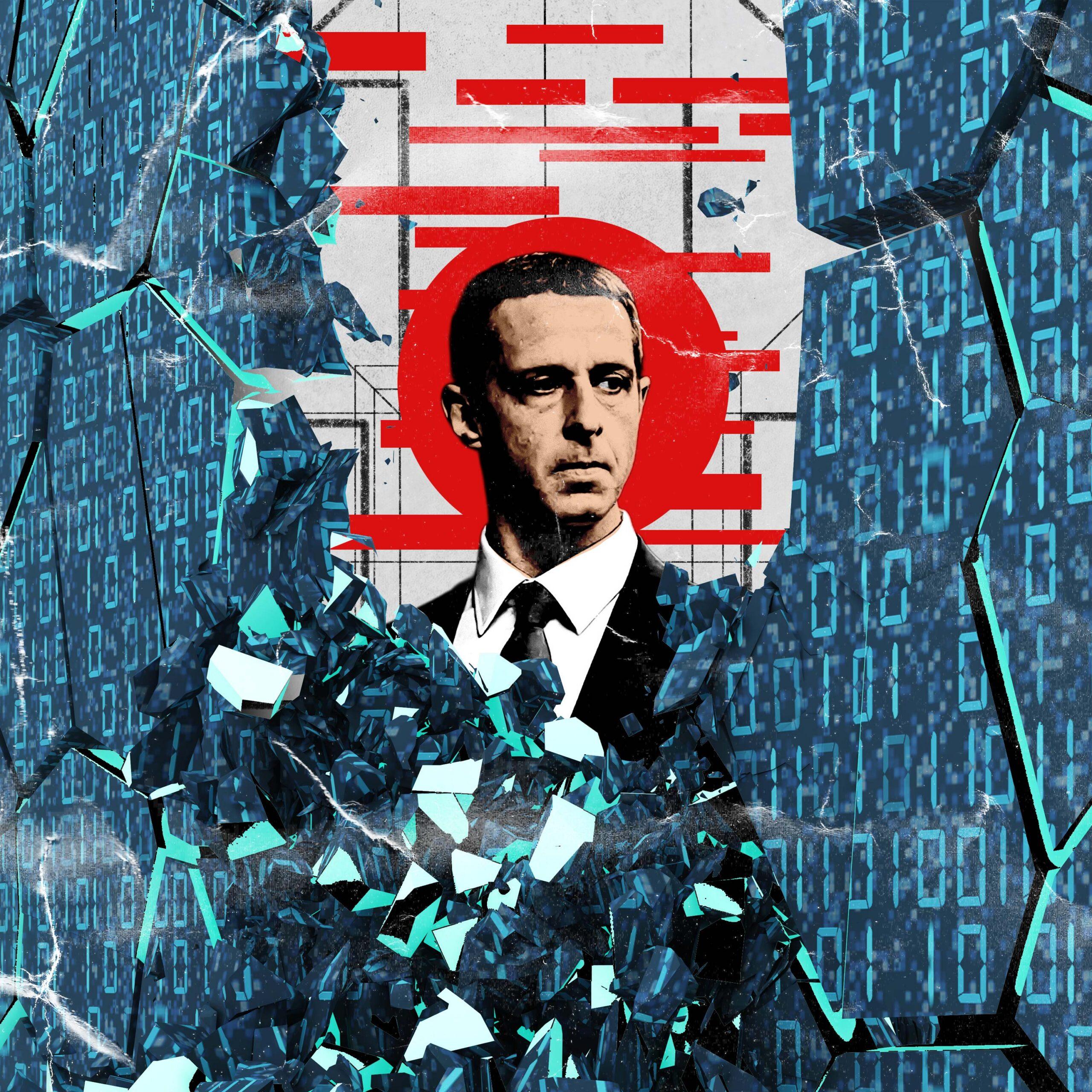
Hovering above the fray is Strong’s much-anticipated impersonation of Zuckerberg as an unblinking, unsmiling master of the universe—a technically faultless performance that, like his turn as Roy Cohn in The Apprentice, is strangely lacking where it counts. Part of the brilliance of Jesse Eisenberg’s turn in The Social Network was how vividly he conveyed a reptilian persona in formation, blood chilling in real time; you could feel his version of Mark stepping, tentatively, into that pair of fuck-you flip-flops. Here, though, Zuckerberg appears as a finished product: Not only is he CEO—bitch—but his vindictive pleasure at building an empire at the expense of his friends and classmates has been sublimated, along with every other aspect of his personality. Strong makes Zuckerberg 2.0 sleek, bulletproof, and ethically intractable to the point of paralysis; he’s formidable and also a bit boring.
There are a few discrete pleasures in The Social Network—like Bill Burr blasting Strong over and over with his Boston-cop bullhorn voice as the most unsparing and outspoken of Zuckerberg's advisers—and exponentially more sources of annoyance. Almost none of the one-liners land, the time shifts are graceless, Alexandre Desplat’s score is slop on the soundtrack. Sorkin may have thought that his ace in the hole would be including re-creations of the Capitol riots, but, like the scenes of police brutality in The Trial of the Chicago 7, the images don’t resonate beyond their own luridness—they’re there mostly to give Strong something to brood over in silent, tight-lipped close-up. Leave it to Sorkin to deploy violent images of social unrest primarily as a way of scoring points off his villain, and also to prefigure the hoariest trick of all—a climactic victory speech about accountability that may exist on the record yet plays as utterly ersatz, right down to a fist pump that seems to transport Madison back to The Breakfast Club. If Sorkin had explicitly—or even subtly—framed Frances’s triumph as a provisional victory in a larger war that’s still being waged (and won) by the digital empire, The Social Reckoning might have fulfilled its eponymous promise to wrestle with our predicament. As is, Sorkin’s film is nothing more than a hypothetically defiant, finally futile crowd-pleaser. Would it have killed him to make something else?