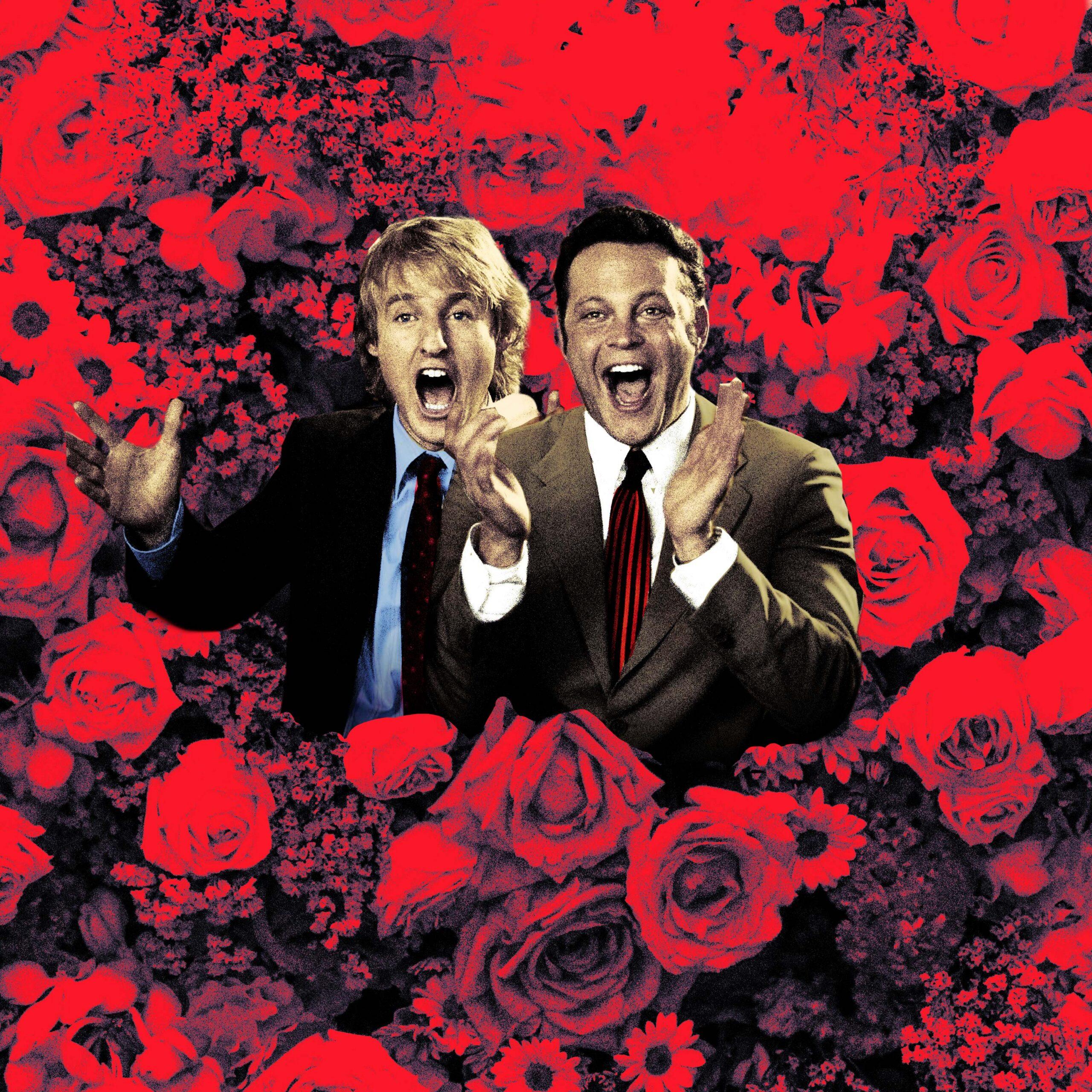

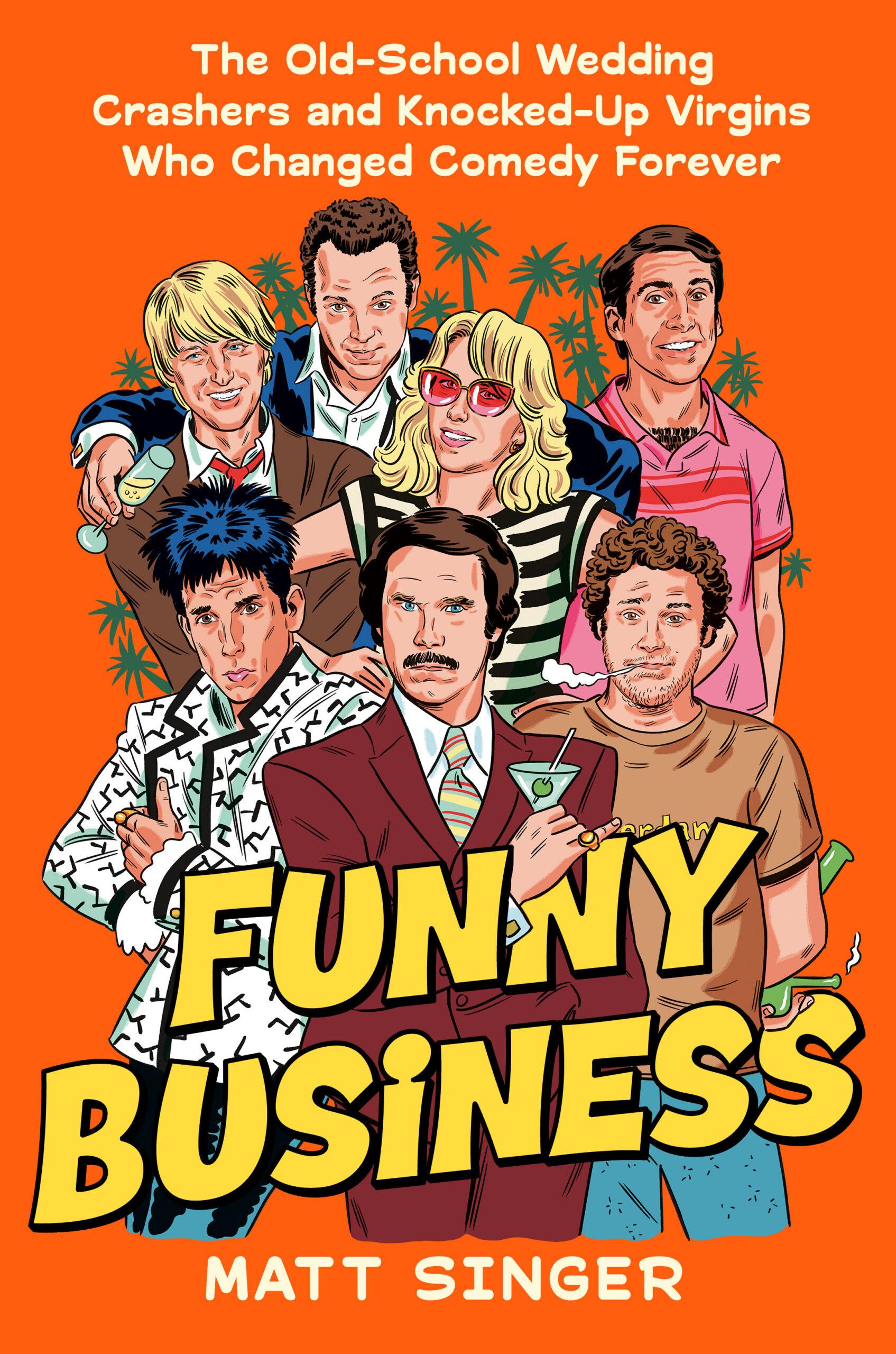
Comedies? For adults? With jokes in them? What a concept! In the 2000s, there was no shortage of adult-centric comedies at the multiplex, thanks to unlikely stars like Seth Rogen, Will Ferrell, Vince Vaughn, and Steve Carell. In his new book, Funny Business: The Old-School Wedding Crashers and Knocked-Up Virgins Who Changed Comedy Forever, out Tuesday, Matt Singer looks back on the 21st-century comedy boom—how it grew, why it exploded, and where studio comedies stand in the streaming era. In this exclusive excerpt, Singer dives into the production of Wedding Crashers, whose R-rated sensibility connected with audiences despite ambivalence from studio executives.
“One day you’ll look back on all this and laugh. Say we were young and stupid. Couple of dumb kids running around.” —Jeremy Grey, Wedding Crashers
Two weeks before Old School opened in theaters and rejuvenated his film career, Vince Vaughn attended the Hollywood premiere of a rival movie comedy.
Shanghai Knights was a sequel to the 2000 hit Shanghai Noon. The franchise offered a unique blend of genres: mismatched buddy Western comedy martial arts pictures headlined by Jackie Chan as, ahem, “Chon Wang.” (Say it aloud; that helps sell the joke.) The indomitable action hero’s sidekick in both films was played by Owen Wilson, whose mellow onscreen vibes played well opposite the hyperactive Hong Kong action star.
Vaughn went to the Shanghai Knights premiere to support its director, David Dobkin. The two had worked on Dobkin’s directorial debut, 1998’s Clay Pigeons, one of the many serial killer-centric movies Vaughn made after Swingers.
“We had a great connection and had been looking for years for something,” says Dobkin. “He was in the foreground talking to me. He was giving me notes on the movie which was kind of funny, little trims that he would have done. And I was watching him, and across the room I can see Owen talking to somebody. And I was looking at Vince and looking at Owen, the thing that popped in my head was Abbott and Costello. I love buddy comedy, and my agent knew I had been looking for an R-rated comedy. That’s where my sensibility was. Everything I liked was R. And I turned to my agent and said ‘You know the movie I’ve been looking for? Let’s find something for Vince and Owen.’”
Two months later, Dobkin’s agent brought him something. It originated as a very simple idea from a producer named Andrew Panay. Years earlier, Panay was hanging out in Vegas when he stumbled across a wedding reception. The guests looked like they were having so much fun that Panay couldn’t help himself; he snuck into the party and joined the festivities. Panay only did it that one time, and only for a few minutes. But it was such a great experience, he couldn’t get it out of his mind. Eventually, he wondered: What if a couple buddies snuck into weddings as a hobby? It sounded like a movie.
Panay pitched the idea to a pair of screenwriters, Steve Faber and Bob Fisher, who had written a comedy script called We’re the Millers that was getting some attention around Hollywood. Initially, Faber and Fisher weren’t convinced Panay’s notion had enough juice for feature-length comedy.
“We weren’t sure, right off the bat, if it was going to be able to sustain a whole movie,” Fisher said. “We figured, obviously, one of the guys will fall in love and that’ll be kind of his thing. It really came together for us, however, when we came up with the idea that the family of the two women that Vince and Owen are interested in are very much like the Kennedys … when we thought about that, we knew we were on the road to [the idea] becoming a cool movie.”
Fisher had once spent a summer interning for a congressman in Washington, D.C., and sneaking into lobbyist events for the free food and booze. The script Faber and Fisher wrote blended their interest in the inner workings of powerful political families with Panay’s wedding crashing concept, yielding a script that Dobkin said contained “a couple of the funniest set pieces” he’d ever read. He then added several more scenes beefing up the friendship between the two leads, yielding “a coming-of-age story for 35-year-old men still in their ‘chasing girls mode’ and hadn’t dealt with love yet … that was very much built out of trying to find something for Vince and Owen.”
Vaughn and Wilson would ultimately play Jeremy and John, two best friends who work together as divorce mediators. In their spare time, they crash weddings, both because weddings are really fun, and also because they’re filled with swooning single women so besotted with their romantic surroundings that they’re easily swept off their feet and into the heroes’ beds by a series of false identities. (At one wedding, Vaughn pretends to be a member of the French Foreign Legion; at another, he wistfully recalls the good men they lost climbing Mount Everest.)

But then John breaks one of the cardinal rules of wedding crashing set down by the duo’s often mentioned, never-seen mentor Chazz Reinhold: He falls in love. Smitten with Claire (Rachel McAdams), the sister of the bride at a glitzy Washington, D.C., wedding, John cons his way into an invite to her family’s compound in Maryland, where his obvious feelings for her put him into conflict with Claire’s obnoxious boyfriend (Bradley Cooper). While John and Jeremy hobnob with Claire’s father, the U.S. Secretary of the Treasury (Christopher Walken), and John’s relationship with Claire gets more serious, Jeremy contends with Claire’s younger sister Gloria (Isla Fisher), who hooks up with him at the wedding, then reveals that she was, at least until their meeting, a virgin. The now-deflowered Gloria spends the rest of the film forcing Jeremy to help her tap into all sorts of wild but previously undiscovered sexual proclivities.
Just how wild those proclivities could get, though, was a matter of debate between Dobkin, the cast, and the studio. From the very beginning, Wedding Crashers was conceived as a throwback to the R-rated comedies of yesteryear.
“I grew up [loving] these rated-R comedies like Animal House and this stuff,” Vaughn said during the Wedding Crashers press tour in 2005. “So for me, if you’re going to do an adult themed movie called Wedding Crashers, well, what are you going to do? You gotta get into it, and it’s fun to get into it.”
In the case of Wedding Crashers, a story about two unapologetic cads sleeping their way around the Washington, D.C., wedding scene, it definitely made sense to push the envelope a little. (Wedding Crashers’ big partying montage was set to a cover of the Isley Brothers’ “Shout,” the same song used in Animal House’s big toga party scene—an homage Dobkin says was “absolutely” intentional.) Including a little nudity and several sex scenes didn’t necessarily lend the film a sense of maturity—if anything, it lent the film the opposite—but it did allow the film to speak in the four-letter language that guys like John and Jeremy would use in real life.
That didn’t mean that the studio was necessarily keen on the plan. An R-rating meant that teenage boys, traditionally the core audience for raunchy comedies like Wedding Crashers, would be unable to buy a ticket to the movie. From a box-office perspective, the film could be shooting itself in the foot if its R rating kept its target demographic away. Dobkin says the studio at one point even offered him money—“like, a lot of money, like twice as much as I made on the movie”—to cut Wedding Crashers down to PG-13.
“I really fought to keep [the rating] what it is, and they ultimately honored that,” Dobkin recalled. “I also just think that real life is R-rated—as an adult, that’s just how people really talk.”
Some sequences got so R-rated, though, they threatened to tip the film over into NC-17 territory. In one of Wedding Crashers’ most graphic scenes, Gloria gives Jeremy a hand job under the table during a family dinner. The initial cut included close-ups of her rubbing his crotch through his pants; those images had to be reshot after editor Mark Livolsi got a look at the initial footage, which employed a prosthetic stunt penis, and realized they would never get an R-rating if they used it. A second version that, in Livolsi’s words, was “a little subtler” was filmed. (If you’ve seen the movie, the fact that this was the “subtler” take might surprise you.)
All through production, Wedding Crashers’ raunchy sexual humor, along with the central conceit of dudes lying their way into weddings (and then into some of the more attractive guests’ arms) kept those in charge at the film’s distributor, New Line Cinema, nervous. Dobkin recalled meetings with the studio, where they warned him that they couldn’t sell the film.
Ultimately, audiences agreed with Dobkin. While Wedding Crashers’ sexual content might have pushed a few boundaries for a studio movie, and its premise could read on paper like a celebration of misogyny, its storyline was pure screwball comedy, with a pair of mismatched couples facing various obstacles to their love before an inevitable resolution. Jeremy and John begin the movie as unrepentant scoundrels, but they both wind up in committed relationships. Wild as some individual scenes may have been, Wedding Crashers’ celebration of monogamy and marriage was almost old fashioned.
It also showed the power of great casting, not just of Wilson and Vaughn as a duo, but also in picking relative unknowns like McAdams, whose star-making turn in The Notebook had yet to premiere when she was hired, and Cooper, who was best known at the time for a character on the TV spy series Alias who became so superfluous to its ongoing espionage storyline that he was eventually written out of the show.
The movie also showed the value of casting guys like Vaughn and Wilson—both skilled improvisers and working screenwriters—as the leads of a comedy. Dobkin let the pair each tailor their characters to their own voices, and to punch up their dialogue whenever they deemed necessary. Vaughn later said that when they worked with the script during rehearsals “there wasn’t a scene that we didn’t go through and change.” (“We wanted to make sure it wasn’t just about some tomcats, some frat guys,” Wilson concurred.)
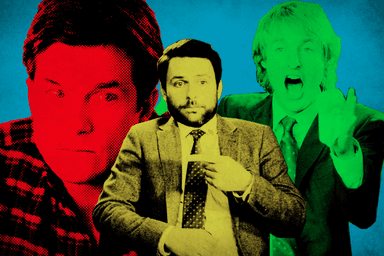
That included massaging the plot to push the buddy dynamics between John and Jeremy to the center of the movie. Like Starsky & Hutch, Wedding Crashers’ true love story is the platonic one between the two male leads, who even undergo a classic sort of rom-com break-up during the second act after John discovers that Jeremy has fallen for Gloria. (“The secret of Wedding Crashers is that it’s a chick flick dressed up like a guy movie,” notes Dobkin.) In the original script, John was supposed to interrupt Claire’s wedding to Cooper’s evocatively named Sack Lodge, an homage to the famous climax of The Graduate. In the revised version, the climactic wedding is between Jeremy and Gloria, and John shows up not only to win back Claire but to make amends with his best bud as well.
“That’s what the movie is really about. ‘Wait a minute. You fell in love with someone? What about us?’” Dobkin explains. “It was one of those moments where I had a very personal story to tell about being young, being kind of a nerd and a loser, my group of friends was really tight, none of us had girlfriends. And then finally someone had a girlfriend—and they’re dragging the girl along or they’re not around anymore. And either version felt like a breakup.”
Despite Wedding Crashers’ R-rated sexual humor—or maybe because of it—a huge audience showed up to see the film in theaters. By the time Wedding Crashers ended its run in multiplexes, it had become the first R-rated comedy in history to gross more than $200 million at the U.S. box office. Coming closely on the heels of Old School, it was clear: The moviegoing audience wanted more adult comedies.
Susan Wloszczyna’s USA Today article that dubbed Stiller, Ferrell, Wilson, and Vaughn part of Hollywood’s “Frat Pack” was reported from the Wedding Crashers set and published back in the summer of 2004. By the time Wedding Crashers debuted in theaters on July 15, 2005, the rest of the media had taken the ball and run with it. In March of that same year, The New York Times published a 2,500-word profile of the crew it dubbed “Hollywood’s Funniest Clique,” citing all the same onscreen performers, but also mentioning filmmakers Adam McKay and Judd Apatow, and even agents like UTA’s Nick Stevens, who represented Stiller, and talent managers like Eric Gold and Jimmy Miller, who worked with Ferrell, Vaughn, Apatow, and others.
The group, the Times’ Sharon Waxman wrote, was “reshaping screen humor to their liking” by “coming up with their own concepts, finding screenwriters and then offering the whole package for production—script, director and cast, take it or leave it.” Stiller’s producer Stuart Cornfeld told the Times that the men not only collaborated on shared projects, they also offered support and suggestions on films they weren’t directly involved in, citing an instance where Apatow had recently attended a reading of one of Stiller’s scripts and offered his notes, despite the fact that Apatow wasn’t technically working on the film. Cornfeld labeled their collective body of work “smart-dumb comedy.”
The whole piece was bullish about this “clique” and their enormous success, but small hints of concern creep in at the margins of the article. In one paragraph, Waxman notes that the studios like making these comedies because of “their low production cost and their huge return at the box office.” In the next, she reveals that those production costs weren’t as low as they used to be. The more the Frat Pack’s movies made money, the more its actors, writers, and directors could charge for their services.
The script for Vince Vaughn’s follow-up to Wedding Crashers, The Break-Up, for example, had recently sold at auction for $2.25 million, plus another $12 million to Vaughn to star in the film and produce it. A few years earlier, that figure would cover almost the entire cost of one of these comedies. A few months after the Times’ article, Wedding Crashers opened in theaters, shattered records for an R-rated comedy, and ensured that Wilson and Vaughn’s salaries would rise even higher.
One of the guys who saw Wedding Crashers in the summer of 2005 was Judd Apatow, who was getting ready to release his feature directorial debut later that year. Like Wedding Crashers, Apatow’s movie was an R-rated comedy filled with provocative jokes. Apatow liked Wedding Crashers, but when he left the theater he only had one thought about his own movie:
“Oh my gosh, we’re 100 times dirtier than that.”
This piece has been lightly edited to fit the excerpt format.
From Funny Business: The Old-School Wedding Crashers and Knocked-Up Virgins Who Changed Comedy Forever by Matt Singer, published by Putnam, an imprint of Penguin Publishing Group, a division of Penguin Random House, LLC. Copyright (c) 2026 by Matt Singer.