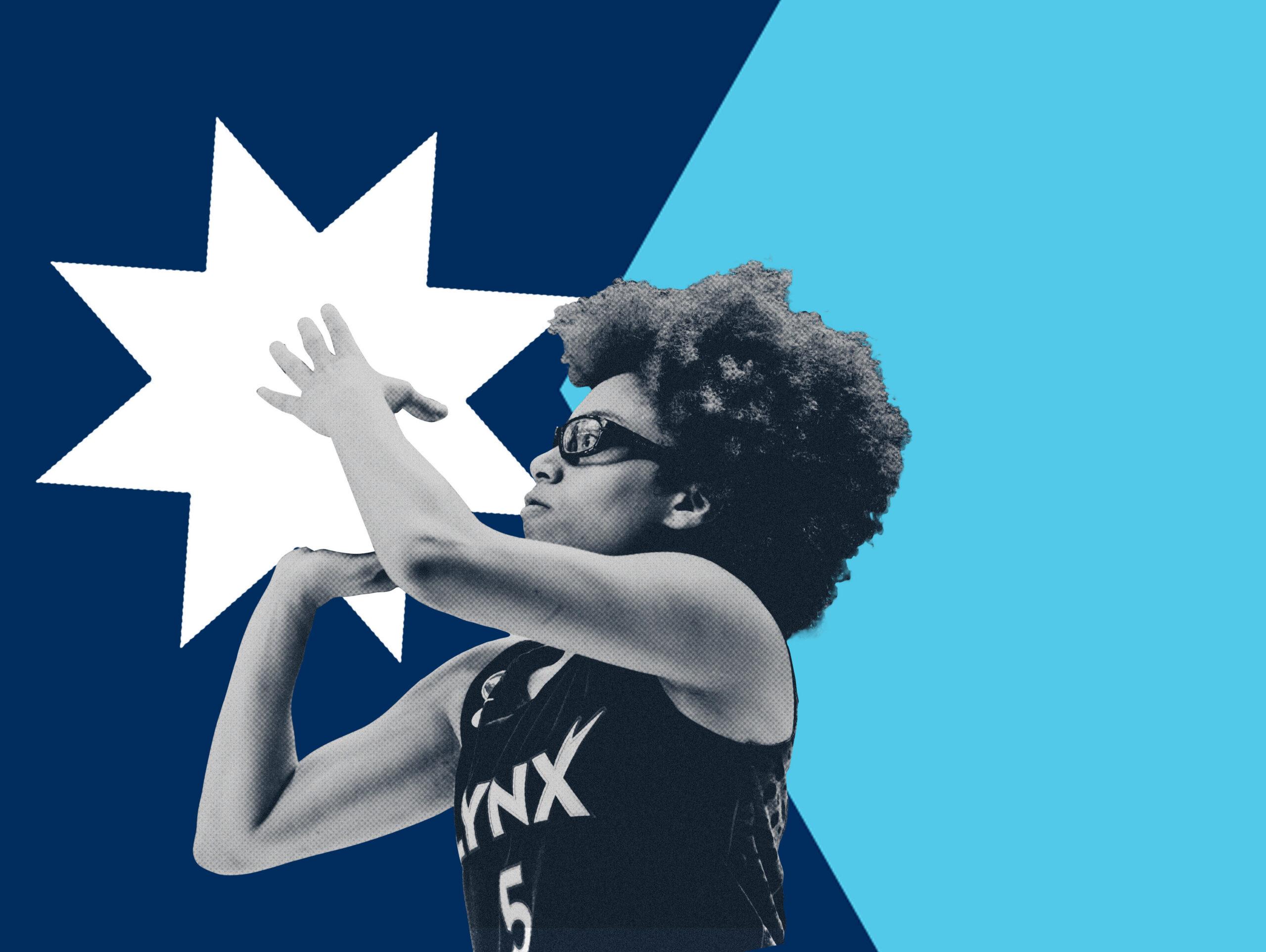

Spectacle (.n)
1. Something exhibited to view as unusual, notable, or entertaining
especially: an eye-catching or dramatic public display
2. Something suggesting a pair of glasses
The exact origin of the nickname is hard to trace. Some ideas just burst from the seams of the universe as a communal epiphany. At the Target Center, where Olivia Miles fires dazzling no-look laser beams and carves out heretofore-unseen passing angles, “the Spectacle” emerged as a feeling in search of a name, a product of the cognitive convergence of attention, delight, and curiosity.
Sloane Martin, the Minnesota Lynx play-by-play broadcaster, was the first announcer to use “the Spectacle” on air, after she saw the nickname on a sign. But it was on the lips of Minnesota fans as early as the WNBA draft in April, when Miles was selected with the no. 2 pick.
When commissioner Cathy Engelbert announced her name, Miles emerged in an oversized suit and trousers, with a wallet chain attached to a carabiner and her natural hair combed into an afro. But her glasses are what made her look like a cross between a 1980s sitcom chemist and Dr. J—or, in other words, unmistakably like Olivia Miles.
In the months since—as Miles has stormed the WNBA and led her team to the top seed in the playoffs—they’ve become something of a signature.
“I tried contacts before,” Miles tells The Ringer on the day before her playoff debut. “But it’s so disorienting when you wear glasses for so long and you see the frame, and then you wear contacts. You’re not used to the way that life looks.”
Her glasses are catching her own reflection a lot these days. Her highlights have piqued the interest of the mainstream sports world, while also making her into a folk hero in Minneapolis. Throughout the city, grown men wear afro wigs, and Miles’s likeness is plastered on everything from lawn signs to crop art. Across the street from the Target Center, an Adidas billboard captures half of Miles’s face and the outline of her afro, cutting off beneath her glasses—all anyone really needs to recognize her—alongside the letters R - O - T - Y.
On Monday, Miles became the WNBA’s sixth unanimous Rookie of the Year winner. She accepted the award in the Target Center in front of her teammates, Lynx personnel, and media members. The Adidas billboard, visible outside the window, made it look like Olivia Miles, the brand, is watching Olivia Miles, the person.


The real Miles, wearing a collared button-up with baggy slacks and loafers, sticks out her tongue while her teammates pantomime taking snapshots of her. Miles recalls the energy at the arena during her preseason debut, the first time she realized her play could inspire something like devotion.
“I didn’t know the Lynx fans were as crazy as they were, in the best way possible,” Miles says. “I didn’t realize I was amping up the crowd. It was a preseason game that meant nothing, but they were still all in it. At that point, I knew the city was special.”
After this brief opportunity for (public) reflection, Miles is whisked away for pictures and a film session. Off the court, she’s no stranger to moving quickly. In the past 16 months, she played on Team USA at the FIBA AmeriCup, transferred from Notre Dame to TCU, led the Horned Frogs to the Elite Eight, and was drafted to the WNBA.
The 2026 season was supposed to be a step back for the Lynx. Star forward Napheesa Collier, who had offseason surgery on both of her ankles, was expected to be out for over half the season. Free agency and the expansion draft led to the departures of Alanna Smith and Bridget Carleton, two starters, as well as key reserve Jessica Shepard. Minnesota’s internal preseason projections, with Miles performing as an average rookie, reportedly had them finishing just inside the playoff picture. But Miles was anything but average, driving Minnesota’s offense prior to Collier’s return and helping the Lynx secure the no. 1 seed.
In the regular season, Miles averaged 19.8 points and six assists on 49.2 percent shooting from the field, 38.8 percent from 3, and 87 percent from the free throw line. She will likely finish top-three in MVP voting. All season, her veteran-esque efficiency, command, and flair while playing the intellectually taxing and complicated role of point guard for Hall of Fame coach Cheryl Reeve has awed analysts, teammates, and fans alike.
Miles’s Instagram followers have quintupled. She launched a collection with Glasses USA called “Trust Your Vision.” Last week, she announced partnerships with GEICO and Adidas. Moments when life, or basketball, happens too fast for Miles, are rare. But her playoff debut, one of the most difficult games of her career, was one of them.
In Game 1 against the Liberty, Miles put up 11 points on 12 shots, turned the ball over four times, and notched just one assist. The Lynx lost, and are now facing elimination in Game 2 on Tuesday night. The learning curve of leading a team to a title is steeper than what she’s faced so far. “There’s a lot that goes with being a really good player,” says Reeve this past week. “Some of it is being targeted and focused on.”
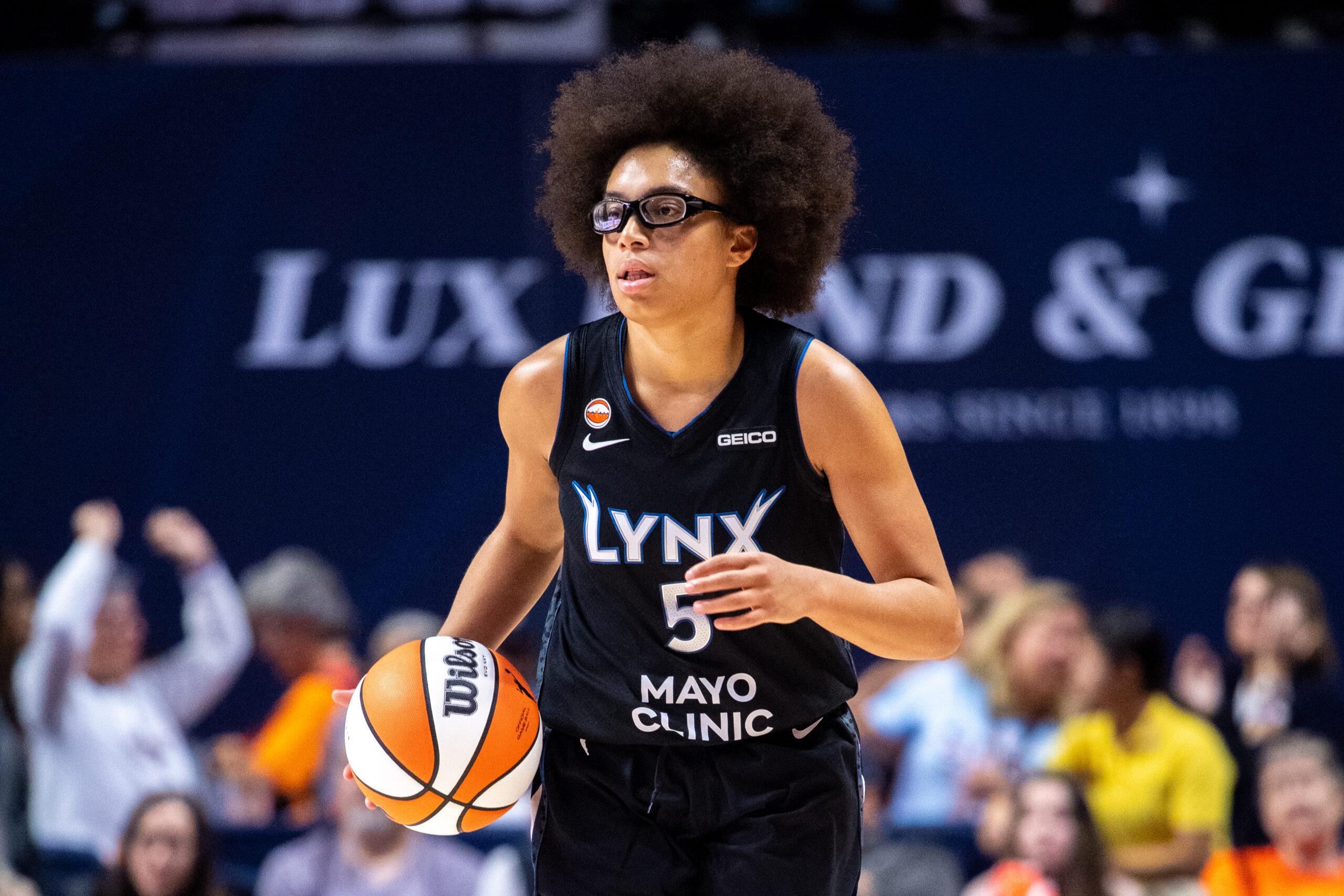
On the court, Miles is fierce and competitive. She drops stepback 3s in opponents’ faces and bursts into bouts of trash-talking, crouching, stomping, and flexing. Off the court, Miles is soft-spoken and thoughtful, with a voice that could narrate a Headspace meditation.
“I think a lot of people kind of just see the competitive, aggressive side of her, which we love and adore,” says teammate Maya Caldwell. “But she can sometimes be the exact opposite.”
That distinction is part of what allows Miles to separate the Spectacle from the person wearing them. “They’re opinionated on that version of me and not this version of me, if that makes sense,” she says. Same goes for when a coach destroys her performance in a film session. They’re critiquing Olivia Miles the basketball player, not the person.
In a conversation after a Lynx practice this week, Miles reflects on the moment that she says prepared her for all of this. In the 2023 ACC title game and the preamble to March Madness, Miles—then at Notre Dame—slipped on a drive and immediately grabbed her knee, repeatedly screaming “Oh, shit” before ripping off her goggles and slamming the hardwood in frustration. Miles, then a junior, had torn her ACL.
Miles had spent the better part of her young athletic career riding the highs and lows of public perception. “Growing up, you’re trained to expect a ‘good job’ and a ‘good game,’” she says. She would agonize over how many points she scored, or whether she was passing the ball enough. “It would actually affect the way that I thought about myself as a person,” she said.
After her injury, she realized she had formed her identity not around who she was, but what she did. “I really just had to sit and heal those parts of myself that gave me so much anxiety, and learn how to validate and help myself and love a new—not a new me—but a new ACL and the new muscles that I’m growing,” she says, gesturing toward her knee.
I think a lot of people kind of just see the competitive, aggressive side of her, which we love and adore. But she can sometimes be the exact opposite.Maya Caldwell
She started working with a mental performance coach. She learned to admire the traits she values most in herself—humility, selflessness, emotional awareness—so much that she stopped needing to perform them to validate her sense of self.
“Just learning to set up boundaries and to say no when it’s appropriate and not feel bad about that, and not feel responsible for someone else’s feelings,” she says.
People-pleasing morphed into attunement, a necessary ingredient for any elite point guard. “I’m not saying I’m perfect,” she says. “But I think I have a pretty good understanding of people around me and what they need.”
It’s what allowed her to recognize the tiny glimmers of not only acceptance, but also encouragement her teammates extended to her. On the first few days of training camp, oohs and aaahs overtook the scrimmages. “That’s when I kinda took the weight off my shoulders and allowed myself to be free.”
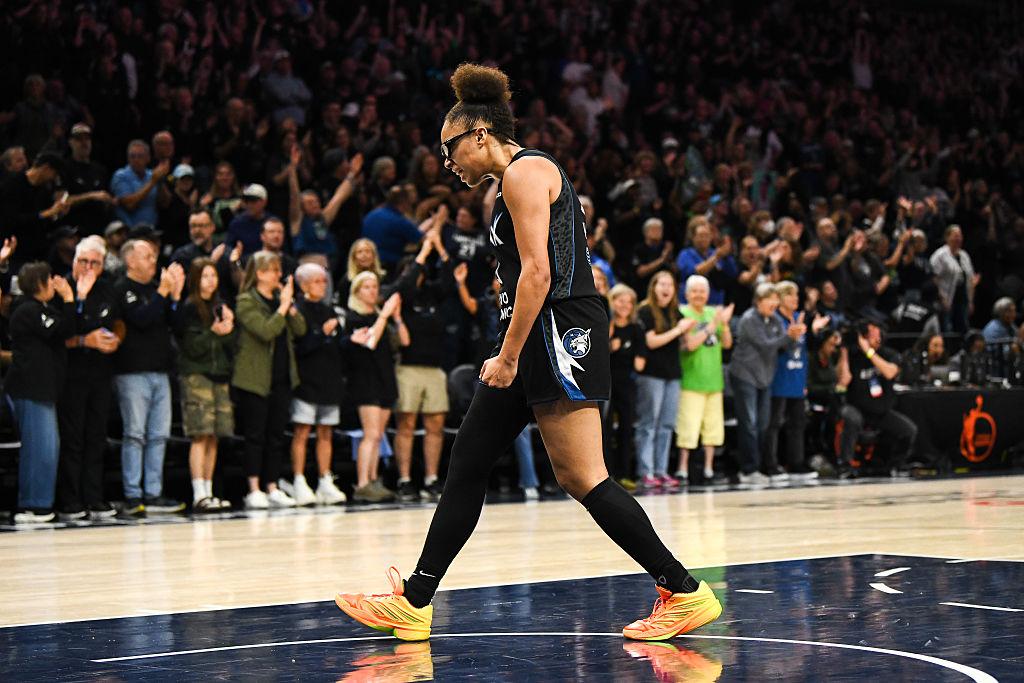
Minneapolis is one of those tight-knit, midsized American cities that often gets described as “quirky.” Minnesotans made a greeting out of Naz Reid, the Timberwolves’ former sixth man. Prince, another afro’ed savant, is revered like he’s still dropping by Fine Line, a local music venue, and telling Oprah he lives in Minnesota instead of Los Angeles because the cold “keeps the bad people out.” People here can organize community around the sharpening of a giant pencil.
Plug Miles into that context, and it’s not surprising what has arisen: a city peppered with symbols of her likeness, on billboards, coffee shop pop-ups, lawns, and, of course, crop art—a beloved type of Minnesotan folk art in which artists spend painstaking hours turning locally grown seeds into intricate mosaics.
Amanda Welliver, a Minnesota Gophers supporter who became a Lynx fan when Minnesota legend Lindsay Whalen joined the coaching staff, had very little knowledge of Miles before the season began. It didn’t take long for her to be inspired to make Miles the subject of her crop art submission at the Minnesota State Fair.
The organizers put Welliver’s portrait next to several others of Miles, who is a perfect subject for the art form. For one, Miles’s distinguishing traits make her recognizable to anyone in the city. And for another, Miles has come to fit Minneapolis’s sense of itself—idiosyncratic, progressive, and proudly quirky—at a time when the city has been starved for joy.
“Minnesota’s been through a lot in the last couple of years,” said Welliver, referring to Operation Metro Surge, in which thousands of ICE agents descended into the region to target Minnesota’s immigrant communities. Two protesters, Renee Nicole Good and Alex Pretti, were killed by ICE agents. Businesses and schools were shuttered. In a city with a demonstrated instinct for turning individual feelings into communal action, residents mobilized quickly, resisting ICE in the streets and dropping off necessary supplies to people who were scared to leave their homes.
“I painted portraits of George Floyd, Renee Good, Alex Pretti. Those things are hard to paint, but I feel like I want to paint them,” says Adam Johnson, a local artist. Lately, he’s been painting Olivia Miles. “The Lynx stuff I want to paint, but it also makes me happy to share and talk about it.”
Welliver adds, “It was really something that I think people are really embracing—the joy of her game and who she is.”
For fans, the Lynx organization’s long history of standing up for social justice initiatives makes the connection less arbitrary. When the community feels pain, members of the Lynx are often there to support them. They know that the play of one 23-year-old basketball player is minuscule compared to the collective psychic toll the past year has taken on Minneapolis; one fan told me they twitch when they hear helicopters overhead, and another still carries a whistle on their keychain to alert citizens to the presence of ICE agents. Yet the idea that Miles represented a reprieve and a symbol of joy was a constant refrain among people I spoke to, and it does explain the intensity of feeling around her, and the desire to inscribe her likeness everywhere: great artists inspire great art, in response to both pain and awe.
Miles, who is just scratching the surface of her potential impact, is grateful for the way the community has embraced her. “When you get people to just have fun and be themselves and just let loose for a night all the stress going on in the world, what people are dealing with with their families, whatever it may be, to get people to just tune out and find joy in a safe space, it is pretty cool,” she says.
She’s a thinker. There’s never a thing that goes by that she just thinks is just insignificant, and at that position, that’s really special.Cheryl Reeve
Here’s the central irony of the moment Miles currently occupies: The qualities that have won the hearts of the public were cultivated by her developing a fierce sense of self and trusting her gut. Now, that very authenticity is getting churned into mass-produced iconography—both by the fans that love her and sponsors that recognize her visual power.
But how does one not get overwhelmed by all of this? How does being turned into a symbol impact how she sees herself?
“Honestly, it’s not up to them,” Miles says. “I think it’s up to me. I see myself, and that’s all I really need. I appreciate everyone who creates versions and identities of me. At the end of the day, I’m just a human. I understand and separate the two. It’s all out of good intentions, so I don’t ever get too wrapped up in it. But I know me. I see me. I love myself.”
When you walk into A Bar of Their Own, a women’s sports bar in Minneapolis, the first thing that greets you is a life-sized cardboard cutout of Billie Jean King. The bar is a shrine to women’s basketball history. Bobbleheads line every shelf. There’s a basketball signed by Pat Summitt, and more memorabilia in the basement, sent from fans all over the country. Jerseys, including a WNBA Finals–worn Whalen jersey, fill the walls. Collier, announcing an Unrivaled tour spot, bartended there last week. Kayla McBride and Cheryl Reeve are regulars.
A little over a week ago, Miles’s parents—Yakubu and Maria—stopped by. They were in town for Minnesota’s final regular-season matchup with the New York Liberty, in the lead-up to Miles breaking the rookie single-season scoring record, previously held by Caitlin Clark. She had already become the fastest player in WNBA history to record 300 points and 100 assists, needing just 18 games—clearing both Clark and Paige Bueckers by one game. She also broke the record for most 3-pointers in a game by a rookie (eight vs. Golden State) and most points in a first half by a rookie (24 vs. Los Angeles).
The only other rookie to ever lead their league’s best team in scoring, in the WNBA or the NBA, has been Larry Bird.
On their way out of A Bar of Their Own, Miles’s parents stopped at a photo stand set up by Johnson, eyeing a print of Miles they’d seen before. They peppered Johnson with questions about his process as an artist. He told them about how he started working on his first painting of Miles after her Lynx debut, and a second after she revealed her afro. That second painting of Miles captures the glint in her eyes, beyond her goggles, as well as the spotlight that reflects off them. After about 10 minutes, the conversation turned to hoops, and of course, to the electric play of the point guard taking the city by storm.
“They just kind of looked at me,” Johnson recalls. “They’re like, ‘That’s our daughter.’ My jaw dropped.”
This right to anonymity, to being private citizens asking questions, and choosing when to reveal themselves, is a privilege their daughter is quickly losing. While Miles’s likeness is all over the bar, the point guard herself has never been. “It’s definitely something that I want to prioritize and make sure I go into that space because it’s really cool,” she says. “I just have to go in the right situation and have people there to manage everything because it can be a lot for me. I just want to make sure I’m safe.”
Prior to the beginning of the playoffs, Reeve met with her budding young point guard to discuss the postseason. Miles, in her typically inquisitive fashion, peppered Reeve with questions. “She’s a thinker,” Reeve says. “There’s never a thing that goes by that she just thinks is just insignificant, and at that position, that’s really special.”
Reeve, the winningest coach in WNBA history, regaled Miles with tales of past series to hammer home her point that the postseason would not be easy.
After Game 1, Miles, who had a charmed and relatively frictionless rookie season, can attest to that. She had one of her worst games as a pro in the 91-75 loss. She is now facing her first real moment of WNBA adversity, down 0-1 and going on the road for an elimination game in just her second playoff game ever.
While warming up for Game 1, Miles admitted to assistant coach Rebekkah Brunson that she was nervous, which might be why the Liberty’s simplified game plan—normally a blessing for a point guard who prides herself on making complex reads against multiple defenders—worked so well. New York sped her up, picking her up full court, pressuring the ball, and offering the illusion of a runway to the rim only to funnel Miles into the towering Jonquel Jones and Han Xu. She got blocked at the rim multiple times, and fired off rushed midrange jumpers before getting her feet set.
Reeve has taken pains to guide Miles’s greatness without getting in the way. “Sharing information,” Reeve says, “and then letting her put her stamp on it.”
Miles’s exponential rise, ironically, has been fueled by her ability to slow down, break concepts into their component parts, and ask questions until everything makes sense. At her best, she has a way of freezing time on the court, so she can see the whole floor—what happened and what is going to happen—before making a split-second decision.
If Minnesota survives Game 2, the velocity with which life approaches her—from the defenders encroaching on her space to the magnitude of the eyeballs tantalized by her—will only increase. She can’t slow any of that down. But she can keep playing at her own pace, even as the world around her moves faster.