
The NBA’s Missing State
Vermont is the only state that has never produced an NBA player, but its basketball culture is alive and … well, it’s aliveThe NBA’s Missing State
Vermont is the only state that has never produced an NBA player, but its basketball culture is alive and … well, it’s alive
Steve Pratt laughed. Cackled, really.
Pratt is a longtime basketball trainer and skills coach who’s worked with the likes of Elton Brand, Jon Scheyer, Brad Miller, Jewell Loyd, Matas Buzelis, and Terrence Shannon Jr. over the years. He’s a self-described “kid from fucking rural Vermont” who came to the game in college only after he realized he wouldn’t make it as a football player.
He got cut from the Johnson State College hoops team as a freshman, but the coach allowed him to hang around and work out with the squad anyway because it was clear he loved the game. He would do anything to be around basketball.
“We didn’t have a pickup game on Saturday morning, so I hitchhiked up to Rutland because I knew guys got together and played there,” Pratt says.
After making the team at Johnson State as a sophomore, Pratt worked his way into the starting lineup. And post-graduation, he got into coaching—winning a state title with Hazen Union High School in 1996—and then skill development, starting Full Package Athletics outside Chicago in 2000. “I’m like a weird story where I was able to kind of develop pro development skills in Vermont … [because] I was aggressively pursuing and learning the craft.”
Oh, right: The reason Pratt practically squealed with amusement? This question: “Is Vermont just not a place the NBA turns its attention to?”
Five seconds of laughter later, Pratt responded: “Are you being serious? Are you asking me a serious question?”
Alaska has two. Hawaii has two. And the Dakotas could combine for a full game of five-on-five with a solid bench.
Heck, Estonia, Mali, and Tanzania have each produced more NBA players than the Green Mountain State. In fact, Vermont is the only state that has never had a native in the Association.
One of these kids makes it, he’s going to have an entire state rallying behind him.Will Voigt
The closest the state has come in the past quarter century is Taylor Coppenrath, who, after starring at the University of Vermont (where he tied the record for most consecutive America East MVP awards set by Reggie Lewis) from 2001-02 to 2004-05, went undrafted, played in summer league for the Celtics and Pacers … and never cracked a regular-season roster. To find the last time a Vermonter was drafted, you have to go way back, to the age of short shorts and long drafts.
It was the ’80s. A decade that started with an NBA draft that was a mammoth 10 rounds and ended with a draft that was much slimmer, featuring the two rounds we recognize today. With so many picks to go around, teams could afford to take a flier on a slim, 6-foot-2 scorer like Holy Cross star Jim McCaffrey. And the Phoenix Suns decided to do just that in the sixth round of the 1986 draft, taking the Rutland, Vermont, lad with their eighth pick. Not the eighth pick; their eighth pick, and the 123rd overall pick of the draft.
McCaffrey faced an uphill climb to a roster spot, in other words. And though the Rutland Herald reported that he outshot the other rookie guards in camp, finishing 16-for-24 from the field, he got cut. (One of the guards the Suns kept over him? A second-rounder named Jeff Hornacek.)
“When they cut me, they said they had obligations and interests in players who maybe didn’t play as well,” McCaffrey told the paper in July 1986. “I told them that’s probably why they’re 30-60.” (In fairness to the Suns, they went 32-50 in ’85-86.)
After he was cut by Phoenix, McCaffrey snagged a spot in a rookie tryout camp with the Celtics. He figured playing college ball in nearby Worcester had helped him land a shot with Boston and vowed, “I’m going to keep trying out ’til I make it. Someone, somewhere, is going to have to take me.”
About that … McCaffrey didn’t make the cut in Boston, though he was briefly teammates with Larry Bird … kind of. In 1987, the two appeared together in a Nestle Crunch commercial. McCaffrey played a janitor whose loud chocolate bar crunching in the empty arena keeps causing Bird to miss shots. After tossing a bar to Bird, McCaffrey unleashes some nifty ballhandling moves before letting one fly.
Then Bird’s loud crunch causes McCaffrey to miss his shot, too. He never got another.
Before Cooper Flagg went first in the 2025 draft, the longest statewide drought between draftees belonged to Maine, which hadn’t seen a native son selected for 41 years (since Jeff Turner went to the Nets in 1984), according to NBA draft historian Matthew Maurer. After that streak ended, the (dubious) honor simply hopped a couple of mountain ranges and skipped a couple of borders over to Vermont.
While Vermont may not have produced an NBA player to date, it’d be wrong to say there’s no athletic talent in the state. Vermonters have played in the three other major American professional leagues, dotting NHL rosters (St. Albans’s John LeClair played in five All-Star Games during his 16-year career), dashing around MLB fields (Middlebury’s Ray Fisher pitched for 10 seasons in the bigs, then coached Michigan’s men’s baseball team for 38 years), and gamboling on NFL grass (Rutland’s Steve Wisniewski played 13 years in the NFL, making eight Pro Bowls and two All-Pro teams). They’ve hit the links (Keegan Bradley’s from Woodstock and owns eight PGA Tour wins) and the racetrack (Kevin Lepage is from Shelburne and raced in NASCAR’s Winston Cup). There’s even been a Vermonter in the WNBA: Nicole Levesque (Shaftsbury) played 27 games for the Charlotte Sting in the W’s inaugural season in 1997.
Oh, and they’ve been all over Team USA rosters at the Winter Olympics—in the 2026 event in Italy, Ben Ogden (Landgrove) won the first U.S. men’s cross-country skiing medal in 50 years (then added a second later in the Games), and Ryan Cochran-Siegle (Starksboro) won a silver medal in super-G, 54 years after his mom, Barbara, won gold in Sapporo.
The NBA drought continues, though, and 40 years after the 1986 NBA draft, McCaffrey is still the most recent Vermonter to be selected. And like a winding mountain road in winter, the end is not necessarily in sight.
To date, Vermont’s high-water mark in the NBA came in February 2025, when its first native logged a few minutes on the hardwood.
I refer, of course, to Noah Kahan, proud Vermonter and famous “Stick Season” musician, who suited up for the celebrity game at All-Star Weekend.
Kahan’s wry Vermont sense of humor comes through in the Instagram caption he wrote after the event:
bucket (noun)
a roughly cylindrical open container, typically made of metal or plastic, with a handle, used to hold and carry liquids or other materialExample “a bucket and spade”
Or “noah kahan is a walking bucket”
He scored two points. (One-time New Englander and noted blogger Luke Kornet was probably not impressed.)
Kahan broke into the mainstream with a song about life in Vermont, so it’s not surprising that he talks a lot about the state on his 2026 album, The Great Divide. And while it’s not explicitly about the future of basketball in the Green Mountains, this lyric from “Doors” might as well be:
You’re putting money on red
I’m a sure bet at a losing streak.
I keep showing you doors, but you can’t open them up.
’Cause it gets harder to see me the closer you try to look.
In an interview with Katie Nolan ahead of the release of his album, Kahan joked about his appearance at the celebrity game. “I didn’t play basketball growing up, as you could see if you watched the game,” he quipped.
“I was unbelievable in the practice round the night before. I had literally a Like Mike moment where I just started being really good at basketball. But … Barry Bonds [was the coach] the next day, and he hadn’t seen me. And so he saw me in the warm-up line, and he was like, ‘Oh, hell no. You’re not going in. You suck.’”
Like many Vermonters, Kahan rooted for most of the Boston teams—the Red Sox, Bruins, and Celtics—growing up, though mostly from afar. The drive down to Boston from his hometown of Strafford, Vermont, takes two and a half hours without traffic, so the Kahans didn’t attend many games in person. He played soccer as a kid—he told Nolan he’s a big Chelsea fan—and loves golf.
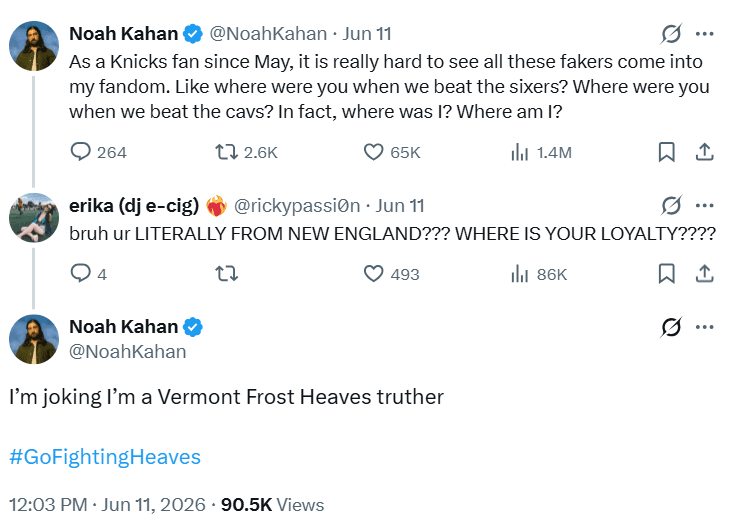
When the Knicks won their first title in 53 years in June, Kahan caused a minor stir on X by joking about his fandom:
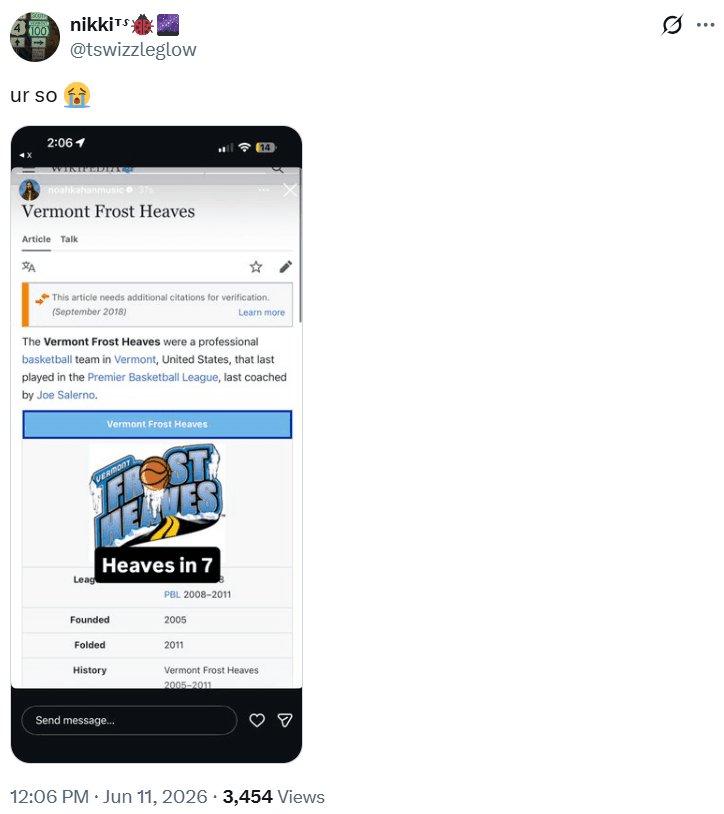
Really, though, it was just another chance to rep a Vermont basketball success story:
Why have Vermonters been such a bad bet to make it in the NBA? To paraphrase the old saw about what wins elections, “It’s the demographics, stupid.”
As of the 2024 census, Vermont had the second-smallest population (648,493) in the country, ahead of only Wyoming (587,618, with a claim to eight NBA players in its history and the fifth-longest drought between draft picks). For reference, the city of Boston—the 25th-most populous city in the country, according to Data Commons—has more residents (672,973) than the entire state of Vermont.
“I don’t know what the demographics of the state are today,” said Will Voigt, a Cabot native and the associate head coach at Boise State, “but if you look at the demographics of the NBA, I guarantee you that the makeup of Vermont is probably the opposite of those.”
Vermont was 89 percent white in 2024, according to Census Reporter. That’s the highest figure in the country. In the 2022-23 season, the NBA was 82.5 percent people of color, according to a study by the Institute for Diversity and Ethics in Sports at the University of Central Florida.
Vermont is also, as anyone from there will tell you, very rural. It’s made up of small towns, often spread out, and sometimes separated by literal mountains. People there tend to develop tight bonds in their small communities and sometimes seem disinclined to leave them.
“When I was growing up, there was no prep school or whatever it might be where you’re like, … ‘I’m better than the competition in the state, so let me go to this private school,’” Voigt said. “It’s not in our mindset. You wouldn’t even think of leaving your local school for a better school.”
Longtime Sports Illustrated writer Alexander Wolff, who’s authored multiple books on basketball, moved to Vermont years ago and has become something of an authority on the sport in the state.
“Burlington has a very suburban quality to it,” Wolff said of Vermont’s largest city. “That’s not exactly the EYBL. It’s not a proving ground for the next generation of D-I athletes.”
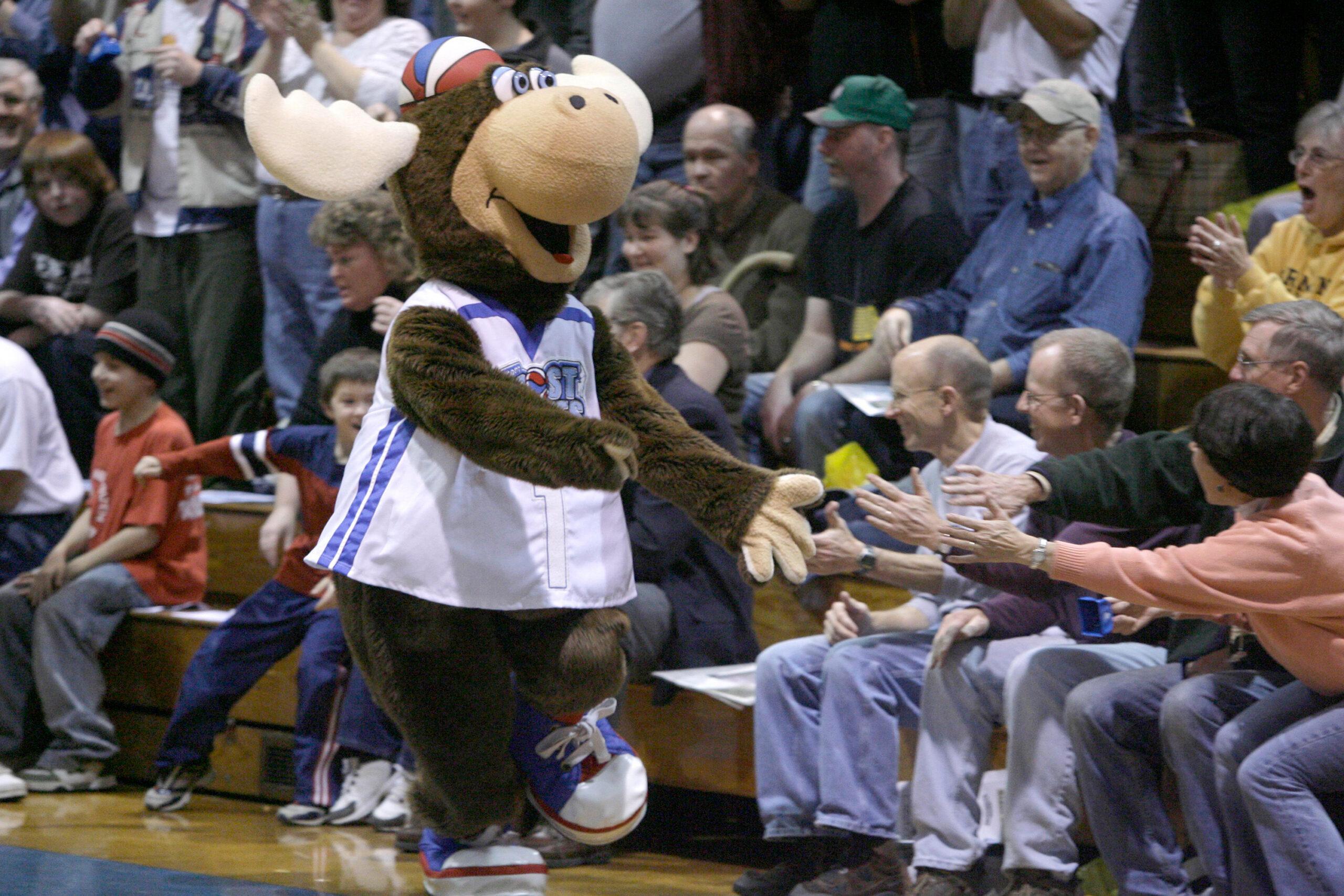
But Wolff saw a clear love for the game, in packed high school gyms and in the ability of both the men’s and women’s teams at the University of Vermont to draw crowds to their home games at Patrick Gymnasium. So Wolff and his wife, Vanessa, cofounded a professional basketball team there in 2005. The Vermont Frost Heaves—named for an all-too-common occurrence in the Green Mountain State, where the freeze-thaw-freeze cycle causes soil to expand upward, cracking pavement and leaving bumps on all manner of byways—were made up of guys who played at small Division I or Division II schools or in lower-level European leagues and a few local strivers. They drew enthusiastic, vociferous crowds—their idea to hand out cowbells, as an ode to the state’s dairy roots and as a way to amp up the in-arena noise, worked almost too well—and won back-to-back championships in their first two seasons in the American Basketball Association with Voigt as their head coach.
“I’d love to sit here and tell you that the Frost Heaves touched off this great grassroots flowering that led to Division I rosters being stocked with people who were inspired by John Bryant and Aaron Cook and guys you’ve never heard of who were stars for us, but that’s not what happened,” Wolff said. “We’re simply the answer to the trivia question: ‘Which team besides the Indiana Pacers won back-to-back ABA titles?’ We’ll go to our grave with that distinction.”
The Frost Heaves’ ABA was plagued by financial issues and featured multiple teams that started seasons they never finished. And when the Great Recession hit in 2007, the already daunting task of raising enough cash to pay the players and coaches, rent an arena, and cover travel and lodging became too much for the Frost Heaves, and the team folded in 2011. But during their brief existence, the Frost Heaves performed for big crowds, thanks to the locals’ passion for the game and the tireless work of Wolff, the players and coaches, and the team’s moose mascot, Bump. (Frost Heaves, Bump, get it?)
Wolff says the team won because of Voigt’s coaching and because it imported most of its talent. It was too hard to find natives who had enough juice to play big minutes.
On our running list of reasons Vermont is NBA-player-less, add to demographics a lack of infrastructure—both in facilities and in abilities.
Aaron Hill is the athletic director at Hazen Union School in Hardwick, and the longtime boys’ basketball coach there. He’s led the Wildcats to six Division III state championships and four runner-up finishes. One way he’s done that?
“We keep the gym open almost all the time, and kids live in it,” Hill said, “because there’s nowhere else to play.”
Basketball courts aren’t exactly plentiful in the state, according to Hill, mostly limited to high school gyms and a couple of community centers in places like Burlington. You might find a run on an outdoor court, but only if you’re lucky with both geography and meteorology.
The high school basketball season is also shorter (20 games) in Vermont than it is in many other places, and until recently coaches weren’t even allowed to work with players out of season. And the AAU scene that might have filled that gap doesn’t exist at a high level in Vermont.
“A lot of these kids don’t have access to high-level coaching or coaching with individual development in mind,” Hill said. “Mainly everybody’s focused on winning the state tournament or putting out the best team they can.”
Where does that leave a basketball-loving kid who craves competition and has a decent amount of skill? Looking outside the state, to AAU programs in upstate New York or in Massachusetts, perhaps, or to prep schools like Montverde Academy, the one Flagg attended in Florida.
“I’m just doing the simple math of development,” Pratt said. “You need pressure, right? You need to feel pressure. You need to play at a high level. You need to have teammates that play at a high level.”
To really give kids a chance at the next level, Hill says, there would need to be structural change in Vermont. More focus on individual development, and less on team cohesion aimed at making the state tourney in the Barre Auditorium, or the Aud, as locals call it (the same historic gym Wolff’s Frost Heaves played half their home games in).
A lot of these kids don’t have access to high-level coaching or coaching with individual development in mind. Mainly everybody’s focused on winning the state tournament or putting out the best team they can.Aaron Hill
Where that change might come from is unclear. Messages The Ringer left with the office of longtime Vermont Senator Bernie Sanders went unanswered. (The senator is a hoops fan but may have other things on his plate.)
“Our kids all talk about it,” Hill said of making it to the NBA. “And what an amazing feat it would be to be the first Vermonter to do so.”
More than one person interviewed for this story pointed to Taylor Bol Bowen, a 6-foot-10, 202-pound forward who just transferred from Alabama to Oregon for his senior year, as the best bet to break through. Bowen, who was born in a South Sudanese refugee camp in Egypt and moved to Jericho, Vermont, where he was adopted as a 2-year-old, averaged 6.3 points and 4.2 rebounds in 19 minutes a game for the Crimson Tide in 2025-26.
Though he lists Jericho as his hometown, Bowen played most of his high school ball in Rhode Island (at St. George’s School) and New Hampshire (Brewster Academy) and got AAU reps with Expressions Basketball, a Nike EYBL program based in Boston. He played his first two seasons of college ball at Florida State before trading Tallahassee for Tuscaloosa, and then trading Tuscaloosa for Eugene. In short, Bowen’s been on a journey—one he hopes will end in the NBA.
“If you’ve got it and you’re a competitive person, it’s in front of you now,” Pratt said. “All you got to do is work for it. The problem is getting people to work for it consistently and just stay after it.”
And when someone eventually breaks through to the NBA? Well, the state will take notice.
“There’s a sense of pride for one of their own,” Voigt says of the drive to be the first. “One of these kids makes it, he’s going to have an entire state rallying behind him.”
The door is there, waiting for the right person to open it up.