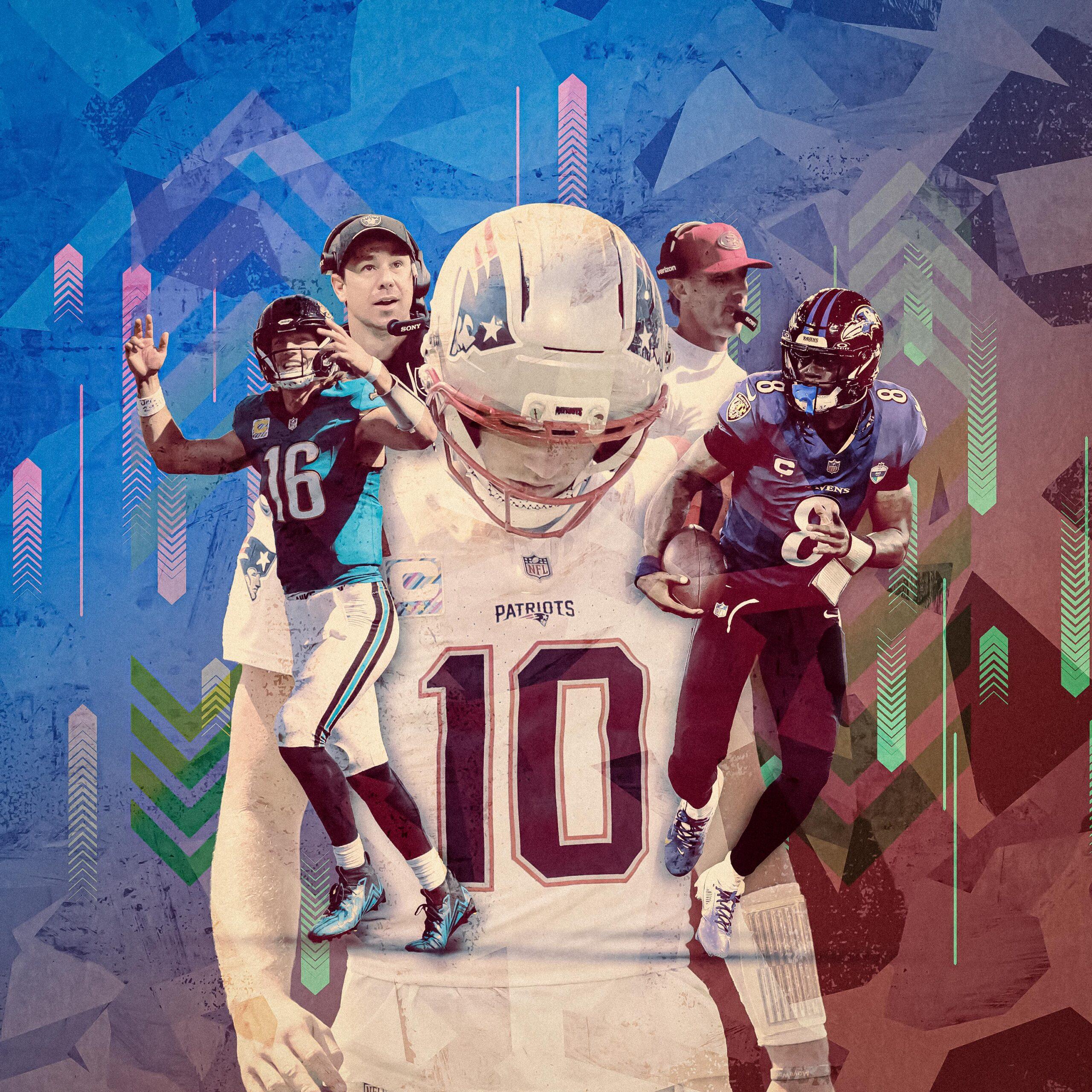

Every week this NFL season, we will break down the highs and lows—and everything in between—from the most recent slate of pro football. This week, Drake Maye looked toast, Trevor Lawrence looked like a potential MVP, and the 49ers suffered even more devastating injuries. Welcome to Winners and Losers.
Winner: Sunday Night Football’s Wild Ending
Sunday night’s matchup between the Broncos and Rams was a mile high, that’s for sure. The second half of Denver’s 30-26 win was the most overstimulating chunk of football of the young season, and I had to rewind a handful of times in the fourth quarter to make sure I was actually witnessing the wild swings between the two teams.
At the start of the fourth quarter, after scoring 16 unanswered points to tie the game, Denver was staging a drive to finally go ahead. Then, quarterback Bo Nix threw one of the worst interceptions of the weekend to cornerback Josh Wallace. The throw was altered by pressure from defensive tackle Kobie Turner, but it’s still a hilarious play to rewatch—as the camera pans out after the throw, you see that absolutely nobody is open for the Broncos, making the throw indefensible in any context.
And when it comes to inexplicable, poorly-timed interceptions, reigning MVP Matthew Stafford is always good for a few per year. With just under five minutes to go in the fourth, Stafford panicked against a Broncos blitz and left the ball hanging inside for safety Talanoa Hufanga to pick off and run back for a 66-yard go-ahead touchdown. That gave Denver a 23-19 lead. Stafford was mostly excellent on Sunday, finishing with 390 yards and a pair of touchdowns, but he had been close to giving up the ball all night, and Hufanga was hunting for an opportunity.
After Hufanga’s pick-six, Stafford instantly locked back in and zipped downfield with the Rams offense, completing three straight passes spanning 77 yards to score and snatch the game back. Then … a bunch of shit just started happening. An easy completion from Nix to receiver Pat Bryant turned second-and-20 into a 39-yard-gain, and a wide-open completion to receiver Troy Franklin got Denver into the red zone. That led to the game-swinging play, an unabashed flop from Bryant that turned what would’ve been a game-sealing interception from Nix—on a throw just as bad as his earlier turnover—into a defensive pass interference call. That gave Denver a new set of downs inside the 10-yard line and they eventually turned that into a game-winning score.
This isn’t me being a defensive-minded shill and railing against soft receivers, either. Bryant might as well have turned in his Broncos jersey for a Nuggets one, because he deployed his best basketball flop to get this call. His fall (and tug of Wallace’s) jersey was so egregious it’s actually what put Wallace in position to intercept the ball! The NFL’s use of replay assist has made many things in the game more efficient and true to what actually happened on each play, but I always feel a little hollow when obvious plays like this can’t be corrected upon review.
The missed call sucked, but the second half was incredible. I don’t even know if we learned anything about either team from the result, but who cares! The game went from boring to close to off the rails in the span of a few possessions. This is what makes staring at our screens through bleary eyes worth it. —Diante Lee
Loser: The Drake Maye Panic Meter
“This was a bad choice.”
CBS analyst Adam Archuleta’s evaluation of Maye’s goal-line interception just before halftime against the Jaguars sums up the young quarterback’s season thus far. After throwing two picks and losing a fumble (he recovered a second) in Jacksonville on Sunday, Maye has committed an NFL-leading seven turnovers through three games and is causing major worry in New England.
“My concern level is very high for this football team,” head coach Mike Vrabel said following the 35-6 Jaguars rout.
The goal-line pick, thrown recklessly to slot receiver Efton Chism III, who was closely covered by Jaguars cornerback Travis Hunter, was Maye’s worst play of the day and made the game feel over for the Patriots. He threw another interception in the third quarter, on an attempted back-shoulder pass to receiver Kyle Williams. The fumble was in the first quarter. As Maye dropped back to pass, the ball flew out of his hand and landed in front of Jaguars defensive tackle DaVon Hamilton, who jumped on it. After the game, Maye said that the ball was slippery because center Jared Wilson had bled on it.
Maye’s turnover and decision-making problems date back to last year. In seven games from the beginning of last season’s playoffs to now, he’s turned the ball over 15 times.
He looks panicky and hesitant when deciding where to go with the ball. And his issues seem more mental than physical. Still, he’s danced around the question of whether the shoulder injury he played through last postseason is completely healed.
Maye’s age (24), talent, and importance to the Patriots franchise mean he’d have to continue much further down this worrisome path before his job is seriously questioned. New England seemed like a regression candidate heading into this season after facing a soft schedule on its run to the Super Bowl last year, and injuries have been a significant factor in its struggles this year. Still, I don’t think many in New England expected to be heading to Buffalo next week with the season feeling genuinely on the ropes—or for the team’s biggest problem to be QB1. —Nora Princiotti
Winner: Trevor Lawrence
Trevor Lawrence’s strong performances don’t need qualifiers or context anymore. He’s just really good again.
In Sunday’s 35-6 win over the Patriots, Lawrence looked like the best player on the field in a game where he completed less than 20 passes for just 182 yards. He finished with three touchdowns, and would’ve had four if he hadn’t kneeled at the 1-yard line to keep the clock running instead of taking a walk-in touchdown run. Lawrence did his best work inside the red zone this week, with all three scores coming in the area—and he whizzed each touchdown pass into closing windows.
Lawrence has a 118.9 passer rating on throws in the red zone this year, with five touchdown passes, no interceptions, and just one sack. He’s been decisive, he’s operating within the system, and he’s putting his arm talent on full display with tight-window throws like this one to receiver Jakobi Meyers.
Lawrence and the Jaguars are 10-1 in their last 11 regular-season games, stretching back to last November. This offense has been a buzz saw throughout that stretch, and it took full advantage of short fields and extra possessions on Sunday thanks to New England’s bad offensive outing. With so much of the league feeling unpredictable on a week-to-week basis, I’m pretty certain about Lawrence and this passing game, especially when Jacksonville is in the red zone. —Lee
Winner: Lamar Jackson
Lamar Jackson is already in MVP form, leading the Ravens to a 34-31 win over the Cowboys in Rio on Sunday afternoon. Baltimore can wash off the stink from last week’s disappointing loss to the Saints thanks to Jackson’s clutch fourth-quarter play, where the quarterback completed six of seven passes for 72 yards and a score. Between Jackson’s end-of-game performance and the back-and-forth nature of Baltimore’s and Dallas’s matchup, it’s best to work backwards through the Ravens win.
The game’s most important play was its penultimate snap, a 26-yard connection between Jackson and receiver Zay Flowers that set up a walk-off field goal from kicker Tyler Loop. While I can’t yet explain why Baltimore’s best receiver was open at the end of the game—but stay tuned for this week’s “Ball Knower’s Notebook” on Tuesday—Jackson somehow managed to get the ball to him with the right balance of velocity and touch to make for an easy completion with one second remaining on the clock.
Jackson’s best throw of the game was the completion to Flowers, but his best drive came earlier in the fourth quarter to give the Ravens a 31-28 lead. Baltimore went 64 yards on 11 plays thanks to a 17-yard scramble and several completions from Jackson to a variety of receivers. And with Flowers back in the lineup after missing Week 2 with a hamstring injury, offensive coordinator Declan Doyle had his best playmaker and a comfortable option for Jackson to target in key situations. Flowers’s 84 yards came on just six targets Sunday, and he’s now up to 234 yards on just 12 targets this year.
Over these first three weeks of the season, Jackson has put to bed any questions about whether he’d bounce back following a disappointing (and injury-filled) 2025 campaign. But we aren’t quite there yet with Baltimore’s defense, which is still struggling to put games away when they have leads in the second half. With just under four minutes remaining in the third quarter, the Ravens were up 24-13 and clearly looked like the better team. Then the Cowboys put up 18 points and 227 yards of offense to tie things at 31. By the time we got to the questionable defensive pass interference call on cornerback Nate Wiggins, I was sure the Ravens were in for another blown lead and unlucky loss for Jackson. The fact that Baltimore escaped with this win means they’re tied with the rest of the AFC North at 2-1, and their 92 points makes them a top-five scoring offense in the league. Winning with offense is the Ravens’ way in the Jackson era, but he’ll need his defense to get better at closing out games if they plan to be more than a dominant regular-season team. —Lee
Loser: The 49ers’ Injury Report
Some things are working in the 49ers’ favor—namely that they’re 3-0 and sitting alone atop the competitive NFC West. But there are also things that threaten to derail everything.
The 49ers beat the Cardinals 36-30 on Sunday in a game that never truly felt as close as that final score would indicate. But the 49ers saw two important offensive starters leave the game with injuries, adding to the team’s ever-growing list of health issues. The newest additions to the injury report are 33-year-old receiver Mike Evans, who suffered a rib injury in the second quarter, and 38-year-old left tackle Trent Williams, who was driven to the locker room on a cart after suffering a stinger in the third quarter. Williams eventually returned to the sideline, but he did not return to the game. Linebacker Dre Greenlaw was also in and out of the game in the fourth quarter after injuring his quadriceps. And all of this came just hours after edge rusher Nick Bosa was ruled inactive because of a calf injury he suffered earlier in the week in practice.
Here’s where the math gets tricky. While it’s too soon to know the extent of the 49ers’ newest injuries, the team is running out of options for how to handle players who might need a few weeks off. ESPN’s Adam Schefter reported on Friday that the 49ers were “leaning against” putting Bosa on injured reserve because they were “running out of spots.” There’s no limit to how many players can go on IR, but teams are allowed to designate only eight players to return from IR in a single season. San Francisco has 16 total players currently on IR and has reportedly already assigned those eight spots:
Three injured players were on the 49ers’ inactive list for Sunday, and that number could grow in the coming weeks depending on how quickly Evans, Williams, and others heal. This could put even more strain on the Niners’ depth, which has already been tested.
The good news, of course, is that no one in the league is better equipped to coach his way out of injury issues than Kyle Shanahan, particularly if quarterback Brock Purdy continues to play at an elite level. Purdy threw four touchdowns and no interceptions against the Cardinals on Sunday, and he had the best expected points added per dropback of any quarterback in Week 3—by far. —Lindsay Jones
Winner: The Sloppy Buffalo Bills
There were at least five reasons the Bills should have lost to the Chargers on Sunday.
Reason one:
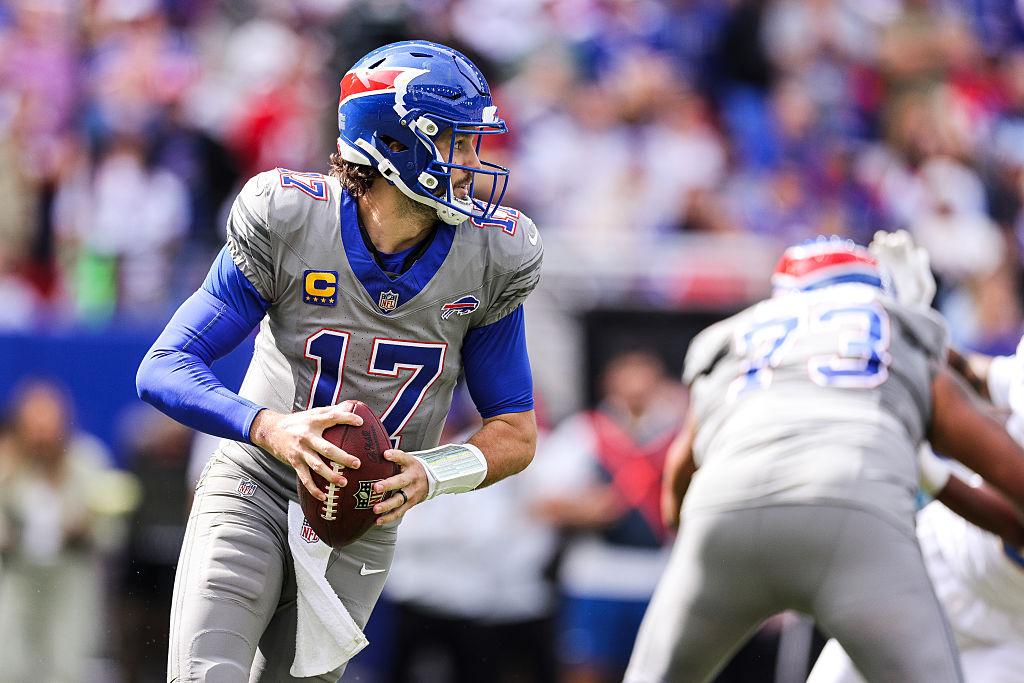
These alternate “Nickel City” uniforms have been widely panned since they were unveiled in July, but after seeing them in action, I’m afraid we were not mean enough. These uniforms are atrocious. Some real UFL bullshit. Last year, The Ringer proved—using math and our own damn eyeballs—that the “look good, play good” theory is real. So of course the Bills were going to play like absolute garbage in this bland AF getup.
Reasons two through five:
This James Cook fumble, on the Bills’ first offensive play of the game:
This Josh Allen interception:
This second Allen interception, hauled in by Genesis Smith (arguably the best pick of the season):
And this Dalton Kincaid fumble at the end of a long catch-and-run:
(There was also this Allen fumble, but it sort of feels like we’re just piling on at this point.)
The Bills committed five turnovers in an uncharacteristically sloppy performance for an offense that didn’t lose a fumble or throw an interception across the first two weeks of the season. The Bills defense forced one turnover of its own, but that still put the Bills at a minus-4 turnover margin on the day. And yet! Buffalo won 24-16, pulling away from the Chargers via a 14-point fourth-quarter.
Ultimately, this result tells us a lot more about the Chargers than it does about the Bills. Buffalo has a superhero quarterback who gives the team a massive margin for error—particularly when the opponent just keeps finding new and increasingly embarrassing ways to lose. On Sunday, the Chargers became just the third team in the past 10 seasons to lose a regular-season game in which they won the turnover battle by four. (We also must note that the Chargers hold the inglorious distinction of being the only team this century to lose a playoff game with a turnover margin of plus-5. This type of thing is just in their DNA.)
At 0-3, the Chargers have been the biggest loser of the season so far. They lost home games to the Cardinals and Raiders, two of the worst teams in the league last season, and when they had a chance to put a good Buffalo team on the ropes, they folded. Despite their incredible turnover luck, the Chargers managed only 10 points off all of those Buffalo mistakes. The offense continues to be disjointed—particularly the deep passing game—and messy. Los Angeles committed five offensive penalties in the third quarter alone, including two false starts that ultimately turned a second-and-goal at the 1-yard line into a third-and-11. (Justin Herbert’s third-down pass was completed for just 8 yards, and the Chargers kicked a field goal.) Their 18 total offensive penalties are tied for the league lead through three weeks.
At some point, the Chargers have to admit this is more than just “growing pains.” This is an entire system failure. And when you can’t beat a team that’s turned it over five times—a team that’s also wearing the ugliest uniforms in recent NFL history—something has to change. —Jones
Losers: Baker Mayfield and the Buccaneers
For most of Sunday’s late-afternoon contest between Minnesota and Tampa Bay, neither team seemed like it was really capable of winning. Moving the ball looked impossible: Both offenses finished with more drives than first downs. And in one sequence in the late third quarter and early fourth quarter, the teams combined for eight consecutive drives without a first. The two offenses were in such hell that they combined to convert on four of 32 third-down attempts.
The Vikings’ two touchdowns came on a punt return and a single deep pass that receiver Jordan Addison beautifully adjusted to while the ball was in midair. I feel bad for anyone who paid too much attention to this game while the other three in the same window were full of drama, scoring, and explosive plays. This was largely an unmemorable football game.
That is, until Mayfield went down late in the fourth quarter, the Vikings squeaked out a 23-16 win, and this game suddenly became extremely meaningful. As the Packers and Bears go through their respective crises in the NFC North, Minnesota is now 3-0, with two division wins and three conference wins. The Vikings will not continue to win football games if they keep failing this miserably on offense, but Brian Flores’s defensive master classes continue to buy Kevin O’Connell time to figure it out.
Mayfield left the game with a dislocated right thumb and questions about what kind of injury timeline he may now be on. X-rays did not show a fracture, according to head coach Todd Bowles, but Mayfield will undergo an MRI on Monday. And Bowles, for his part, has now failed to cover the spread in an absurd 12 straight games. His teams are 2-10 in that time frame, and even on a day when the defense finally played well, Tampa Bay lived behind the chains. The Bucs’ average third-down distance was 10.4 yards, and they rank inside the bottom five in the NFL in early-down success rate. All of the metrics are trending downward.
As I wrote in this column last week, you’re never actually out of the NFC South race. The three teams in the division that played on Sunday all lost, and the Falcons, Panthers, and Saints are all tied atop the South at 1-2. But with each game that the Buccaneers offense fails to execute, it becomes more evident that a forgiving division may not be enough to save them.
Tampa Bay had every opportunity to steal a game in which Minnesota’s offense barely functioned. Instead, the Bucs went home with another loss and a potentially serious injury to the quarterback who gives them their best chance of surviving the season. The standings say they’re only a game out of first place. But watching them try to gain a first down on Sunday made that feel much further away. —Anthony Dabbundo
Loser: Cam Ward
Quarterback Cam Ward’s own words sum up his play this season—right now, he’s ass. Ward mustered just 181 passing yards on 36 attempts in the Titans’ 12-7 loss to the Giants on Sunday. It’s the second time this season he’s averaged 5 or fewer yards per attempt, and those games were against the Giants and Jets. Coming off of a strong outing against an Eagles defense that could be the best in the league, Ward’s Week 3 performance shows that he still can’t be trusted to be consistent.
Ward’s supporting cast needs a lot of work too, but the second-year signal caller has to own his shortcomings from Sunday. There weren’t any heartbreaking drops from his receivers that cost the Titans points. And his pass protection was as good this week as he’s had in his young career—Tennessee’s four pressures allowed are the fewest in a game since Ward became the starting quarterback.
Ward’s primary issue was inaccuracy, especially in the red zone. He completed just three of his eight passes in the red zone, missing an open Carnell Tate for a potential touchdown in the third quarter and throwing the game-sealing interception to Giants safety Jevon Holland. And while the Titans were clearly pushing for a touchdown with time dwindling, the interception was inexplicable given that it came on first-and-goal and Tennessee still had two timeouts. Ward could’ve scrambled, thrown it away, taken a sack, or done literally anything other than throwing a poorly placed ball toward a blanketed receiver.
I’m trying to hold out hope that the game will eventually slow down for the former no. 1 pick, allowing his arm talent and playmaking potential to finally shine through. But consecutive seasons with 0-3 starts are going to make people question whether Ward is a bust—and we’ll only see scrutiny grow given that the Titans are now 3-17 in their 20 games since drafting Ward. Ward’s been challenged already at a press conference this season over his struggles, and head coach Robert Saleh is fielding questions about whether the Titans need to bench Ward to better their chances to win.
The Ravens and Texans are next on the schedule, and the Titans will be underdogs in both games. If Ward’s play looks anything like it did today, Tennessee will have to weigh how much longer it can reasonably extend grace to its flailing young passer. —Lee
Winner: The Raiders’ Hot September
Last season, it took the Raiders until Week 18 and a game against a Chiefs team quarterbacked by [checks notes] Chris Oladokun and Shane Buechele to pick up their third win of the season. This year, they got there before October.
Las Vegas trailed New Orleans by 11 points late in the third quarter, but forced four turnovers in the fourth quarter to rally back for a 35-27 win. Yes, the Raiders’ wins have come against a Dolphins team that’s in the early stages of a complete rebuild, a Chargers team that is in complete disarray, and a Saints team that has been wildly inconsistent. But first-year head coach Klint Kubiak has clearly found something that works.
Kirk Cousins looks revitalized and extremely comfortable in Kubiak’s offense, throwing for three touchdowns and no picks against New Orleans, while the defense continues to be opportunistic, with nine takeaways and 10 sacks in three games. Plus, they got tight end Brock Bowers back in Week 3 and he went off on Sunday: 10 catches for 116 yards, including a 4-yard touchdown that iced the game for Las Vegas. Next up, the Raiders head home to face the Chiefs—this time, with Patrick Mahomes—but with the way Las Vegas has played in September, it would be silly to write them off in that matchup. —Jones
Loser: The Seahawks in Sam Darnold’s Return
The Seahawks didn’t commit a single turnover during their three-game postseason run to a Super Bowl victory last season, so it’s easy to forget how sloppy their offense was for much of the 2025 regular season. Seattle gave the ball away 28 times in 17 games, which amounted to the second-most turnovers in the NFL. And on Sunday, as Sam Darnold returned from a glute injury that kept him sidelined for most of the first two weeks of the season, that mistake-prone version of the Seahawks came back with him.
Seattle lost 33-31 to a Washington team that was playing without Jayden Daniels. It didn’t matter that the Seahawks outgained the Commanders 437 yards to 258. Or that Darnold’s final stat line featured 379 passing yards and four touchdowns. The possessions they squandered away explain why they lost.
The damage started in the first quarter, when Jadarian Price fumbled at his own 21-yard line. Washington needed just four plays to turn the gift into a touchdown. Then, late in the first half, the Seahawks drove 78 yards to the Commanders’ 2-yard line, only for Darnold to throw three straight incompletions and turn the ball over on downs.
Darnold’s first interception came early in the third quarter. Teair Tart tipped a pass intended for Jaxon Smith-Njigba, and rookie linebacker Sonny Styles picked it off, giving Washington another short field. Later, after Washington kicked a field goal to retake the lead 27-24 midway through the fourth quarter, the Seahawks had a chance to answer. But on second-and-15 near midfield, Darnold tried to find AJ Barner over the middle. Instead, second-year linebacker Kain Medrano intercepted the pass and ran 50 yards the other way for a touchdown.
Darnold’s interceptions will draw the most attention from this loss, but Seattle’s problems extend beyond its quarterback. The offense has struggled to get to the line on time and avoid procedural penalties. Its first halves have been uneven, and the run game is still searching for consistency. That makes every wasted possession more costly, even for an offense that’s capable of producing 31 points in a loss.
Backup quarterback Drew Lock didn’t turn the ball over in either of the Seahawks’ first two games while Darnold was out. But he also couldn’t give Seattle what Darnold did on Sunday. Darnold moved well outside the pocket, looked healthy, and repeatedly created the kind of explosive offense the Seahawks need from him. The problem is that the high-powered Darnold experience also comes with mistakes. Seattle got its starting quarterback back—and with him came the reason why this offense can lose when its defense isn't totally in control of the game. —Dabbundo