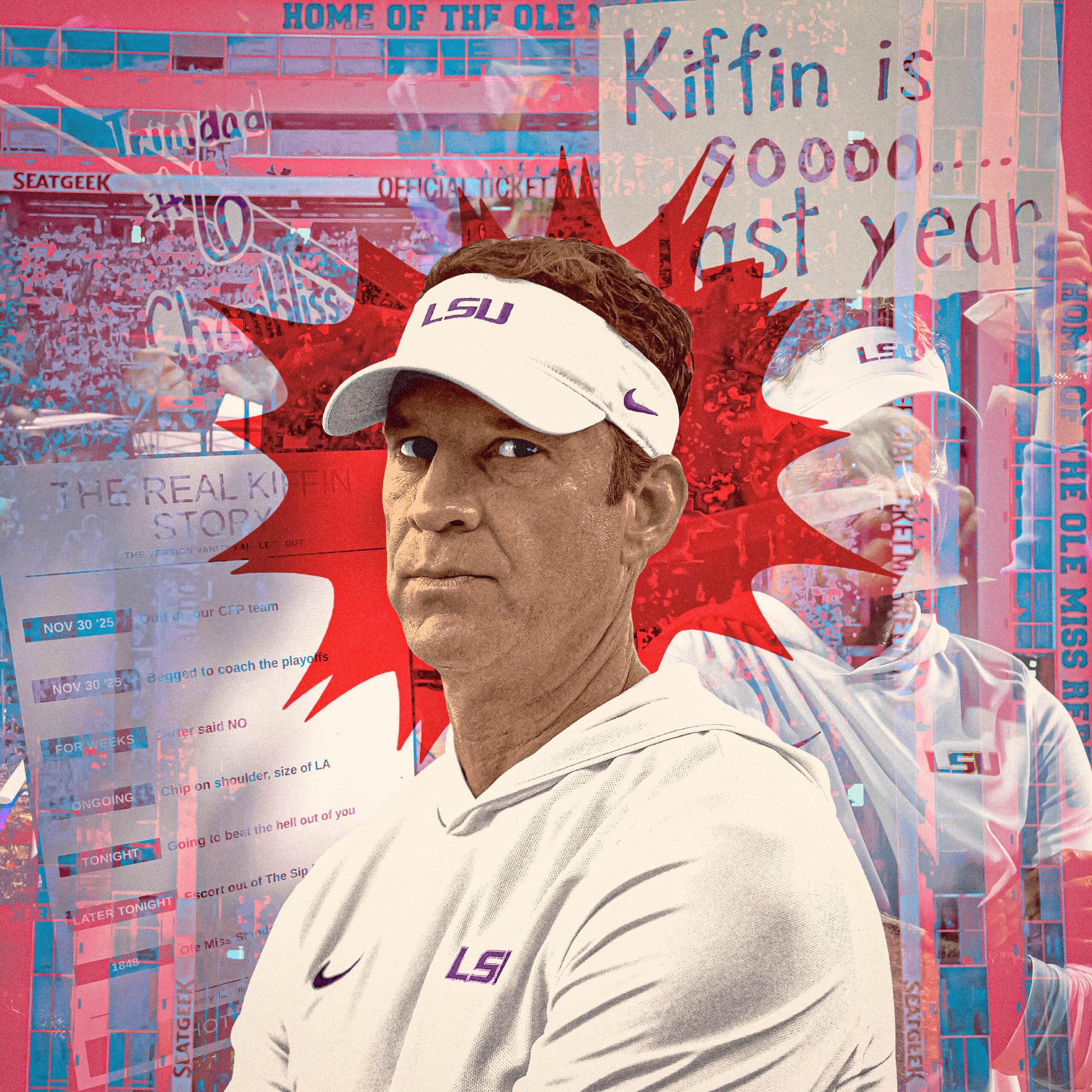
The Party of the Year, Powered by Hate
More than a quarter of a million people descended on Ole Miss to watch the Rebels exact revenge on Lane Kiffin. The game delivered so much more than that.The Party of the Year, Powered by Hate
More than a quarter of a million people descended on Ole Miss to watch the Rebels exact revenge on Lane Kiffin. The game delivered so much more than that.
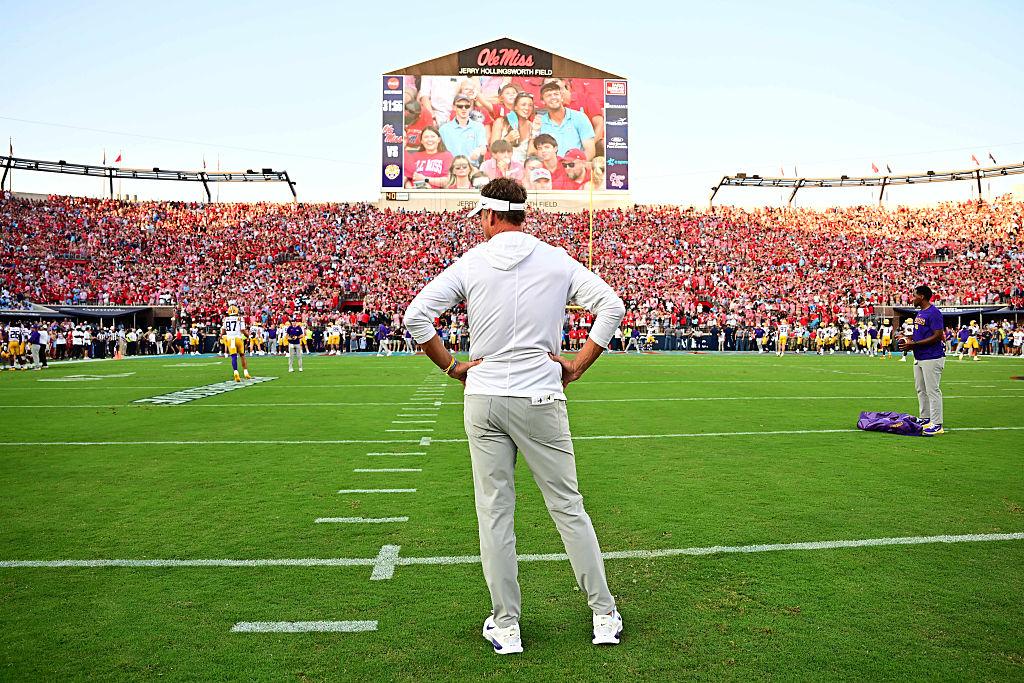
Lane Kiffin does not look or sound like a man whose presence moves masses to the brink of violence. His voice is soft, his face open. He sits on a small chair in a small room just footsteps from a field that became a cauldron, and he says all of the things football coaches are supposed to say when they’ve just been humbled on the road. You gotta hand it to those guys. The crowd really brought it. Give credit to their coaches. Outside this room, hundreds of thousands of Mississippians are euphoric and ravenous. For the past 10 months, they have lusted to watch him suffer. Now, on this scorching Saturday night in Oxford, after the Ole Miss Rebels held off Kiffin’s LSU Tigers for a 32-24 win, they’ve been given all that they craved.
We’re deep into a day, week, and year that has been fueled by anger at this one man—this 51-year-old charismatic but awkward football savant, boy genius turned pariah turned genius turned pariah again. Anger at a man whose first head-coaching job, with the Oakland Raiders, ended with a press conference dedicated to calling him a liar; whose second head-coaching job, at Tennessee, ended with fans chasing him to the airport out of town; whose third head-coaching job, at Southern Cal, ended with him being left on an airport tarmac; and whose rehabilitation stint as an Alabama assistant ended with him being relieved of his duties days before an appearance in the national championship game. At every stop, Lane Kiffin has been loved and loathed in alternate measure. No one, though, has ever loved or loathed him quite like Ole Miss, the school he declared his passion for, delivered to heights it hadn’t reached in more than half a century, and then abandoned in the most dramatic way imaginable by taking a job with hated rival LSU. Now he is here, this lanky middle-aged man in a visor, talking pensively with the press while thousands outside celebrate his suffering.
“I’m glad,” Kiffin says, “this is over.”


I arrive in Oxford on Friday afternoon, and on my walk from my parking lot to the downtown square, I hear one floppy-haired young man say to another, “I wonder what the record for the most people ever in Oxford at once is.” Whatever it is, it’s clear that the record will soon be broken. By 3 p.m., the line outside the famed restaurant City Grocery stretches halfway down the block. Inside the lobby of the Graduate Hotel, fans shout greetings to a tank-topped Pat McAfee, who offers dap to outstretched hands on his way to the elevator. Even the city’s legendary bookstore, Square Books, is totally packed. I drive 54 miles east to Tupelo, the only place I could find a hotel room, and even there, all anyone wants to talk about is Kiffin.
“I just think he’s a shitbag,” a man named Rudy tells me before he downs a shot at the bar of Woody’s, a Tupelo steakhouse. The restaurant is filled on one side with a tour bus full of retirees who’ve come to visit the birthplace of Elvis, and on the other with visiting Ole Miss fans who, like me, couldn’t get a hotel room anywhere closer to the game. Rudy belongs to neither group. “I’m actually a Mississippi State fan,” he says. “I always told Ole Miss fans that Kiffin would turn his back on them. But now that he finally did it, I feel kinda bad.”
The next day, Oxford is on fire. Literally. As soon as I get to the Grove, the university’s famed tailgating village, I watch a young man sprint past me into the nearest building, then back out with a fire extinguisher. “Generator blew!” he yells when someone asks what happened. A crowd follows him back to his tailgate tent, where he and others armed with their own fire extinguishers put out the flames.
It’s 98 degrees by midafternoon. As I walk around the tailgate I sweat through my shirt, a rookie move I soon realize, as I watch Grove veterans take off one sweat-wicking Ole Miss polo only to pull a backup sweat-wicking polo out of their bags. Women cool themselves with fans, whether of the motorized or the “church fan” variety, and in every single building on the Grove’s perimeter, bodies pack together to soak in the air conditioning’s relief.
It’s my first visit to the Grove, and the scene is every bit as advertised. Chandeliers in tents, massive catered spreads, booze of every strength and color, schlubbily dressed men alongside immaculately dressed women, most of them extending welcome to passersby, even those in purple and gold. There is, however, a clear theme for the day. Multiple tents prominently display a garden hoe. Several times throughout the day, including once later that night when it’s played by the Rebel band, I hear the 1999 Ludacris song, “Ho.” Several women wear dresses adorned with buttons bearing the message: “Bye Heaux.”
All are references to Kiffin. “Are you getting any royalties today?” I hear someone ask Ben Garrett, the prominent local media figure, when I meet up with him outside the Alumni House. Garrett laughs. It’s not the first time he’s heard that joke today. “I wish,” he says. Last November, Garrett went on his Talk of Champions podcast, as rumors spread that Kiffin would abandon Ole Miss for LSU, and said, now quite infamously, “You can’t turn a ho into a housewife.” Kiffin then accosted Garrett on the sideline of the following week’s game against Mississippi State and seemed to threaten him: “You wanna walk in here and call me a ho? Well see how that goes.”
When I meet up with Garrett, he immediately passes me off to his podcast cohost, Brad Logan, who pulls me onto their livestream just outside the Grove. “People get mad at me when I say this,” says Logan, “but I think eventually Ole Miss fans will welcome [Kiffin] back.” He points to the momentum the program is building, the two Heisman Trophy contenders on its roster (quarterback Trinidad Chambliss and running back Kewan Lacy), and the NIL operation that has the Rebels contending well above their historical weight. “A lot of this,” Logan says, “is because of him.”
Once, it seemed Kiffin was on track to have a statue built in Oxford. Now, Logan’s prediction of a future reconciliation feels nearly impossible to fathom. Logan smiles. “It’s not going to be tonight.”
A few minutes later, I meet a man with decades worth of perspective. Mitch Monsour has, by his count, been to more than 60 LSU–Ole Miss games. A 75-year-old who built a career in hospital administration, Monsour grew up in Jackson as the son of an LSU grad, cheered for Billy Cannon on his legendary 89-yard punt return in 1959, then graduated high school, decided to attend Ole Miss, and switched sides. He can count the number of Grove tailgates he’s missed in the past half-century on his hands. He’s never seen one like this. “This is the most crushing crowd we’ve ever had,” he says.
Local officials estimate 300,000 visitors have arrived in Oxford this weekend. Vaught-Hemingway Stadium holds only 64,038 fans. That means that nearly a quarter of a million people, roughly the same number of attendees as at Coachella, have descended on this town, not even to go to the Ole Miss–LSU game, but merely to be in the vicinity of the building where Kiffin might get his comeuppance.
For most of his life as an Ole Miss fan, Monsour cheered on Saturdays for a program that delivered mediocrity. Between 1970 and 2020, Ole Miss averaged about six wins per season. During the first two decades of this century, the Rebels enjoyed fleeting spells of success: They went 10-3 in 2003 with Eli Manning as quarterback, and 10-3 again in 2015 when Hugh Freeze coached them to the Sugar Bowl. “We were never embarrassing as a program,” Monsour says, “but we could never get to that top level.”
Before Kiffin’s debut season in 2020, Ole Miss had five 10-win seasons in the previous 60 years, and only three since the SEC began racially integrating in 1965. Then Kiffin led the Rebels to four 10-win seasons in six years. “Lane Kiffin did a great job for us here,” Monsour says. “No doubt about that. He was a great coach.”
It wasn’t just him, though. Kiffin’s Oxford tenure coincided with an era when the tectonic plates of college football had begun to shift. The transfer portal, NIL, and revenue sharing have all flattened the competitive landscape. Historical pedigree and recruiting footprint no longer represent a program’s destiny. We live in a world in which the Indiana Hoosiers are the defending national champions. The right coach and the right budget can lift almost any program to contention. “We put a great organization together,” Monsour says.
He turned his back on us, and he tried to do the maximum amount of damage on his way out the door.—Mitch Monsour
Of course, Ole Miss’s hatred of Kiffin isn’t just the product of him leaving what he helped build. It’s how he did it, trying to bring as many coaches and players along with him as possible, and who he left for, one of the Rebels’ oldest and most despised rivals. In John Talty’s excellent new book, Lane Being Lane, he reports that after Kiffin took the LSU job last December, he texted friends edited images of Ole Miss running back Lacy in an LSU uniform. Talty also details the lengths Kiffin went to initiate the legal effort to get the NCAA to grant Chambliss a sixth year of eligibility, under the belief that Chambliss would follow him to LSU. Kiffin lost interest in that particular legal battle once the star quarterback made clear that he wanted to remain in Oxford.
“He turned his back on us,” Monsour says, “and he tried to do the maximum amount of damage on his way out the door.”
On the way down the hill from the Grove, hordes of fans pour into the stadium more than an hour before kickoff. I meet a young man named Joe, who wears blue and red overalls, no shirt underneath, and has a giddy grin as he watches the stream of Rebels fans all around him. “Tonight is about one thing only,” he says. “Mississippi versus the world.”
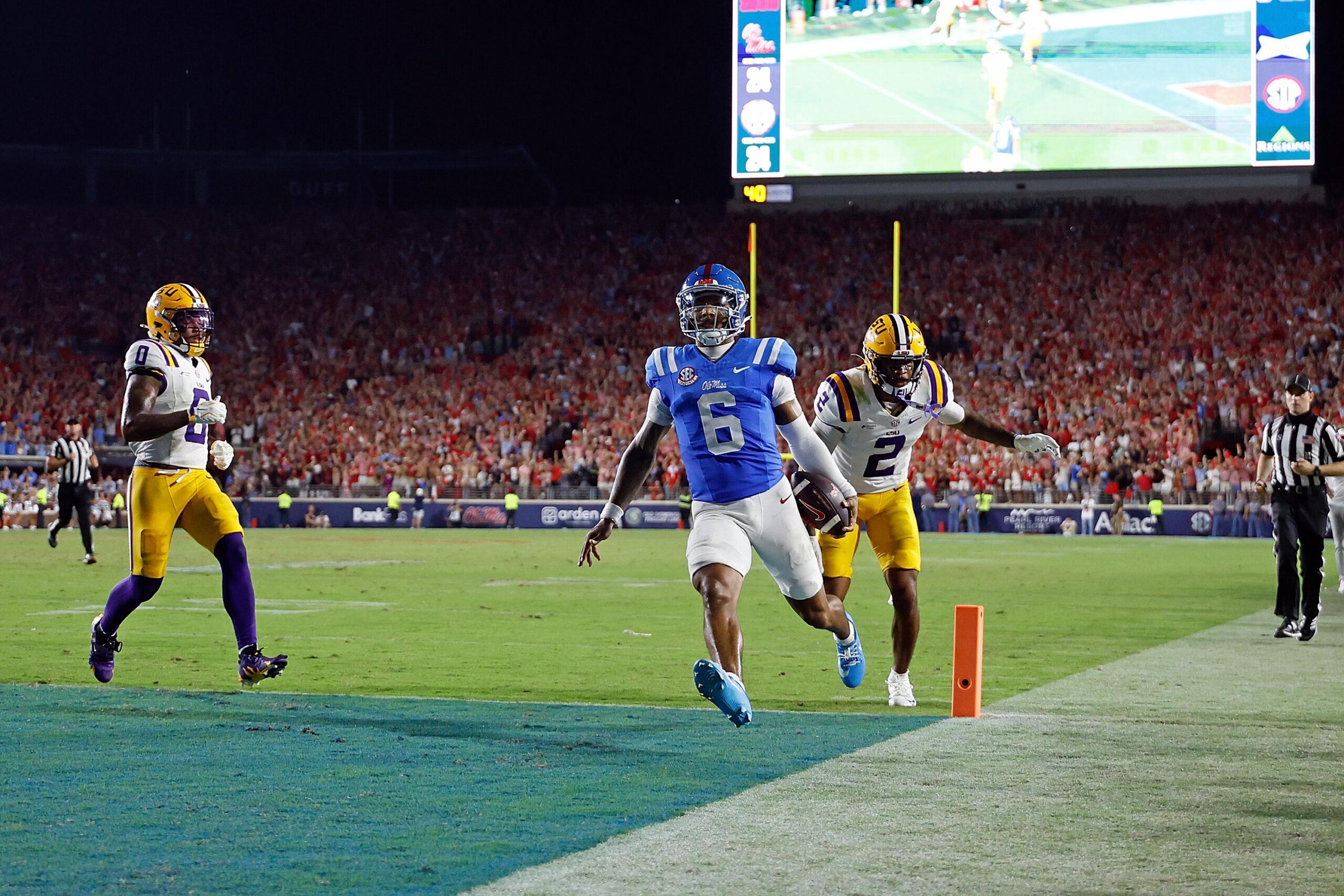
Mississippi wins. Deep into the night, after Chambliss emerges as the Heisman front-runner by making one impossible play after another on his way to 363 passing yards and two touchdowns with a rushing touchdown to boot; after the Rebels defense suffocates LSU in the first half and holds off a late rally in the second; after the crowd breaks into “Fuck Lane Kiffin” chants seemingly every time the action reaches a lull; after the band plays Lucacris’s “Ho” and rips off LSU’s unofficial anthem, “Neck”; after the PA announcer reminds fans not to throw objects on the field in the first half and not to storm it in the second; after the clock ticks toward zero and Kiffin rushes toward midfield to shake his successor Pete Golding’s hand and then, as quickly as possible, bolts off the field and into the tunnel; finally, with the whole stadium shaking, Oxford is able to exhale. “It meant more than other games,” Chambliss tells reporters afterward. Defensive lineman Will Echoles says the place was the loudest he’s ever heard it. “The fans were crazy,” he says.
And then there is Kiffin, lingering for a little while in his presser, surprisingly open and reflective, as if still clinging to the love he long proclaimed for the state that was once his home. He talks about the ride in, on the bus, preparing to take the field in Oxford for the first time since he left. “That was really emotional,” he says. “But it was not emotions maybe that I thought I would’ve felt.” He refers to the name-calling he heard on his walk from the bus to the locker room, to the way he imagined feeling extra competitive venom on a night like this. “I thought I’d probably be more in the competitive mode,” he says, “and just kind of embrace it.” Instead, he found himself feeling something else. “It was much more a lot of gratitude for this place,” he says, “and the people that changed my life.”
He’s asked at one point if he’d ever, in his six years here, seen an atmosphere like the one that came together to torment him. “Don’t ask questions you know the answer to,” he says, with a grin.
Kiffin knows well that hatred is a hell of a uniting force. He references how fans came together to boo him in the first game he returned to Tennessee. “It bonds people together,” he says. He noticed the stadium was completely packed an hour before kickoff. “I guess I had to leave to get them to do that,” he says. “So, you’re welcome.”
A concept floats around Oxford: closure. Earlier in the day, during the tailgate, Logan quotes an administrator telling him, “We’re just ready to turn the page.” I ask him if he thinks an Ole Miss win would help the fan base to do that. “It would happen a hell of a lot faster,” he says, “than if they were to lose.”
After the Rebels’ victory, you can already feel that shift. Golding calls the win “a full-circle moment” for a lot of people. Echoles expresses relief that the team was able to “get it over with.” Traylon Ray says that when Ole Miss clinched the win with a last-minute Jaylon Braxton interception, he could “finally take a breath.”
Kiffin takes the idea head on. “It kind of brings some closure,” he says. He references the players and coaches he worked with who are now celebrating in the other locker room, thrilled to have beaten the man who left them behind. “I know it’ll sound weird,” he says, “but as much as I dislike the losing … I’m glad for them.”
Maybe he’ll be back here in two years, and maybe again two years after that, and if so, the boos, and the chants, and the insults will all likely return with him. But hate can be exhausting. And something might have been punctured in Oxford on Saturday night.
On his way out of the press room and back to the locker room, Kiffin looks up to see some hecklers hanging around just outside the stadium, but most of the Ole Miss fans in his vicinity are just happily walking back to their cars. The LSU drumline marches out of the stadium and back to its bus, and I hear a young woman in blue and red shout at them, “You suck!” But then she stops herself. “I’m sorry,” she says. “That wasn’t very nice. I’m sorry y’all lost.”