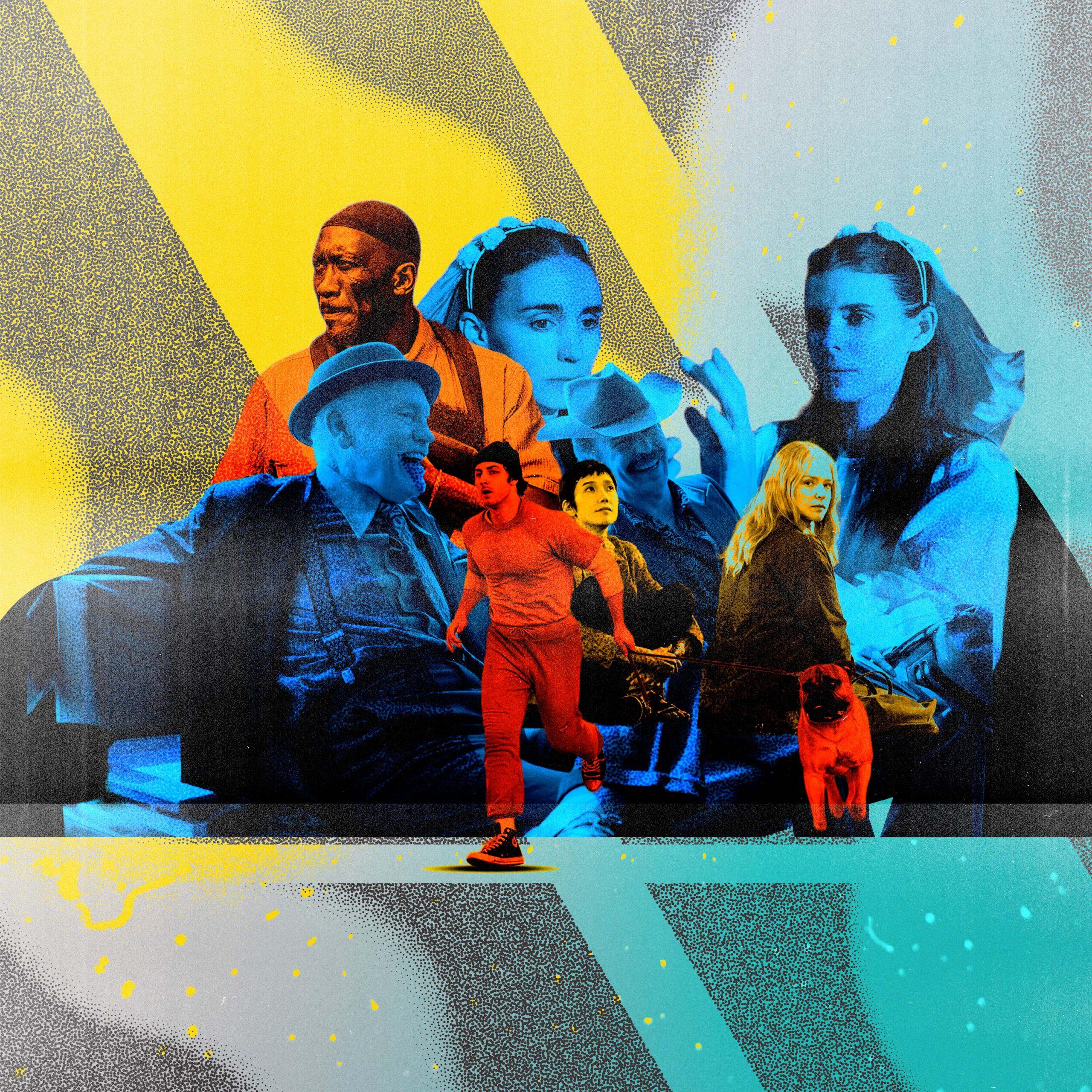

“Never do that shit again,” yelled an audience member at the Toronto International Film Festival, addressing Danny Boyle during the Q&A for the Oscar-winning director’s new tabloid drama, Ink. The film documents the ascendancy of London’s sensationalistic daily The Sun at the end of the swinging ’60s via the stewardship of Rupert Murdoch and his protégé Larry Lamb (played respectively by Guy Pearce and Jack O’Connell). The shit in question was 30 seconds’ worth of generative AI imagery, a “tiny amount” according to Boyle, who’s as charming and likable in conversation as any A-list filmmaker around but didn’t quite manage to stammer his way out of the rhetorical corner on this one.
“I don’t think we can go into [it] here,” Boyle told the moderator apologetically seconds before getting heckled and yanked off the stage. Awkward—but fascinating. Given that TIFF’s brand is one of monolithic, clockwork precision, it’s exciting and telling when things go off script. It’s a puncturing of the bubble of anodyne, corporate-backed positivity that annually transforms my city into a kind of lanyard-clad dystopia. Besides, the irony of a sweaty, anxious cautionary tale about the systematic degradation of mass media doubling as a showcase—however briefly—for Google DeepMind was more striking than anything in Ink’s lively but enervating compendium of newspaper-movie clichés. (Boyle needs to get back to the Bone Temple ASAP, and all will be forgiven on my end.)
The demonstrativeness of audiences was a running subplot during this year’s festival; I’ve been covering TIFF for 25 years now—a sentence that feels like an icy hand on the back of my neck, by the way—and I’ve never seen or heard so many screenings descend into bizarro versions of The Rocky Horror Picture Show. I mean, it was funny when the local press corps interrupted a pre-festival preview of Jesse Eisenberg’s The Debut to applaud one of Julianne Moore’s mid-film monologues. The same thing had happened the day before in Telluride, so why not follow the industry’s lead? But I also witnessed spontaneous—or else effectively calculated—outbursts of clapping and yelling at press and public screenings for films as varied as I Play Rocky, Elsinore, Wild Horse Nine, and Josephine, the latter a dark-hued and harrowing study of childhood psychological trauma distorted, against its own intentions, into a crowd-pleaser.
The generous reading of all this enthusiasm is that the movies on offer were so powerful and transporting that there was simply no choice but to stand up and cheer; another possibility is that the September swoon of the probably-no-longer-playoff-bound Toronto Blue Jays left locals looking for another outlet for their enthusiasm. Far be it from me to begrudge anybody’s good time—especially if they’re paying through the nose for Gala Presentations—but I found that causes for celebration at TIFF 2026 were few and far between, at least on-screen. The proliferation of friends and familiar faces in the bars and restaurants around the TIFF Lightbox is always nice, and I skipped one entire evening of screenings to see Robyn in concert with my wife (that was worth applauding). Of course there were some very good and enjoyable movies (and at least one possibly great one, which I’ll get to shortly), but, in the parlance of our times, the vibes felt off—maybe only a tiny bit, as per Danny Boyle, but enough that I was left wondering how to approach this annual report from the front.


More in Movies
Let’s accentuate the positive. I had a good time at Joshua Giuliano’s Midnight Madness opener, River, a nicely plated meat-and-potatoes slasher that doubled as the festival’s first—and so far only—headline-grabbing sale. The $10 million bid by Universal Pictures and Blumhouse reflects the genuine commercial potential of a film that earns its squirms (a guy beside me had his head buried in his hands during one set piece); it also suggests that distributors are chasing the next Obsession. Speaking of which: Curry Barker was in town one year after his film’s Canadian unveiling to run a victory lap along with his cast; “it was like an episode of Entourage,” he told The Globe and Mail, which, as far as television shows he’s referenced to make sense of his film and its success go, is not as good a comparison as The Simpsons. Expecting River to have even a fraction of the cultural impact of Obsession is probably unfair, but credit is due to Giuliano for his stripped-down premise (tetchy siblings on a motorboat ride run out of gas on the wrong stretch of water), genre-savvy casting (Jessica Rothe and Jane Levy, who play sisters, are both good sports with final girl bona fides), and some genuinely freaky staging, including the second-best use of a flare gun in the festival.
River’s windfall stands in opposition to the wayward status of Werner Herzog’s Bucking Fastard, which came to town for sale and remains so. In a way, the highest compliment that can be paid to the octogenarian German auteur’s latest is that it’s hard to imagine it ever getting a mainstream release—despite its starry cast and directorial pedigree, it’s a case study in keeping things weird. In lieu of a plot, Herzog offers a conceit: a tale of two sisters, Jean and Joan Holbrooke (Kate and Rooney Mara, respectively), who are so close that they dress, speak, and dream in unison—a fugue-like state of psychic and physical synchronization that’s so far beyond explanation that the movie never really tries. Such extremities of human behavior are a Herzogian specialty, but the results of his admittedly brilliant casting gambit split the difference between the fairy-tale strangeness of his best work and an extended, increasingly repetitive improv exercise. Bucking Fastard is lyrical and lilting in accordance with its Emerald Isle setting; the tweeness eventually takes a startling detour into Fitzcarraldo territory. Herzog is naturally polarizing, of course: It’d be a bad sign if people were talking about his work in Holbrooke-style unison.
With nearly 300 features and shorts on offer, TIFF’s slate is too diverse—or distended—to allow for too much in the way of trendspotting. Still, a few funny double bills emerged from the fog of my four-screenings-a-day schedule. For instance: Within a period of 48 hours, I saw two violent, stylized comedies about existentially addled hitmen and two awards-bait dramas centered on actors tackling the roles of a lifetime. In the first category, I much preferred Bassam Tariq’s Your Mother Your Mother Your Mother, starring Mahershala Ali, to Martin McDonagh’s Wild Horse Nine with Sam Rockwell and John Malkovich, my preference probably being the difference between a movie I haven’t quite seen before (a devoutly Muslim contract killer trying to care for his kids in the wake of their mother’s death) and one by a filmmaker who’s making a habit of repeating himself (this one is In Bruges on Easter Island). Enough people have pointed out that Your Mother’s swift, adrenalized action sequences suggest what could have been if Tariq had been allowed to make Blade with Ali that I don’t have to do the same; there’s similarly enough buzz around Malkovich’s (admittedly hilarious) performance in Wild Horse Nine as a burned-out CIA spook sitting down to write his memoirs that I can hold off on handicapping his Oscar chances. (Though I will point out that, one, it’s pretty brazen for McDonagh to lift the CIA memoir thing straight from Burn After Reading and, two, that Wild Horse Nine isn’t as funny as Burn After Reading.)
As for the thespian melodramas, both Simon Stone’s Elsinore and Peter Farrelly’s I Play Rocky boast sterling lead turns by actors with their eyes on the prize. The casting of Andrew Scott in the former as Chariots of Fire star Ian Charleson—who famously portrayed Hamlet at London’s National Theatre in the late 1980s while contending with an AIDS diagnosis—is so apt that the film is unimaginable without him. He’s a terrific actor playing a terrific actor and brings so much texture and nuance to his work that he almost overrides the lugubrious manipulation of the filmmaking. But he doesn’t: Stone has a moving subject and good intentions and no faith whatsoever in his audience. There’s a difference between characters articulating their anxieties and serving as mouthpieces for filmmakers determined to say something, and Elsinore is so relentlessly literal-minded that it becomes grueling. It’s also too bad that Stone keeps slicing and dicing Scott’s riveting Shakespearean oratory into music-drenched montages; he deserves better than the slings and arrows of overzealous editors. Meanwhile, the best scene in I Play Rocky is the one where Anthony Ippolito—steadily working his way through the repertory of Italian American Hollywood icons after doing Al Pacino in The Offer—reproduces Sylvester Stallone's “what about my prime?” lament so perfectly we might be watching the original film (or maybe generative AI). The possibility, however faint, that I Play Rocky’s brawny Hollywood mythmaking might earn Farrelly a second Best Picture statuette after Green Book (or at least another TIFF People’s Choice Award) is funny and worrying in equal measure, especially considering how determined the film is to sidestep the racial politics around the original Rocky. (A scene where Stallone watches Chuck Wepner get whupped by Muhammad Ali in a bar filled with screaming, white, working-class patrons is perched on the verge of revelation.) Is the sweaty shamelessness of the whole thing a bug or a feature? Depends on your desire to hold a movie—or yourself—to any kind of artistic standard.

To quote a friend I ran into after the screening: I Play Rocky is coworker cinema par excellence. As for my own coworkers—meaning other critics—the best buzz was mostly around the usual suspects. I was, probably predictably, smitten with Ryusuke Hamaguchi’s All of a Sudden, which continues the Japanese director’s streak as the festival circuit’s most capable shape-shifter; here, the bleak, apocalyptic eco-horror of 2024’s Evil Does Not Exist gives way to a humane meditation on human compassion and frailty. Earlier this year at Cannes, Park Chan-wook’s jury split the Best Actress prize between Hamaguchi’s stars Virginie Efira and Tao Okamoto, and it’s easy to see why; cast respectively as a Parisian elder-care administrator and a terminally ill theater director mounting her latest play in France, their divergent styles mesh beautifully. The similarity between the two women's names—Marie-Lou and Mari—anticipates their emotional and philosophical synchronicity; over the course of the film’s languid three-hour running time, their dynamic morphs and shimmers as they go from friends to intellectual sparring partners, all in the shadow of encroaching mortality (a tension that comes through more powerfully in these theatrical-performance scenes than in Elsinore’s). Hamaguchi’s ability to fuse broad, abstract ideas about life, work, and class relations with granular, quotidian details and even eroticism (massage fetishists will be pleased) is uncanny—ditto his knack for occasionally startling the viewer out of nowhere. Hence the double-edged poetry of the title: In tragedy as well as vitality, All of a Sudden takes us by surprise.
I thought of Hamaguchi’s apparent effortlessness in conjuring up emotional effects while watching the Korean master Lee Chang-dong’s Possible Love—a strong film that nevertheless felt labored. It’s a simmering study of class relations rooted in the meeting of haves and have-nots: documentary filmmaker Ye-ji (Cho Yeo-jeong) and her mogul husband, Sang-woo (Zo In-sung), and recently fired factory worker Ho-seok (Sul Kyung-gu) and his wife, Mi-ok (Jeon Do-yeon). Ye-ji is working on a film about industrial downsizing and gloms on to Ho-seok as a potential subject; the question of whether she’s empathizing with his plight or exploiting it is one of several mysteries that Lee’s screenplay (cowritten with Oh Jung-mi) leaves ajar. Comparisons to Parasite are perhaps inevitable given the casting of Cho, who played that film’s oblivious, bougie trophy wife, but Lee is working in a more sober register; the opening title card, “Thou shalt not covet,” nods to the late Polish director Krzysztof Kieslowski’s legendary, Ten Commandments–inspired series, The Decalogue, but the vision—stark, fatalistic, and cosmic despite the small scale—is Lee’s own.
To say that Possible Love is dense is an understatement. That epigraph, and the central theme of covetousness, plays out on multiple planes of action, with layers of implication about state violence, corporate greed, documentary ethics, shattered workplace solidarity, and the internalized self-loathing of a working class in the process of being shoved violently aside. Everything Lee does with his camera placement and cutting is scrupulous, intelligent, and suggestive, to the point that throwaway scenes are pressurized by dread, yet the overall sense of convergence—of characters moving, obliviously but inevitably, toward some terrible sort of release—isn’t as convincing or overwhelming as it was in Lee’s 2018 masterpiece, Burning, to which Possible Love plays as a spiritual sequel. Where the former film used the absence of femininity to structure its battle of alpha and beta male egos, Possible Love is more attuned to the distaff half of its ensemble, and Cho and Jeon are remarkable, separately and together, in evoking equal but inverted anxieties around their roles and statuses as wives and professionals. The film is undeniably powerful; whether that’s because it’s also so predictable or in spite of it is something I’ll be thinking about for a while.
The best film I saw at this year’s TIFF is also one I’ll spend time figuring out, though in a different way. One week after watching Austrian writer-director Sandra Wollner’s frightening, heartbreaking, and completely absorbing Everytime, I still don’t know what to make of it, even as its jagged, fragmented pieces keep rearranging themselves in my mind. To say that Wollner’s feature is difficult to describe isn’t a dodge or an evacuation of critical responsibility; the way it works on the audience—a sort of insidious, subliminal form of suggestion—defies synopsis.
Cinematographer Gregory Oke’s presence behind the camera links Everytime to Charlotte Wells’s Aftersun; it’s not meant as a put-down (of either film) to say that there’s not really that much else between them. The common denominator—that they’re both about grief—belies Wollner’s wildly divergent approach to the theme. Wells’s movie is a meticulously organized memory piece in which distance heightens scrutiny and perception; in Everytime, we can’t believe—or process—what we’re seeing in real time. The protagonist is Berlin resident and single mother Ella (Birgit Minichmayr), who’s placed, all of a sudden, in the position of mourning one of her two daughters while trying to nurture and protect the other. The accidental death of the teenage Jessie (Carla Huttermann) is a tragedy, and yet, as per cliché, life goes on for her mother and devastated younger sister, Melli (Lotte Shirin Keiling). What’s unsettling is the possibility that Jessie is—in some hovering, ephemeral form—still there as well.
If that last part makes Everytime sound like a ghost story, that’s because, in some ways, it is: not elevated horror but fear of the unknown given supple, unsettling form. Here’s a compliment: The movie I thought of throughout was Nicolas Roeg’s Don’t Look Now, which Wollner, however unconsciously, mimics by keeping the immediate aftermath of Jessie’s death off-screen (the story picks up several months after her funeral) and structuring the material as a travelogue—to Tenerife rather than Venice, but with the same underlying idea about possibly mitigating despair through a change of scene. (Ella brings along Jessie’s boyfriend, Lux, played by Tristán López, for reasons that are hard to parse but completely convincing in context.) Roeg’s classic used the canals and cathedrals of Venice to suggest a drowning world and submerged terror; it was a labyrinth. Everytime is, by contrast, sunstruck, observing the Spanish coast and its tourist traps through a haze or from a great height. Gradually, we realize that the vacation spot looks more than a little bit like the landscapes Jessie liked to build in her favorite open-world video game.
There’s something subtle and disorienting going on in terms of form in Everytime, a staggered merging of celluloid and digital formats that leads toward an immersion in polygonal video game imagery. In other words, this is the greatest Minecraft movie ever made. It’s rare to watch a movie that honestly feels transformative (or trance-formative); it’s even rarer to have the feeling that you’re losing your bearings without suspecting that the director is losing theirs. Wollner isn’t a showy director or an aspirationally masterful one; nevertheless, she obliges us to meet her on her own terms. It would be more than fair for somebody watching Everytime to feel lost, or frustrated, or impatient, or to hope for something more decisive; for me, the imagery in the homestretch—including the best use of a flare gun in the festival—is so lucid and eloquent that the movie seemed to be reading my mind (or vice versa). I’m not exaggerating when I say that there were two separate moments in Everytime when my heart stopped—the sort of full-body shock that filmmakers often go chasing and for which we tag along. I’m used to movies coming up short instead of getting there. In a year when everybody seemed to be talking to the screen, I was grateful to be left speechless.