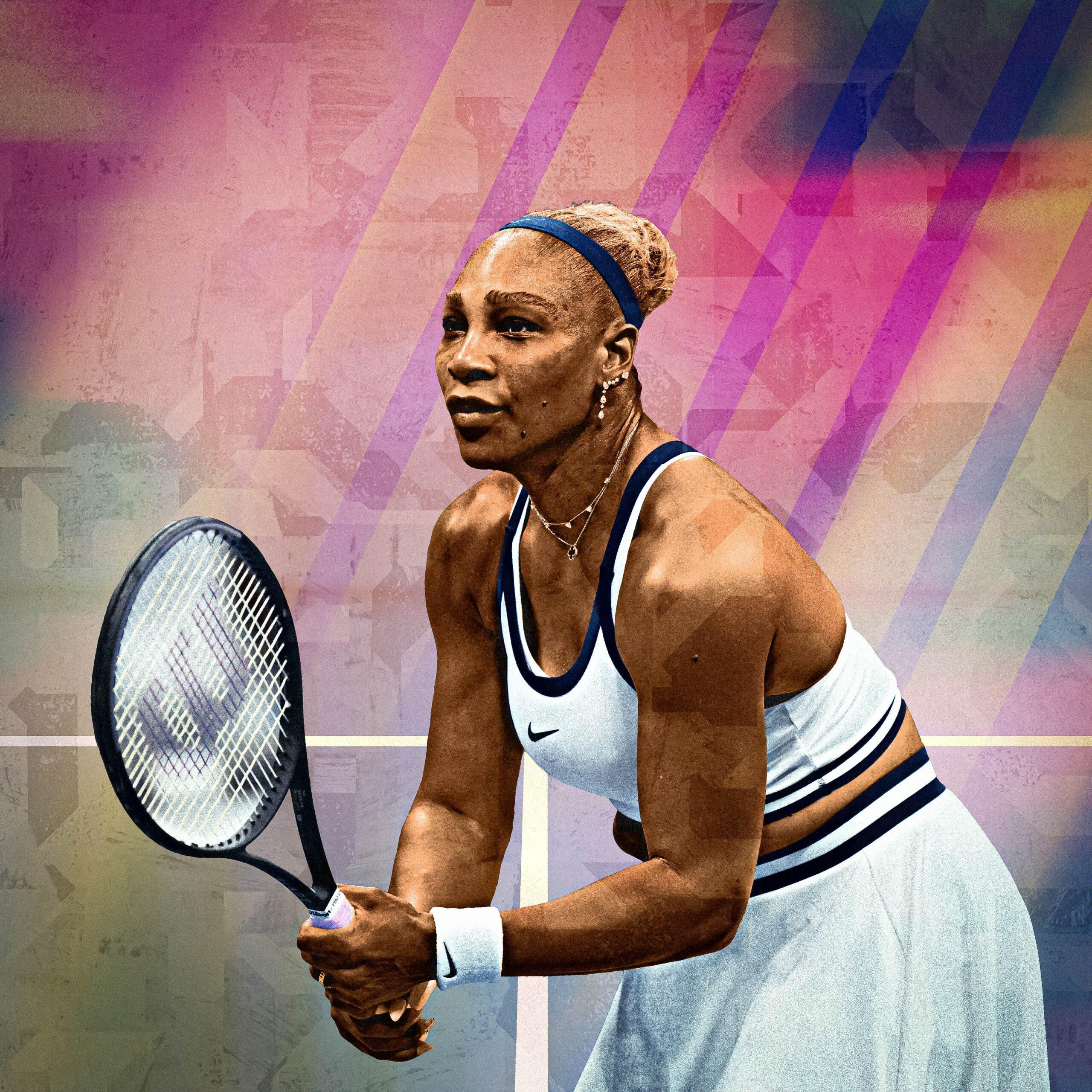

As resurrections go, it was initially a rather drab affair. On Friday evening, Serena Williams returned to the stage she’d once chosen for her moonlit athletic eulogy. Across Arthur Ashe Stadium, many of the roughly 23,000 witnesses to this spectacle were late to arrive. That’s hardly unique for a function that has morphed in recent years from the people’s tournament to an affluent plaything, but it had the general effect of making all the pyrotechnic displays preceding Serena and her sister Venus’s opening-round doubles matchup fall a bit flat.
The markers of their reign were still present. A gaggle of A-listers eventually trickled into the lower bowl. (Anna Wintour and Mr. T were seated in the same row.) Early in the match’s opening set, it looked possible that both Williams sisters would wield their shotmaking velocity to undercut the mobility of their opponents—the 14th-seeded pairing of Hao-Ching Chan and Maya Joint. Serena’s perfectly concave serve remains a thing of scary symmetrical beauty.
Those peripherals would prove fleeting. Within four games of the first set, she and Venus were down a break. They went on to lose the opening stanza, 3-6. It took a pair of missed break points, a series of doomed rallies, and a second-set tiebreaker for the crowd to mount a full-throated defense of the two veterans. If nothing else, the reaction was subtly illuminating.
For the first 75 or so minutes of Friday’s match, an impossibility—the return of the greatest tennis player in American history—was greeted with faint recognition by those in attendance. For the next two-plus hours, it triggered rapturous regard. It was as if the people watching that impossibility were at first perplexed by its very existence. The longer the match went on, though, the more of it they wanted. And the more unsure they seemed to be of what, exactly, it was.
Serena and Venus lost their Queens revival, 3-6, 7-6(8), 6-7(10). For the younger of the two all-time greats, this U.S. Open marked her second Grand Slam appearance this summer and her fifth overall tournament in 2026 after four years away from the tour. In Flushing, Serena opted to play only mixed and standard doubles, telling reporters that her right knee still wasn’t quite ready for the stress of one-on-one play.
The ultimate goal of her comeback remains unclear. Both her peers and those in her orbit tend to speak about it in gushing, hagiographic terms. The 39-year-old Novak Djokovic described Williams’s return as “an inspiration.” Naomi Osaka told reporters she considered it a “privilege” to watch her again. Rennae Stubbs, Williams’s coach, said the 44-year-old’s reemergence is about “trying to play the sport she loves,” as well as wanting to “show the kids” and “give the people another look.” At minimum, most everyone believes that Serena’s comeback will provide a ratings boost for the rest of the tour, a sentiment that thus far has been borne out.
Williams, though, has been deliberately vague about her ambitions. “I don’t need to win,” she told reporters at the HSBC Championships in June. “It’s not that important to me.” There is, no doubt, an incongruity in observing this woman, this unrelenting victor, plainly arguing that winning is “not that important” in the middle of a return to competition itself. The lonesome grain of truth embedded in all of this is left unstated—the only person who really knows why Serena has decided to return is the same one who’s under no obligation to share: her alone.
That Williams would make the game fit her whims and not the other way around rings more than a bit familiar for those with even a passing fluency in her folklore. Returning under such conditions is, above all else, her prerogative. Part and parcel of Serena’s patent alchemy—the kinetic force she rode from cracked Compton hardcourts to manicured All England tracts—is her uncanny disregard for even the idea of practicality. Study her movements closely enough, and you’ll see that this isn’t a bug in her approach; it’s the feature.
As with most every other maneuver in her decades-long conquest of the sport, she’s seemingly reemerged for the simple and altogether warranted reason that she can. How that turns out may not be entirely up to her.
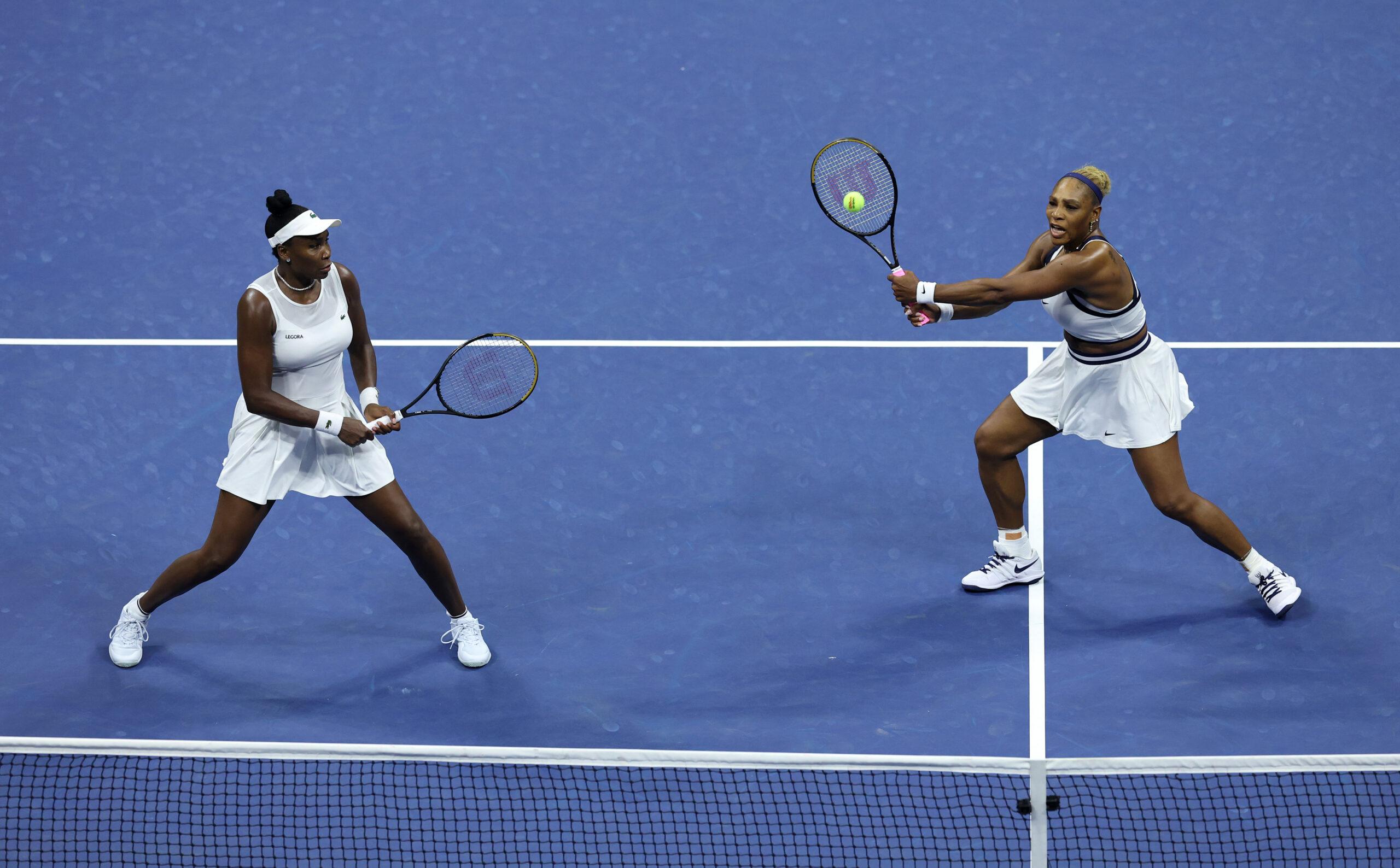
Venus and Serena Williams in their women’s doubles match against Hao-Ching Chan and Maya Joint at the 2026 U.S. Open
Williams has long been past letting us in. The constant throughout Serena’s surprise comeback is her consistent attempts to shroud it under a haze of ambiguity and obfuscation. In December 2025, when the independent tennis reporter Ben Rothenberg first reported that Williams was “preparing to return to tennis” and had recommitted herself to the WTA anti-doping protocol, Williams responded with the kind of vigorous denial that reads as almost comedic in hindsight. (“Omg yall I’m NOT coming back,” she tweeted.) When NBC’s Savannah Guthrie spent two minutes lobbing inquiries about a potential comeback to Williams a few months later, Serena consigned herself to a wry smile and said, “I can’t discuss this.” Less than three weeks later, she was posting TikToks of herself serving.
The coyness did not dissipate upon her official return. Leading into Wimbledon, after she’d already suited up at HSBC Championships, Williams told reporters she would need “to train a little bit more if I want to play singles” … and then proceeded to take a singles wild card from the All England Club 14 days later. After her first-round exit at the tournament, she was asked about her plans for competing throughout the summer. She said only, “All I can say is stay tuned to a city near you.”
Even now, after five months and a U.S. Open appearance, it’s not clear how healthy Williams is, what type of competitive shape she’s in, or how long her comeback might last. If you listen to Stubbs, Serena is merely “enjoying all of the process.” After Wimbledon, no one knew why she skipped her mandated press conference appearance until her agent told reporters that she’d “tweaked her right knee at the end of the first set.” Stubbs, for her part, said it was “pretty miraculous” that Serena had even finished the match “considering how bad the knee was”—then added that she’d been “beating players that are still in the tournament” in practice sessions, but refused to name who.

More on Serena Williams
Williams’s play says another thing, although even there it’s hard to discern the degree to which her physical limitations are impacting her performance. During Friday’s match, she showed she could raise her game repeatedly, but maintaining that level was elusive. In the fourth game of the deciding third set, Serena and Venus fell behind 0-30 before the younger sister uncorked a vintage service sequence, forcing back-to-back return-of-serve errors. She looked comfortable at net, redirecting returns with quick-twitch volleys and forehand smashes. But for each of these highlights, she would often almost immediately give back the point on a miscue. In the third game of the first set, Williams launched a two-handed rocket of a backhand to seemingly save another service game, only to double-fault on break point moments later. In the second set, she and Venus blew four set points (the last of which was a Serena double-fault) before they were bailed out by Joint’s own serving hiccups.
The Williams sisters went up 5-0 and then 6-3 in their third-set tiebreaker but squandered both leads behind more unforced errors. Part of this was probably age, and part was probably their opponent. But another piece of the equation was that Serena simply does not have enough high-tension repetitions, and her own team disclosed as much. During one of her mixed doubles outings, ESPN’s Patrick McEnroe said that Serena’s agent told him she was “close” to being ready to play singles. Her sister Venus framed any rust as an issue of “getting our stride.”
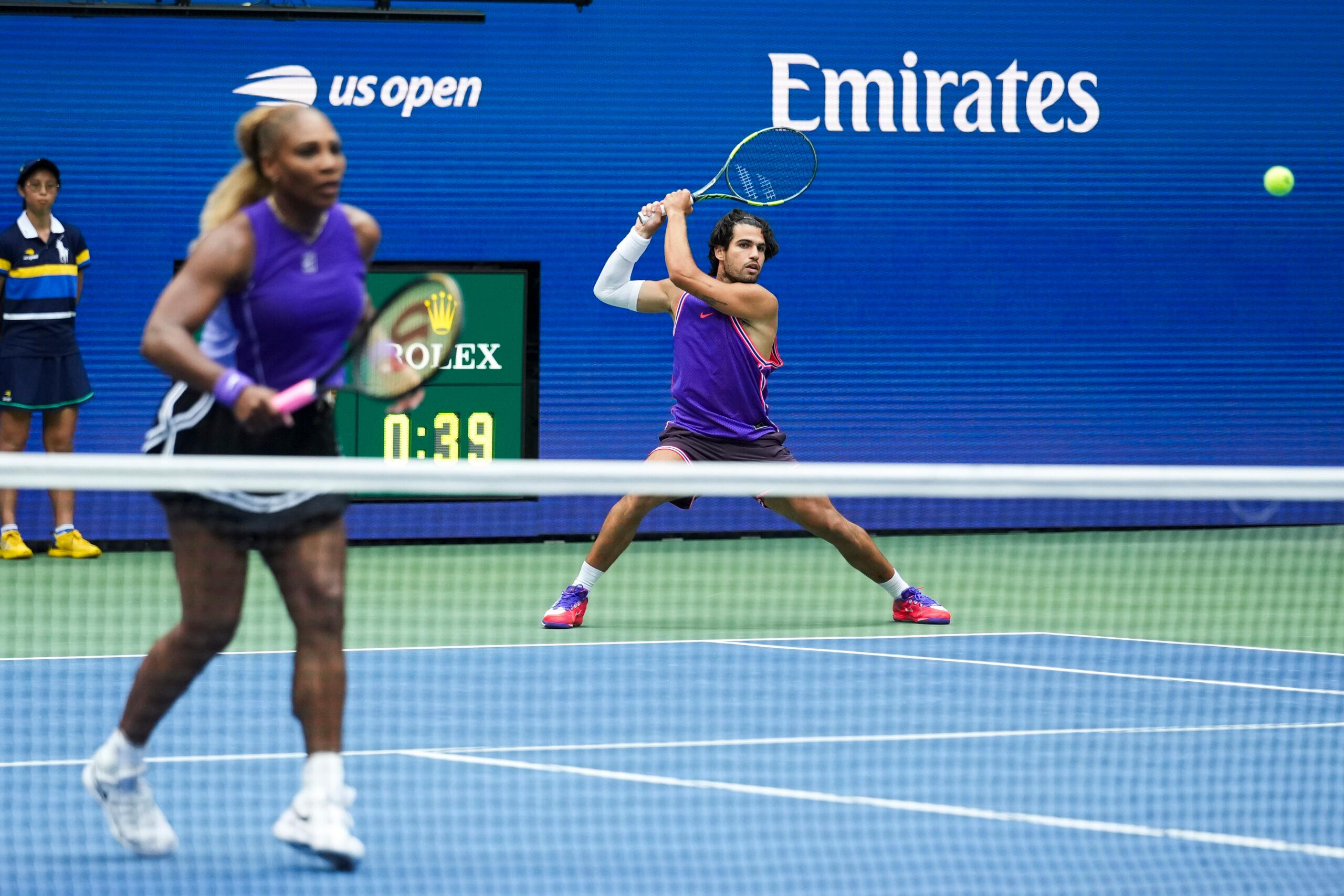
Carlos Alcaraz and Serena Williams in the mixed doubles quarterfinal match during U.S. Open Fan Week
Before Friday’s match, Serena’s friend and former competitor Caroline Wozniacki said on ESPN that Williams’s U.S. Open doubles appearance was really about “getting ready for the next season” and “play[ing] a real match before she really asserts herself back into the singles court.” When asked explicitly by Good Morning America whether she planned to return to the singles court, Serena said that she “probably will play again” but added that her comeback “isn’t something permanent.”
On the court, she carries herself as competitively as ever. Between points at Ashe, she huddled up with Venus and plotted their next move. When the momentum of the match started slipping, Serena got more vocal after her shots. But outside the lines, when it comes to explaining what she’s competing for, she has gone quiet.
A portion of the ambiguity surrounding her next moves might be clarified if Williams participated in post-match press conferences in lieu of (reportedly) leaving her sister solo. Granted, Serena choosing not to open up to the U.S. Open press pool—and, more broadly, to tennis’s media ecosystem—fits cleanly within her personal and professional narrative for a few distinct reasons. The first is that, if you gave her truth serum, she’d probably say she doesn’t know for sure what her plans are. The second is that there’s never really been a time when Serena didn’t have grounds to reasonably doubt the tennis world’s worthiness with that kind of information. One needn’t be a sociologist to understand that a theme of Williams’s world-shaping career was, time and again, how the sport couldn’t handle all of her: the inconsistencies, the contradictions, the magic, the hunger, the flaws.
No matter what she’s done or how dominant her reign, Serena has always had to contend with the polarized reactions her presence evokes. Even now, if you look up her favorability ratings on public opinion polling entities like YouGov, her negatives are almost twice those of her peers (even the controversial ones). These are small subsets of the overall population, and they pale in comparison with the number of folks who hold a favorable view of her, but they reflect the ways Williams’s career has been shaped by race and gender—to say nothing of how the sport itself has repeatedly made her feel unwelcome, unappreciated, or exoticized.
The uncomfortable truth that Williams’s comeback is enabled by a controversial and widespread class of weight-loss drugs has done little to tamp down these currents. Serena’s role as a prominent spokesperson and financial backer of GLP-1s complicates the simple, good-vibes narrative that her PR apparatus appears to desire. (Whether GLP-1s provide Serena with a competitive advantage is another question entirely.) It also serves as an easy excuse for folks who’ve never liked her to reconstitute their old grievances. All of which makes it less likely that Williams shares about herself, her beliefs, and her comeback motivations.
Remember, she’s been past letting us in. If the past few weeks are any indication, Williams will let the tennis world know what her next move is when she makes it. She remade playing. She remade winning. Now she’s remaking the act of walking away.
Williams is right in more ways than one when she says that nothing is permanent. Every star fades. Even resurrections have their limits. What’s worth it here is watching and waiting. It won’t last forever. She always plays out her endgame.