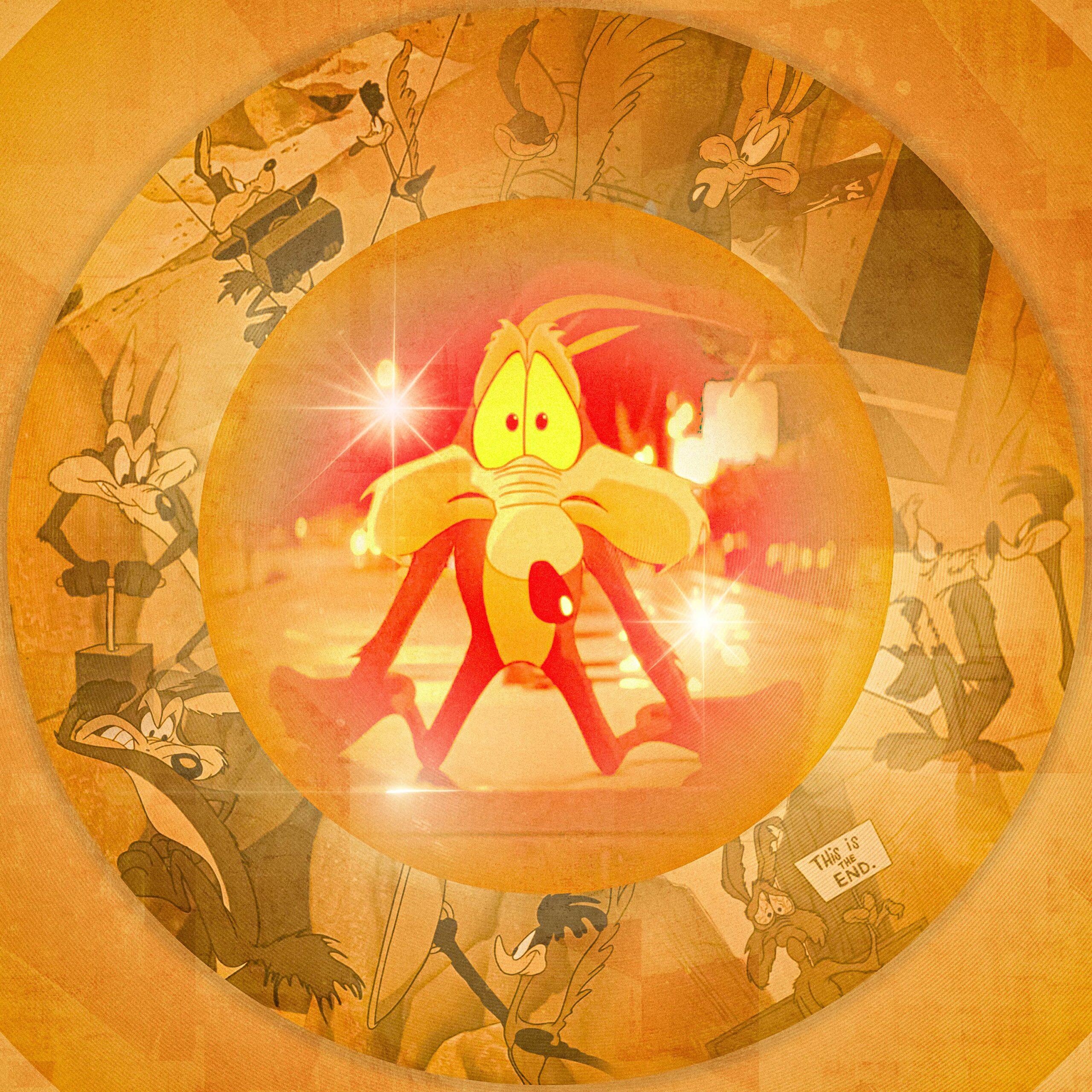
“The Road Runner cannot harm the Coyote except by going ‘beep-beep!’”
As divine ordinances go, the first of the nine commandments supposedly chiseled in stone by charter members of the Looney Tunes brain trust back in 1949 (the year of the premiere of “Fast and Furry-ous”) seemingly lacks the gravitas of “I am the Lord your God.” But the edict, credited to the legendary animator Chuck Jones and writer Michael Maltese—although the latter eventually denied its existence—is nevertheless as strict and unforgiving as anything in the Old Testament.
Or maybe more so. An eye for an eye is insufficient when both parties are indestructible. Sticks and stones and boulders—so, so many boulders, whether dropped from great heights, dislodged by dynamite, or boomeranged backward by miscalibrated catapults—will break bones, but that diabolical bit of birdsong is what really twists the knife. Two chirps, one for each of the vocalizer’s brain cells. It would take a true social Darwinian (or a Dodgers fan) to sympathize with a soulless, front-running cipher who lives his empty life one quarter mile at a time. Like the shark’s theme from Jaws, the Road Runner's call conjures up something primal, beguiling, and terrifying. Do not ask for whom the beep tolls.
At their best, the Looney Tunes were vessels of pure American existentialism. Think of the would-be entrepreneur in “One Froggy Evening,” whose singing amphibian refuses to croon for the public (a setup as maddening as anything by Luis Buñuel), or Daffy in “Duck Amuck,” fulminating helplessly at the animator who’s robbed him of his powers of speech (he has a beak but cannot scream). The Coyote’s own muteness heightens the slumped eloquence of his body language; it links him to the great stuntman comedians of the 1920s like Buster Keaton, Charlie Chaplin, and especially Harold Lloyd, whose masterpiece Safety Last! hovers over the Road Runner cartoons like a North Star … or a dangling piano. The hand-lettered signs held up by our bedraggled antihero in moments of imminent crisis—“Help!,” “Yikes,” “How About Ending This Cartoon Before I Hit?”—are similarly tied to the aesthetics of silent cinema. They’re distress calls that ring true for anybody who feels like they’ve ended up on the wrong end of natural selection. Every time the Coyote breaks the fourth wall, he becomes our mirror.
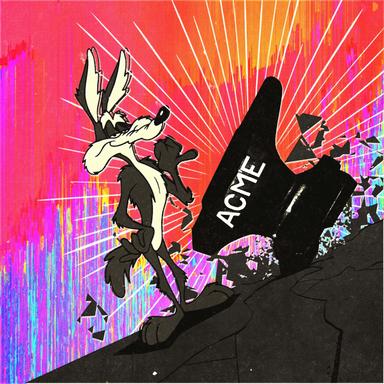
The exquisite slapstick sadism emanating from Termite Terrace stood in proud, subversive opposition to the classical fairy tales being peddled around the same time by Disney. It’s also aged better: Would you rather have the gormless complacency of Mickey Mouse or the cross-dressing tricksterism of Bugs Bunny? The grand operatic ambitions of Fantasia or the glorious cultural leveling of the “Rabbit of Seville”? Where Disney obliged viewers to wish upon a star, the Coyote put his faith in a different sort of higher power—one that delivered expensive, backfiring dei ex machina directly to his door.
Imagine Don Quixote ordering his windmills from the manufacturer, and the satirical thrust of the series’ premise comes into focus. To paraphrase Homer Simpson—who’s been known to do a pretty good impression of Wile E. Coyote—Acme offered the solution to, and cause of, all of its best customer’s problems. Those fake-Latin species names—Carnivorous vulgaris, Accelerati incredibilus—kidded National Geographic and Madison Avenue simultaneously; if foxes were historically emblems of American wit, the Coyote was defined by futility long before Jones and Maltese took up the cause. In his comedic travelogue Roughing It (1872), Mark Twain memorably described the animal as “a living, breathing allegory of Want.” What the cartoons did was translate that voracious appetite for (self-)destruction into consumerist terms. Like his coincidental namesake Willy Loman, Wile E. Coyote is an avatar of slumped postwar masculinity, redeemed—but not really—by his buying power; he’s a striver at the mercy of an invisible hand that’s forever flipping him the bird. (He’s neither liked nor well liked, because as a figurative lone wolf, he doesn’t have any friends to begin with.) The paradox was delectable: the apex predator reduced, willingly, to a prisoner of his own devices.
“My client, Mr. Wile E. Coyote, a resident of Arizona and contiguous states, does hereby bring suit for damages against the Acme Company.” So wrote Ian Frazier, under the name “Harold Schoff,” in The New Yorker in February of 1990, as part of a meticulously detailed, fictional legal brief. The article, supposedly submitted on behalf of the plaintiff in a district court in Tempe, Arizona, was a brilliant piece of literary fan fiction that attracted the attention of the Warner Bros. brain trust; it was the perfect setup for a movie, except that “Coyote v. Acme” was too brainy to realize in conventional multiplex terms. It was easier to create spinoff merchandise and an A-list soundtrack for a broad, crowd-pleasing comedy about Michael Jordan saving the world from basketball-playing aliens than to properly calibrate Frank Capra–style drama about a starving loner suing a humorless corporation for punitive damages. Especially if the corporation in question suspected it might just be the butt of the conceptual joke.
Director Dave Green’s new live-action and animated comedy, Coyote vs. Acme, takes Frazier’s setup and runs with it, swiftly and agilely and without breaking stride; it bulldozes through the brick wall of diminishing returns that have marked the majority of contemporary efforts to resurrect or reimagine the Looney Tunes. (Respect is due, as always, to Joe Dante, whose 2003 Looney Tunes: Back in Action was fitfully brilliant.) Green, a former music video director, and his screenwriter Samy Burch—Oscar nominated for her harrowingly booby-trapped script for Todd Haynes’s May December—are resourceful filmmakers with a healthy respect for their audience and their material, and they’re willing to leverage fidelity against invention when required. They’re well suited to their roles as custodians of what is genuinely priceless intellectual property—exponentially more so than the studio slumlords who’d wanted to use the finished product as a $30 million tax write-off.
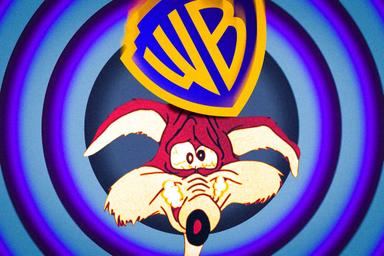
The twisty, infuriating story of how and why that noted cinephile David Zaslav—the guy who once picked a fight with a 93-year-old Clint Eastwood—tried to shelve Coyote vs. Acme has already been exhaustively documented: It serves nicely to contextualize a film already styled as a David-and-Goliath parable. “The movie Acme doesn’t want you to see,” reads the film’s tagline—a nifty bit of anti-branding that uses the studio’s weight and legacy against it, jiujitsu-style. That Coyote vs. Acme has seen the light of day via an independent distributor—Ketchup Entertainment, which bought the rights for $50 million—is, in and of itself, cause for celebration. But what really matters is that the movie is good. The first sign that Burch and Green know exactly what they’re doing is the appearance in the prologue, set in 1952, of an animated version of Peter Lorre, a callback to the bulgy-eyed Hungarian character actor’s insertion into various classic Looney Tunes shorts. (In keeping with the existentialist theme, his presence collapsed the distance between Bugs Bunny and Bertolt Brecht.) The second is that Lorre’s character, a well-intentioned scientist working in a subterranean Acme lab, gets disappeared by his employers down one of his own portable black holes; one wonders whether Zaslav has any of those in his office.
The question of where Lorre has gone—and the point of the top-secret initiative known as Project Sisyphus—provides Coyote vs. Acme with its mock–legal thriller framework. “In [the original] pitch, there were shots from The Insider and a lot of the [John] Grisham adaptations and Erin Brokovich, these great genre pieces about corruption,” Burch told Letterboxd. “When I hopped on, that was a big part of the challenge and the fun, to balance that with these characters.” With this in mind, the writer set the story in the desolate strip-mall labyrinth of Albuquerque, which makes sense given the series’ use of the Southwest as the Coyote’s de facto hunting grounds. The impact craters carving his failures into cliffsides and stalactites slyly alluded to the Trinity test and the Roswell UFO crash in the original shorts, while Coyote vs. Acme also evokes Breaking Bad and Better Call Saul, load-bearing 21st-century allegories of petty malfeasance and failure. Hence the way Will Forte—an actor born to share screen space with cartoon pals—does what’s essentially a nifty Jimmy McGill riff as low-rent billboard attorney Kevin Avery, an ambulance chaser whose infomercials promise Acme’s two-dimensional victims quick cash payouts in exchange for being bonked, blown up, or worse.
Enter Wile E. Coyote, armed with a mountain of busted, faulty merchandise and a few props to better facilitate communication with his new legal team (“I Have a Limited Number of Signs,” reads one placard). Kevin isn’t interested in taking on the risk, but his bright-eyed niece-slash-intern, Paige (Lana Condor), is an idealist through and through. Gradually, she convinces her uncle to poke around in a conspiracy that stretches beyond what one sinister Acme honcho dismissively terms a “sordid affair between a bird and a dog.” That means seeking out buried clues, surveilling locations on both sides of the human-cartoon divide, and meeting up with a Deep Throat–style informant who seems to exist in proximity to the local carrot festival. The resulting media circus threatens to transform Kevin into a public pariah, while the costs of the case threaten his firm’s existence altogether.
There’s plenty of plot in Coyote vs. Acme, which follows Who Framed Roger Rabbit? in attempting to fuse a set of family-friendly figureheads with film-noir tropes. If it’s significantly less hard-edged than Robert Zemeckis’s hybrid classic—a dark-hued throwback filled with toxic waste and made under the sign of Chinatown—it’s still got the courage of its convictions. Like the Looney Tunes shorts, Coyote vs. Acme is willing to play dumb to let the subtext shine through. The idea that cartoon characters are routinely being abused to more smoothly lubricate the gears of capital is suggestive without being sanctimonious, while the use of Acme and its staffers as bad guys—including a superbly cast and game John Cena as ace litigator Buddy Crane—gives the filmmakers nice ammunition to take a few in-house potshots as semi-friendly fire. The film’s resonance is partly a matter of timing: In a moment when the Warner back catalog has become a carrot dangled in front of different (and non-comedically malevolent) conglomerates, seeing some of its greatest characters take the stand and testify to their own worth is stirring stuff.
The self-reflexive satire of Coyote vs. Acme is complemented by the quality of its craftsmanship—the live-action cinematography by Brandon Trost is wonderfully tactile—and suffused by the abiding affection that it displays for its characters. One of the biggest risks that Green and Burch take is interpolating snippets of the original Road Runner cartoons into the mix; luckily, the carnage caused by—and inflicted on—this version of Wile E. is inspired enough to survive the juxtaposition.
Their other, even more daring, leap of faith has to do with the Road Runner and potentially violating the boundaries of his mutually antagonistic relationship with Coyote. Suffice it to say that Coyote vs. Acme breaks the golden rule only to reinforce it. Green and Burch are wise enough to understand that harm and healing are part of the same love language, and they use this vocabulary to engineer a crucial late-film exchange that manages to be genuinely emotional without ruining the theater-of-cruelty vibes. It would take a couple of pretty smart filmmakers to pull that off, especially under the noses of executives who can’t sniff the difference between art and content. What the beep do they know?