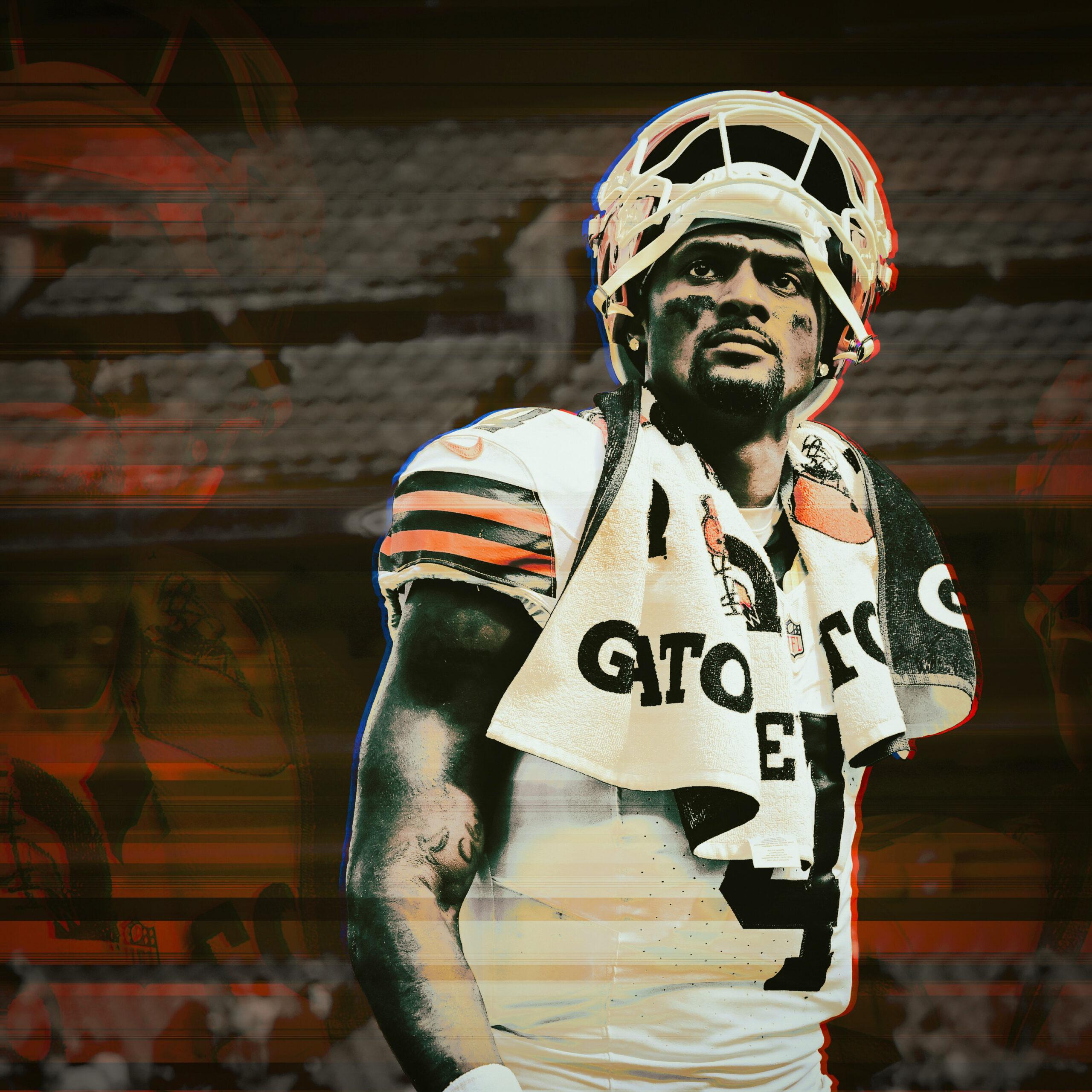

Cleveland Browns fans first lost their team in 1996, when then-owner Art Modell moved the franchise to Baltimore. They lost it again on Monday when first-year head coach Todd Monken named Deshaun Watson the team’s starting quarterback. The first loss was heartbreak incarnate, an owner who was simply looking to get richer elsewhere. The second was a giant middle finger to fans who have stuck around through decades of losing and debasement—and are about to experience another season of the same.
Naming Watson the starter two days after he gave one of the most out-of-touch postgame press conferences in recent NFL history—in which he called Browns fans “disrespectful” for booing him for what he felt were “personal” reasons not about his performance—is another low point for a franchise that has churned through 42 starting quarterbacks this quarter century, went 1-31 over a two-season stretch, hasn’t won a division title since 1989, and has never reached a Super Bowl.
The fans aren’t stupid, but the Browns organization has treated them as such from the moment it made the morally bankrupt decision in 2022 to trade for Watson and give him a $230 million fully guaranteed contract. The franchise stood by Watson during an 11-game suspension in 2022, his punishment from the league after more than two dozen women came forward with accounts of his sexual misconduct during massage appointments. They found excuses for his play when he was statistically one of the worst quarterbacks in the NFL in 2022 and 2023. And it wasn’t until after Watson tore his Achilles tendon (twice) in 2024, and was once again one of the league’s worst passers by nearly every metric, that team owner Jimmy Haslam admitted that acquiring Watson had been a “swing and a miss.” Watson has played just 19 games since what we can now and forever call the Worst Trade in the History of the NFL. And in that time, he’s been inaccurate (completing just 61 percent of his passes), indecisive (from 2022 to 2024, he held on to the ball longer than all but one other qualified quarterback and took 70 sacks), and often injured (he’s needed surgery on his shoulder and Achilles tendon).
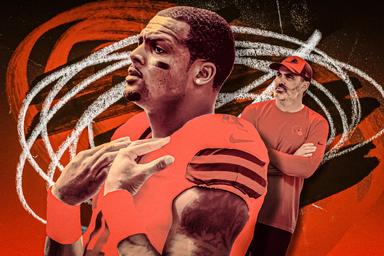
So how did the Browns wind up back here with Watson as their starter in 2026? Through a combination of hubris, a lack of long-term planning around the most important position in football, and a stubborn adherence to the sunk cost fallacy that has defined nearly all of Watson’s disastrous tenure in Cleveland.
Last spring, on the heels of Haslam’s comments about Watson, the Browns signed veteran QB Joe Flacco, traded for Kenny Pickett, and drafted a pair of mid-round quarterbacks—Dillon Gabriel in the third and Shedeur Sanders in the fifth. The hodgepodge plan made little sense in the moment—Flacco was on the wrong side of 40 and not likely capable of elevating a subpar offensive roster or mentoring two developmental QB prospects—and even less sense by mid-October, when both Pickett and Flacco had been traded away and Sanders was struggling under center. Then in December, the team opened a post-injury practice window for Watson, and news leaked that because his contract had a league-record $86.2 million dead cap hit, Watson would be on the team’s roster in 2026.
By the time Monken, who was hired in January, opened up a competition between Watson and Sanders this spring, the team was steamrolling toward this conclusion. The Browns went 3-5 with Sanders to close last season, and he ranked last among qualified quarterbacks in expected points added per dropback (–0.21, only slightly better than Watson’s league-worst mark of –0.25 in 2024). There was no possibility for a good outcome to this very sad competition—no solution that would make the Browns a respectable football team in 2026. Either way, the team would be paying Watson his $46 million salary. Either way, they’d wind up with a noncompetitive quarterback and an ugly on-field product. Yet the Browns still made the choice that would have the team’s own fans reacting to news that Watson had won the starting job like this:
An important note here: The Browns training facility is tucked between a quiet neighborhood and an industrial park in the Cleveland suburbs. It is not near a major thoroughfare, so these fans were probably going out of their way to do some drive-by screaming.
While fans were trolling from their cars on Lou Groza Boulevard, though, Cleveland’s spin machine was cranked up to 11. Well before Monken gave his first official comments on his quarterback decision Monday morning, X was flooded with posts from NFL insiders about how the Browns valued Watson’s experience, how Watson’s “body of work” during training camp won him the job, and how Saturday’s comments didn’t impact the team’s decision. Monken would later step in front of a microphone and explain that Watson gives the Browns the best chance to win, as if we didn’t all just watch the QB go 5-of-12 for 36 yards and an interception against the Bills backups on Saturday and haven’t been inundated with training camp videos like the one below, showing him getting intercepted while throwing into triple coverage:
None of this should be read as a defense of Sanders, who has been at best underwhelming and at worst unplayable since he entered the NFL. But given a choice between a guy who hasn’t played good football since before the pandemic and was credibly described by dozens of women as being a creep and whose contract was so bad that the NFL urged owners to make sure that much guaranteed money wouldn’t go out again and a second-year quarterback with a famous father who has poor pocket presence and holds on to the ball too long, well, I know where I come down. At least trying to develop Sanders into a competent starter is a more worthwhile endeavor for a team that isn’t likely to be competitive this season anyway.
The Browns would be better off just admitting that none of this is about trying to play winning football in 2026. But that would mean confronting one or more embarrassing truths: that they can’t afford to cut Watson, that Haslam either (a) was lying when he said the Watson trade was a misstep or (b) doesn’t have the backbone to double down on that statement, and that the new coaching staff has little interest in continuing the Sanders experience.
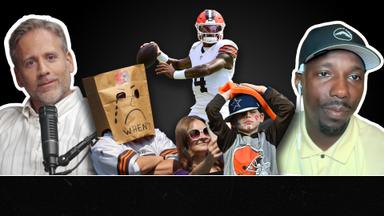
The correct move, of course, would have been to never trade for Watson in the first place. Racing to give up three first-round picks and subsequently hand Watson the largest fully guaranteed quarterback contract in league history, all while dozens of lawsuits were still pending against him, showed there was no moral line the Browns wouldn’t cross. Yet, in the years since, they’ve actually committed themselves further to Watson—by adjusting his contract to free up cap space in the short term, adding to Watson’s future cap hits. What was initially a five-year deal now comes with cap ramifications through 2030. If the Browns had cut ties with Watson this offseason, they could have at least spread the dead cap hit out across multiple years, like the Dolphins are currently doing with Tua Tagovailoa’s contract, and like the Broncos did after releasing Russell Wilson. As it stands now, though, the Browns would take on $86.2 million in dead cap charges in 2026 alone if they cut Watson before the start of the season—more than $30 million more than the Dolphins and Broncos took on in one year.
So the Browns are committed, but at what cost? Their credibility? Haslam and Co. lost that years ago. Their on-field performance? It’s not like the Browns have any track record of winning. All the franchise truly had was a fan base that, for decades, had been willing to forgive anything. They fought to keep the Browns name and colors when Modell moved the team out of town. They cheered for Brandon Weeden and DeShone Kizer and Johnny Manziel. Plenty of them even rooted for Watson, choosing to ignore all of the off-field issues that came with him, until there was irrefutable proof that he wasn’t any good on the field.
By naming Watson the starter on Monday, the Browns have set themselves up for a lost season. But what they stand to lose going forward is more consequential than just a bunch of games.