Why the Most Urgent Threat to America Is Actually a Bee
The giant, coordinated movement against them is not enough. Just ask these extremely credible experts.Why the Most Urgent Threat to America Is Actually a Bee
The giant, coordinated movement against them is not enough. Just ask these extremely credible experts.
What if I told you that the most frightening threat now facing the United States isn’t war, authoritarianism, climate change, oligarchy, the collapse of democratic institutions, rampant misinformation, or the price of oil? What if I told you that—according to a growing ecosystem of content creators, podcasters, and activists—our gravest menace is actually a small and little-known member of the honeybee family, one that, though it doesn’t look terrifying or even particularly remarkable at first glance, has the potential to destroy Western civilization? What if I then told you that this bee has what some online detectives think may be extraplanetary DNA—in other words, that its genome contains elements whose origins may lie beyond our world?
Would that get your attention? Would you close your tabs on pending Supreme Court decisions and ICE raids and learn about the danger you should really be worrying about? The one that, if the opposition claims are correct, could determine not just your future, but your children’s and your children’s children’s futures as well?
“You know how a metaphor works, right?” Bradley Vapors, the host of the Killer Bees podcast, asked me recently. “I tell you a thing is like another thing, and the comparison may be totally outlandish, because I’m only using it for shock value. When I tell you this bee is like the atom bomb, only a thousand times more dangerous to the future of humanity, I’m not exaggerating for effect. It’s the literal truth. It’s barely a metaphor at all.”
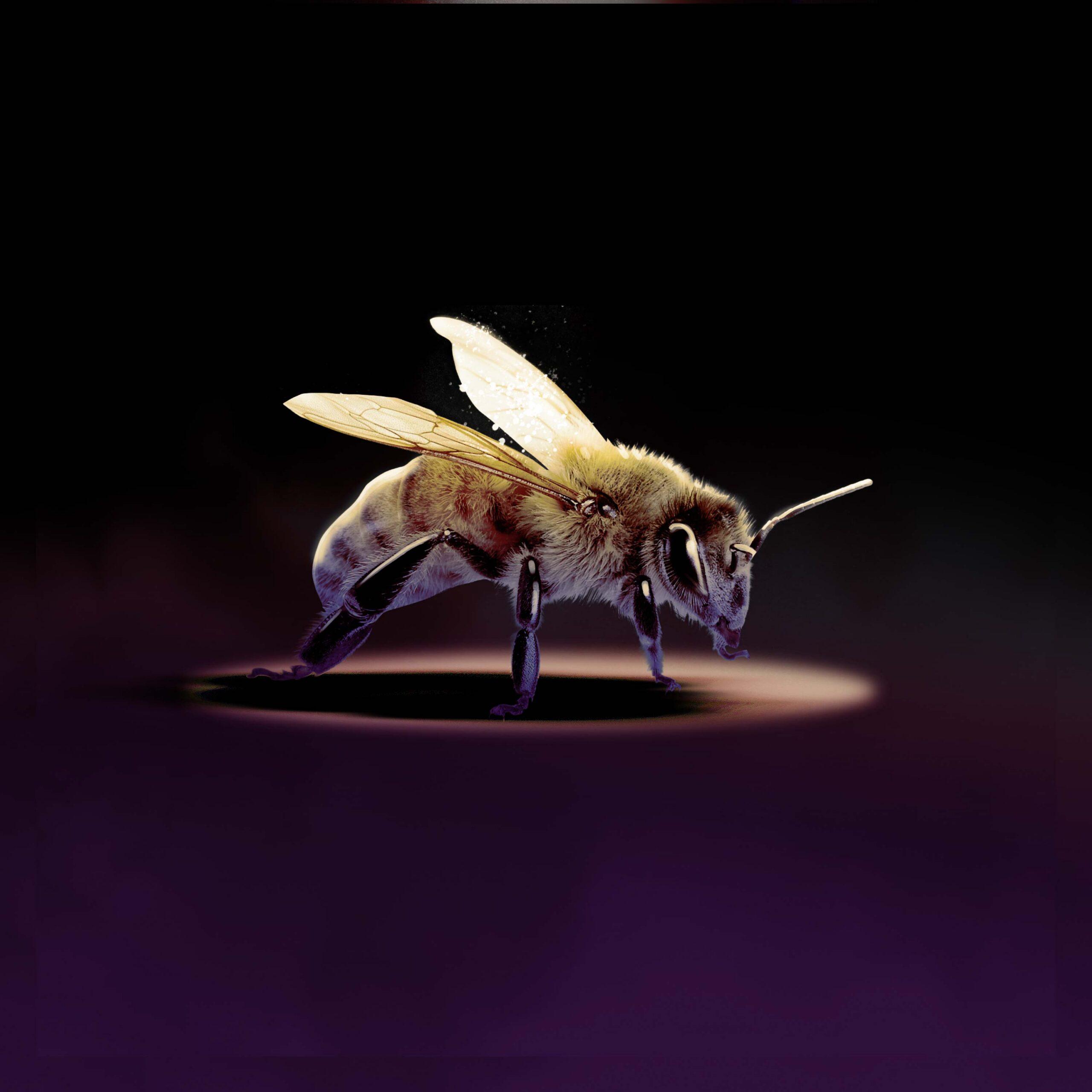
Kiplinger’s Demon Bee, Apis daemonica in scientific parlance, doesn’t look different from the bees you’ll find in any backyard garden. It’s less than an inch long. It has a fuzzy, striped body. Its eyes are black and elongated, like wraparound sunglasses; its faceted wings are translucent. The difference, according to critics, lies in its sting. With a typical bee sting, the insect’s barbed stinger injects a venom, known as an apitoxin, into whatever it embeds in; the apitoxin contains peptides like melittin, which causes pain in humans and animals, and phospholipase A2, which causes pain and cell necrosis. In nonallergic humans, the effects are generally mild. “It hurts like a son of a bitch,” Vapors tells me. “But you get over it.”
Apis daemonica’s sting, the activists say, is far more serious. Because of an apparent alteration in the mechanism that regulates the melittin–phospholipase A2 relationship—one so confounding to science that mainstream entomologists deny it exists, leading to burgeoning speculation in the online bee space that daemonica’s biology may be partly alien in origin—the apitoxin affects the human body in a manner unlike that of any other bee sting. “A human body with a daemonica sting will not feel pain,” says Vapors. “In fact, the sting doesn’t quote-unquote hurt at all. What it does is rewire the human brain. This should terrify every man, woman, and child on this planet.”
Melittin, Vapors explains, is supposed to activate PLA2. But he says daemonica’s venom includes a protein that somehow transforms the phospholipase into a mind-altering chemical. “Scientifically, it shouldn’t work, but it does. After the sting, you feel mild discomfort—psychological, not physical—for a few minutes, then … I know it sounds unbelievable, but your brain changes. You start to think, ‘Hey, maybe right and wrong are a little more nuanced than I was brought up to believe. Maybe I should try to get along with people.’ And the scariest part is that daemonica especially loves to sting children.”
“The bee makes you, for lack of a better word, woke,” says the Idaho pastor Will Dougson, who has spoken about daemonica on both his Twitch stream and his podcast, Paging Doctor Jesus. “It’s a known fact that exposure to the toxin makes you less judgmental. Less assertive. Good, God-fearing folks become more accepting of, and let me use the politically correct term here, different lifestyles. My kids would say it makes you ‘chill,’ but in case that sounds appealing to you, let me assure you that a whole nation infected by the toxin would be absolutely unable to wage war against its enemies.”
Dougson adds: “The bee is an abomination. Let me ask you this. Had you ever heard of Apis daemonica 10 years ago? God created each species of bee. God assigns each individual bee to a particular species at birth. The last thing we need is some strange new type of bee flying in like, ‘Buzz buzz buzz, I’m here to confuse the natural order.’ And make no mistake, son. This is one deviant bee.”
Miley Deficits, a 26-year-old former competitive beekeeper who rose to prominence after tying for fifth place at the 2022 NCAA honey-making championships with a keeper who used honey from a daemonica, says the main issue is one of fairness. “The bees are taking away our jobs,” Deficits, who now works as an influencer, asserted recently on her Red Ink podcast. “Well, I mean, at the moment they’re only taking away regular honeybees’ jobs. But where will it end? Ask yourself, how can your daughters compete in a world where all the rewards go to people who’ve been exposed to this bee venom? I’m telling you, it’s like a virus. Like measles, only real.”
So grim are the potential consequences for humanity, many of the bee’s most vocal critics insist, that we ought to turn our attention entirely away from other problems to fixate on it. “I keep telling people, it’s not that the other stuff you’re worried about—political corruption or whatever—isn’t important,” Deficits says. “It’s just that this is so much more important that we should really all be focused exclusively on this. Trust me, AI is going to solve corruption anyway, at least once the new frontier LLMs drop.”



More From Brian Phillips
To be sure, not everyone agrees about the scale of the threat Apis daemonica poses to humanity. I first learned of the bee from the Gold Smoke Chain Daddy podcast, hosted by former NBA journeyman Kraisin Blaze. Blaze, one of the loudest proponents of the theory that the bee has what he calls “outer-space DNA,” recently got into a social media dispute with Amanda Stern, a Caltech professor widely regarded as one of the world’s leading experts on apian biology. “Please stop scaring your audience with false and easily disproved claims about an endangered and ecologically beneficial creature,” Stern wrote on X. Blaze’s reply, a Grok-generated video of the Smoking Man from The X-Files vomiting into a bowl labeled LIBERAL IDEAS, has garnered more than 1.3 million likes on the social networking platform. (Blaze was recently profiled by ESPN in a story titled “Kraisin Blaze Really, Truly, to a Degree That You Can Barely Comprehend, Does Not Care What You Think.”)
“It’s ludicrous,” Stern told me over Zoom when I asked about the exchange. “Do you know how many members of Apis daemonica have ever been found in the wild? Seven. Seven! And I’m not talking about seven colonies. I’m talking about seven individual bees. There was one in Florida, three in California, two in Hawaii, and one in Kansas. That’s it!” When I pointed out that anti-daemonica activists would say that seven bees with venom as toxic as the Demon Bee’s could still unleash horror on the world, Stern sighed and performed a theatrical facepalm. “But the bee isn’t unusually toxic. I am telling you, I have studied the apitoxin under a microscope, and all this talk of alien proteins and rewiring brain chemistry is pure conspiracy nonsense. It’s all made up. They’re just normal bees. I think some of these so-called experts are so afraid of being exposed to anything that might make them more tolerant that they have to invent crises that aren’t really there. On top of which, there’s no record of these bees ever actually stinging anyone.”
“I don’t know, bro,” Blaze told me from Chengdu, China, where he’s averaging nine points and two rebounds off the bench for the Sichuan Blue Whales. “I asked ChatGPT, and it said a melittin sequencer that catalyzes PLA2 into a brain-morphing supervenom would have to be from an alien planet, because nothing like that could exist in the real world. Like, that’s literally not even how our human science works! Or look at Polymarket. People are betting the bees are going to wipe out human culture in six months or less. We gotta stop these fuckin’ bees. I’m all about love, bro.”
“My question for Amanda Stern, your so-called ‘bee expert,’” said the internationally bestselling fantasy novelist A.J. Howling, who tweets frequently about the bees and who has devoted part of her large fortune to funding lawsuits against them, “is this: If the bees are really a nonissue, then why, in the past six months, has The New York Times devoted more column inches to them than to data center construction? Why does everyone Ezra Klein interviews believe the bee is a bigger story than genocides taking place around the globe? Good heavens, I sometimes think that the Sifting Cap from my novel Roderick Plumb and the Flagon of Significance must have sifted too many people into Moron house.”
While the scientific community overwhelmingly supports Stern’s position that Apis daemonica is a normal and unthreatening part of the natural order—“We should be protecting the bees,” said one scientist, who asked that his name not be used for fear of reprisals, “not targeting them”—few online voices agree. One of Stern’s rare allies in the social media space is the gardener Darius Chen, who runs a popular TikTok account in which he dispenses horticultural advice and shows off his enormous gladioli. “I have one of these little beauties in my place on Oahu,” Chen tells me. “And the garden’s thriving. The bee’s good for the flowers, it doesn’t threaten anyone or anything, and as far as I can see, it doesn’t even compete with the other honeybees. It lives in the hive with them. They all seem to get along fine.”
Chen pauses, then continues. “I don’t know why this is only just occurring to me, but I’m starting to wonder if the daemonica isn’t just a regular honeybee that we’ve decided to pretend is different? Have we all gotten ourselves worked up over this bee for no reason?”
Both Chen and Stern point out that the anti-daemonica movement has spent enormous sums of money in an effort to turn the bee into a national obsession. “Do you know who named it the Demon Bee?” Stern asks. “A right-wing oil billionaire whose son works as a Diablo coach for Elon Musk. They’re doing everything they can to demonize—literally demonize!—this bee, which is just trying to live its life.”
“Listen,” Tom Kiplinger, the oil billionaire mentioned by Stern, counters, “it’s simply not true that the Demon Bee hasn’t hurt anyone. Why else would Fox News dedicate more than half of its programming to it? Thank God so many patriots have had the courage to oppose the bee, because without our brave TV sports analysts helping other people see the magnitude of the bee threat, I’m not sure President Trump wins in 2024.”
In Silicon Valley, the bee has been a source of both fascination and fear. “The effects of the toxin are obviously devastating,” the billionaire AI executive Amadeus Mario told investors in a recent funding call. “That’s why, for the good of humanity, our company has invented its own apitoxin, which causes anyone who comes into contact with it to crumble instantly to dust, while also unlocking all the doors of their house for some reason. We believe this technology is urgently needed to save the human race. It is also far, far too dangerous for us to ever release it to the public.” Benson Rong, Mario’s fellow CEO and partner in the venture, added, “We have already produced 500 million bees capable of spreading this toxin. Next stop: utopia.”
When asked how to get more people to care about this urgent issue, Vapors takes a beat to gather his thoughts. “Well, there are really two possibilities here,” he tells me. “One is that a strand of biological material from beyond our solar system somehow interfaced with the genome of the Western honeybee, creating a new species of flying predator hell-bent on morphing your children into low-T communist operatives with poorly defined jawlines. The other is that all of that is bullshit. And sure, if it’s bullshit, you can look at the whole cultural ecosystem that’s sprung up around the bee—influencers, op-ed writers, publicity-seeking C-list athletes, podcasters like me—and say it’s all part of a giant, coordinated effort to distract people from problems that are actually hurting them. And then, hey, maybe it does look like we’re stirring up hatred toward the bee to keep people from noticing that their country is being looted, and in that case maybe it would make sense to pay more attention to the president’s constant lying, the assault on voting rights, the limited release of the Epstein files, the AI industry annexing the economy, and all the rest of it.”
He shakes his head. “I get that. I do. But look at it this way: What if the stories about the bee are true? Can you really afford to worry about the Trump family making billions from crypto schemes if there could be a Demon Bee behind you at this very second? To me, focusing all our energy on the bee is the equivalent of a slam dunk thrown down by the best basketball player on the planet, Sophie Cunningham. Who I’m sure would be a key ally in this crusade if she weren’t concentrating all her energies on the only issue in the world that’s equally important.”
Unrelatedly, here’s a reminder that of the 510,000 student-athletes currently competing in the NCAA, fewer than 10 are transgender. And in 2023, an advocacy group dedicated to banning trans athletes from women’s sports identified only five competing at the high school level. Trans athletes are not only not taking roster spots away from cis athletes, they’re massively underrepresented in sports at all levels. Not to mention, multiple studies have found no evidence that trans athletes have any kind of competitive advantage over cis ones. Something to keep in mind the next time you wonder why the national discourse looks the way it does. You know how metaphors work, right?