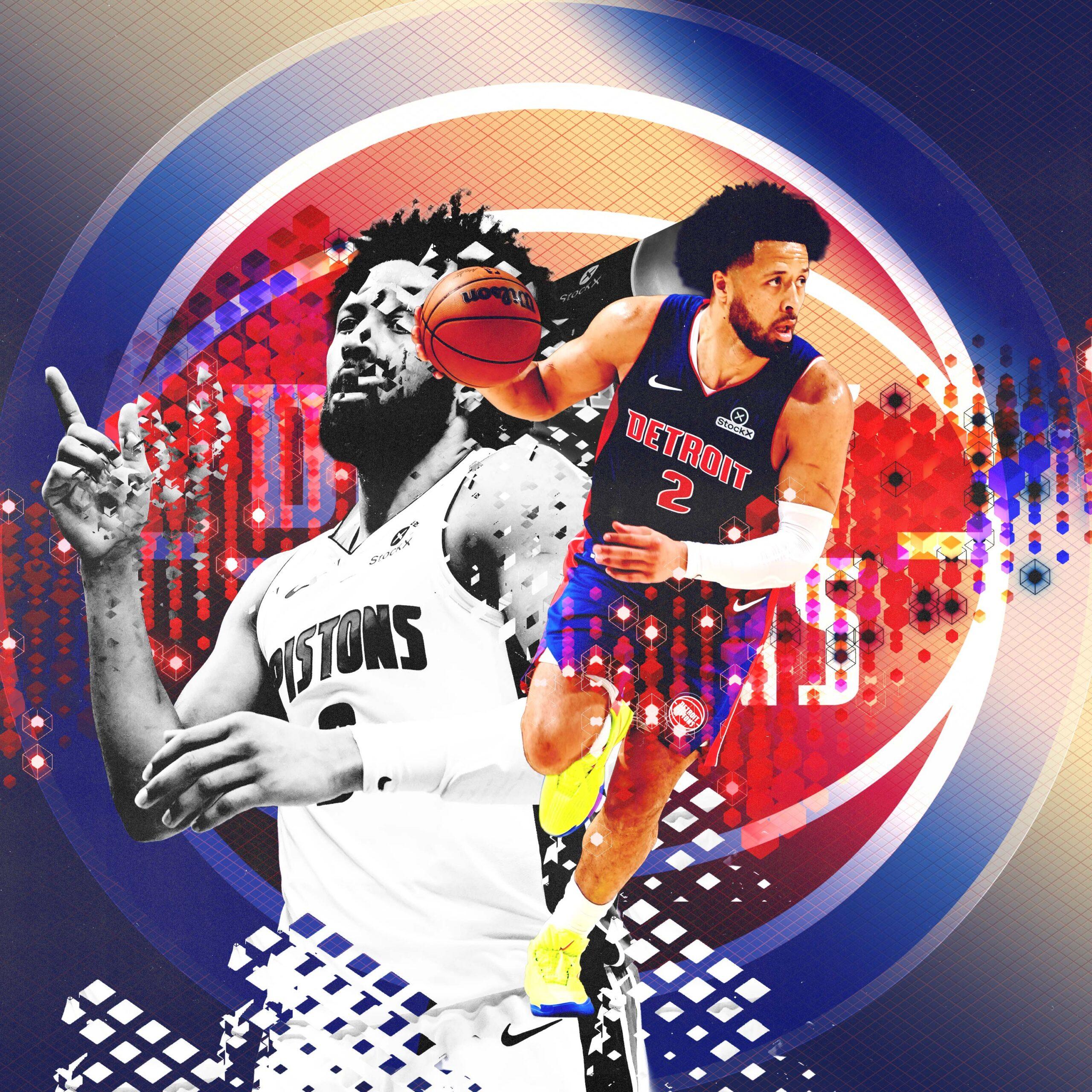

The Detroit Pistons just spent the summer that followed their winningest season in two decades by redefining their own identity. It’s a fascinating plot twist. Here we have an ascending team with genuine ambition, and the means to quickly achieve it, pseudo-renouncing the style of play that just helped it win 60 regular-season games. It’s not an identity crisis, but if you wanted to call it that, I wouldn’t argue. An unusual albeit understandable call for some kind of transformation.
As the architect of a defending top seed that probably would’ve lost to Orlando in Round 1 if Franz Wagner were healthy, Trajan Langdon, Detroit’s general manager, had to confront a few difficult questions once his team was eliminated by Cleveland in the semifinals. In the aggregate, how much of last season’s dominance was sustainable? Can nostalgia be a guiding light? Is it even possible to improve weaknesses without disfiguring the key traits that made championship contention seem realistic?
He answered them this offseason by altering his team’s personality around Cade Cunningham without adding or subtracting any core pieces—illuminating, relatively quiet moves that will either propel Detroit forward or neutralize the progress it celebrated last year. In: John Collins, Isaiah Joe, Taurean Prince, Gary Harris, and Ebuka Okorie. Out: Tobias Harris, Isaiah Stewart, Caris LeVert, and Marcus Sasser.
It hasn’t been the most popular course of action. No big swings were made. The Pistons didn’t trade for Giannis Antetokounmpo, Kawhi Leonard, or Jaylen Brown. They didn’t make a hyper-aggressive statement that would be akin to the seemingly imbalanced deals executed by the New York Knicks and Orlando Magic for Mikal Bridges and Desmond Bane, respectively, in recent years. Instead, they kept their powder dry and shape-shifted on the fly, inverting their makeup with a few decisions that clarify the organization’s on-court priorities. For some, Langdon’s overhaul was either too conservative in its failure to tackle Detroit’s actual concerns or too radical in the ways it sanded down the recognizable qualities that made it such a force to reckon with in the first place.
We’re only in August, when just about every personnel decision seen over the past couple of months is little more than a calculated gamble disguised as preemptive maintenance. Personally, I’ve come around and kinda like the Pistons’ new look. What we have here is not a perfect roster, but one that’s more sensibly built in a league that’s constantly demanding self-reflection and growth—Bad Boys–era pastiche is endearing, marketable, and something of a template for success. But in today’s game, there was always going to be a clear ceiling on what that homage could accomplish.

More on the NBA
Before we go further, a Jalen Duren–sized elephant in the room must be addressed. Even though he’s been stuck in a frustrating contract negotiation that’s sparked trade rumors and discontent, I can’t see a future in which the Pistons won’t keep their franchise center. Anything else would be a massive surprise. The Utah Jazz fleecing the Los Angeles Lakers for Walker Kessler notwithstanding, restricted free agents hold very little leverage over their employers. Still, we’re talking about a 22-year-old whose arms are stuffed with medicine balls, sprouting from shoulders that were plucked from a mountain range. Duren just made third-team All-NBA, finished second for Most Improved Player, and led the league in true shooting percentage. He’s a cornerstone carved from granite. Now, to be fair, granite isn’t supposed to melt like it did during Duren’s cataclysmic postseason, wherein he briefly forgot how to play basketball.
October 1 is currently the deadline to sign his qualifying offer—a one-year, $9.6 million deal that would let him become an unrestricted free agent in 2027—but he’s integral to Detroit’s present and future in ways that would make that contract the basis for an ironclad malpractice suit if it came to pass. Duren could suffer a career-altering injury and wind up squandering more than a hundred million dollars, while the Pistons could jeopardize their long-term future by letting someone who’s led them in win shares for four straight years walk for nothing. Before that worst-case scenario happens, though, there are a number of contract structures (varying in length and dollars) to choose from; per common sense, I believe that one of them can make everyone happy. Too much is at stake for this not to happen. (My prediction: They’ll eventually agree to a contract that’s slightly above the four-year, $129 million pact L.A. is paying Kessler, which would keep the Pistons well under the luxury tax for at least one more season.)
Moving on—under the assumption that Duren will be on the Pistons next year—it’s unusual for any team to win more games in a season than it did in the previous two combined. It’s even rarer for the result of that success to yield a summer in which the roster gets reconfigured to the degree that Detroit’s has.
In an era when accurate outside shooting has cemented itself as a clear-cut nonnegotiable for any team that aspires to win it all, Detroit finished last season ranked 29th in 3-point rate and 17th in 3-point percentage. When Duncan Robinson, Detroit’s lone movement shooter, sat, the team’s offensive rating suffered a steeper drop than the Thunder and Lakers experienced without Shai Gilgeous-Alexander and Luka Doncic.
According to Bball Index, Cunningham—a definitional franchise anchor whose best interests should rest at the center of every single choice that’s made by Detroit’s front office—finished in the 10th percentile in “teammate overall gravity,” which is definitely not what you want for your most important player (although it’s less problematic when one of your players is Ausar Thompson, who’s regularly locking the opponent’s top scorer in a sarcophagus). None of these spacing issues were a serious problem until, predictably, they became one in the playoffs.
Beforehand, the Pistons were allergic to subtlety. This is who we are. What are you gonna do about it? It’s a crucial amount of moxie that can drag a team only so far. Deception and adaptability are also musts. Off-speed sliders that graze the dirt. Cunningham is smooth enough to cue Sade’s voice on the Little Caesars Arena’s PA system, but his supporting cast’s temperament was a lid rattling over a pot of boiling water.
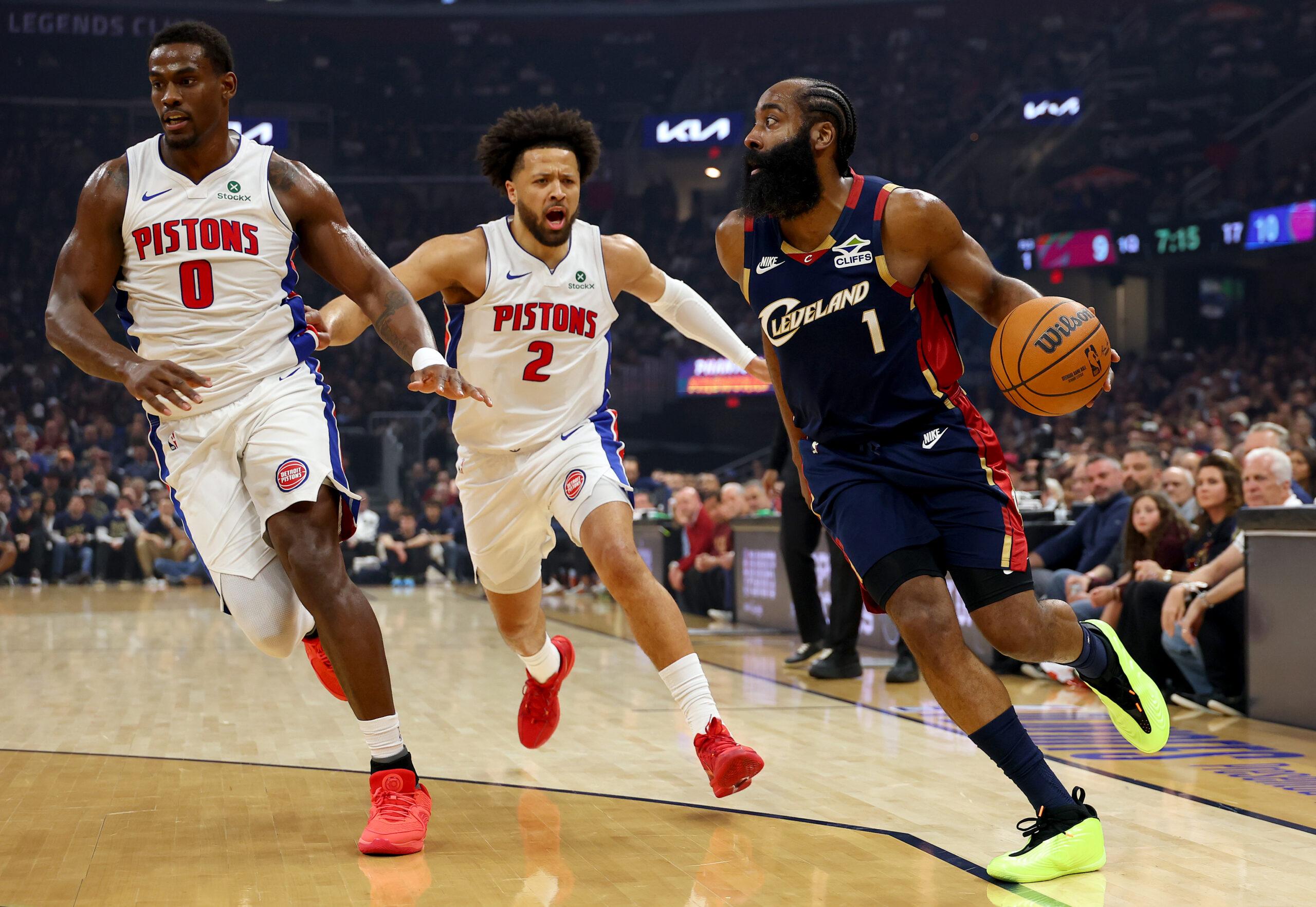
James Harden drives to the basket against Jalen Duren and Cade Cunningham
Sans shooting, the Pistons were reliant on an elite defense that dared referees to call even more fouls than the league-leading number they were already committing. It was a manic assembly line of hustle. Detroit recovered the most loose balls. It averaged more deflections and allowed a lower shooting percentage at the rim than any other team except the Thunder. Some defenses line the paint with velvet rope. The Pistons were not one of them. Instead, they enacted a preventative policy. Stop and frisk with flypaper. Kidney shots and sharp elbows swung hard enough to leave scars. Detroit suited up like a crew that truly believed its home arena should double as an infirmary.
Stewart was beloved as a spiritual connection to the organization’s glory days. His strengths functioned as the team’s backbone. At backup center, as Detroit’s longest-tenured player, Beef Stew was the most effective rim protector in the entire league. His weaknesses—clunky ball skills and an erratic outside shot—were a broader source of agitation, though. When push came to shove in the playoffs, he fell out of Detroit’s rotation.
Hence, the most emblematic switcheroo Detroit made all summer saw it swap the league’s most diametrically opposed Isaiahs. Out went Stewart, in came Joe. Irrepressible intimidation for scrawny skill. A wrecking ball for a locksmith.
It’s here where the gist of Detroit’s playing style starts to churn, from heavy metal scraping against stone to fingertips gliding across a piano. Joe is eloquent, an unassuming movement shooter who spent the past four seasons helping Oklahoma City’s offense shine. He doesn’t need the ball to disrupt an opposing defense, and he thrived as something of a decoy setting ghost screens for SGA. He (probably) won’t start, but he will have a much larger and more important role with the Pistons than he did for the Thunder, who had approximately 28 guards ahead of him on their depth chart.
If Detroit’s goal this summer was to make Cunningham’s life easier by prying open driving lanes so that he could attack shifting, distracted defenders as they veered off mark, acquiring Joe is mission accomplished. (Among all players who’ve attempted at least 1,500 3s since the 2022-23 season, none have had a higher 3-point percentage than Joe’s 41.5 percent.)
He’ll set devastating rip screens in Spain pick-and-rolls, work a mean two-man game with Cade out of Detroit’s signature Pistol series, drill open looks in transition, and, importantly, make the offense less dependent on Robinson (while turning the court into a lava pit whenever they share the floor). Joe can also run standard and inverted pick-and-rolls with Duren and Thompson, two essential pieces who’ll be looking for more ways to get involved in Detroit’s half-court offense.
The drawback for Joe comes on defense, where he’s dangerously close to (but not quite!) a liability. Even though he and Stewart play different positions, there’s a new Jenga tower dilemma in Detroit’s rotation.
An even more notable replacement was Collins for Tobias Harris, who signed a two-year, $31 million contract with the San Antonio Spurs. This change isn’t about expanding a one-dimensional offense so much as enhancing its key cogs. Collins isn’t self-sufficient like Harris, at his best, can be. He doesn’t create looks within the flow of a possession or bail his teammates out with improvisational buckets earned late in the shot clock. That stuff is valuable, for sure. But Collins should be far more efficient and dynamic in a tapered role that can better accentuate Cade, Duren, and Thompson.
Last season, Collins made 46 percent of his open 3s—one of the highest marks in the league—and converted 76 percent of his looks at the basket. Collins will rarely isolate and isn’t the type of presence who requires deference from others. Harris’s departure redirects more on-ball responsibility to Thompson, Duren, Daniss Jenkins, and possibly even Okorie, their rookie guard. Collins can also moonlight at the 5, run more traditional pick-and-rolls with Cunningham, and be a tight end–sized target for kick-aheads in transition.
When Collins shared the court with James Harden in Los Angeles last season, he took and made more efficient shots; his Moreyball frequency—a.k.a. the percentage of his field goal attempts that came at the rim or behind the 3-point line—rose 15 percentage points. If nothing else, it suggests that his fit with Cunningham will be seamless.
Accentuating their MVP candidate was a summerlong theme for the Pistons. In a much less heralded exchange, they swapped Caris Levert’s ballhandling for more catch-and-shoot reliability from Prince and Gary Harris. It’s pretty much the same “let’s surround our elite high-usage playmaker with as many spot-up threats as possible” playbook that Milwaukee followed last year with Giannis Antetokounmpo. The Pistons have significantly more talent than those Bucks did, but critics of their shake-up will politely ask that you not confuse action with progress. It’s a fair point. In all this deconstruction, Detroit has yet to fill one of its deeper holes: the clear need for a self-reliant, bona fide bucket-getting no. 2 option who can spotlight Cade and reduce his increasingly heavy load.
Around this time last year, I thought that Lauri Markkanen was the answer. For the time being, that ship has sailed. But in its wake, the Pistons still have all their draft capital and some tradable contracts that can be moved for the type of player who can relieve the on-ball pressure Cunningham feels in a playoff series.
More on the Pistons
The most intriguing solution is probably Kyrie Irving, who’s already assumed this exact same role beside LeBron and Luka. The natural question that follows that hypothetical target is how many future assets the Pistons would be willing to part with for a 34-year-old who missed all of last year with a torn ACL. The answer shouldn’t be “whatever it takes,” but this type of player is invaluable and hard to find. The Pistons would undeniably be better equipped for a legitimate Finals run with Irving in their starting backcourt. If he’s healthy, it’d be hard to overpay.
On the other hand, Tyler Herro is a knockoff version who should be avoided at all costs. He’s on an expiring contract and, as a conclusively terrible defender, might have the largest target on his back in the entire league when the playoffs begin. Michael Porter Jr. and Norm Powell have been rumored to be on Detroit’s radar, and they make sense in the same way Markkanen would have. But neither one is a high-usage ball handler, and both are lesser defenders.
Trey Murphy III splits the difference as someone who can space the floor, handle the ball a little bit, and guard multiple positions. Along those lines, if things go south for Indiana, Aaron Nembhard or Aaron Nesmith should be explored. Ron Holland II for AJ Green makes sense for everyone involved!
How aggressive will Langdon be this season? It’s a question the rest of the league is eager to find out. Detroit didn’t have to pivot this summer. It could’ve comfortably carried on with a formula that would win a bunch of games; re-signing Harris, not trading Beef Stew, and doubling down on the defensive-minded tough-guy approach that elevated it to within a game of the conference finals was the least complicated path forward. It was also fatalistic. Sisyphean, even. A route that would lull it into a false sense of security.
The combination of lottery reform, better health, and star movement will intensify the East next season. Jayson Tatum and Tyrese Haliburton are rehabilitated. Giannis was traded to a serious organization. Tyrese Maxey, Joel Embiid, LeBron James, and Brown are somehow teammates. Kawhi may or may not flip the conference on its head with a flying elbow from the north. Competition is fierce.
Detroit didn’t sit still. In a worthy attempt to strike a finer balance on both sides of the ball, it also struggled to indisputably get better. What we have instead is an organization that identified today as the time to evolve and then did so without backing itself into a financial corner. An adjustment period is ahead, and it’s unlikely that it will finish next season at the top of the East’s standings again. But while last year’s Pistons seemed like sitting ducks, this season’s group, almost regardless of how many games they win, is so much closer to where they ultimately want to be.