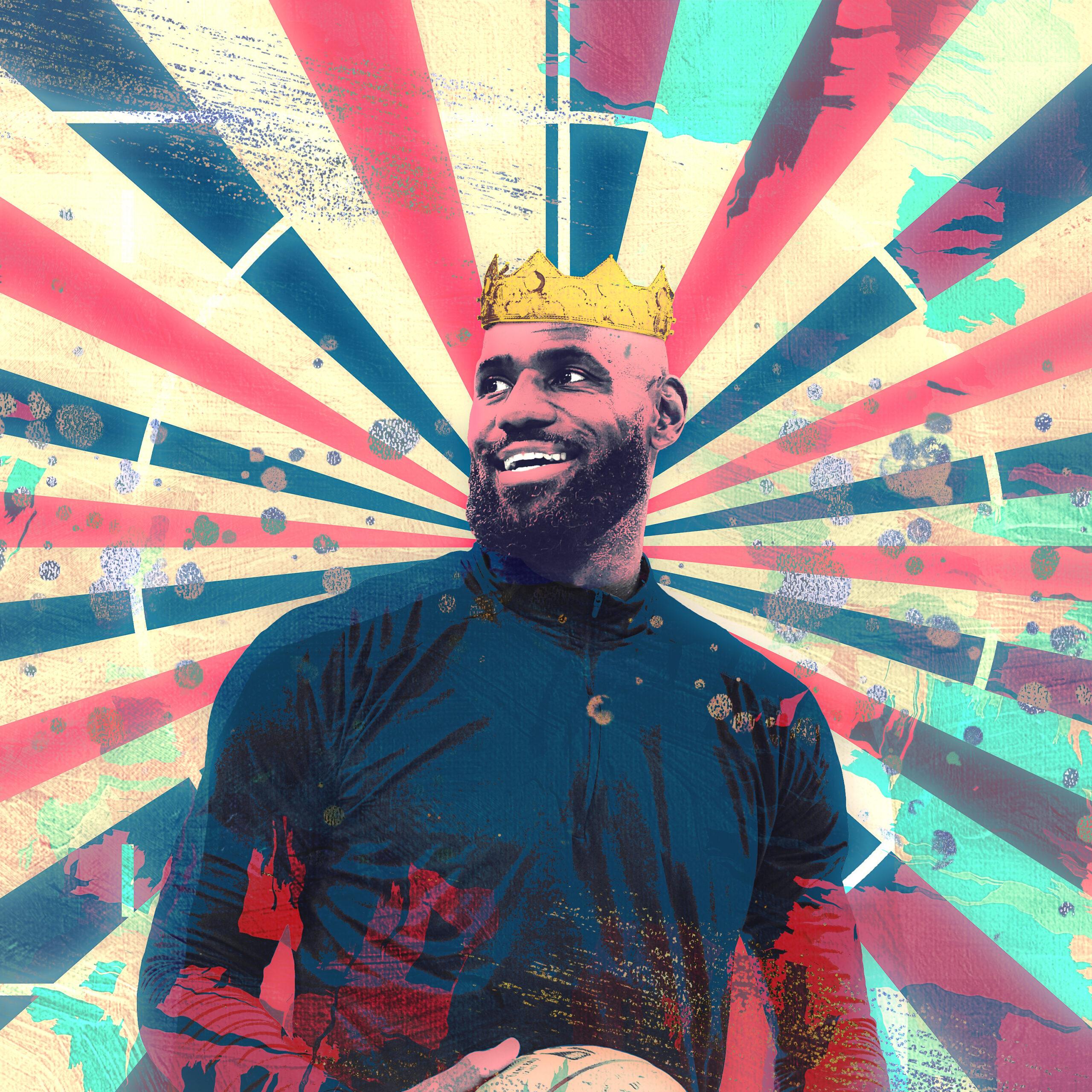

Last week, LeBron James shook up the NBA landscape by announcing a two-year, $8 million deal with the Philadelphia 76ers. This latest decision represents another remarkable turn in one of the most impressive careers this league has ever witnessed and proves that at age 41, this aging king can still reign over our basketball attention.
James is now the oldest active player in the league and simultaneously the best 41-year-old the sport has ever seen. Sure, he is no longer the five-tool freight train that dominated the Eastern Conference with eight straight Finals trips from 2011 to 2018, but as he returns to the conference he owned in the 2010s, LeBron remains a high-end contributor operating comfortably at an All-Star level.
So, besides one of the greatest bargains in pro basketball history, what exactly is Philadelphia getting in LeBron James?
LeBron the Scorer
Let’s start with the scoring. LeBron’s production has declined sharply in each of his last four seasons. Back in 2021-22, James was a consistent 30-point threat; now his points-per-game average sits closer to 20. He’s still efficient, but his volume has dropped. In his prime, he routinely launched upward of 20 shots a game, but last season in Los Angeles, that mark had dropped all the way to 15.3, the lowest of his 23-year career. That could dip even lower next season in Philly, where he’ll share the offensive load with Joel Embiid, Jaylen Brown, Tyrese Maxey, VJ Edgecombe, and D-Wade.
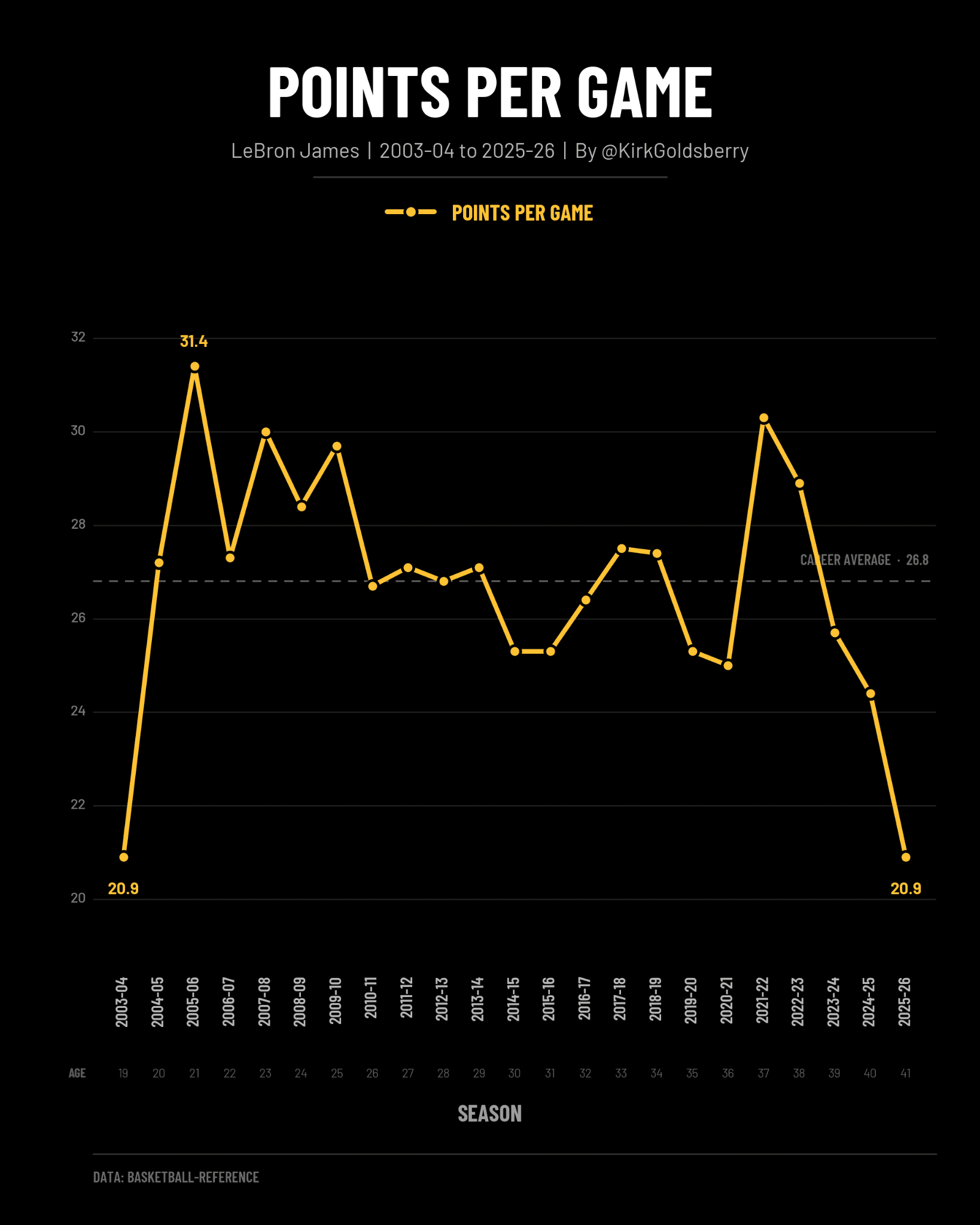
Look at that golden crown in the graph above. Despite the recent dip, the King’s basic scoring formula remains durable. Last season, his 20.9 points per game ranked 26th in the league, and, as ever, it all starts close to the rim.
In the Paint
LeBron is the NBA’s top interior scorer of the 21st century by a wide mile, and these interior buckets are still the lifeblood of his scoring—it’s the part of the floor where he does the majority of his damage.
Last season, LeBron averaged 11.1 points per game in the paint, down from his career average but still good enough to rank 20th in the NBA.
The clip below compiles his paint buckets from the 2026 playoffs—his last 10 games as a Laker—but we’ve dressed up his avatar in the Sixers uniform. As you can see, late-stage LeBron still thrives at the rack: His combination of size, power, speed, and smarts still allows him to both create and convert layups and dunks better than almost anyone. He’s not the athlete he once was, but stopping LeBron in the paint remains one of the toughest defensive chores in the NBA.
In the Midrange
Away from the basket, James is a serviceable jump shooter (complimentary). His jumper has evolved considerably over two decades. His very first career bucket was a midrange baseline jumper against Sacramento back in October 2003, and when he passed Kareem Abdul-Jabbar for the all-time scoring crown in 2023, he did that from the midrange too. At 41, James still manufactures a few of those looks each game, chipping in 2.6 points per night from that intermediate zone last season. That in-between floor spacing will translate seamlessly to Philly but, again, may be less necessary given the talent around him—especially when he shares the floor with Brown, who loves to operate in this area of the court.
Behind the 3-Point Line
For the most part, LeBron has become a more prolific 3-point shooter as his career has progressed. Seven of James’s eight most productive deep-shooting seasons by volume occurred in Los Angeles. The lone exception? Last season, when he dipped to 31.7 percent from beyond the arc. Not ideal, but the previous two seasons in L.A. had yielded some of the finest long-range shooting metrics of his career (39 percent on 5.4 shots per game combined). That perimeter competency is the primary engine behind his extended prime, and given the wealth of offensive talent surrounding him in Philadelphia, it’s entirely fair to expect LeBron’s shooting percentages to rebound in year 24. Next to Maxey, Brown, and Embiid, he will also enjoy more clean catch-and-shoot looks than he got down the stretch of last season, when Luka Doncic and Austin Reaves missed time with injuries.
Free Throws
And then there is the charity stripe. Between the regular season and the playoffs, James has racked up over 10,000 career points on free throws alone. That volume is staggering. His combo of deceleration, power, and clever body control still generates over five freebies per game. While his efficiency from the line has never been elite, only Karl Malone has made more free throws in NBA history.
LeBron the Playmaker
James is obviously much more than just a scorer—and the other aspects of his game will arguably be most essential to Philly’s success. LeBron remains arguably the most complete offensive player in league history, and his court vision is better than ever. During the 2026 playoffs, he ranked sixth among all players in points generated via assists, creating 18.3 points per game for his teammates.
One of the more underappreciated milestones on LeBron’s résumé is that he stands as the NBA’s all-time leader in 3-point assists—a testament to how heavily he shaped the modern spacing revolution and great news for his new friends in Philadelphia. What says brotherly love more than a clean kickout to an open corner 3?
While he will never catch John Stockton for the career assists crown (LeBron has 12,016; Stockton has 15,806), LeBron’s dimes will thrive in Nick Nurse’s system. James can be the glue that binds the component parts of Philly’s new-look offense, connecting Embiid’s mid-post roll game with Brown’s slashing and Maxey’s shooting gravity.
Last season, Lakers shooters—not exactly Ray Allen, Kyrie Irving, or Danny Green—converted nearly 39 percent of their triples off his passes, translating to nearly seven points per game from deep alone.
LeBron the Rebounder
Then there is the glass. James ranks 23rd all time in career rebounds, and last season in Los Angeles, he pulled down 6.1 boards per contest. This is a huge number to watch in Philly. Given the perpetual health uncertainties of Embiid, frontcourt depth is the biggest structural vulnerability of the new-look Sixers. LeBron’s ability to hold his own on the glass as a small-ball 5 in some matchups is one of the many fascinating subplots to watch in Philly’s upcoming season.
LeBron the Defender
Finally, let’s move to the defensive side of the ball. In the early 2010s, at his athletic zenith, James was arguably the most versatile defender on the planet—capable of locking down lightning-quick point guards like Chris Paul on the perimeter and matching the physicality of elite big men like Dwight Howard in the post.
Those days are behind him. At 41, tracking 23-year-old slashers for 80-plus possessions is no longer realistic, and his off-ball endurance has predictably waned. But like Lionel Messi in the World Cup, LeBron still possesses bursts of brilliance; he just has to budget them these days.
As LeBron picks his spots more, his overall defensive impact has dipped, but he compensates with unmatched tactical intelligence. He has seen every offensive set a hundred times over, allowing anticipation to bridge the gap left by physical decline. The graphic below maps out two advanced defensive metrics that both point to that same idea: His defensive impact has gone from elite to pedestrian.
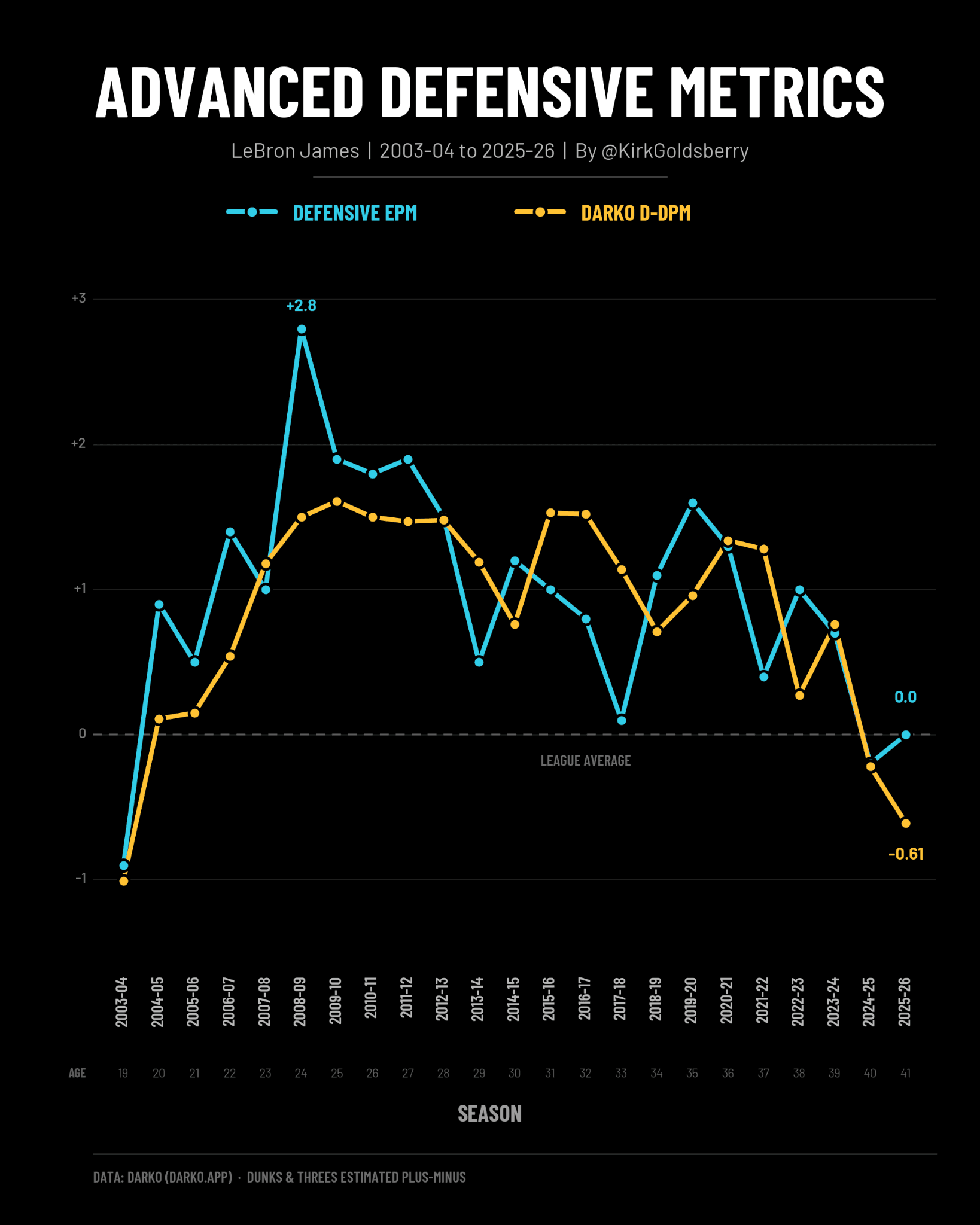
The defensive question marks around late-stage LeBron also swirl around this new-look Sixers squad. That side of the ball remains Philly’s biggest variable for the coming season; whether a soon-to-be 42-year-old iteration of James elevates the Sixers or exposes them on defense will define Philly’s ceiling.
There was a time when James could’ve helped this team uncover a new, dominant defensive identity. His Miami teams routinely ranked in the top 10 on defense, and that’s a huge reason they won it all twice. Both the Spurs and Knicks, last season’s finalists, posted top-10 defenses in the regular season, while the Sixers ranked 17th and LeBron’s Lakers ranked 20th.
While the addition of James unquestionably makes this Sixers team an intriguing new contender in the Eastern Conference, it’s unfair to expect a 41-year-old to consistently produce greatness throughout the NBA’s grueling calendar. But LeBron has proved that there’s enough in the tank to show up when his team needs him most.