“I hate endings. Just detest them. Beginnings are definitely the most exciting, middles are perplexing, and endings are a disaster.” —Sam Shepard, interview with The Paris Review
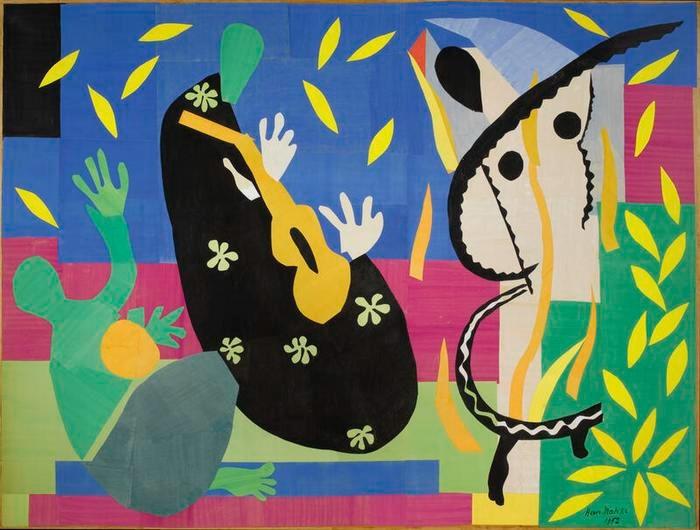
In the middle is a king in black, yellow-green flowers on his cloak. His face is hidden. He’s being a shy guy. He holds a guitar. To his right is a dancer and behind him, I don’t know. One website with a weird font called her an odalisque who “symbolises the Orient.” And all around them: shape and color. Blue and pink and orange, more yellow, more green. Lemon-colored petals in the air. Twirls of black, the dancer spins.
This is a collage of gouache-painted paper cutouts by Henri Matisse from 1952, a couple of years before his death. The Sorrows of the King. It was Matisse’s final self-portrait, a reference to Rembrandt’s David jouant de la harpe devant Saul (David Playing the Harp Before Saul). In Rembrandt’s painting, Saul’s a mess. All the ladies are way more into David now. They’re singing songs about him. Saul’s feeling weak, ineffectual, pissed. And even still, David’s music, it’s so beautiful. It’s really hitting. This guy knows his way around a lyre. Saul wipes tears from his eyes with a curtain and grips a spear. Later, he will throw that spear at David and miss the giant killer entirely. He will do this twice. People see the booming calves and rocking thighs and think of David as more of a power back, but he had some wiggle to him, too, very elusive. Get him in space, he could make guys miss.
Matisse’s piece doesn’t feel as tortured as all that. His king revels in a music of his own making, the room wild with joy, electric colors, surrounded by the things that have given him pleasure.
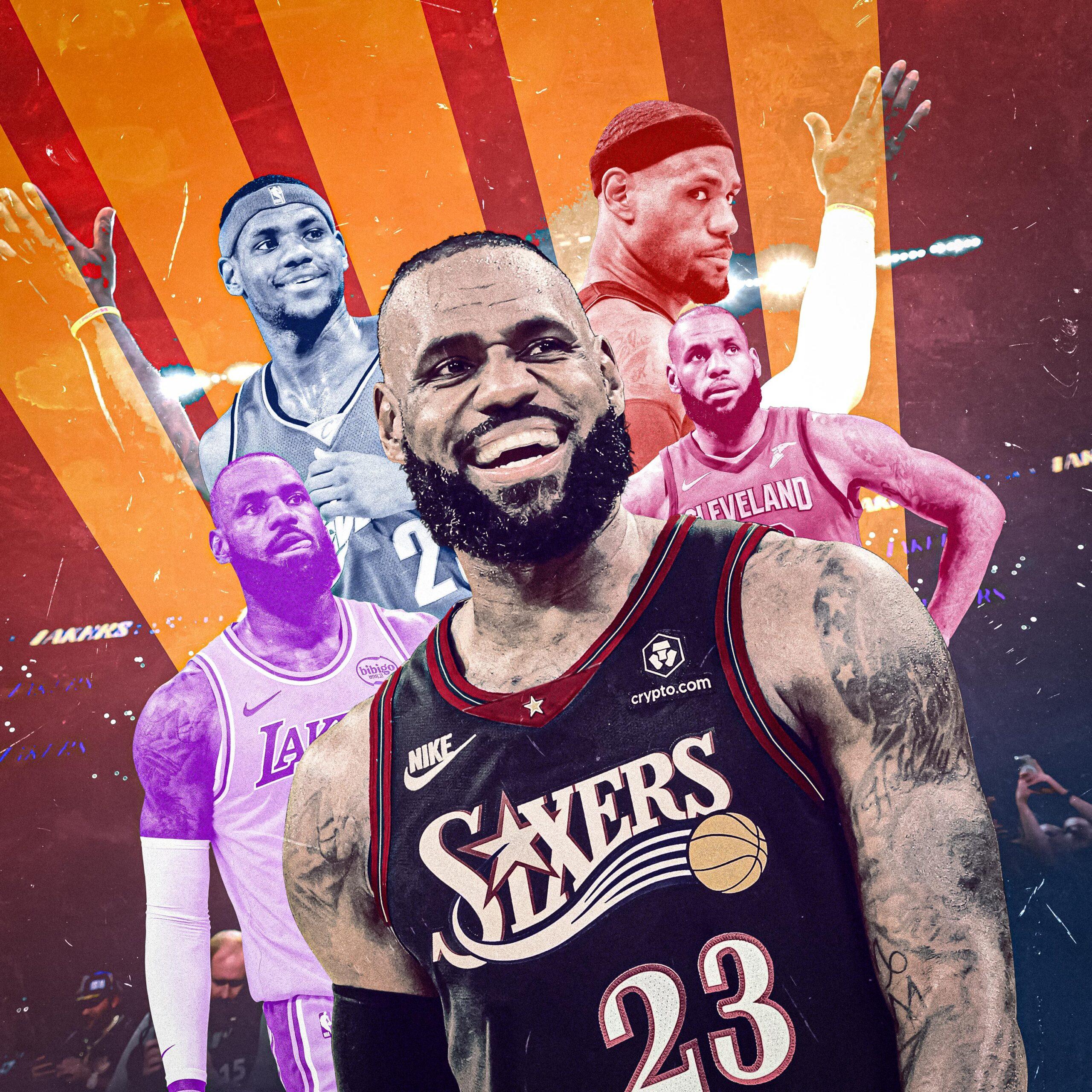
LeBron James is a Sixer. His announcement came Friday. We no longer need to wonder what he wants, what’s most important. The driving factor is no mystery. He told us himself.
The last few weeks have really been special. I’ve never been able to have no clue what to do and take real time to just think. I’ve had an incredible few months with all the people I love trying to figure it all out. This is my last decision. I’m not going for money. I’m not going for family. What am I really playing for at this point? I still want to sacrifice. I still want to work. I still want to grind. I still want to compete, to win and to have a chance at the feeling of winning another championship.
James took some time to make up his mind—so much so that the commissioner whined to the press that the league needed him to hurry so it could finalize the national television schedule. But it’s understandable that LeBron wanted to chew on it for a little while. Endings are hard in general, and ending well is even harder.
Here are some things with good endings: “Smoke Gets in Your Eyes,” The Truman Show, “Mio Cristo Piange Diamanti,” The Straight Story, True Grit the novel, getting a large popcorn and refilling it before you leave the theater, Speaking in Tongues, the word panorama, “Illegal Smile,” “Wants” by Grace Paley, The Story of Ferdinand, Oreo milkshakes, True Grit the movie (the one from 2010), a guy in a tuxedo slipping on a banana peel, the George and Martha story where George gets his gold tooth, Pop-Ice freezer pops. All of them finish strong, end well.
And LeBron James wants to end well. Much has been said about LBJ as GM, as pioneer, as the patron saint of player empowerment. Less has been said about James as a writer. LeBron has been deeply invested in telling his story throughout his career, but choosing the Sixers almost feels like him putting the pen down. Sorry, what’s that? He’s picking up a camera crew? Ah! Well. Nevertheless. Either way, LeBron could have written a sentimental final chapter and gone with the familiar. Instead, he gave us one of the finest types of endings we have: a swerve.
It’s a fine illustration of the Art of the Swerve Ending. People think you’re doing one thing? Do another. Deviate, deviate with alacrity and a little flair for the dramatic. Yes, a swerve has certain prerequisites. There need to be people convinced the swerver will do something somewhat obvious. Strong prevailing winds. James could have gone to a team he’d already won two titles with. Or he could’ve gone to a team where he has famous friends who also like to golf. Or he could’ve gone back to the place it all started, reteamed with his old running mate Thomas Bryant, and tried to win another one in Cleveland. All three of those options would have made more narrative sense than Philly. But here’s the deal, fuck sense, narratively or otherwise. LeBron studied the options for his final chapter and said, you know what, let’s get weird. Also Allen Iverson was really cool.
Nobody, least of all James, wants to see his once-proud bonfire of a game fade to embers. In Philadelphia, LeBron can be the skeleton key that unlocks parts of the team that might otherwise go unexplored. Best-case scenario, everyone stays healthy, the chemistry is right, and the Sixers make a run at a title. Tyrese Maxey, V.J. Edgecombe, Jaylen Brown, LeBron James, and Joel Embiid mesh and become the most devastating starting lineup in the league.
Of course, there’s always a possibility that swerve endings can go south. See: Ewing in Seattle, Hakeem in Toronto, Iverson in Memphis. But James has not yet entered that phase of his game. He was a top 25 player last season, maybe even top 20. To say that about someone who is 41 is unprecedented, the same way it was when he was 40, and 39 before that, and 38 before—you see what I’m saying. The old bull can still buck.
Endings make people think about beginnings. Go back and watch LeBron’s first NBA game now, and it’s a feast for the eyes, a real buffet. Cavs and Kings. ARCO Arena. Sacramento, California, two days before Halloween 2003. Our hosts for the evening: Brad Nessler, Sean Elliott, Dan Majerle. The first thing out of Majerle’s mouth is “Mistake by the lake no more,” so, you know, seems like a fun hang. It’s messed up that his name is spelled Majerle but pronounced “Marley.” It’s unnatural. It’s indecent. I will not be silent.
It takes less than two minutes for Elliott to proclaim that James has “the best body on the floor,” and after LeBron’s back-to-back steals late in the first quarter, Elliott asks whether he can stand up and light a match. A few minutes after that, he will say James is his new favorite player. On more than one occasion, LeBron makes Elliott coo. At the 10:50 mark of the second quarter, James checks out for the first time. Elliott pleads with an imaginary Paul Silas: “Don’t take him out. Keep him in for 48.” James is 6-of-10 from the field. He has 12 points, three assists, and two boards. Nessler says it’s the first time all game they’ve been able to hear themselves talk.
Drink in the surroundings. See Ricky Davis’s sideburns. Let me take that again—see the face of God. Come face-to-face with the infinite. You think that’s a cheek? That’s heaven, friend. That’s hallelujah. Watch Chris Mihm brick a couple of deep fadeaways. Look at Terrell Owens, Dusty Baker, Jeff Garcia, Moses Malone in the arena. Nike flew Malone out special to have lunch with James earlier that day. Jim Gray’s the sideline reporter. He’s with Malone on the baseline, asking him questions about the drama between Shaq and Kobe, and it’s like come on, JG, read the room. We’ve got a blockbuster on our hands. Let Moses and the rest of us enjoy the show.
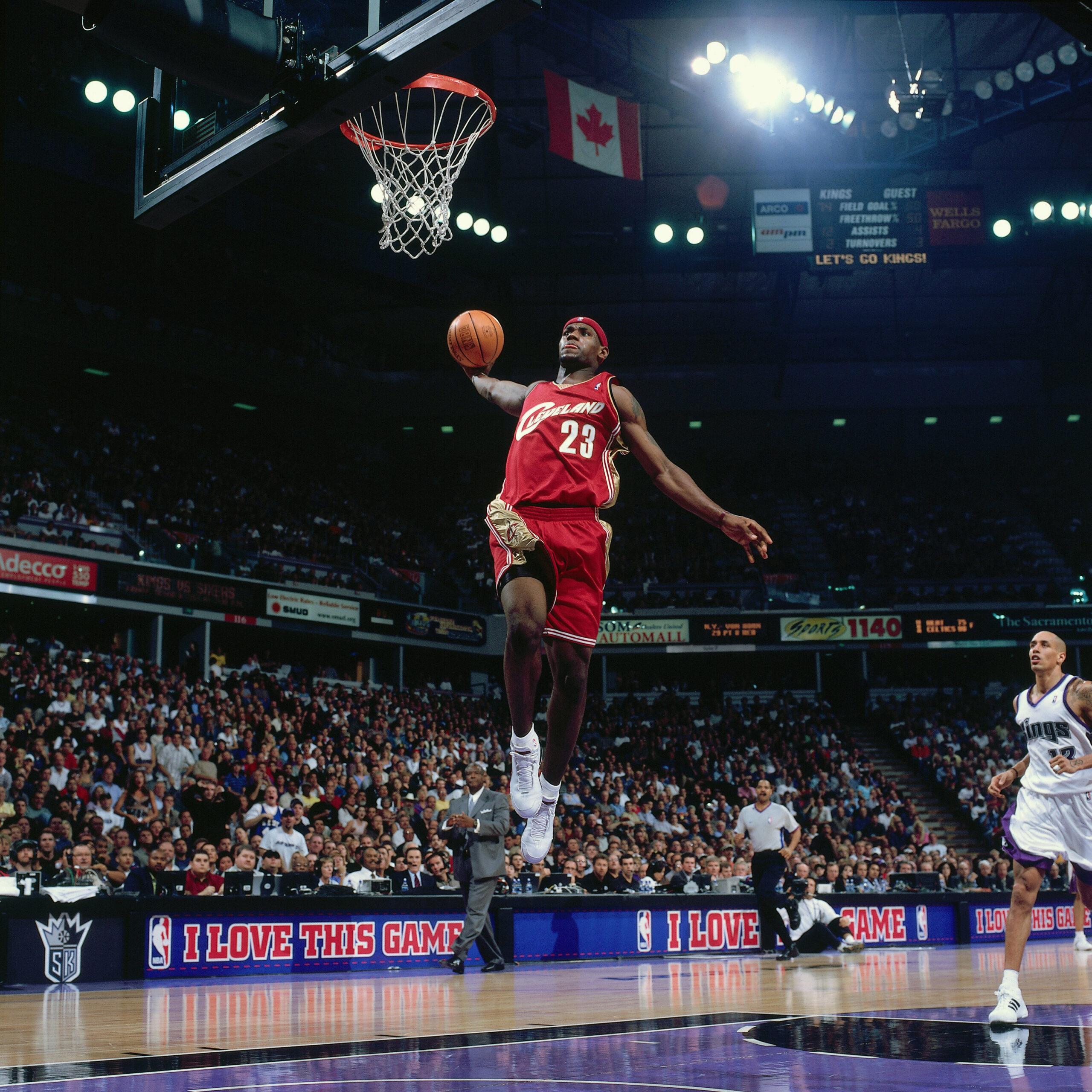
LeBron James during his debut in October 2003
With a smidge under 7:30 left in the third quarter, Silas calls a timeout with the Cavs down 11, and ESPN goes to commercial. When the broadcast comes back from break, Gray is back on the screen. He is holding a shoe, LeBron’s first signature sneaker, the Nike Air Zoom Generation, available December 20, 2003. Retail price $110. LeBron helped design them. Let’s go to Jim for more.
“He calls them beautiful aggression.”
Thanks, Jim. Apparently the H2 was an inspiration. Shout-out Tony Massenburg. Shout-out J.R. Bremer. Shout-out Darius Songaila. Chris Webber had knee surgery in June and tells Jim Gray he’s still recovering but is planning to go see some doctors in Alabama soon. At one point, Sean Elliott screams, “Bobby Jackson is undressing people out here.” James ends the game with 25 points, nine assists, six rebounds, and four steals. Carlos Boozer started alongside the rookie and hauled in a team-high 11 boards. This year, James will play against Boozer’s son. He will also play against his own son.
Here are some things with bad endings: milk, Moana 2, Long John Silver’s, Shawn Kemp in Orlando, drowning, porta-potties, Antoine Walker making his first three 3s, standing in the general vicinity of a bison, vacations, trying to see whether a button will fit up your nose, dinosaurs (some birds are actually pretty cool, though), pogo sticks, unfinished smoothies left in hot cars, the scene in Terms of Endearment where Jack Nicholson drives his Corvette into the ocean (that scene should have never ended, ever, it should still be going, always, it should last for all time), non-amphibious land creatures, the internet, The Wife. All end in disaster.
James is trying to avoid a bad ending later by making a good decision now. Decisions, decisions, decisions. It’s been one of the defining words of his career, ever since he took his talents to South Beach in 2010 to play with Dwyane Wade and Chris Bosh. LeBron had spent the first seven years of his career without a dynamic no. 2 and said no more. In Miami, he turned heel, got broken, and built himself back up. Then he went back home, to see whether he could win what he didn’t the first time around. Kyrie Irving was already there, and a Klutch-orchestrated Andrew Wiggins–for–Kevin Love trade brought the Minnesota big man to Cleveland. In the end, James fulfilled his promise.
His third big decision took him to the Lakers, which had less to do with the team’s roster and more to do with the fact that it played in Los Angeles. After a year of below-.500 basketball, the Lakers forked over just about every young player they had for Anthony Davis. James and AD brought them back to prominence. LeBron won his fourth title and his fourth Finals MVP and made a Space Jam. LeBron’s final decision slots into this lineage. It swerves. It echoes. He wants to play good, meaningful basketball at the highest level. He wants to win, wants to keep creating. It’s what he knows. It’s what he loves.
In 1941, Matisse was diagnosed with abdominal cancer. Surgery left him in a wheelchair and rarely able to leave bed. Between that and the arthritis, he couldn’t paint, he couldn’t sculpt. This is how the cutouts came to be the medium Matisse worked in throughout the final years of his life. He’d used the technique years prior when designing decor for an opera, and in the wake of his health struggles he blew it out. He accepted the constraints and did some of the most interesting work of his career, made new masterpieces, kept the art going. At 41 years old, as the newest member of the Philadelphia 76ers, this is the most interesting LeBron James has been in years. When you up the fallibility, you up the relatability. Now we will see how many more masterpieces he has left.