This Has Always Been Jay-Z’s Blueprint
Jay-Z said 2026 will be a year of “all offense.” Here’s what that really means.This Has Always Been Jay-Z’s Blueprint
Jay-Z said 2026 will be a year of “all offense.” Here’s what that really means.
The way Elizabeth Méndez Berry remembers it, she was standing by the bar and munching on hors d’oeuvres at a Robin Thicke album release party in the fall of 2003. Then a writer for Vibe magazine, Méndez Berry observed Jay-Z from a distance when he walked in wearing a Che Guevara T-shirt and a diamond-encrusted Jesus piece around his neck. She was taken aback by the audacity.
“The piece was smacking Che Guevara upside the head,” Méndez Berry tells me. “Communism and capitalism colliding with every step.”
Méndez Berry was inspired to write about that moment of walking contradiction—Guevara, a Marxist revolutionary, loathed obscene displays of wealth—in a critical essay on Jay-Z’s music as part of a 2003 book titled Classic Material. Sometime later, while waiting around a studio for an interview that never happened, Méndez Berry slipped a copy of the essay into the hands of Jay-Z himself.
The next day, Jay-Z called to tell her that she inspired him to write a new verse for a song titled “Public Service Announcement (Interlude)” on his upcoming release, The Black Album. She was impressed by his curiosity. “He wanted to engage,” she says.
Jay-Z also recounted their encounter in his 2010 memoir, Decoded, writing: “To have contradictions—especially when you’re fighting for your life—is human, and to wear the Che shirt and the platinum and diamonds together is honest. In the end I wore it because I meant it.”
The line that ended up in his nearly three-minute interlude was: “I’m like Che Guevara with bling on, I’m complex.” In the 2008 Los Angeles Times essay “Capitalizing on Che Guevara’s Image,” Ben Ehrenreich wrote that it was “about as likely as Che the jihadi, but never mind.” In other words: The image was as incoherent as it sounds.
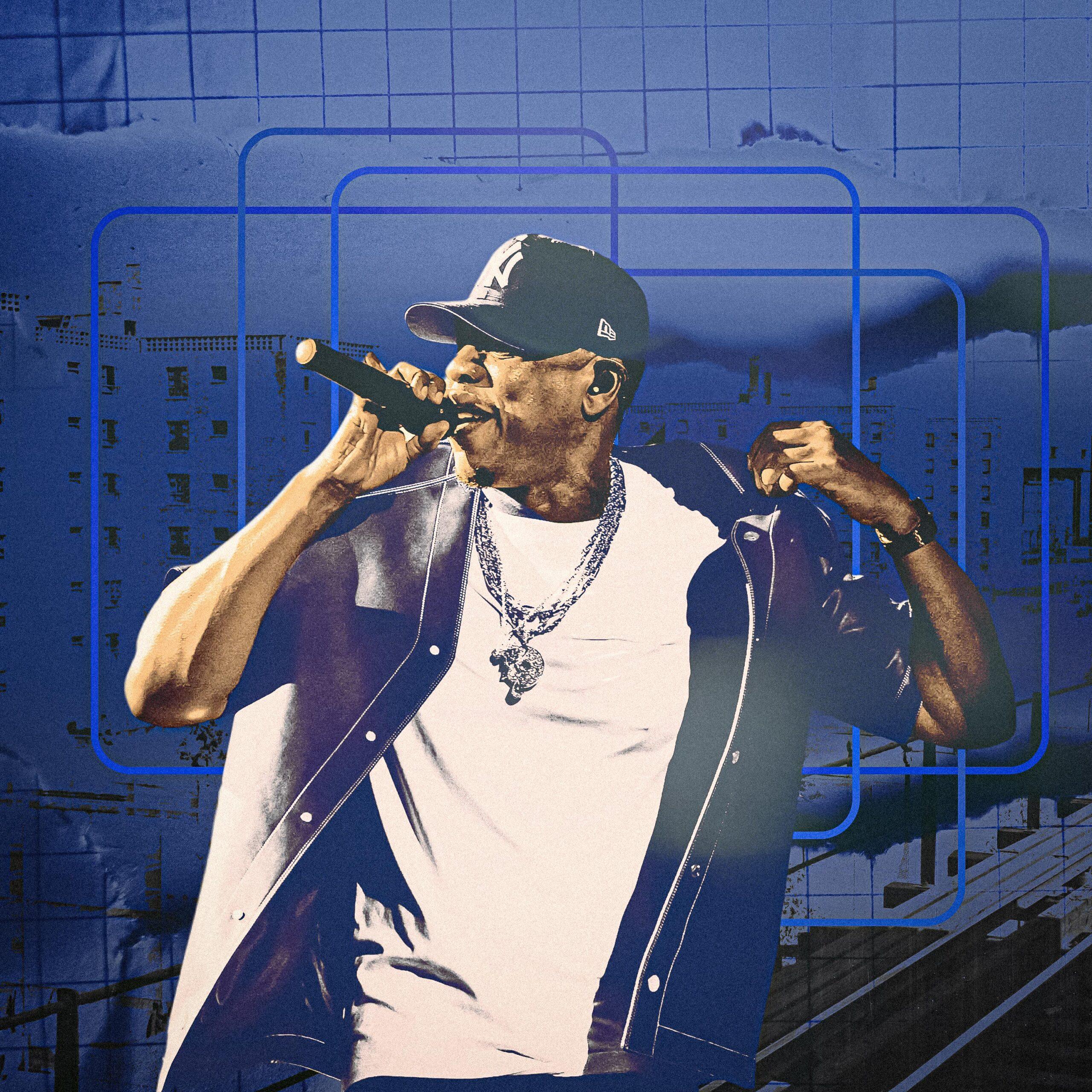
I thought of Jay-Z’s response to Méndez Berry after his Yankee Stadium residency two weeks ago, a three-day celebration that started with a tribute to the 30th anniversary of his debut album, Reasonable Doubt, and ended as a sort of coronation for one of the defining hip-hop figures of his generation. Sellout crowds of more than 45,000 fans packed into the stadium from July 10 to 12 to watch Jay-Z perform alongside legendary collaborators including Beyoncé, Rihanna, Nas, Alicia Keys, Pharrell, and others.
But what should have been a triumphant homecoming for the 56-year-old billionaire rapper and business executive took a surprising turn minutes into his first show Friday night. The 10-person band and 18-piece string section cut the music as Jay-Z moved to the center of the stage, backlit by a nearly 3,000-square-foot screen that spanned the outfield and beamed him all the way to the cheap seats.
He launched into a freestyle, intended to address his new partnership with Target amid Black consumers’ ongoing boycott of the retailer over its retreat from diversity, equity, and inclusion initiatives. “They say I sold out. Yeah, I did sell out. Three nights. I sold Yankee Stadium the hell out,” Jay-Z said, drawing cheers from the crowd.
He continued: “I’m a target? You aim, don’t miss that target. … You shopping at Amazon or you boycotting? You posting on Instagram? That’s Meta, boy. Stop it. Y’all know Google owns YouTube. You picking and choosing politicking as usual.”
Jay-Z then took a shot at Colin Kaepernick, the former quarterback whose NFL career ended after the 2016 season, when he kneeled on the field during the national anthem to protest systemic racism and police brutality. Kaepernick reached an undisclosed settlement with the league in 2019.
“Buddy took a check, I ain’t even mad at him,” Jay-Z rapped. “But along with that check you have to sign a non-disparagement. I’m the one they can’t control.”
Not only was Jay-Z’s characterization of the deal reportedly inaccurate, but it was another public betrayal of Kaepernick and his work. Jay-Z had once supported Kaepernick by wearing a black Nike football jersey with “Colin K” stitched across the back during a 2017 Saturday Night Live performance. He boasted that he’d turned down an offer to perform during the Super Bowl LII halftime show. But after Jay-Z and his company, Roc Nation, struck a deal with the league in 2019 to produce the Super Bowl halftime show, he downplayed the impact of Kaepernick’s protest—“I think we have moved past kneeling,” he said in a news conference announcing the partnership—and claimed he would be an agent of change from the inside.
Of course, there were no fact checks at Yankee Stadium earlier this month. The crowd whooped it up, and the show went on. Jay-Z’s freestyle wasn’t one of his best. And as an answer to his critics, it was the same old refrain wrapped in new verses.
In a genre that has long exalted the hustler, no rapper—not Kanye, not 50 Cent, not even Diddy—has been a more enthusiastic ambassador of the free market than Jay-Z. Whether dealing crack, rap, or cognac, his bottom line has always been the primary concern. “It’s just a rational response to the reality we faced,” Jay-Z explained in Decoded.
So, with the undivided attention of fans and critics at Yankee Stadium, Jay-Z resorted to his most enduring argument in a time of growing wealth disparity, when Americans are souring on capitalism in record numbers. His New York homecoming was his reminder that he’s still hustling—and that everyone should keep buying what he’s selling.
“He’s a person who has literally created songs the whole world sings that advocate for a … very corrosive but very seductive capitalism,” Méndez Berry says. “He’s made it about as seductive as it could be.”
Perhaps better than any rapper before or after him, Jay-Z is capable of crafting a glib response to his critics that reveals nothing about his intentions and certainly nothing about the reasoning behind them. It’s been an effective rhetorical device for more than 30 years now.
“He says all of these silly things,” says Demetrius Noble, an African American studies professor at UNC Greensboro and a spoken word artist, “hoping his skill as a rapper and the slickness of the lyrics will wash over these contradictions.”
But a gift for slickness is apparently not enough for Jay-Z. Even with near-universal recognition of his talent, smarts, and savvy, Jay has continually pushed for a different kind of acclaim, comparing himself to Black radicals from Rosa Parks (“I’m representin’ for the seat where Rosa Parks sat”) to Fred Hampton (“arrived on the day Fred Hampton died/Real n----- just multiply”) to Mumia Abu-Jamal (“the soul of Mumia in this modern-day time”). It’s been a tried-and-true bit of self-mythologizing in his music.
He’s made a very full-throated endorsement of capitalism as a liberation strategy. And because Jay-Z wants to be seen and recognized as some kind of Black revolutionary, the critique does bother him.Demetrius Noble
Jay-Z wants his journey from the Marcy Houses in Brooklyn to the most exclusive boardrooms in America to be rendered as a chapter in the civil rights movement. He believes it to be a form of Black freedom fighting and has outright said as much over the years. In Decoded, Jay-Z explicitly makes a comparison between the Black American struggle for civil rights and the struggle of small-time crack dealers turned rappers, like his old friend the Notorious B.I.G., hoping to deal their way out of the streets.
“It was definitely different, less easily defined, less pure, and harder to celebrate than a simple call for revolution,” he wrote. “But in their way words made an even more desperate case for some kind of change.”
As a plan for advancement, that ruthless sales approach might work for a teenage dope dealer. As a broader strategy for Black people, it is simply not viable.
“My thing with Jay is he often inverts collective social justice rhetoric for individualist capitalist pursuits,” says Jason England, a former English professor and cultural critic who published a scathing critique of hip-hop on its 50th anniversary. “They killed all our heroes. So we pivoted to people who achieved visibility, acceptance, and financial success. I get it.”
Jay-Z has regularly branded business opportunism as Black activism. For example, when asked why he agreed to work with a league that effectively blacklisted Kaepernick, Jay-Z responded that he could help more people that way. “We forget that Colin’s whole thing was to bring attention to social injustice. In that case, this is a success. This is the next phase,” Jay-Z said in a news conference with NFL commissioner Roger Goodell seated next to him. “So what are we gonna do? You know what I’m saying? [Help] millions and millions of people, or we get stuck on Colin not having a job.”
Later that day, without referring to Jay-Z specifically, Kaepernick made clear he wasn’t on board with the Roc Nation–NFL partnership. “I continue to work and stand with the people in our fight for liberation, despite those who are trying to erase the movement! The movement has always lived with the people!” he wrote in a post on Twitter. Eric Reid, who was the first player to join Kaepernick in his protest, was more direct in his response. “It looks like your goal was to make millions and millions of dollars by assisting the NFL in burying Colin’s career,” Reid tweeted about Jay-Z’s comments.
It wasn’t the first time Jay-Z was accused of cashing in at the expense of people he was supposed to represent. A decade earlier, he was positioned as the frontman of a nearly $5 billion development in his home borough of Brooklyn, not far from the projects where he grew up.
In 2004, when real estate developer Bruce Ratner wanted to buy the New Jersey Nets, bring them to Brooklyn, and build a new arena, he sought out Jay-Z to help with the proposal. Jay was touted as a part owner of the franchise, a local hero who brought the NBA home. It was all part of a 22-acre, $4.9 billion project that was supposed to include Barclays Center and a 16-tower “mini-city” with thousands of housing units.
At the groundbreaking ceremony in 2010, Jay-Z donned a construction helmet and wielded a shovel while standing alongside New York City Mayor Mike Bloomberg and Governor David Paterson, among other local officials. About 100 protesters gathered nearby, shouting “Shame on you!” and warning of eminent domain and the inevitable displacement of longtime residents and businesses. “I stand here representing hope for Brooklyn,” Jay-Z said. In 2012, he opened Barclays Center with eight sold-out concerts in nine nights.
Later, it was revealed Jay-Z owned only one-fifteenth of a percent of the Nets. Ratner and the Nets had leaned heavily on Jay-Z’s cultural capital to launch the project, and within a year, Jay-Z sold off his tiny stake in the franchise. In the years since, the project formerly named Atlantic Yards has been a bust. Many of the commitments attached to the deal didn’t happen, the developer never delivered the affordable units slated to be built above the railyard, and the project remains unfinished.
“Jay-Z was crucial to getting working Black and brown folks on board with the gentrification project,” Noble tells me. “[Atlantic Yards was] another example of Jay-Z being a tool of the white ruling class.”
From Jay-Z’s point of view, however, his involvement was an unqualified success.
“It’s like: I had ownership in a basketball team. In Brooklyn. That actually relied on me heavily to get to Brooklyn, right?” Jay-Z said in a March interview with GQ. “So yeah, I didn’t win the championship with the Nets. I still won.”
Earlier this year, Jay-Z sat down for a pair of two-hour interviews for that GQ profile, part of a strategy that he described as “all offense.” He was most determined to address his legal battle with a woman in Alabama and her attorney, Tony Buzbee. In 2024, the woman said Jay-Z and Diddy drugged and raped her after the 2000 MTV Video Music Awards, when she was 13 years old. Jay-Z denied the account in a statement posted to Roc Nation’s X account.
“Only your network of conspiracy theorists, fake physics [sic], will believe the idiotic claims you have levied against me that, if not for the seriousness surrounding harm to kids, would be laughable,” he wrote. “I look forward to showing you just how different I am.”
The woman dropped the civil lawsuit in February 2025. She told reporters that there were inconsistencies in the suit when it was refiled in December 2024 to name Jay-Z, but said she stood by her account. Jay-Z called this development “a victory.”
“I would not wish this experience on anyone,” Jay-Z said in a post announcing the end of the suit via the Roc Nation X account. “The trauma that my wife, my children, loved ones and I have endured can never be dismissed.”
Jay-Z has pursued legal action against Buzbee and the woman at least twice, alleging defamation, extortion, and civil conspiracy. A federal judge dismissed an extortion and defamation suit in July 2025, but Jay-Z is still pursuing claims against Buzbee and his client in federal court for malicious prosecution, civil conspiracy, and abuse of process.
The lawsuit against Jay-Z was the first issue addressed in his GQ interview. “That shit took a lot out of me,” he said. “I was angry. I haven’t been that angry in a long time, uncontrollable anger. You don’t put that on someone.”
Jay-Z also used the interview as an opportunity to respond to enduring critics of his business practices. “The only thing I heard coming up was the American dream. You could make it, if you pull yourself up by the bootstraps,” Jay-Z said. “I heard that my entire life—until we started being successful. Then it was like: You’re selling out because you’re making money.”
He also bristled at the label of “capitalist,” which suggests he either isn’t familiar with the substance of the critique—that his personal success is not a substitute for societal change—or simply doesn’t like its implications.
“He said it like it was some kind of racial slur used against him because he built himself up by his bootstraps,” Noble says. “But he’s made a very full-throated endorsement of capitalism as a liberation strategy. And because Jay-Z wants to be seen and recognized as some kind of Black revolutionary, the critique does bother him.”
Harry Belafonte, the legendary singer, actor, and civil rights activist, drew Jay-Z’s indignation in 2012 by pointing to him and Beyoncé as two Black celebrities who’ve shirked their social responsibilities. “They have not told the history of our people, nothing of who we are,” the then-85-year-old Belafonte said at a Swiss film festival. “I think one of the great abuses of this modern time is that we should have had such high-profile artists, powerful celebrities. But they have turned their back on social responsibility. That goes for Jay-Z and Beyoncé.”
Jay-Z fired back in the 2013 song “Nickels and Dimes”: “I’m just trying to find common ground / ’fore Mr. Belafonte come and chop a n---- down / Mr. Day O, major fail / Respect these youngins boy, it’s my time now / Hublot homie, two door homie / You don’t know all the shit I do for the homies.”
He expanded on those thoughts in an interview with Rap Radar’s Elliott Wilson later that year: “I’m offended by that because first of all, and this is going to sound arrogant, but my presence is charity. Just who I am. Just like Obama’s is. Obama provides hope. Whether he does anything, the hope that he provides for a nation, and outside of America is enough.”
Though Jay-Z said in 2018 he regretted attacking Belafonte, he has deployed that “my presence is charity” line in a variety of ways over the years. It came up again at the end of his Yankee Stadium freestyle: “My presence is a present, and my gift is rapping.”
“He says the same shit—that’s always been his thing,” England says. “It’s crazy, it’s easily picked apart, and people eat it up.”
His presence in certain movements has caught him some flak, like when his clothing brand Rocawear released a line of “Occupy All Streets” T-shirts in 2011 that was supposedly in support of the Occupy Wall Street movement. But Jay-Z was forced to pull the shirts from Rocawear’s website when it was revealed that none of the profits would go to the protesters or affiliated groups. By the next year, he’d taken to questioning the aims of the protesters. “What are you fighting for?” he said in a 2012 interview with The New York Times. “I don’t know what the fight is about. What do we want, do you know?”
He’s a person who has literally created songs the whole world sings that advocate for a … very corrosive but very seductive capitalism. He’s made it about as seductive as it could be.Elizabeth Méndez Berry
More recently, there was his 2022 attempt to bring cryptocurrency to the Marcy Houses as part of a collaboration with Twitter cofounder Jack Dorsey. The Bitcoin Academy was available exclusively to about 2,300 residents in the New York City Housing Authority apartments in the Bedford-Stuyvesant section of Brooklyn. The program, which also offered financial literacy classes, was immediately met with skepticism by local residents. “If you want to do something, fix this place up,” one said to The Guardian. The timing of the program couldn’t have been worse; Bitcoin and other cryptocurrencies suffered a steep drop in value that summer. The Bitcoin Academy website doesn’t show any scheduled classes for this year.
“A lot of hustlers turned rappers never figuratively stopped selling dope,” England says. “Which means their community are all potential fiends. And no dealer actually respects a fiend.”
That tactic of rebranding capitalism as social activism has been wielded by billionaires as a means of suppression and exploitation. The Epstein files online database turned up a 2014 email from Jes Staley, the former CEO of Barclays, written to Jeffrey Epstein. In it, Staley reflected on why poor Americans don’t storm into the streets to protest inequality and injustice.
“You want to know why we are not São Paulo, watch the TV adds [sic] on the Super Bowl,” wrote Staley, who was forced to resign in 2021 because he failed to disclose the nature of his relationship with the disgraced Epstein.
“Its all about hip Blacks in hip cars with white women. The group that should be in the streets, has been bought off. by Jay Z.”
In Jay-Z’s year of “all offense,” Noble suggests the Target partnership and Yankee Stadium residency were loyalty tests for his longtime supporters.
“Why Target? Out of all the motherfucking people … Target?” Noble says. “To me, the larger thing was to demonstrate to white power that ‘My allegiance is to y’all. Fuck these n-----.’
“The real question is really about us. When do we say enough is enough?”
According to England, it’s unlikely to happen anytime soon. He notes that Jay-Z has few hip-hop peers maintaining such a devoted fan base—and that there are no other hit rappers approaching 60 years old. Jay-Z’s longevity partly comes from his skill at self-reverence; he has several hit songs that repeat his nicknames—Jigga and Hov, the latter being a play on Jehovah, an Old Testament name for God—in the chorus.
“He has cultivated a fan base whose devotion goes beyond music,” England says. “For them, he’s a sort of sage beyond reproach. I find his story fascinating, and in many ways he reminds me of certain family members. I think he’s too cool and self-made to call his movement Trumpish. But it’s definitely cultish.”
Over the rest of 2026, Jay-Z will count on that same fervent support that has turned him into one of the wealthiest rappers ever. He has planned concert dates for London and Paris in September and Los Angeles in October. He will also be the subject of an eight-part HBO documentary released in the fall, yet another one of his collaborations with Rick Rubin.
The choice of Rubin is curious, given that he’s a known political conservative who industry insiders say leans much further right than publicly revealed. That has led some to speculate that Jay could be shifting rightward himself. After repeatedly criticizing President Trump during his first term, Jay-Z has mostly been quiet since Trump’s reelection and seems to have warmed to some MAGA members in recent years.
In 2024, Jay-Z and Roc Nation teamed with billionaire Trump mega-donor Jeff Yass and other Republican leaders in Pennsylvania to back a plan to use taxpayer dollars to fund private schools. A year later, he and Beyoncé were spotted sharing a table with Ivanka Trump and her husband, Jared Kushner, who is one of Trump’s senior advisers.
And Roc Nation CEO Desiree Perez, who reportedly served as an informant for the Drug Enforcement Administration in the 1990s, received a pardon from Trump in the final hours of his first term. That pardon has raised suspicions that Jay-Z and Roc Nation were forced to shush their criticism of Trump, given that lobbying and paying for presidential clemency are now reportedly established norms.
“It wouldn’t surprise me, in the years to come, if he comes out as a full-blown Republican,” Noble says of Jay-Z. “If he sees doing that as the avenue to gain entry and access to more capital, more market share, more opportunity to expand his empire, I think he’ll take it.”
At the end of his GQ interview, Jay-Z mused about learning from former Nets owner Mikhail Prokhorov that the Russian billionaire had a room on a higher floor of a hotel at which they both regularly stay. To Jay-Z, the challenge ahead was clear.
“The next step is owning the building,” he said. “No, you’re staying at my hotel.”