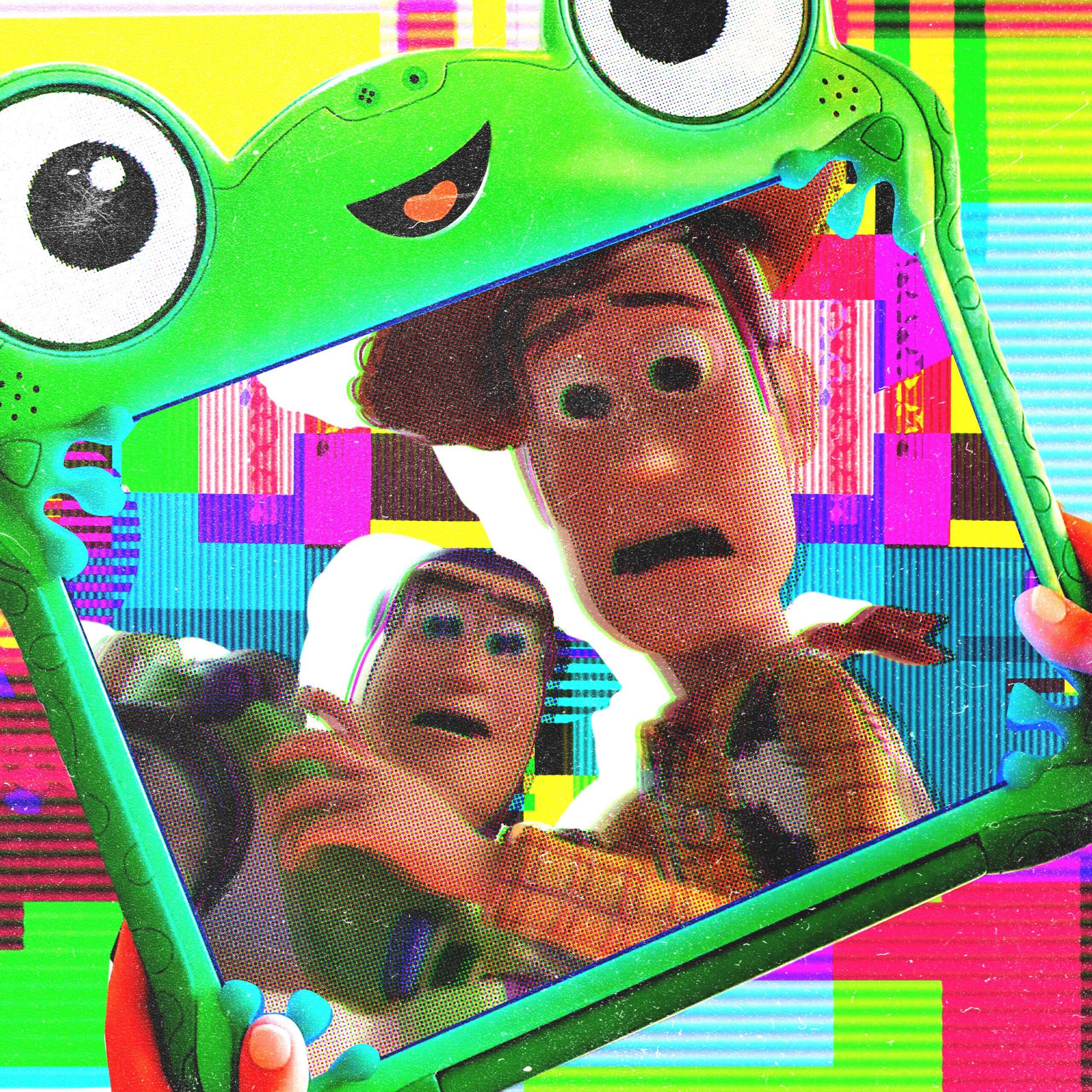

There was something charming about the cognitive dissonance of the original Toy Story: a state-of-the-art computer-animated cartoon about the tactile pleasures of playtime, a glimpse of the future suffused with nostalgia for analog textures. Understood in retrospect as the primal scene of the Pixar empire, John Lasseter’s film warrants consideration as one of the last truly important Hollywood movies of the 1990s, or maybe the first blockbuster of the 21st century. Its only real competitor on that front might be Terminator 2: Judgment Day, its secret spiritual twin. “Cool, my own Terminator,” says Edward Furlong’s John Connor after realizing that Arnold is at his beck and call; it’s fun to play with action figures.
The themes of boys coming of age and temporal dislocation were embedded smartly into Toy Story via the frenemy-mine dynamic between a cowboy rag doll and a hard-bodied, plastic astronaut. The heroic toys were voiced by the decade’s reigning big- and small-screen dads and deployed by Lasseter and his collaborators as symbols of postwar masculinity: cuddly but adversarial mascots of Pax Americana. “From out of the sky comes some little punk in a rocket,” drawled Randy Newman in “Strange Things,” giving voice to Sheriff Woody’s irritation at being supplanted in his owner’s affections by the alpha-male Buzz Lightyear—“laser envy,” snarks one onlooker—and excavating the subtext of a modern fairytale stuck intriguingly between stations.
Toy Story is a great movie: funny and trenchant and genuinely existential, as in the sequence where Buzz sees a television commercial for himself and experiences a PG-appropriate version of total ego death. It doesn’t matter that the film’s animation is dated; it’s aged well regardless because its surfaces are specific to their moment, and its sentiment is timeless. It deftly conveys the weightless excitement of one giant leap—“to infinity and beyond”—and the slumped melancholy of what gets discarded and left behind in the process.
Thirty-one years—and several stellar-to-serviceable sequels—later, Toy Story 5 arrives to tell basically the same story, supplemented with plenty of fan service and fine-tuned to channel a new set of extremely online anxieties. Once again, the status quo is under siege; this time out, the bad guy is an avatar of Big Tech, an anthropomorphic tablet programmed to fully monopolize the eyeballs of its users. “You’re dead where you lie,” moans one discarded plaything. “The age of toys is over,” wails another.
Obsolescence means expendability, and there’s always plenty of room in the garage for outmoded crap. We’ve been down this road—or shoved into this rhetorical drawer—with Buzz and Woody several times before. We know they’re not really going anywhere; the age of Toy Story will end when the franchise is no longer profitable, i.e., when the Earth crashes into the sun. What’s at stake this go-around, beyond Pixar’s return to box office supremacy, is the cognitive development and emotional stability of a human protagonist. This marks another shift. Toy Story 5 is unapologetically aimed at millennial parents who grew up with the earlier films and who want to bestow the characters—and the bittersweet life lessons they so earnestly embody—upon their children.

‘Toy Story’ Through the Years
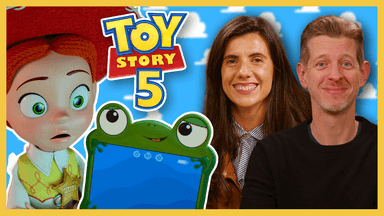
With this in mind, those hoping for a check-in with Andy—last seen heading off to college—will be disappointed (ditto for those who like to spin elaborate conspiracy theories about him and his family). The central figure in Toy Story 5 is Bonnie, who has aged up from 5 to 8 since Toy Story 4 (the one with Forky, which is about all there is to say about it) and is seemingly suffering from COVID-coded social difficulties. She walks around with her head down, as if allergic to eye contact; she’s too shy to try to make friends with the kids across the street. There’s something distinctly recognizable about this spectacle, as well as the click-through impulse that compels her parents to purchase a frog-green Lilypad tablet as a salve for their daughter’s loneliness—and a substitute for their own attention. (It’s around here that millennial parents in the audience may start squirming in their seats.) Within seconds of getting online, Bonnie is fielding texts from her dance class pals and invitations to sleepovers; the messages show up within a cheerful virtual swamp called the Pond, with its ecosystem of dopamine-dispensing games and chat bubbles. “You can take today to figure out how to use it. But then tomorrow we’ll start having strict screen time,” says Bonnie’s mother, her voice notably buried in the mix. It’s the sound of good intentions being tuned out, maybe forever.
It’s quotidian moments like these—the everyday rendered extra vivid on the far shore of the uncanny valley—that testify to what Pixar and its stable of filmmakers are capable of when they’re inspired. One of the studio’s enduring legacies is quality control—or it used to be in the early 2000s; by now, it’s known for running victory laps around its own valuable intellectual properties. These two imperatives have rarely converged. Suffice it to say that there won’t be 30th-anniversary appreciations of Finding Dory or Cars 3. But the visual storytelling chops and voice-acting talent in Toy Story 5, which adds Conan O’Brien and Greta Lee to the cast and Taylor Swift to the soundtrack, are the best that money can buy. They should be, too, because at $250 million, this film has the biggest budget in Pixar’s history.
The good news is that the quality control filter is back in place. The bad news is that the cognitive dissonance is also back, and considerably less charming. Toy Story 5 is frenetic en route to a foregone conclusion while its flaws pile up quietly in the margins. That’s OK, given three decades’ worth of accrued goodwill. Never mind that the premise of sentient toys skulking around under the noses of oblivious adults feels exhausted. Don’t sweat the standard-issue plotting, thinned satirical tone, and inevitable (and enervating) third-act chase structure (a gimmick that already reached its apex for this series in the airport conveyor belt set piece of Toy Story 2). Forgive the producers for recasting Mr. Potato Head with comedian Jeff Bergman after the death of supporting-cast MVP Don Rickles (RIP). Forget that the coda of 2010’s Toy Story 3 sufficed nicely as a send-off for a legitimately iconic group of characters, leaving them in safe hands on-screen while bequeathing them more broadly to the collective imagination.
That’s all nitpicking. The biggest problem with Toy Story 5, which is cowritten and directed by Andrew Stanton—arguably the most assured of Pixar’s in-house auteur project managers, and a filmmaker of real imagination—is that the film makes a show of concern without displaying much conviction. As a technophobic critique, Stanton’s film is occasionally startling but ultimately half-hearted; the tears it jerks so forcefully in the home stretch are of a suspiciously crocodile variety. For all her malign, plugged-in omnipotence, Lee’s Lilypad isn’t really a villain, nor even a fascinatingly ambiguous antagonist like Maya Hawke’s frazzled, insatiable Anxiety in Inside Out 2, one of the rare Pixar-quels that actually felt more additive than redundant. Rather, Lily is just another toy with a good heart, straight from the franchise assembly line. She means well. So does Stanton. But there’s a thin line between subtlety and indecision, and such distinctions are not cost-effective anyway. It’s hard for a movie to rail persuasively against the dangers of screen time when it’s going to be streaming in perpetuity on Disney+.
Yes, we live in a society. And yes, I know: Movies—especially Toy Story movies—are supposed to be fun. So why not just relax and give in to the pleasures of what is, in many ways, expertly calibrated early-summer entertainment? A film where the aforementioned O’Brien—hilarious, by the way—voices a caustic battery-operated toilet-training toy called Smarty Pants? Which brings back both of America’s dads, even the one who compared being a conservative in Trump-era Hollywood to living in 1930s Germany, to offer edifying speeches about the need to hold on and to let go? Which gives Taylor Swift a chance to block Olivia Rodrigo on the charts by strategically releasing her semi-catchy end-credits song “I Knew It, I Knew You” to streaming (a tune that, unlike, say, the very catchy “drop dead” or “the cure,” I can’t ever imagine listening to other than in a movie theater as it’s slowly emptying out, though Swift’s Oscar surely awaits)?
At this point, it’s worth pointing out that the conjoined futility and necessity of resistance was the subject of Stanton’s Wall-E, a wonderful, expressive, and occasionally scarifying sci-fi parable that was also impressively ahead of the curve in diagnosing the symptoms of tech-driven infantilization. Without sacrificing mainstream accessibility or narrative momentum—and with well-placed nods to vintage silent comedy, old-school musicals, and Kubrickian minimalism—Wall-E zeroed in on the yearning for material comfort and instant gratification that has led many to become prisoners of their own (branded) devices and to simultaneously ignore social and environmental collapse. Stanton’s knack for tapping into plangent, universal sensations—already evident in Finding Nemo’s fishy father-son odyssey—went deeper than usual; Wall-E’s signature image of small metallic claws in search of communion was an urgent and moving synecdoche for a larger need for connection.
Toy Story 5 is similarly preoccupied with the desire to reach out: The plot turns on the toys’ attempt to find a friend for Bonnie—one who doesn’t live in the Pond. The process feels mechanical, or, worse, algorithmic: a plug-and-play viewing experience, as smooth and frictionless as a touch screen. Full disclosure: The allotment of screen time is a wedge issue in my household, and I’m as susceptible as the next dad (or more so) to the material being dealt with here. I didn’t hold it together during the self-actualizing climax of Inside Out 2, with its preteen heroine reminding herself plaintively, “I’m a good person,” over and over, locating salvation in mixed emotions. The only thing more annoying than Pixar’s proven track record as emotional terrorists, though, is when the proverbial duck press malfunctions. The big, cathartic revelation in Toy Story 5 is centered on Joan Cusack’s plucky but eternally neglected cowgirl, Jessie, who did the emotional heavy lifting in Toy Story 2. Her love for Bonnie may be pure, but her arc is phony; it doesn’t so much build on the sniffle-inducing exposition of the earlier film as smooth it over.
And so it goes. Toy Story 5 is eager to raise the alarms and then grimly determined to mute them. Its guiding spirit isn’t Wall-E but HAL 9000—a congenial but underlyingly sinister simulacrum of emotion. The great joke of 2001, of course, was that HAL was a supercomputer made, to his detriment, in the image of his creators; he didn’t so much transcend human frailties as amplify them, an echo chamber of ulterior motives. Nobody is expecting Lily to be a character on the level of HAL, but she nevertheless has her own Buzz Lightyear moment when she’s forced to confront her true, mass-produced nature and tries to make a bold sacrifice as a result. The other toys are so nice that they talk her out of it, though. They’re determined to work together and stake out the middle ground; Big Tech is welcome in the big tent, as long as the age of toys continues. By the end, she’s one of the gang. You can buy your own Lilypad at Walmart. Hurry, they might sell out.