We All Live on ‘Love Island’ Now
Modern dating tells you there are always bigger and better options. Why would you walk away?We All Live on ‘Love Island’ Now
Modern dating tells you there are always bigger and better options. Why would you walk away?
Season 8 of Love Island USA has a borderline Freudian obsession with size. A few weeks into its run, it’s already featured several mega-beds for quasi-kinky play (and the villa’s first throupling?), plus some big ol’ doors to aid and abet the villa’s courtship dance.
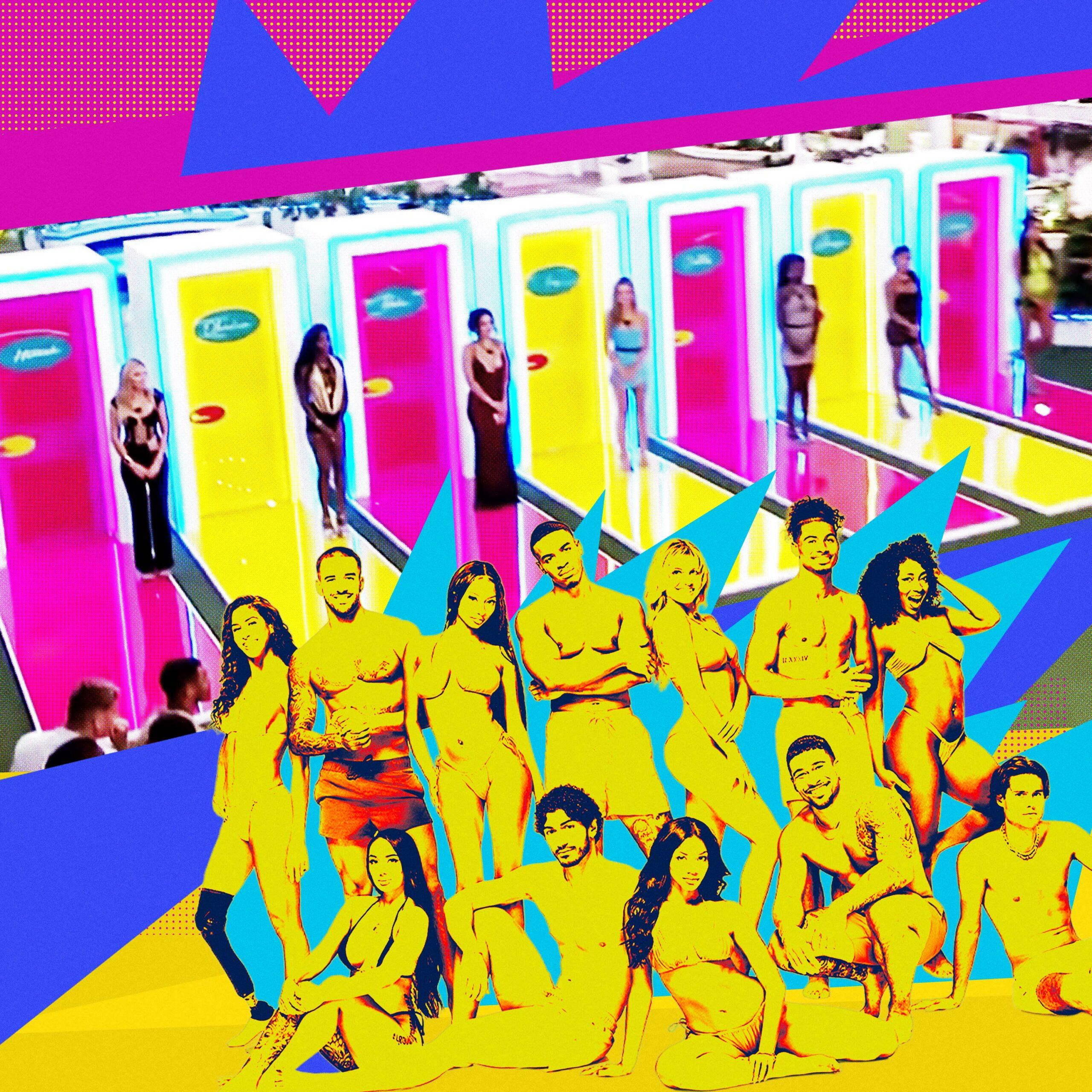
In Episode 1, to break the ice between the islanders and sort them into their show-mandated couples, the male and female islanders split up on either side of bright pink and yellow doors; each represented a preference—dog or cat person? missionary or doggy-style?—and they stood behind the one that spoke to their innermost selves. Based on this probing line of questioning, they settled on a match who miraculously also likes dogs and doggy-style.
That big door challenge is just a grander, lustier version of how we deprived non-islanders date: The villa’s neon panopticon, humming (humping?) spirit of gamesmanship, and looming bombshells merely add a fizz and pop to our otherwise mundane mating rituals. Beneath the set dressing, the challenge bears an uncanny resemblance to the games many of us play on the daily, when we broadcast our arbitrary but utterly essential preferences and hope to find someone on Hinge who feels the same way about religion, taco Tuesdays, The Office, monogamy, and doggy-style that we do. And then, just like on Love Island, we go through the door to find our best match, and we try to build a true connection while beset by temptations, sticky challenges, and Invisalign-propagated disease.
Functionally, Love Island and the apps are designed to keep you playing.
There’s an undeniable parallel between the overt gamification of dating on the show—where your connection gets “tested” by conniving bombshells and the sinister democracy of Love Island voting, and islanders couple up strategically to compete for a $100,000 grand prize (plus love! of course love!)—and dating online, where you need the right prompts, photos, and matches to come out on top, whether that means finding your perfect match or just stockpiling the most matches. Each system was created not only to lead participants to their one true match, but also to optimize the experience of making them feel like they’ve somehow beaten the competition.
The game always tells you there are bigger and better prizes out there, though. So why would you get up from the table and walk away with your winnings?
You might say that there’s nothing new about this. Romance has long been a zero-sum game, with two winners emerging from a heap of contenders: Antony and Cleopatra, Romeo and Juliet, Elizabeth and Darcy, Harry and Sally. Across time immemorial, potential partners have vied for each other’s love, fended off rivals, and played the game of charm and seduction to couple up happily (or, more realistically, quite tragically).
But outside of Shakespeare and rom-coms, past eras of courtship and loveship were structured by family, religion, social class, and elders’ edicts, not solely by the passions of the heart. While finding a partner was a competition, it was a social one, played by a broader network looking to make advantageous matches. It was diplomatic negotiation among factions rather than chess match between pairs.


As Moira Weigel explains in her book Labor of Love, dating as we now know it really got started in the late 19th century, when women could finally get their fucking asses up and work and could also experience the thrill of something even better than work—going out on the town and meeting hot singles. As Weigel describes the early dating scene:
The girls mostly worked in laundries and textile factories. The boys worked in industrial sweatshops. As soon as they punched out, they met up. As twilight wore on, the streets became like one large party, into the darkening corners of which couples slipped. Someone might see you, but nobody was likely to. The risk you took became part of your bond.
Sounds a little like sneaking out to the villa dock to make out with your forbidden lover!
In the swinging ’60s, the game of love got more fun, as another generation claimed additional freedom to decide who and how they dated. Perhaps not coincidentally, this was also when the reality TV pioneer The Dating Game turned a rapidly evolving pastime—dating for sport—into the kind of entertainment it was maybe always destined to be. And The Dating Game and successors like The Newlywed Game were met with a kind of outrage that might be familiar to Love Island fans: Producer Chuck Barris said that the Chicago Tribune review of the show was headlined “Daytime Television Hits All-Time Low”; in his memoir, Barris details the viewers and critics who lambasted the show for its dirty double entendres and manufactured setups. But all that controversy probably factored into its success: The Dating Game was a ratings smash, eventually moving into a slot in prime time and spawning a number of spinoffs.
Love Island’s like if you could swipe through a version of Tinder filled with actually hot people instead of fedora-wearing, fish-brandishing weirdos, and then win $100,000 if you pick the best one and get them to like you too.
The most significant change in the dating landscape, though, came with the sonic boom of the internet. No longer would you have to wade through the teeming masses in the real world to find love. Sites from Match.com to Tinder to Hinge brought the masses to you and tamed them into digestible, playable profiles you could swipe on, click, judge, discard, and forget. If you’re reading this, odds are good that you’ve played the game yourself: Per the Pew Research Center, about half of Americans under 30, and 37 percent of those from 30 to 49, have spent time on dating apps; one in 10 people in the United States met their partner on an app.
Love Island’s like if you could swipe through a version of Tinder filled with actually hot people instead of fedora-wearing, fish-brandishing weirdos, and then win $100,000 if you pick the best one and get them to like you too. Also flooding the zone is a sea of competition for your match, and you’ve got to lock down your connection using all the tried-and-true Love Island tools at your disposal: good banter; good pancake-making skills; expertly balancing loyalty to your partner with a willingness to find an even better one; lying convincingly, although even if you’re a bad liar it might not matter; making out with enough people but not just anyone; following the right relationship steps, from coupling up to deepening your relationship to going exclusive; and, most importantly, convincing your fellow islanders and the audience that you’re not being strategic at all.
On dating apps, you don’t have to worry as much about whether someone is dating you just to shoot Raising Cane’s commercials together at some point down the line. But the apps can feel just as competitive, only with a less obvious prize and fewer 10-person-plus sleepovers (unless you’re on Feeld, probably). Tinder cofounder Chris Gulczynski said, “Humans innately want to get to the bottom of the stack of cards. No matter if it’s an endless stack, you just want to see what’s next.” The fun is in flipping through the stack and optimizing your outcomes: You track what corny but also just suggestive enough opening line gets you the best responses, which Hinge photo of you at Machu Picchu earns the most likes, to separate yourself from everyone else who’s competing for the same people.
Love Island and most dating apps at least claim to angle the game toward monogamy: Couple up and stick together, and you can win the $100,000 and a joint Tru Fru commercial; couple up and stick together, and you can finally delete that damn app and throw your dream destination wedding. But functionally, Love Island and the apps are designed to keep you playing. On Love Island, voters and fellow islanders (and, we can imagine, the production team) gleefully punish you for settling down too quickly. That’s not the game, bro, Ace told Jeremiah when he committed too quickly last season. Your impish inner Ace might tell you the same thing.
Multiple studies of dating apps have found that they dehumanize potential partners and make people more self-centered about their dating choices. As one study put it, “What seems to be at stake is an ideology of love as a risk free, efficient interaction, deprived of the complications of embodied romance. It is a kind of love that strives to do without the painful backlashes of romance, the emotional toll of drama, the tragedy of loneliness.”
This is an incredibly dry and academic way of saying that our dating muse has become Herm Edwards. A big part of why I wanted to write this article was talking to an acquaintance about why he goes out with women even when he’s not particularly attracted to them. He told me he feels he needs to keep them around in case he does become interested, and maybe just as importantly, to feel like he’s winning a competition against other people who also want to date them. On Love Island, daters see each other as utilities to get off or to get ahead. The apps aren’t dramatically different.
Only about 10 percent of Love Island USA couples last after the show. A series that breaks people up via fan voting on a glitchy app obviously wasn’t designed to foster long-enduring relationships. Likewise, according to a study published in Computers in Human Behavior, people who meet on dating apps are less happy over the long term than those who meet offline. That study didn’t isolate the cause of their malaise, but it’s easy enough to trace it back to the lure of the game and the way it flattens out everyone who plays. How can the quieter delights and occasional disappointments of a real relationship, or life outside the villa, compare with the unknown possibilities and pleasures of the game? If you see your partner as a means to an end, how can they get off the spreadsheet and become a real person?
Dating now can feel like scrolling mindlessly on TikTok: No relationship or person can settle in long enough to make an impression.
I love Love Island and, in a past life, I loved playing the dating app game on expert mode. But the ride can burn you out if you don’t get off, its synthetic pleasures convincing you that every hard thing should be a little easier and every person a little more disposable. Stop me if you’ve heard this before, but we could benefit by slowing down and appreciating some real moments and people in between our Hinge scrolls and Love Island marathons. Dating now can feel like scrolling mindlessly on TikTok: No relationship or person can settle in long enough to make an impression.

But maybe there’s something here we can learn from Love Island: Sans phones or the other comforts of human solitude, the contestants do have to get to know each other and, one hopes, develop some level of empathy for their fellow castaways. That may not always stop them from disposing of each other like yesterday’s Shein bikinis, but it can lead to unexpected pairings based on a kind of mutual knowledge we don’t always allow ourselves in real life. It’s almost like putting a Brick around a relationship: How can we stop the game from turning and learn the weird, interesting things about people we might not know if we keep focusing on what’s next and how we could do better?
Bryce, this season’s token male model, says it best in Episode 1: “A lot of girls I meet have that checklist, and they’re just like, ‘He doesn’t have his college degree, he doesn’t have that.’ That’s not love. Love is like, you look someone in the eyes and you have, like, understanding for them and you feel them, like, who they are and what they’ve been through, and bring the better things out of each other.” A himbo answer, for sure, but it’s a description of love that at least sounds like love and not strategy or convenience.