
With each passing win on the New York Knicks’ march through the NBA playoffs, the celebrations in New York are intensifying. On Friday, after the Knicks stole a commanding 2-0 lead against the San Antonio Spurs, the pandemonium hit a new level. The watch parties inside and outside Madison Square Garden spilled onto Seventh Avenue. Brooms were swept, belts were whipped, billboards were climbed. Dozens of arrests were made. Even beyond the Sidetalk hopefuls reaching for virality in midtown Manhattan, New Yorkers across the five boroughs watched and reveled at bars, sidewalks, clubs, cinemas, concerts, and parks. Spike Lee paraded through Fort Greene like the pope parting a sea of faithful supporters outside the Vatican. The sound of the cheers carried all the way across the Hudson.
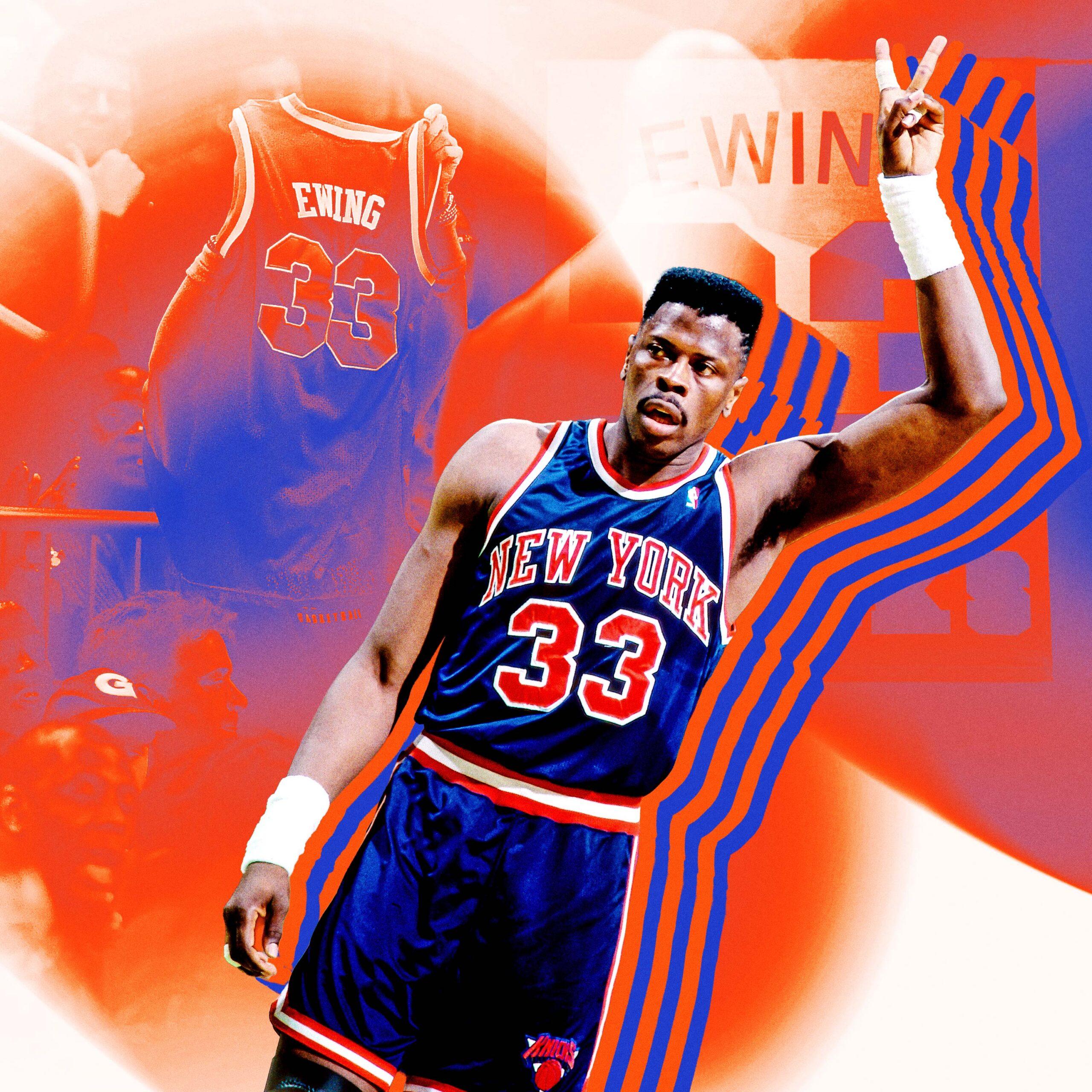
Amid the Knicks’ scorching postseason run, the streets of New York—and even those of every opposing team’s city—have filled with orange and blue jerseys bearing the family names of Brunson, Towns, Anunoby, Hart, and Bridges, as fans have proudly represented the starting five of a team that can almost taste its first championship since 1973. But alongside those of today’s players, there’s another name that stands out in the crowds: Ewing.
The prominence of Patrick Ewing jerseys in Knicks fans’ wardrobes isn’t a surprise or a new phenomenon. After all, Ewing is the Knicks’ all-time leader in every major statistical category save for assists (a record held by the great Walt “Clyde” Frazier). He was a first-ballot Hall of Famer who played in New York for 15 seasons, serving as the face of the franchise from the moment he was selected as the first pick of the 1985 draft to the day he was unceremoniously traded to the Seattle SuperSonics in September 2000, in the twilight of his playing career.
Yet as the Knicks have steamrolled through the playoffs amid a miraculous 13-game winning streak that could go down as one of the great runs in NBA history if they cap it off with a title, New Yorkers are returning to the player who was once labeled as the savior of the franchise—and who fell just short of fulfilling that promise. Ewing’s jersey has become a symbol for long-suffering Knicks fans who endured the years of close calls and false prophets, the many dubious trades and signings, Andrea Bargnani, and so much more. It’s a badge of honor for all those who never gave up on the Knicks—and a salute to a pillar of the organization who demonstrated the value of the journey, if not the destination.
Long before the Brunson Burner began lighting fires under the seats of cheering fans and celebrities at Madison Square Garden, Ewing was the king of New York. The Jamaican-born center entered the league as a product of the golden generation of Big East basketball, a defensive behemoth who left Georgetown after a legendary college career that featured three NCAA championship appearances (including one win) and a National Player of the Year award. Ewing carried that defensive prowess into the NBA, where he became the Garden’s preeminent paint protector. With those massive white kneepads wrapped around his legs, he would soar through the air to spike away shots at the rim like a volleyball player.
But even more impressive than Ewing’s defense was the evolution of his offensive game. Over the course of his career, he transformed into one of the best jump-shooting 7-footers in league history. Whether he was slamming down dunks with thunderous force, hoisting up hook shots at the end of crafty post moves, or using his towering height to launch midrange jumpers over the defense, Ewing could score in a multitude of ways and stood as a system unto himself.
Ewing instantly became the great hope of a fan base that, even 40 years ago, was already desperate for another title. When he was drafted in 1985, it had been a dozen years since the team’s last championship and 15 years since a hobbled Willis Reed walked down the tunnel at the Garden ahead of Game 7 to lead the Knicks to their first true taste of success. Ewing was a warrior who always showed up to work hard on both ends of the court. Along with John Starks, Charles Oakley, Anthony Mason, and—in later years—Allan Houston, Latrell Sprewell, and Larry Johnson, Ewing rose to meet New Yorkers’ lofty expectations and revived the struggling franchise. Even though they never went the distance, the ’90s Knicks were beloved by fans and respected by opponents. They hounded their adversaries with a captivating toughness that helped define the league during that time, and they played with a grit, resiliency, and swagger that embodied the New York City way of life.
In the epilogue of Blood in the Garden: The Flagrant History of the 1990s New York Knicks, author Chris Herring describes the 1990s Knicks as “almost prehistoric, hard-hat-wearing dinosaurs.” He writes:
Back in the days when they roamed the Garden and left their opponent’s blood on the hardwood, the Knicks routinely put their bodies on the line. Shattered teeth. Fractured toes. Broken hands. Broken hearts. It’s the price they paid in hopes of winning a title. And even if the story didn’t have a happy ending, it’s one nearly all the players—and their millions of fans, who’ve longed for a team like that ever since—would gladly relive.
There is perhaps no one who gave more to the Knicks organization than Ewing over his 1,039 games, 37,586 minutes, and 135 playoff games across his decade and a half with the team. He had four arthroscopic surgeries on his right knee from 1986 to 1995 and another on his left knee in 2000. He had to miss much of the 1997-98 season after shattering his right wrist in a rare break known as a lunate dislocation; one of Ewing’s surgeons told Herring that “the supporting structures of the wrist were totally destroyed and torn.” Then there was the partial tear in his left Achilles tendon that prevented him from even stepping onto the court during what would have been the last Finals appearance of his career in 1999.
Beyond the physical toll that basketball took on Ewing’s body, the 11-time All-Star also had to bear the brunt of the intense media and fan pressure that comes with playing under the harsh spotlight in New York City. During his Knicks years, he was a guarded, private person who grew frustrated with his growing celebrity over time. And even Ewing eventually got tired of the tough-love act from New Yorkers, who were known to boo their team when they weren’t playing up to par.

More on the Knicks
“If you go other places, even when the team is still playing bad, the fans still support them,” he said in 1996 amid a shaky start to the season. “Here, they support you one minute, then if something goes wrong, they jump off the bandwagon. I'm just tired of it. It's been like that for 12 years, and I'm fed up with it.''
Through it all, Ewing and his Knicks squads would fight—often literally—through a gauntlet of future Hall of Famers stationed across the Eastern Conference. And year after year, they suffered agonizing defeats. The Charles Smith game in the 1993 Eastern Conference finals against Jordan’s Bulls. Starks’s 2-for-18 performance in Game 7 of the 1994 Finals. Ewing’s missed finger roll ahead of the buzzer in Game 7 of the 1995 East semis. The benches-clearing brawl against the Miami Heat that resulted in five Knicks players—including Ewing—getting suspended for one game each, spread across the final two tilts of the 1997 East semis, to rob the team of one last chance at taking down the Bulls.
The last real shot that Ewing had at winning a title arrived in that 1999 Finals against, of all teams, the San Antonio Spurs. On the heels of a middling, volatile regular season, the eighth-seeded Knicks somehow mutated into a shocking postseason juggernaut, becoming the first eighth seed to ever reach the title round. But Ewing suffered that Achilles injury in the East finals. Against a top-seeded Spurs squad that was on the verge of a dynasty behind the ascent of its 23-year-old star Tim Duncan, and without Ewing on the court, New York faced insurmountable odds in the Finals—and it lost in a lopsided gentlemen’s sweep.
“All I could do was just sit there and watch,” Ewing told MSG Networks. “I remember going on the bus, by myself—no one was there—and I just started crying. [Knicks fans] wanted the same thing that I wanted. We wanted to put another flag on top of the Garden as bad as they wanted to, but it just wasn’t in the cards for us.”
The following season was Ewing’s last with the team. With one year remaining on his four-year, $60 million contract, a 37-year-old Ewing had made it clear that he wanted to play for two additional seasons—but the Knicks were unwilling to extend him and even explored the possibility of trading him. And so Ewing asked out of the only organization he’d ever played for.
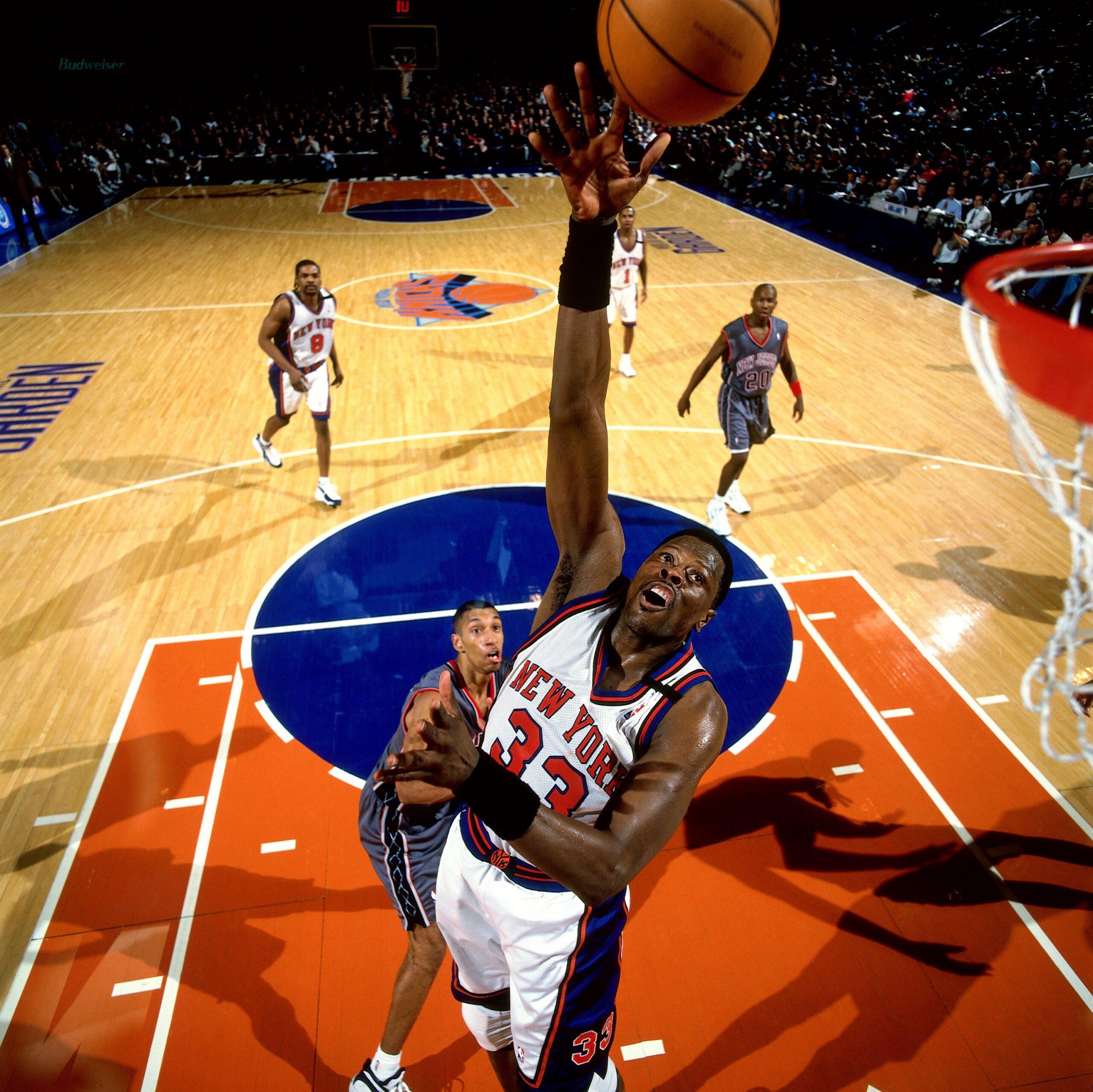
Patrick Ewing grabs a rebound against Kerry Kittles of the New Jersey Nets on March 7, 1999
After letting Ewing go, the Knicks could never get back to where he had taken them. During the 20-year stretch from 2002 to 2022, they missed the playoffs 16 times and lost more games than any other team in the NBA.
Aside from the Knicks’ lone playoff series win in 2013, Carmelo Anthony’s 62-point masterpiece, and a few fleeting weeks of Linsanity, the next generation of fans didn’t get many moments or rosters to latch on to. Kids of the 2000s and 2010s had to look backward to Starks’s dunk over Horace Grant and Jordan, or Larry Johnson’s four-point play. They dug up clips of Reggie Miller scoring eight points in nine seconds to understand how such a travesty could have possibly transpired. And they watched grainy footage of Ewing hopping onto the scorer’s table at Madison Square Garden, raising his elongated arms to the skies in triumph, as he celebrated with the sold-out arena of fans after leading the Knicks to the Finals for the first time in 21 years.
As the 2026 Finals head back to the Garden on Monday, there’s been a beautiful, cosmic symmetry in this rematch of the 1999 title bout. Twenty-two-year-old Victor Wembanyama has the opportunity to follow in Duncan’s footsteps, while Karl-Anthony Towns, a former first pick and a 7-foot center with a feathery shooting touch, has evolved into a two-way powerhouse on the league’s biggest stage. And Jalen Brunson—whose father, Rick, played against the Spurs in the 1999 Finals (if only for 9.8 seconds)—has become the kind of player who can galvanize New York and provide hope after decades of futility.
Ewing’s playing days may be long over, but he’s been part of the Knicks since a few seasons after that shameful trade. In 2003, Ewing returned to the Garden to see his jersey raised to the rafters to join Frazier, Reed, Earl “the Pearl” Monroe, Bradley, and the five other Knicks legends whose numbers have been retired by the franchise. No Knicks player has been granted the rare honor ever since.
Ewing became a basketball ambassador for the organization in 2024 and has been with the team on every step of this wild journey to the Finals. He travels with the players and coaches, and he continues to pass along the wisdom and experience of a Hall of Fame career, bridging the past to the present as he pushes the franchise to that elusive trophy behind the scenes. It almost feels like destiny that, after growing up around the late ’90s Knicks players and witnessing how close they got to winning firsthand (even if he was too young to fully understand the stakes), Brunson would have a chance to finish off the mission that Ewing’s and his father’s Knicks failed to complete.
"This is a kid that I've known since he was 2," Ewing recently told ESPN. "And now he's carrying the team. The rest of the guys are doing their part, carrying the whole city on their backs.”
Knicks fans and players have been forever chasing the success of those early ’70s teams that won the franchise’s only titles. Yet Clyde’s mesmerizing heroics with Reed—the original Captain—are now so distant in the past that their stories have almost ascended to the realms of mythology for younger fans, the kind of fairy tale you tell your kids to help them believe that anything is possible. For decades, video evidence of their decisive Game 5 victory in Los Angeles to win the 1973 championship didn’t even exist; the tapes were restored only in 2013.
That’s part of why the Ewing era, with all of its thrilling achievements and haunting failures, remains so essential in the hearts and minds of so many fans today. A homegrown talent who sacrificed his body for the Knicks to reclaim title glory, Ewing has endured as a source of pride for those who witnessed him and his teammates go to battle with the unbeatable Jordan and still get back up after being knocked down so many times.
With two wins to go for the Knicks, the job is certainly not finished—even if New York City is already bracing itself for a championship that may transform its streets into the lawlessness of Gotham City. The Concrete Jungle has roared to life. Every Ewing jersey you’ll see at MSG and the streets surrounding it (and there’ll be plenty of them) will serve as a reminder of how much this franchise—and fan base—has been through and how far it’s come. And if the Knicks can finally pen a happy ending to the long, bittersweet story of their pursuit of a third title, the journey will have all been worth it.