Who’s to Blame When an Ivy League President Drives Into His Students?
“Ah! He just ran over my fucking foot!”

Are you familiar with driving? Do you know how it works? I don’t mean “Are you licensed to operate a commercial vehicle?” I mean “Have you ever looked at a street for five seconds?” You have, right? You have at least a 3-year-old’s grasp of how drivers are supposed to operate their vehicles? Fabulous. Here’s a question for you: Is it OK for drivers to hit people with their cars?
By “people”—and I can’t believe I’m defining this term, but we live in uneasy times—I just mean regular, unprotected human beings. Your fellow Homo sapiens, standing around on their vulnerable human legs, offering no meaningful resistance to the progress of a high-powered, 4,000-pound luxury sedan. Is it cool to drive right into them?
Think about it. Take all the time you need.
And … you’re correct! OF COURSE IT’S NOT OK TO HIT A PERSON WITH YOUR CAR. Don’t hit a person with your car! There’s zero ambiguity here. “Do not knowingly or by negligent ignorance drive your automobile into another human being” is pretty much driving’s prime directive. Knowing it is more important than knowing how to start your engine. Unless your life was in danger or you genuinely had no way of seeing the person who flung themselves directly into your path, you simply do not have a large fund of valid excuses to justify steering your enormous, unyielding vehicle into a non-enormous, extremely yielding human body.
1. “They were blocking my path.” Not an excuse!
2. “They were touching my car.” Not an excuse!
3. “They disagreed with my politics.” Not an excuse!
4. “They were rude to me.” Not an excuse!
5. “They kept asking me hard questions and filming me with their phones, and I’m a powerful man who’s used to being treated with deference.” Buddy! You cannot ram your Cadillac into a pedestrian just because you’re an easily flustered rich guy! This is so obvious!
At least, I used to think it was obvious. That was before the president of Cornell backed his car into a group of students and got away with it scot-free.
The president of Cornell did what?!
Backed his car into a bunch of students—but hang on, it gets worse.
On April 30, the president of Cornell University, Michael Kotlikoff, delivered an opening statement at a debate on the Israel-Palestine conflict hosted by the Cornell Political Union. After the event, a few members of the free-speech advocacy group Students for a Democratic Cornell walked with Kotlikoff to his car. On the walk, they asked Kotlikoff, whose remarks had emphasized the importance of a free and open exchange of ideas on campus, about the Ivy League university’s recent moves to suppress student speech. If the free exchange of ideas was vital to Cornell, then why had the administration adopted a new policy, in the aftermath of the 2023 protests over Israel’s attack on Gaza, giving it the power to suspend students immediately and indefinitely for protesting? Why was the university allegedly sending employees to take pictures of students at protests? Why had so many students been barred from campus for engaging in the sort of disruptive but nonviolent protest actions—shutting down a career fair, building a pro-Gaza encampment—that have been part of American campus culture for generations?
The students thought they knew: Cornell receives hundreds of millions of dollars in grants from the Department of Defense and major weapons manufacturers and invests the money into endowment funds that include those same military contractors. (Cornell also partners with the Technion-Israel Institute, which has strong ties to the Israeli military and has prompted calls for boycotts in countries from Italy to Korea.) The university’s finances are therefore structurally pro-war: The more money the weapons manufacturers make, the bigger the research grants they can give Cornell. The more their stock prices rise, the more Cornell’s endowment—$11.8 billion at the end of fiscal year 2025, after a 12.3 percent return—increases in value. And because of this system, protests that call for divestment from military companies with ties to Israel have the potential to interfere with Cornell’s money-making operations, and thus can’t be tolerated.
Kotlikoff wasn’t likely to say any of that out loud, and the students who accompanied him to his car weren’t likely to get satisfactory answers to their questions. But confronting him was still a way to make their voices heard, and to emphasize the chasm between the pro-speech principles Kotlikoff supports in public and the anti-speech policies adopted by his administration.
On the walk to the car, the students, who were joined by some recent Cornell graduates, were a little obnoxious, in the way that young, passionate people can be. But they were only a little obnoxious. Extensive video evidence—and don’t worry, we’ll get to the videos—indicates that they didn’t touch Kotlikoff, or crowd him, or threaten him. They didn’t even really raise their voices. They asked him questions in a somewhat hectoring tone; they held up their phones and recorded the encounter. Kotlikoff, in the videos, appears rigid with discomfort. His face is tense, his posture awkward. His answers are clipped and irritated. He looks and sounds like a powerful man who’s unexpectedly found himself outside the environment of lackeys, assistants, and allies in which he normally spends his time—and who absolutely hates it.
Kotlikoff gets into his big black Cadillac. The young people surround the car, still filming. One stands directly behind the vehicle, blocking Kotlikoff’s exit. They don’t touch the car, but they also don’t move. They’re inconveniencing Kotlikoff, not terrorizing him. (In the history of protest movements in the United States, inconvenience has been an extremely potent tool.) Kotlikoff endures this for around 15 seconds before starting to back up—again, with a student standing directly behind his car, inches away from the bumper. The guy behind the car steps back but doesn’t get out of the way; Kotlikoff, driving in a jerky, start-stop manner, keeps backing up. He hits one young person, Hudson Athas, a member of Cornell’s class of 2027, and runs over the foot of another, Aiden Vallecillo, class of 2026.
“Ah! He just ran over my fucking foot!” Vallecillo screams in the video. “Oh my God!”
Wait, the president of Cornell drove a Cadillac over the foot of a member of the class of 2026? He must have immediately jumped out to make sure the guy was OK, right?
Nope! Kotlikoff’s academic background is in medicine—albeit veterinary medicine—but he didn’t even roll down the window. He just drove away.
But surely he at least put out a statement apologizing for his actions?
Oh, he released a statement, all right. The day after the incident, he sent a mass email to the entire Cornell community. The email was titled “Harassment and intimidation incident at Day Hall.” In it, Kotlikoff depicted himself as the victim of an unruly gang of student agitators. His description of the event seemed to spring from the night terrors of all-powerful and insulated people: Having gotten him alone, the students, he wrote, harangued him, “loudly shouting questions”; when he got in the car, he wrote, they started banging on the windows while continuing to shout. “The behavior I experienced last night,” Kotlikoff asserted in the statement, “is not protest. It is harassment and intimidation, with the direct motive of silencing speech. It has no place in an academic community, no place in a democracy, and can have no place at Cornell.”
Amid all this high-toned rhetoric, Kotlikoff didn’t mention the university’s own, far more severe attempts to silence speech on campus. He also left out the whole part where he drove his car into two members of the university community.
Oh, so it’s really Kotlikoff's word versus the students’? He says the incident went down one way, they say it went down another way, who’s to say, we’ll probably never know the truth, blah blah blah. Is that right?
Absolutely not. Remember, several of the students who walked with Kotlikoff to his car were filming on their phones. The incident was recorded from multiple angles. Some of the footage made its way to Cornell’s excellent student newspaper, The Cornell Daily Sun, and the video reveals that Kotlikoff’s email is full of falsities. The students didn’t scream at Kotlikoff. They didn’t bang on his windows, as he claimed. “I waited until I saw space behind my car,” Kotlikoff wrote, “and then, using my car’s rear pedestrian alert and automatic braking system, was able to slowly maneuver my car from the parking space.” The video shows Kotlikoff waiting only a few seconds before backing up, and while there was technically space behind his car when he did so—there’s technically space between two atoms in a molecule—there wasn’t a whole lot.
Kotlikoff, incidentally, later said that he didn’t realize he’d hit the students—or, as he put it, “I did not believe, based on the information I had at the time, that my car had made contact with anyone.” I’ll leave that to you to judge; personally, I don’t believe I could drive over a human foot without feeling a pretty dramatic bump, but my car probably isn’t as smooth as a Cadillac. While it is of course possible that Kotlikoff is telling the truth about not knowing he’d hit anyone, his employment of lawsuit-optimized language like “using my car’s rear pedestrian alert and automatic braking system” doesn’t inspire much confidence. Nor does the fact that his email is full of so many other statements that look rather suspiciously like lies.
It’s too bad for Cornell that it didn’t have its own video footage to back up Kotlikoff’s account of what happened.
Oh, but it did! After the Sun published its video, Cornell responded by releasing security camera footage that school officials said showed a more complete version of what had happened, “instead of clips to support a narrative.” And, like … it doesn’t contradict the students’ narrative? At all? I truly cannot understand why the university would have chosen to release this recording, because it mostly just makes Kotlikoff look worse. It does so first by highlighting the false claims in his account—I clicked on the video assuming it would show students banging on windows; it doesn’t—and second by highlighting his erratic, panicky driving. I mean, look at this video, think of a college-aged person you know, and tell me if this is the level of regard you would like their college president to show for their safety. Or, since there seems to be some dark magic in the word “college” that makes many American adults lose their minds when they see it, think of high school kids: Would you be OK with their principal if he’d done this? Would you try to back out with a 5-year-old standing in that spot behind your car?
It wouldn’t really matter, by the way, if the students had screamed at Kotlikoff and banged on his windows, because—see the beginning of this article—you’re not supposed to drive into people even if they’re being rude to you, standing in your way, disagreeing with your politics, or touching your car. But the footage, which shows that they didn’t, makes it clear that there is only one plainly unreliable party in this controversy. And it’s not the unruly mob of punk youths.
Were any of the students hurt?
Not seriously, thank goodness! It was a low-speed collision. Personally, I’m not all that eager to have an SUV roll over my foot even at low speed. And in any case, speed is not the issue. The issue—I’ll keep repeating it!—is that you shouldn’t hit people with your car.
OK, for a university president to back his car into students, then paint himself as the victim while seemingly lying about what happened, is a pretty awful look. Did whoever’s in charge of a university president (and who is that?) look into the incident?
Yes. On May 7, a week after the incident, the Cornell Board of Trustees announced it was forming a special ad hoc committee to investigate “the events of April 30, 2026, involving Cornell President Michael I. Kotlikoff and a group of individuals.” The board further announced that it was “committed to ensuring a fair and thorough review guided by adherence to university policies and the best interests of the Cornell community.”
Great. So how did they punish Kotlikoff?
They didn’t. They supported Kotlikoff and blamed the students.
Seriously? Despite the video?!
Yes. The committee’s statement is, to me, the most quietly deranged part of this entire sordid tale. There is no concern in it—none!—for Cornell students. The entire document, which is full of obfuscation and misleading logic, drips with resentment and suspicion toward the young people Cornell notionally exists to educate. (Why the committee reserves no suspicion for the one person in the incident who made verifiably false claims about what happened, I will again leave to you to decide.) The statement asserts that Vallecillo refused medical treatment at the scene, which the group Students for a Democratic Cornell says is untrue. In any case, who cares? “I was totally justified in running over your foot because you refused medical treatment afterward” is a nonsense argument! The committee also emphasizes that the students refused to provide sworn statements to campus police; if true, that would potentially be a barrier to the progress of an investigation, except that—oh, wait—there is extensive video footage of the incident.

“How can you know what really destroyed Alderaan when no one from Alderaan made a sworn statement?” Because I don’t know what happened to Alderaan from reading a sworn statement. I know what happened to Alderaan because I FUCKING WATCHED STAR WARS, YOU ABSOLUTE CLOWNS.
The statement concludes with a robust defense of free speech that reads suspiciously like a memorandum on hating free speech. “Expressive activity must occur within the bounds of the law and with respect for the rights and safety of all members of our community.” (Unlike driving, I guess?) “Over the course of his decades-long tenure at Cornell, President Kotlikoff has conveyed his strong belief that with freedom, particularly freedom of speech, comes responsibility.” (Gotta admire the choice to reference a line made famous by Spider-Man, a young person who constantly gets in trouble with obtuse and corrupt old people for doing the right thing.)
“We are confident,” the statement continues, “that he will continue to lead with integrity as we work together to carry out our shared mission to discover, preserve, and disseminate knowledge, to educate the next generation of global citizens, and to promote a culture of broad inquiry throughout and beyond the Cornell community.”
This has got to be the most stirring committee report on a guy hitting two young men with a luxury car that’s ever been published. It sounds like something someone said after planting a flag on the moon. I’m sort of amazed the trustees didn’t give Kotlikoff a raise.
Anyway, while I applaud Cornell’s commitment to its shared mission to discover, preserve, and disseminate knowledge, you know what I think would also do wonders for the health of the institution? A SHARED MISSION TO KEEP THE PRESIDENT FROM HITTING STUDENTS WITH HIS FUCKING CAR.
This is absurd! Was the media at least incensed about the report?
Other than The Cornell Daily Sun—and let’s take a moment to appreciate the essential work student journalists are doing around the U.S.—the media has, uh, not exactly covered itself in glory in its reporting on this story.
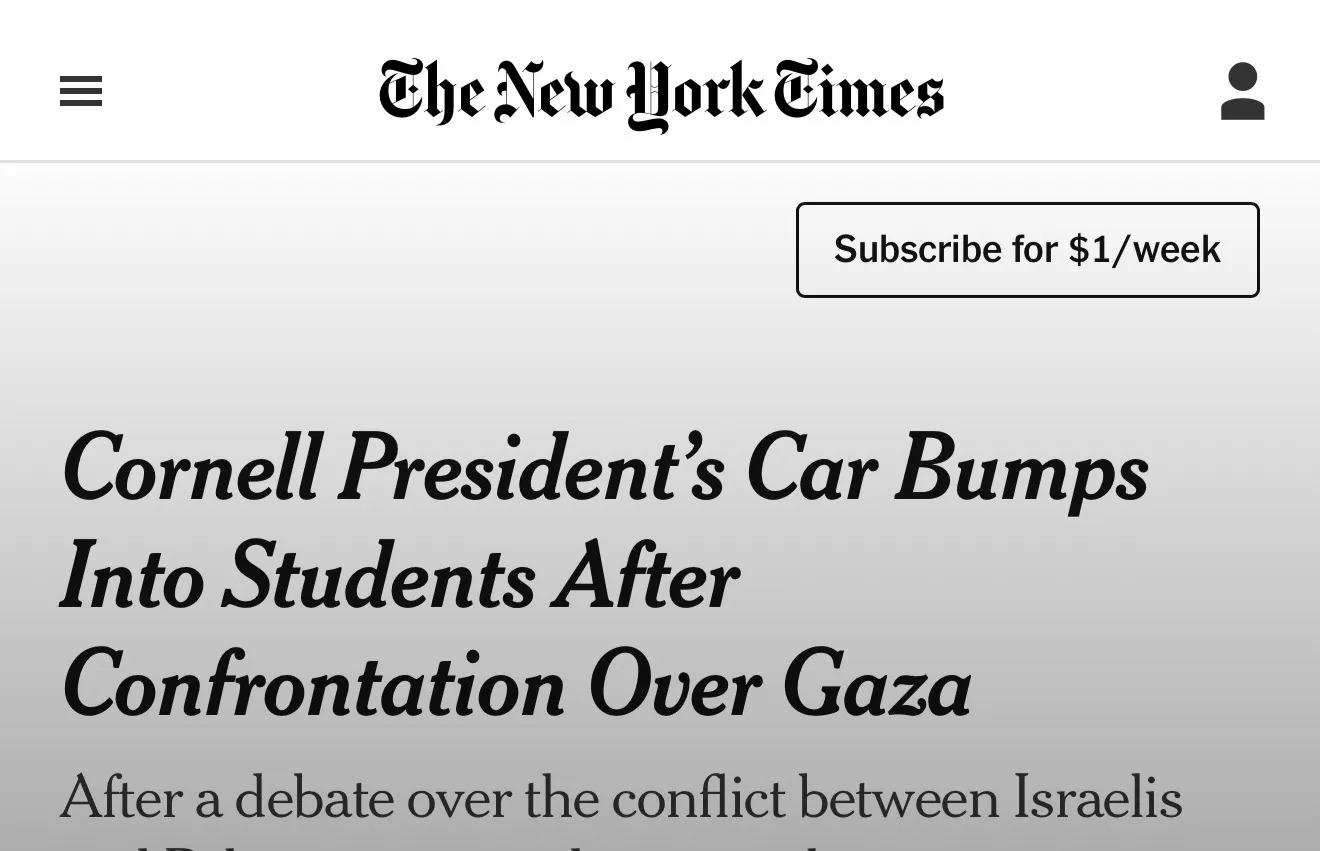
The New York Post went as New York Post as you’d expect, publishing a deceptive video titled “Radical Students Hold Cornell President HOSTAGE in Car After Israel Debate Clash.” The New York Times—more temperate, more responsible, and historically quite willing to go after university presidents if the right conservative billionaires tell it to—took one hard look at the story and concluded that the villain was … the car.
Media coverage of the event was so bad overall—for one thing, it kept calling the students pro-Palestinian activists, rather than what they are, which is advocates for free speech at Cornell—that the students recorded a video explaining their side of the incident. It’s worth a play, partly because it offers a concise explanation of how financial incentives push university administrators to embrace war, partly because it feels several billion times more sincere and human than the statements from the administration and trustees, and partly because … well, how often do you get to watch a video that opens with a young man calmly saying, “The president of Cornell University just ran over my foot”?
At least this was a one-off incident, unrelated to the larger state of American higher education.
I think it was actually a perfect illustration of the state of American higher education.
How so? Surely college presidents aren’t constantly plowing into groups of students with their Audis!
Because of who’s in charge. You’ve read a million pearl-clutching op-eds about woke professors and cancel culture, but for my money, the real crisis facing American higher education is that colleges and universities are increasingly run by people who are hostile to students and professors, and who are frequently hostile to the idea of the university itself.
For much of the 20th century, institutions of higher learning in the U.S. operated under a model of shared governance. Students and staff had means of influencing the direction of university policy, faculty had broad power over day-to-day operations, and boards of trustees acted under advisement from both groups. In the 1970s, however, after postwar investment in higher education started dwindling, trustees moved to take almost all the practical power for themselves. The result is that the people who perform the activities you probably think of when you think of college—teaching, studying, writing books, playing intramural volleyball, eating 2 a.m. Cheetos in the library—exert little influence over what the institution does.
And the people who do exert influence often have little to do with the life of the institution itself. They don’t work or study there; they just call the shots. And you know how sophisticated sports analysts love to say, “The commissioner doesn’t work for the fans, he works for the owners”? Well, college presidents, deans, and administrators don’t work for students, parents, or faculty members. They work for the trustees.
A new paper in the University of Pennsylvania Law Review helps explain why this structure is so flawed. Written by Daniel J. Hemel from the New York University School of Law and David Pozen from the Columbia Law School, “In Search of University Democracy” dives into the surpassing strangeness of this governance model, which is rarely found in prominent universities outside the U.S. “Boards,” Hemel and Pozen write, “are unrepresentative of and unaccountable to the campus community.” Board governance “does not reliably produce better educational or operational outcomes,” and “sits in stark tension with universities’ aspirations to be autonomous intellectual communities.” The authors argue for a stakeholder model of governance that would restore the voice of faculties and students in the university decision-making process.
Who sits on these boards? Well, this is the second problem. As university endowments have grown over time—Harvard’s was $4.7 billion in 1990; it’s now $56.9 billion, a twelvefold increase—the makeup of boards has shifted to include fewer scholars and more business executives, fewer artists and more management consultants, fewer PhDs and more MBAs. At private universities, vacancies on the governing boards are typically filled by the other members of the board, meaning that cultural change is extraordinarily hard to enact: Old board members will keep selecting new board members with similar backgrounds and outlooks. The result of this shift is that the people governing a university often have very little in common with the people who live, work, teach, and study there.
That doesn’t mean they’re hostile to the university, though! Surely the board members are committed to doing what’s best for the school.
Maybe, but even where that’s true, what’s “best” as conceived by the board members is often massively at odds with the preferences of many people at the university. Board members tend to be more politically conservative than students and faculty, and tend to be far more focused on maintaining and growing the endowment. In the same way that SEC schools sometimes resemble professional football teams with boarding schools attached, Ivy League institutions like Cornell are often run as midsized investment firms with vestigial schools tacked on. When they do turn to the business of education, finance- and career-focused board members can be suspicious of the traditional aims of education. Working to understand the human condition is less important than whatever the new buzzy thing is in tech or banking; art, literature, dance, and philosophy are less valuable than STEM, and STEM is only valuable when it produces immediate economically profitable results.
When you understand that this is how universities work, many things that might have struck you as odd quickly start to make sense. Why did so many institutions of higher education surrender to the Trump administration’s extortion tactics last year when their students, faculties, and alumni were screaming for them to fight back? Because their administrations answer to the boards, and the boards didn’t want to take any risks that could disrupt the steady flow of business. Why are universities spending millions on AI and dubious EdTech systems when their own students are booing AI at graduation ceremonies? Because board members love the tech industry and are often invested in its success. Why are universities cutting vital departments and replacing them with bullshit buzzword alternatives, like Syracuse, which recently obliterated its humanities departments, eliminating French, German, Russian, Middle Eastern studies, and painting while launching “the nation’s first academic center for the creator economy”? You can fill in the rest yourself. (It’s not because humanities graduates are less desirable on the job market.)
This is how you end up with an elite university where the president can drive his car into a group of students and be lauded by the board. The president and the trustees are on the same team. The students are on the other team. The trustees know Kotlikoff will reliably enforce their agenda, including cracking down on protests that might be bad for cashflow. It almost doesn’t matter what he does; if there’s any conceivable defense, they’ll keep him in place. (If not, they’ll replace him with someone else who can talk about loving free speech while moving to crush it in practice.) Kotlikoff, after all, has already proved his worth: It was on his watch that Cornell agreed to pay $60 million to the U.S. government to get Trump to unfreeze its research grants.
Kotlikoff may be no fun to walk with, and he may not be great in the driver’s seat, but from the trustees’ perspective, he’s mastered the most important posture of all: He knows how not to take a stand.