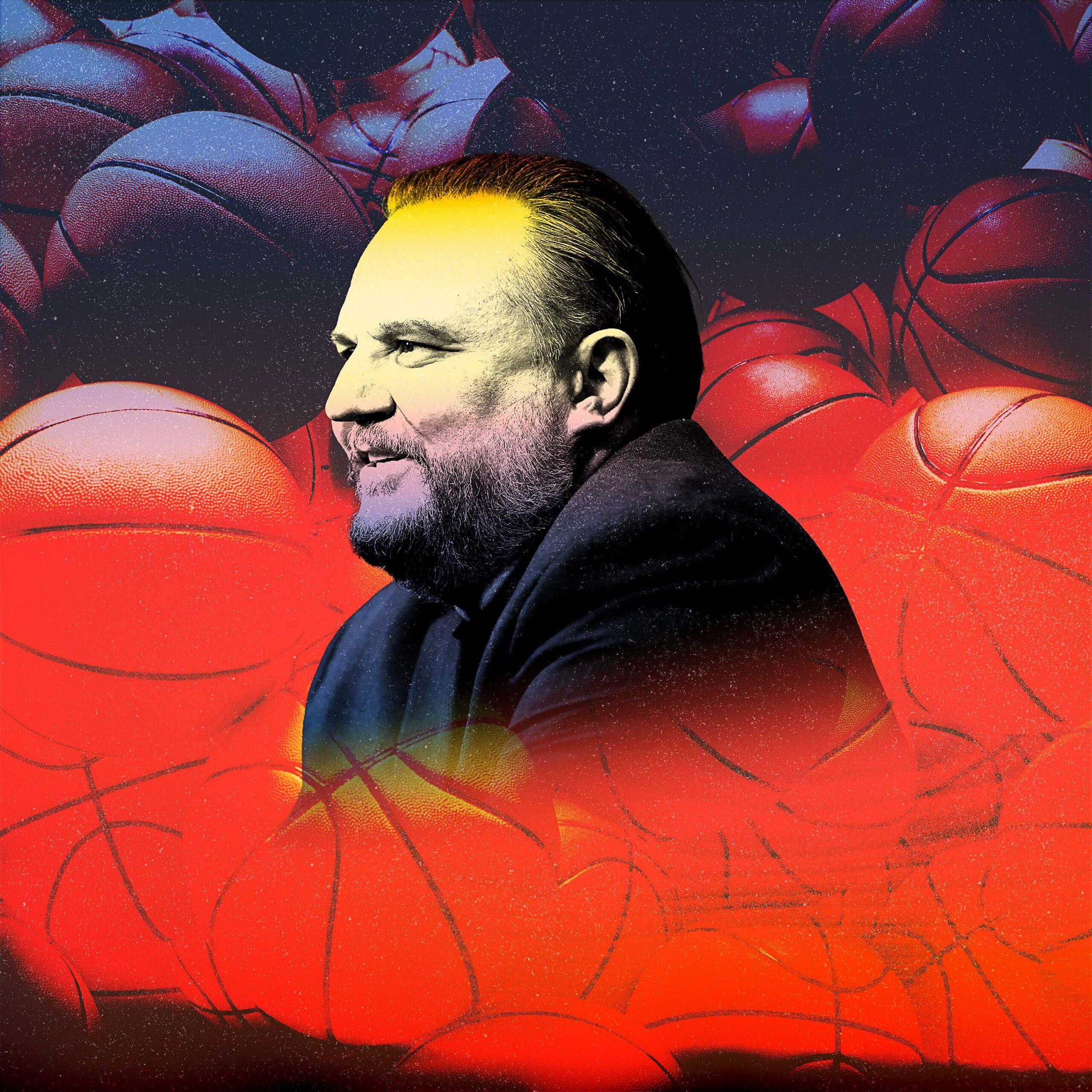

The most persistent critique of Daryl Morey, across his two decades as an NBA general manager, with two franchises in two time zones, is that the man tends to fall a little too hard for superstars. Chases them. Swoons over them. Panders to them. Over-empowers and overpays them. And when one pricey star proves insufficient, he chases another. And another.
In Houston, it was James Harden, alternately flanked by Dwight Howard, Chris Paul, and Russell Westbrook. In Philadelphia, it was Joel Embiid, alternately flanked by Ben Simmons, Harden (hello again!), Tyrese Maxey, and, finally, Paul George.
It’s those same impulses, his critics assert, that led to George’s max contract and Embiid’s max extension, to a Sixers roster that grew top-heavy with oft-injured vets, to a thinned-out bench that crippled them in the postseason, to a humiliating sweep at the hands of the New York Knicks last week, and, ultimately (indeed, consequently), to Morey’s ouster as team president.
The Sixers fired Morey on Tuesday, after six modestly successful, frequently frustrating seasons. During his tenure, Philly made the playoffs five times, made the second round four times, and made the conference finals zero times. That last data point is cited most often as proof of Morey’s failure and is, presumably, the primary reason the Sixers are now searching for a new president of basketball operations while Morey is searching for Airbnb listings in Cancún.
Morey might rebut a few specific criticisms, rationalize a few decisions, and generally defend the process (small p) behind his decision-making. But the star-chasing part? He would emphatically plead guilty—and probably belittle you for calling that a “criticism” at all.


It’s not that Morey, with his background in analytics, discovered some complex mathematical formula, or that he’s even unique in this strategy. It’s just that he, more than most, has made the acquisition of superstars his North Star. A Morey-led franchise will never be subtle in its aims or particularly patient. He isn’t interested in alternate models or “middle builds” or a depth-first approach. It’s stars or bust.
“I think you need elite players to win the title in this league,” Morey, then in his third season as Rockets general manager, told me in December 2009, articulating a thesis statement that’s defined his career. What was notable at that moment was that the Rockets were somehow thriving without their two elite players, Yao Ming and Tracy McGrady, who were both injured for an extended stretch. Houston nonetheless kept churning out wins behind the efforts of unglamorous grinders like Chuck Hayes, Shane Battier, Carl Landry, Aaron Brooks, and Trevor Ariza.
But Morey knew then, as he does now, that Grit and Grind only get you so far for so long. He also knew he’d soon need a new foundational star, with McGrady and Yao quickly fading. Within three years, the two future Hall of Famers would be gone, replaced by Harden, Jeremy Lin, and Chandler Parsons, and Morey began forging a new contender out of the debris.


Morey’s next half decade of transactions reads like a greatest-hits list. He landed Harden in 2012, Howard in 2013, Paul in 2017, and Westbrook in 2019—and along the way chased LeBron James, Carmelo Anthony, Chris Bosh, and probably half a dozen other stars, back when chasing stars in free agency was still a thing. He did so aggressively, sometimes brazenly, always unapologetically, never wavering from that “More is better” mentality. If Morey could have signed them all, he probably would have—salary cap and chemistry concerns be damned.
You need elite players to win the title.
About that: Morey’s teams have posted a winning record in 18 of his 19 seasons and placed in the top two of their respective conferences 10 times. His Rockets made it to the Western Conference finals twice. But, well, that was it. Zero Finals appearances. Zero titles. Yet the Rockets’ failures don’t really undermine Morey’s premise; they prove it. Over his last six seasons, the Rockets were ousted in the playoffs four times by Steph Curry’s Warriors (twice in the conference finals), with the other two playoff defeats dealt by Kawhi Leonard’s Spurs and LeBron’s Lakers.
Morey’s thesis statement is broadly correct. NBA championships are almost always won by a team with an MVP-level player, often with the aid of another All-Star or two. As a general rule, you need a top-10 guy to even have a shot. So yes, Morey happily tied his fate to Harden and Embiid, two of the greatest offensive players of all time. But it takes more than elite players to win titles. It takes elite role players, quality depth, good chemistry, and good fortune. It’s those last few boxes that Morey’s teams have sometimes failed to check—and that have fueled his critics.
“He didn’t adjust to today’s NBA landscape,” said a rival team executive, echoing a common refrain. “You just can’t only hunt stars all the time.”
The Sixers, much like Morey’s Rockets, became top-heavy in talent and payroll. In the summer of 2024, they signed George (at age 34) to a four-year, $212 million contract; Maxey to a five-year, $204 million extension; and Embiid to a two-year, $130 million extension. Their depth has indeed been an issue at times and was exacerbated by the controversial February trade of fan favorite Jared McCain to Oklahoma City.
It’s fair, in retrospect, to question the wisdom of the George and Embiid contracts, given those players’ ages and injury histories. But Embiid was a year removed from his MVP season, still in his prime, and unquestionably the Sixers’ most important player. What NBA team says no to its franchise star in those circumstances? The George signing triggered some winces in real time, but it was also generally lauded as a coup. The Sixers needed another two-way star, and George was the best one available. Yet the risks in both cases were undeniable.
But here’s the thing: If you waved a magic wand and undid all of Morey’s most disputed moves, the Sixers still would have been smoked by the Knicks in the second round. And an entire Hogwarts catalog of magic wands wouldn’t fix what’s ailed the Sixers the most during the Embiid era: Embiid’s health. When your franchise star misses 40 percent of all regular-season games and is constantly limping through the spring, you’re not going to make many deep playoff runs.
The Sixers don’t have a front office problem; they have an Embiid problem. A new team president isn’t changing that. (We could spend another 1,000 words detailing all the ways Sixers ownership has both coddled and failed Embiid over the past decade, but that’s a digression for some other time.)
The next Sixers head of basketball ops will be the fifth since Embiid was drafted in 2014. Nick Nurse, whom the club intends to retain, is the Sixers’ third head coach of the Embiid era. Embiid has had his share of costars, from Simmons to Jimmy Butler to Harden to Maxey and George. The one constant, though, is Embiid’s injury misfortune—from foot problems to knee troubles to concussions to facial fractures to Bell’s palsy to, most recently, an appendectomy just before the 2026 playoffs.
Embiid recovered in time to lead the Sixers to a stunning, history-making upset of the second-seeded Boston Celtics. For a minute or two, they were the NBA’s reigning feel-good story. A week later, they were firing their team president.
Morey’s replacement will inherit one of the most star-crossed superstars in modern times, and all the challenges that come with him. But they’ll also inherit a roster flush with talent, including Maxey and rookie sensation V.J. Edgecombe (both drafted during Morey’s tenure), and a healthy cache of draft picks, including the 22nd pick in June (via Houston), the Clippers’ first-round pick in 2028 and potentially 2029 (via swap rights), and all of the Sixers’ own first-rounders after this year.
The Sixers, given a little good fortune and good health, could be in fine shape. Morey’s reputation is largely intact, too, and he’ll almost certainly be running another NBA team in the near future.
Nineteen years ago, Morey was viewed as a bit of a wunderkind and a curiosity, as well as a pioneer—the first NBA stat nerd to rise to general manager. It rattled a lot of traditionalists, who believed only true “basketball people” (i.e., ex-players and coaches) were qualified for the role. Today, it’s common to find front offices run by lawyers (Rafael Stone in Houston), former agents (Leon Rose in New York), salary cap maestros (Michael Winger in Washington), and number aficionados (Ben Tenzer in Denver).
Every franchise today is deeply invested in analytics. And just about every team is as devoted to high-efficiency scoring—3s, layups, and free throws—as the Rockets were in the early 2010s, back when high-volume 3-point shooting was still broadly derided.
Whatever NBA fans and insiders may think of Morey’s methods or his track record, his imprint on the league is undeniable.
The next owner who interviews Morey might justifiably ask about potential regrets. That Embiid extension. That George signing. The Harden partnership that went sour. Would he do anything differently looking back? Would he change anything in his approach now? All fair questions.
We know this much for certain: Daryl Morey will keep chasing stars, because stars win championships, and championships are the point of the exercise. Whether it’s time to recalibrate or moderate that approach, only Morey can say. Whether he was fairly judged in Philly is in the eye of the beholder.
But it reminds us of another thesis statement Morey offered long ago, back in his rookie season as the Rockets GM.
“I do think, at the end of the day, how people judge it will come down to whether or not we win titles,” Morey said. “I think that’s appropriate.”