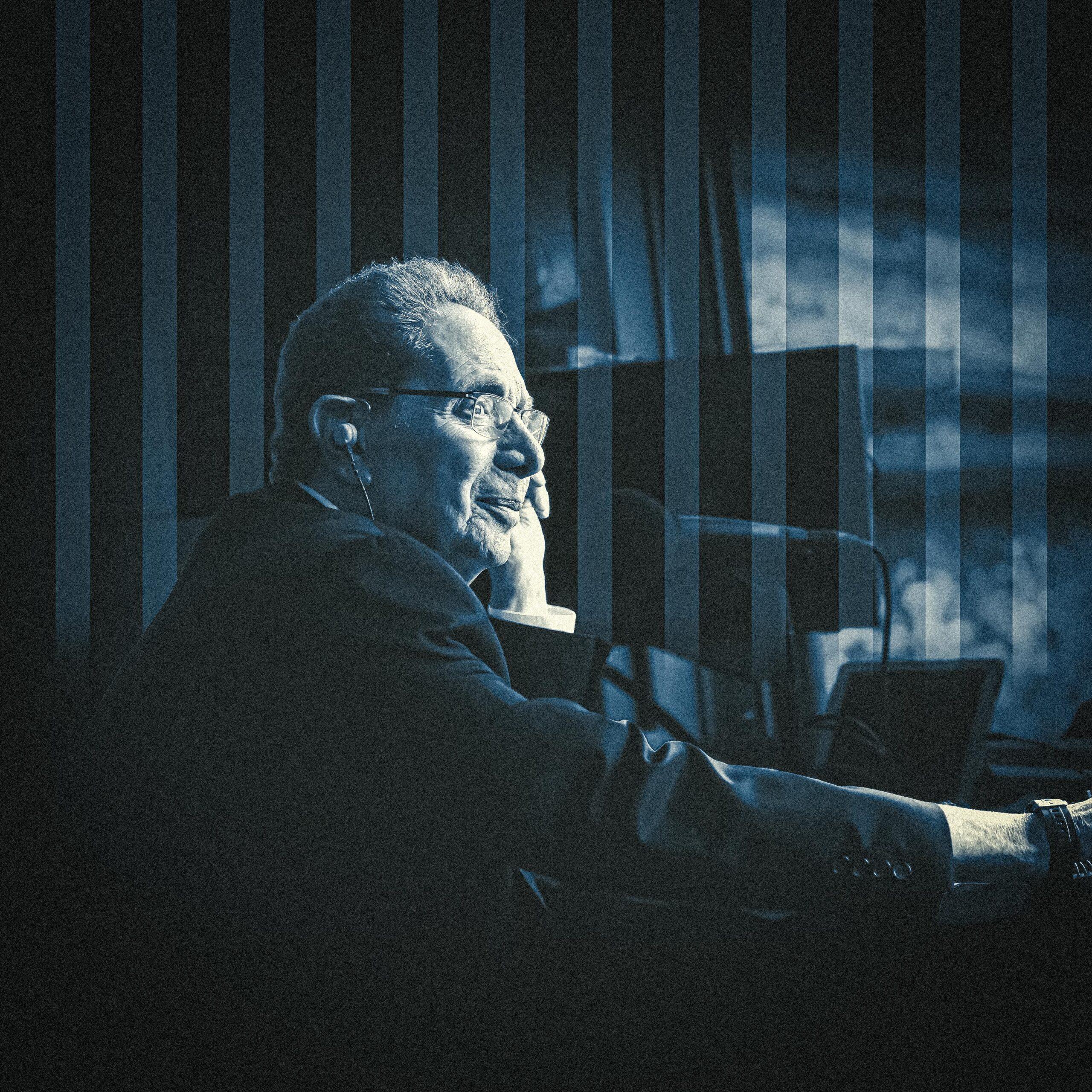

His voice was one of the constants in my life. I heard it when I ate pureed vegetables and learned how to walk. I heard it when I drove off to college, trying to figure out who I was. I heard it in my early 20s when my future seemed infinite. And I heard it when I pushed my newborn son in a stroller, grappling with the great unknowns of fatherhood.
I was born in 1989. John Sterling took over as radio voice of the New York Yankees that same year. Of all the people I didn’t really know in my life, I knew him the best. And on Monday, he died at the age of 87.
Sterling, who outside of Bob Sheppard was the defining voice of the Yankees, had a career that was the stuff of broadcasting legend. As a kid from the Upper West Side, Sterling dreamed of becoming an announcer, and grew up mimicking those he heard on the radio. “I used to get teased as a young boy for my deep voice,” Sterling told The New York Times in 2011, “but I learned I could use it to adapt to different radio styles.”
He got his start as a talk-show host for WMCA in the early 1970s before serving as the play-by-play man for the Baltimore Bullets, New Jersey Nets, New York Islanders, Atlanta Braves, and Atlanta Hawks. He honed his craft the same way anyone does: by doing something enough that it eventually becomes second nature. From that same Times profile: “I had no idea what I was talking about in Baltimore,” he said. “But I knew how to do a talk show. I argued with nuts who called up.”
In New York, Sterling emerged as an institution. He called 5,060 consecutive Yankees games from 1989 to 2019—5,271 if you include the postseason. He soundtracked the franchise’s late-’90s dynasty and punctuated every single pitch of Derek Jeter’s and Mariano Rivera’s careers. His commitment to the gig bordered on unfathomable: In 2000, Sterling’s then-wife, Jennifer, gave birth to triplets before Game 2 of the American League Championship Series. He called the Yankees’ 7-1 win over the Seattle Mariners a few hours later.
He was known for his unmistakable baritone voice and his signature catchphrases. Thuuuuhhhhhh Yankees win!, most notably. It is high, it is far, it is gone! close behind. Day after day, he greeted radio partner Suzyn Waldman with a sonorous Well, Suzyn, I thank you as he approached the mic; when two straight Yankees batters went deep, he delivered a hearty Back-to-back … and belly-to-belly.
And then there were his home run calls. Oh, the home run calls. The first was “Bernie goes boom! Bern, baby, Bern!” to celebrate Bernie Williams. Before long, every Yankees player had his own jingle. Among the most memorable:
- “It’s an A-bomb for A-Rod!”
- “Jorgie juiced one!”
- “Giancarlo, non si può stopparlo! It is a Stantonian home run.”
- “It’s a thrilla from Godzilla! The Sayonara Kid does it again!”
- “Robbie Canó! Dontcha know?!”
- “It’s a Judgian blast! All rise, here comes the Judge!”
My personal favorite was, “Gio Urshela, the most happy fella!” although that speaks mostly to my affinity for Gio and for this moment in particular. Still, it’s a good microcosm of the broader Sterling experience: The call itself was a direct ripoff of his call for José Pirela, a utilityman who played with the club in 2014 and ’15 and hit just a single home run in his entire Yankees tenure. It was hackneyed, but undeniably endearing.
Sterling had lots of critics. The New York Post’s Phil Mushnick famously called him a “dishonest, self-promoting clown.” Sterling routinely got things wrong, often spectacularly so. There’s a Yankees blog called It is high, it is far, it is … caught! as a nod to his tendency to, well, egregiously misjudge fly balls.
If you were an opposing fan who happened to tune in to his broadcast, you’d be forgiven for asking: Why is this man singing show tunes? Why is he constantly bickering with Waldman? Wait, did he just say that the players are running the bases “like drunks”?
But all of this was part of the appeal. Listening to him was as much an experience as following the game. His sing-songy cadence and quirky brand of humor were familiar sources of comfort. They were what I grew up on. They were what I knew.
Every fan base has its version of John Sterling. But for more than three decades before his retirement in 2024, no other fan base had Sterling himself. While the Yankees are regularly seen as a pompous monolith, he was the opposite: a complete cornball, with a shtick verging on caricature, who carried himself as an energetic and unabashed homer. When things for the Yankees went well, you could hear his delight. When things went poorly, you could hear his disappointment too.
He did the job his way, day after day, week after week, season after season. He was always there. Over the course of 35 years, that counts for a lot.
When I first heard the news of his death, I thought about the nature of modern fandom. What defines it? How is it changing? And what might be lost as the ways we follow sports continue to evolve? On the latter front, Sterling was notoriously stubborn. From Brendan Kuty’s obit for Sterling in The Athletic:
He was also known for refusing to adapt to the times. He didn’t have a smartphone or use the internet. On the road, he would seek out that city’s newspaper in the morning and travel with books, typically suspense or crime novels. He had several TVs mounted on the walls of his apartment in Edgewater, N.J., and would sometimes watch several games at a time.
Part of this stubbornness is what made Sterling so prone to mistakes. Part of it is what made him singular. He was always both. That was why he was the link between different generations of Yankees fans, and between different eras of their lives. That was why he was the voice in my ear for more unforgettable moments than I can count, to the point that he sort of felt like family.
Two months after I became a father, I sat on my couch, my son lying on my chest, as Aaron Judge hit his AL record 62nd home run of the season.
We experienced it together, listening to John Sterling.