Higher Education’s Problems Go Way Beyond Trust
Yale put out a report earlier this month reckoning with why America’s universities have lost the public’s faith. But the study doesn’t tell the full story—and may be asking the wrong questions.

Your creditors would like to turn down the temperature. They hear you. Or, they’re here for you. Different strokes for different folks. The key thing they want to emphasize is that it’s healing time in higher education—at least, so says America’s favorite $41 billion endowed research outpost of umpteen dorkily named semi-cults.
Yale University put the word out on April 10: “The issue of declining trust” in the country’s academic landscape “is real, urgent, and must be addressed,” a report from 10 tenured faculty members concluded. Among other factors, the review pointed to “widespread uncertainty about the fundamental purpose and mission of higher education” as a core reason for the drop-off. This exercise in scholarly navel-gazing came amid a multiyear PR nosedive and the Trump administration’s ongoing campaign against higher ed. The Yale group’s findings centered on soaring costs, feelings of doubt over the value of degrees, opaque admissions standards, and a host of free-speech concerns. Its recommendations were plain: “We must be willing to admit where we have been wrong and where we might improve.”
In fairness, it’s not just Yale spouting a fine array of crisis-management-curated gobbledygook. The whole system is buckling. For the past two decades, perception of higher education has plummeted across the United States. According to a Pew Research survey released last October, seven in 10 Americans believe that colleges and universities are headed in the wrong direction. While Republicans are more likely than Democrats to hold these views, a majority of both parties harbor serious doubts about the future of U.S. postsecondary education. Their reasoning varies: Nearly 80 percent of adults voiced concern about rising tuition costs; 45 percent said schools were doing a “fair or poor job” of “exposing students to a wide range of opinions or viewpoints”; 55 percent gave these institutions a “fair or poor” appraisal when it came to preparing graduates “for well-paying jobs.”
And that’s to say nothing of the aspirin-addled elephant in the room: a president whose efforts to forcibly reshape higher education to suit his ideology are rivaled historically only by the zenith of the House Committee on Un-American Activities. Since Trump returned to the White House, he has attempted to institute bans on international students of various backgrounds, opened bogus investigations into schools he suspected gave financial aid to undocumented enrollees, revoked thousands of students’ immigration statuses, detained a number of pro-Palestine campus activists, withheld funds from a hodgepodge of universities for spurious ideological offenses, and strong-armed those same institutions into paying multimillion-dollar tributes to recover the illegally suppressed funds. He and his envoys have found no more convenient home for their contrived blitzes against DEI, “gender ideology,” “anti-Israel” sentiments, and “impermissible race-based” policies than in academic life.
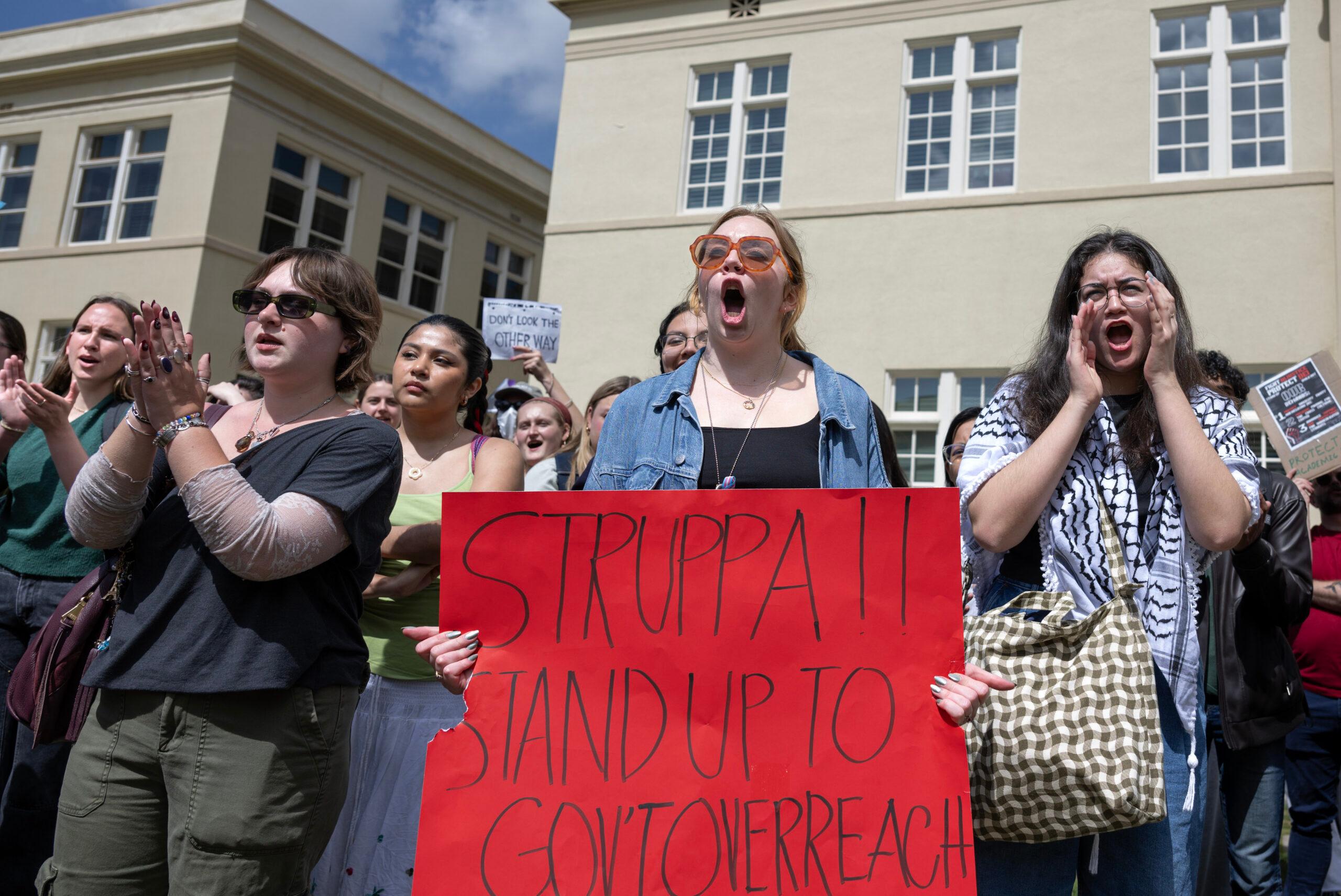
Chapman University students take part in a walkout and protest on Monday, March 17, 2025, against Trump’s policies, including his executive orders to dismantle DEI
That has left colleges and universities at all levels scrambling to meet and outlast the moment. It’s no small task. From an optics standpoint, the folks most often defined by their proximity to power are striving to regain public trust at the height of contemporary anti-elite sentiments. Your general outlook on the merit of that attempt probably depends on whether you regard higher education as a gateway to economic mobility or strictly a place of learning. The Yale report describes a vision closer to the latter. “Universities exist,” it affirms, “to preserve, create, and share knowledge.” But the progression of higher education in the United States—the ways in which it has reflected and reinforced the national mood—conveys a more complicated answer.
The institution has never been everything to everyone, and it’s not what its foils would have you believe today. Colleges and universities across the country might be imperiled for all the wrong reasons, but that’s not because the right ones aren’t worth examining. These days, there’s too much riding on the whole setup for it to either fall apart or fail to outgrow its broken shell.
“Universities are designed to stand at a certain distance from the rest of society,” the Yale study proclaims. It’s an alluring depiction but not quite authentic. For as long as colleges and universities have existed on U.S. soil, the benefits they’ve offered have invariably come at a cost. In their early years, the first colonial schools functioned mostly on a religious level. They were not secular institutions or public ones. In the mid-1700s, the only students at the then-fledgling Dartmouth College who weren’t the sons of land-owning white men were the Indigenous youths the college had enrolled with an explicit aim of proselytization. As colleges and universities like Williams, the University of Alabama, and NYU were founded between the end of the Revolutionary War and the beginning of the Civil War, these institutions remained racially and sexually exclusive.
The bones of the modern higher education system can be found in the Land-Grant or Morrill Acts of 1862 and 1890—laws that created a range of public universities and historically Black colleges and also relied on the theft and sale of Indigenous tracts to fund them. As the statutes that enshrined the present-day system were implemented over the first half of the 20th century, access to higher ed’s benefits remained a question of exclusivity. Both the 1944 G.I. Bill and the 1958 National Defense Education Act omitted women and Black folks from their gains. American colleges and universities didn’t broadly desegregate until five years after the Civil Rights Act had been passed.
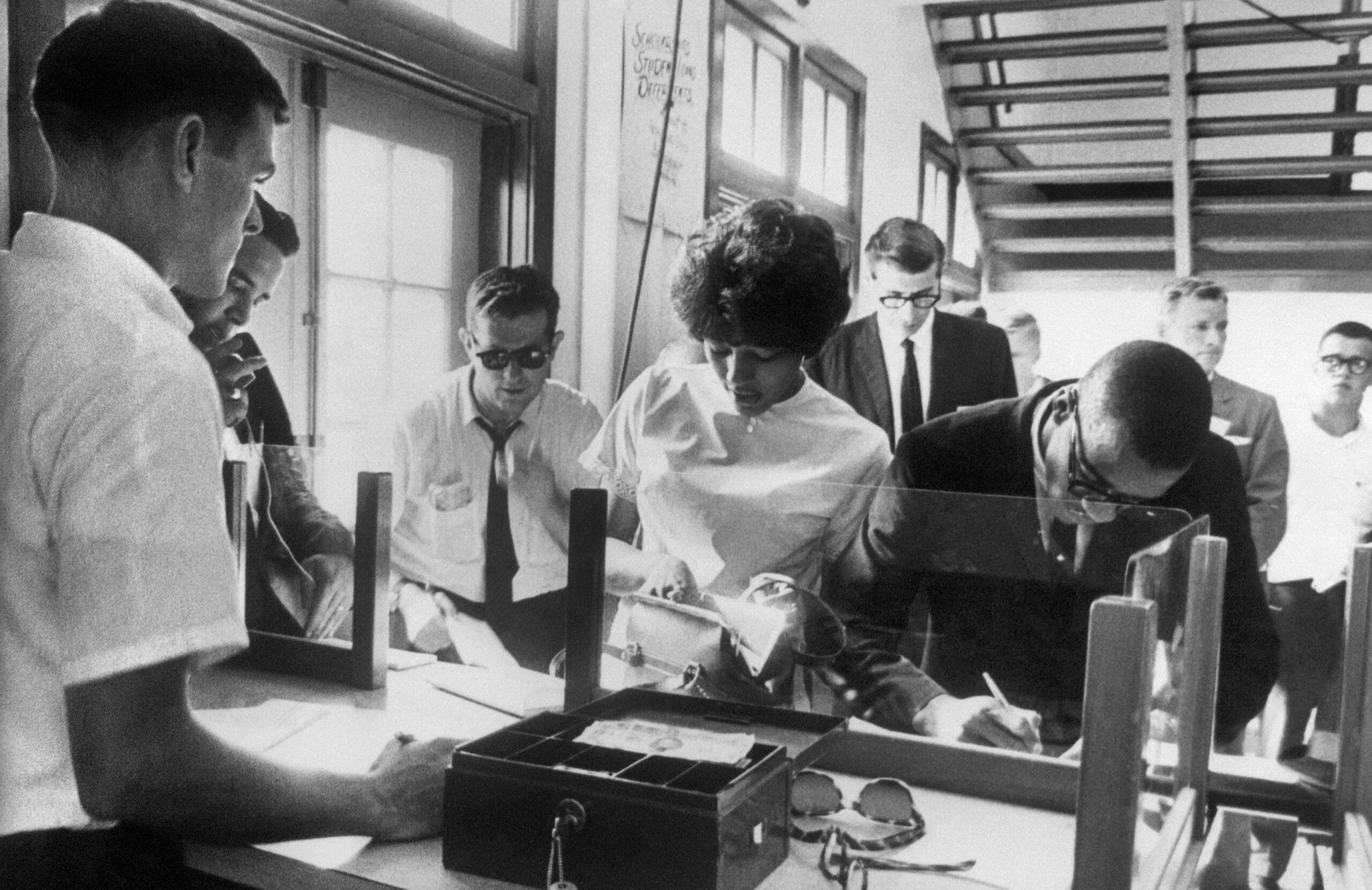
Vivian Malone and James Hood, two Black students, register at the University of Alabama on June 12, 1963. In June 1963, a federal court barred any state government interference with their enrollment.
Today, a pervasive belief positioning higher education as separate from public life nonetheless flourishes. The actual record says the opposite. When settlers wanted to strip Native people of their culture, much less their land, universities facilitated it. When both major political parties permitted Jim Crow, schools fitted themselves in line with the practice. When anti-Jewish sentiments peaked, colleges and universities incorporated quotas. When the Red Scare ensued, many institutions sold out their students and employees.
Now, as income inequality has worsened, higher education has become overwhelmingly more expensive and—particularly at elite institutions—overwhelmingly more corporate. The same schools that hold a plethora of research patents and pad their real estate holdings with tax-exempt status are the ones raising tuition costs by upward of 30 percent in a span of two decades. To suggest that schools have, even broadly speaking, ever stood “at a certain distance from the rest of society,” in goal or in function, is a part of why people don’t have much trust in them.
Granted, many of the issues higher education has grappled with for the past 15 months aren’t exactly new. Conservatives have been complaining about liberal bias in academies since back when non-whites and women weren’t even allowed in certain classrooms and dorms. Calls to make higher education more affordable have a similar track record on the left: In 1962, President John F. Kennedy dedicated an entire speech to the subject. Even now, much of the Trump administration’s playbook for straining and defunding higher education comes straight from the policies and platforms of Richard Nixon and Ronald Reagan. While a substantial degree of the criticism lobbed at American colleges and universities is warranted, there is a subcurrent of the pushback that’s tied to the same anti-intellectualism, class resentments, and cultural cleavages that have always colored these kinds of conversations.
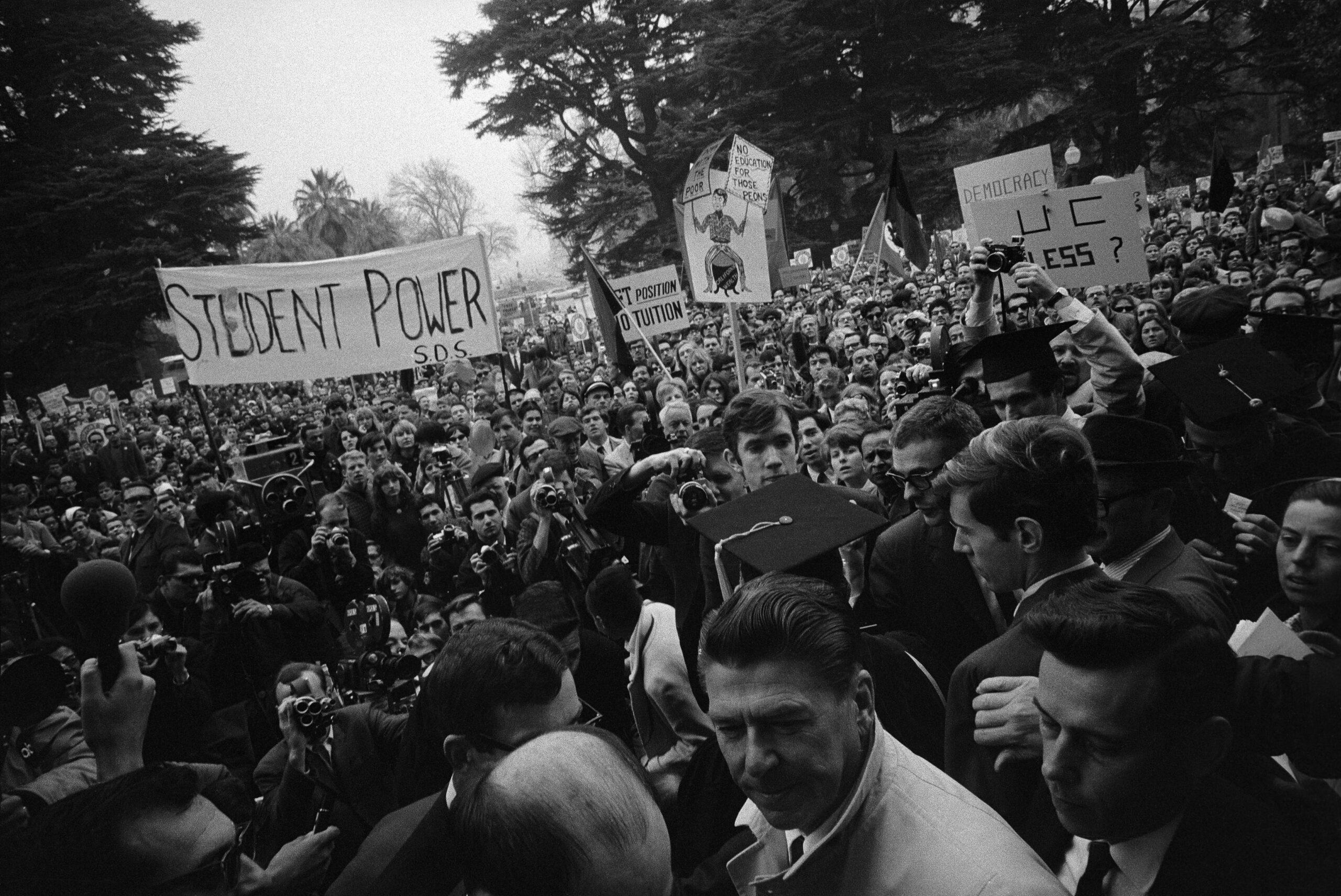
Ronald Reagan turns to leave after speaking to 7,500 students demonstrating in opposition to his proposed tuition plans and budget cuts for the University of California
The reality is more muddled than it appears at a glance. On the tuition front, prices are up, although there’s static in the data. For in-state students, rates have actually gone down in recent years, at least according to one prominent report. While the hiring market for recent graduates is more congested than it’s ever been, the long-term earning potential of those with a degree still significantly outpaces that of non–college graduates. Even the anti-DEI and anti-affirmative-action manias that have overtaken predominantly white institutions in recent decades are mostly divorced from fact, considering how segregated elite schools still are and how disadvantaged Black and Brown students are before they even arrive on campus.
Given these complications, it’s unclear whether any amount of reform could calm the frenzy surrounding schools nationwide. American colleges and universities are deeply flawed institutions, but it’s not those certifiable flaws that seem to have ratcheted up the contempt that they’re now so desperate to address.

There is a reason none of the nuances inherent to the system have ever been reflected in the ferocity of the executive branch’s recent forays against higher education: It would be both politically and ideologically inconvenient to acknowledge as much. The Trump administration has never earnestly tried to improve postsecondary education in America. It is merely attempting to afflict it. The executive branch is not investigating universities for violating any laws; it is preemptively cutting congressionally approved funding in retaliation for the appearance of those violations. There is no consideration of fact or fairness. There is only adherence or resistance.
It’s this philosophy that compelled Education Secretary Linda McMahon to state that “universities should continue to be able to do research” so long as they are “in sync” with “the administration and what the administration is trying to accomplish.” It’s this philosophy that has driven the highest levels of the regime to tar colleges and universities as “the enemy” while deploying them as political wedges. The long-term legal inefficacy of Trump’s pressure campaign is of little significance. Like elsewhere in his orbit, here, too, the process is the punishment, and the punishment is the point.
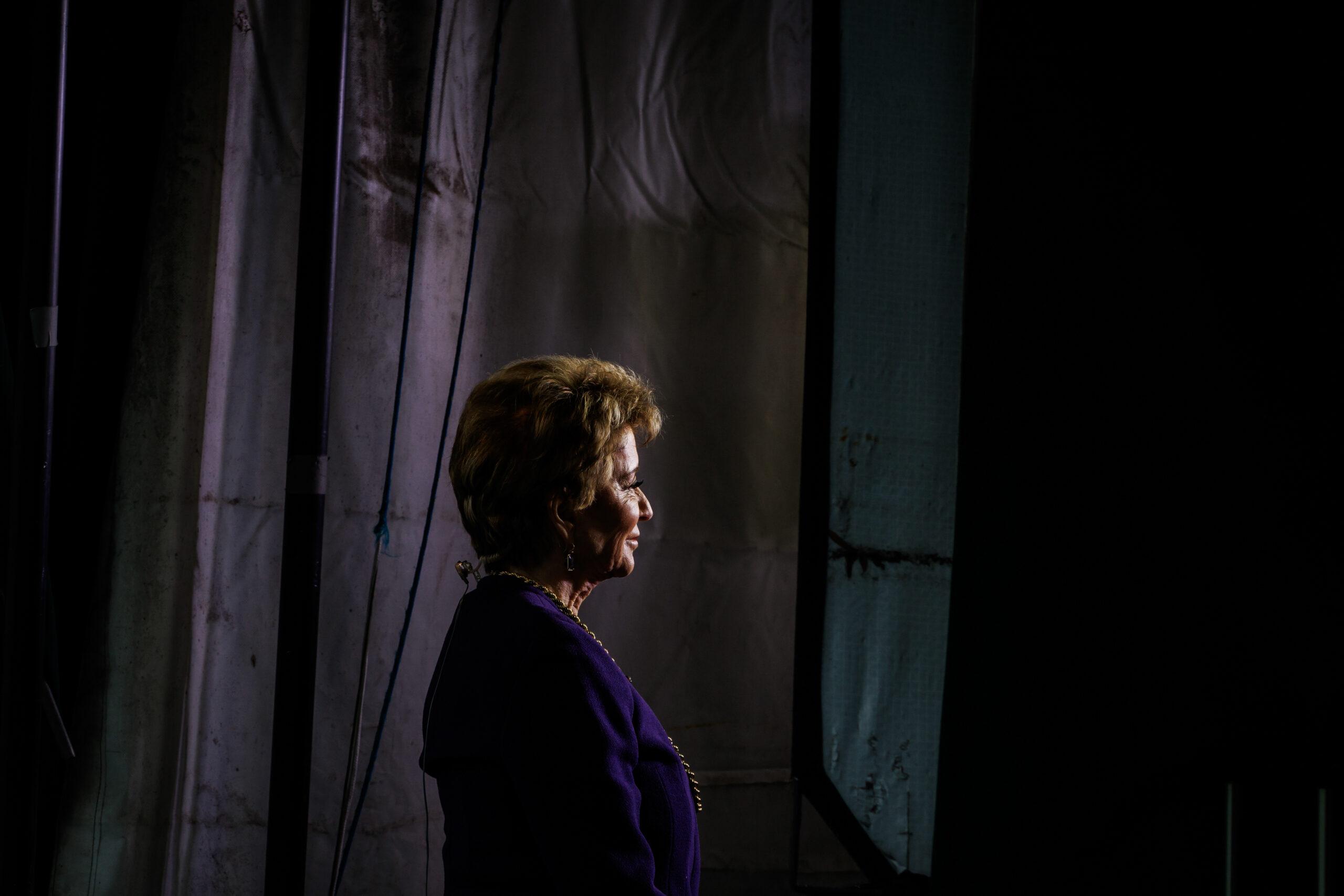
Linda McMahon during a television interview in front of the White House
The question is not whether academia can temper the swell that threatens to engulf it, but rather whether doing so is a matter of trust at all. There is a juncture at which what these schools are grasping for becomes less about winning back a disabused public than providing that public with a tangible service. At its most effectual, that’s what the U.S. education system has always had the capacity to do.
Maybe Yale and its peer institutions genuinely believe what they’re hawking. Maybe they just want the folks they depend on as customers and benefactors to know they’ve been heard. These are not the places we should be worried about. Rather, it’s the public universities and mechanical institutes and shrinking community colleges that don’t have $41 billion endowments or backroom networks to fall back on.
If the message coming out of Yale has a lone intended takeaway, it’s that these institutions recognize the breadth of the quagmire they’re in. If and when temperatures rise high enough, there’s no amount of distance that would insulate any place of learning from irrelevancy. And no amount of idealism that will protect against extinction.