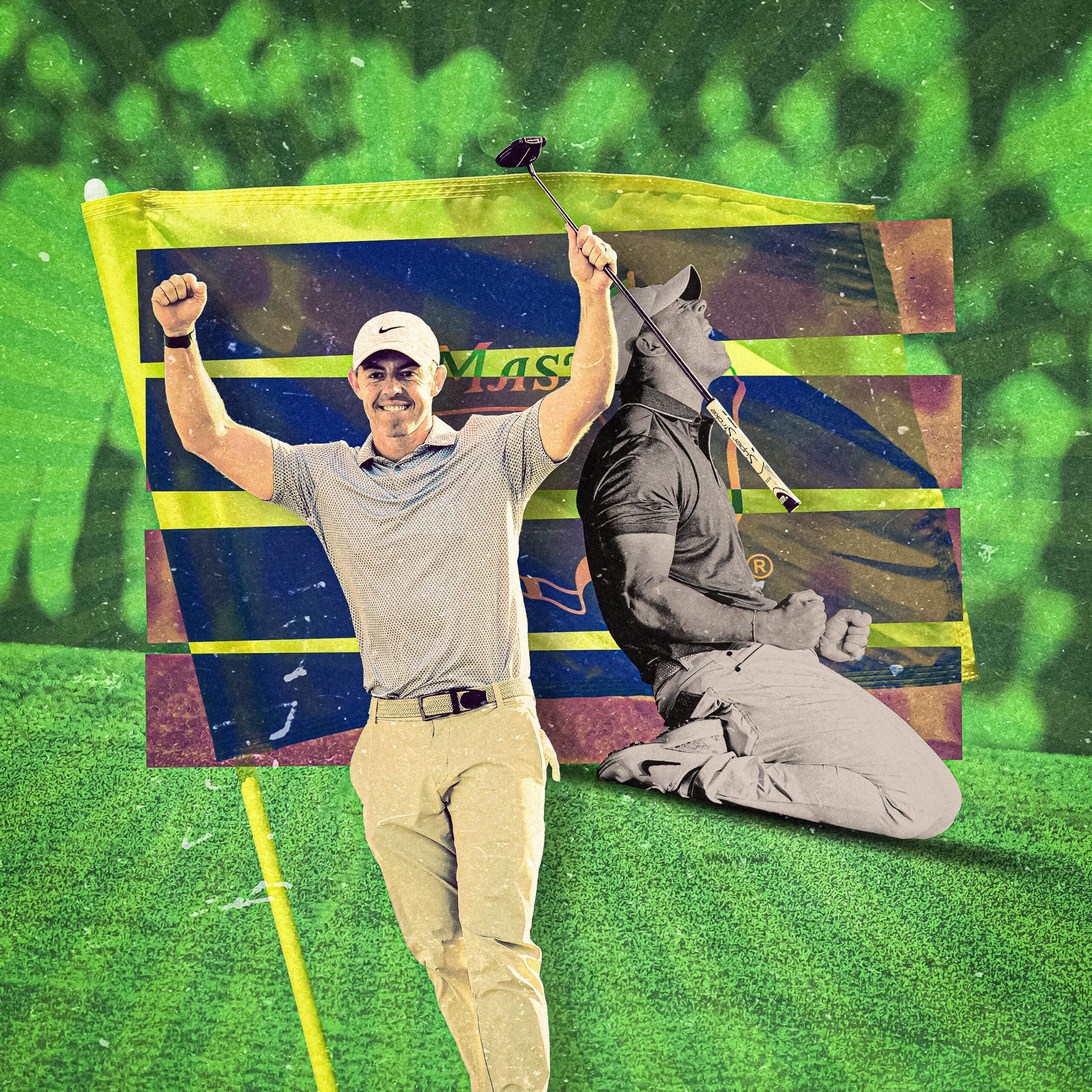

You know when the hard-boiled detective grabs the prime suspect by the scruff of the neck in the interrogation room and says: “We can do this the hard way, or we can do this the easy way”?
Rory Fuckin' McIlroy never does it the easy way.
On Sunday, when he became just the fourth golfer in history to win back-to-back green jackets at the Masters, he kept us in suspense until the very end. Standing on the 18th tee, following a week of wild fluctuations in his game that had nevertheless vouchsafed him a two-shot lead over Scottie Scheffler’s posted 11-under, he only needed to find fairway to functionally call game on the tournament.
But that is not Rory’s MO. Instead, he pulled his drive so far right that my editors and I briefly had to reconsider whether we’d still be writing a Rory-repeat story. Not until he hit his tough third bunker shot to 12 feet could we be absolutely certain that we wouldn’t have a Van de Veldeian ending. A close roll and a tap-in bogey later, and Rory was your one-shot victor, looking slightly rumpled from the experience. For sheer pathos, nothing could compete with his interminably gestating, profoundly cathartic win from a year ago—a passion play that exorcized not only Rory’s personal demons but also certain ones that had afflicted the sport itself. Once he’d accomplished the career Grand Slam, anything else was going to feel like a sequel. But dude, this sequel was rad.
McIlroy had built a massive six-shot lead going into the weekend, after a white-hot Friday back nine that saw him card birdies on 12, 13, 15, 16, 17, and 18. There are enough birdie holes at Augusta National that a six-shot lead for a brilliant player (a reigning champion, no less) should be a safe enough space to let him run away and hide over the weekend. McIlroy … did not do this. Following his Friday blitzkrieg, he was simply not sharp on Saturday. He shot 73—with a strange double bogey on 11 and a frustrating one on 16—and brought literally everyone else into the mix. His dramatic playoff adversary from the previous year, Justin Rose, loomed constantly, and Rose was at one time the solo leader on Sunday. Cam Young, Rory’s playing partner and Ringer man of destiny, took an early lead in their head-to-head match, only to feel the nerves and par out with a whimper. Ultimately, it came down to Rory and the specter of Scheffler, who overcame a pedestrian opening two days with the first bogey-free weekend at the Masters since 1942, while coming up one stroke short.
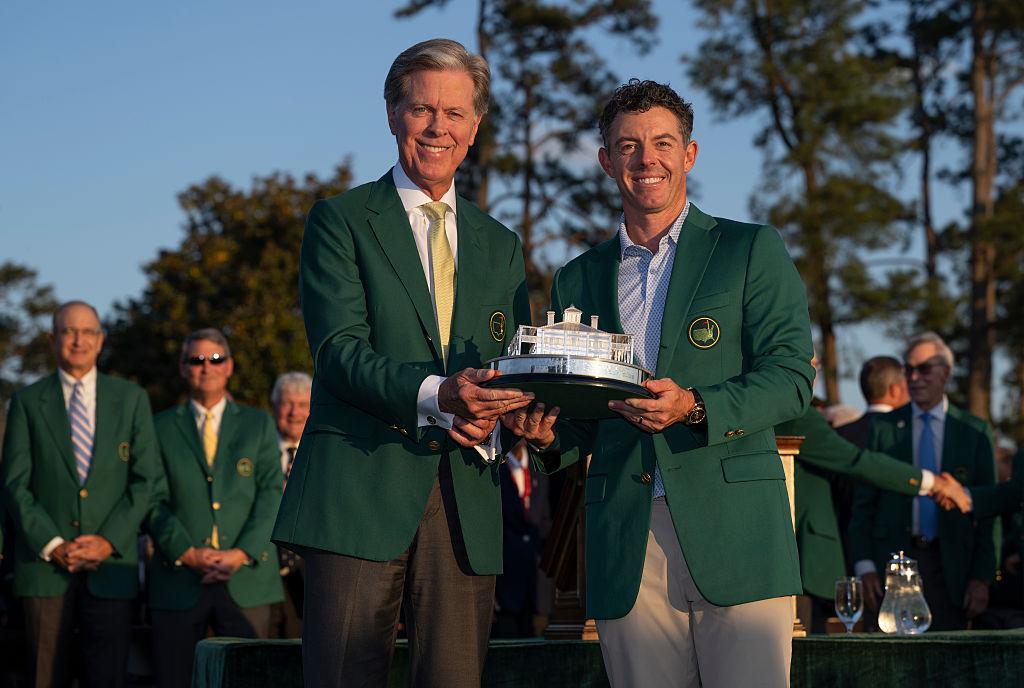
Chairman of Augusta National Golf Club and the Masters Tournament Fred S. Ridley presents Masters champion Rory McIlroy with the Masters Trophy
Of course, some small part of me was rooting for a Scottie-Rory playoff. Not because I wanted to see Rory collapse—I probably would have metabolically de-atomized if he had doubled 18—but rather because this is the confrontation that golf needs. It’s not so much Nicklaus-Watson as it is Ali-Frazier: two differing absolute obsessives at the peak of their golfing powers who are now quite clearly in conversation about which is the best of their era. Say what you will about the Masters and Augusta National—the trumped-up pomp and circumstance from a jumped-up Southern town that never knew its place—but they have a remarkable facility in two regards: telling great stories and finding great champions.
What a difference 13 calendar months make. Just last March, Rory seemed to be living under a bad sign. Despite his ongoing greatness as a consistent tour winner, he had gone an unfathomable 10 years without having won a major. Sadistically, but obsessively, this is what we as golf writers do. We fixate on the big four. During the decade-long lacuna between major victories, McIlroy won at a frantic state during nonmajor events and often did the most exciting things at majors he ultimately didn’t win. He was outspoken about his opposition to LIV, the Saudi-backed breakaway tour that poached some of golf’s greatest players for blood money.
Now there are only four men who have won the Masters back-to-back: Jack Nicklaus, Nick Faldo, Tiger Woods, and Rory McIlroy. The tradition at the Masters is that the previous victor puts the green jacket on the new one. It’s so rare for there to be a repeat winner that I couldn’t remember how the Butler Cabin ceremony would even work. Would Rory put the jacket on himself? Would Scheffler, the winner previous to Rory, tag in for a second year? Nothing so satisfying, as it turns out. Augusta National chairman Fred Ridley put the jacket on him instead.
My favorite thing from the CBS broadcast was the live cutaways they did to the Holywood Golf Club in Northern Ireland, where Rory fans gathered to watch him hit his no-no-no-no drive on 18, which was ultimately recovered and brought the green jacket back home. Maybe the worst impulse of the sportswriter is to try to pathologize your subjects, but I admit that I cannot help it.


Rory is so unreliable yet so uncanny. I guess you could say he’s a referendum on what kind of golfer you like. Do you like a risk-taker? He’s a risk-taker. Do you like a gent who’s gracious in his failures? There were so many crushing ones, but Rory has taken responsibility. Do you like a man who first donned the green jacket as the culmination of an obsession, then kept it another year just for kicks? I do, too. Contrast this year’s shrugging 72nd hole tap-in to last year's full-on 12-act opera, and you can conclude only: Here marks the day that McIlroy's major faucet is open and likely to start a flood. No one ever said that the fun way would be easy.
Rory hasn’t taken the easy way to becoming an all-time great. He was a generational talent who had bagged four majors by age 25, and it appeared that nothing could stand between him and a decades-long career of vaulting achievement. Then, somehow, everything got in his way: injuries, swing issues, geopolitics, some rocky patches in his personal life, Bryson DeChambeau, sometimes simply bad luck. Somehow, a full decade passed without him winning a single major. Now, with his second consecutive thrilling Masters victory, he's made up for lost time and reset expectations once again. Golf is like that. We've gone from wondering how many majors he could possibly win, to wondering whether he'd ever win any more, to wondering again whether he might get to double figures. No wonder he seems a bit exhausted. His career trajectory has been far from straight ahead, but look at him now—right where he was always supposed to have been.