The Winners and Losers of the NCAA Men’s National Championship Game
Dusty May’s Michigan Wolverines were the best team in college basketball all season. Here’s how May’s roster of transfer-portal stars took down UConn in the title game.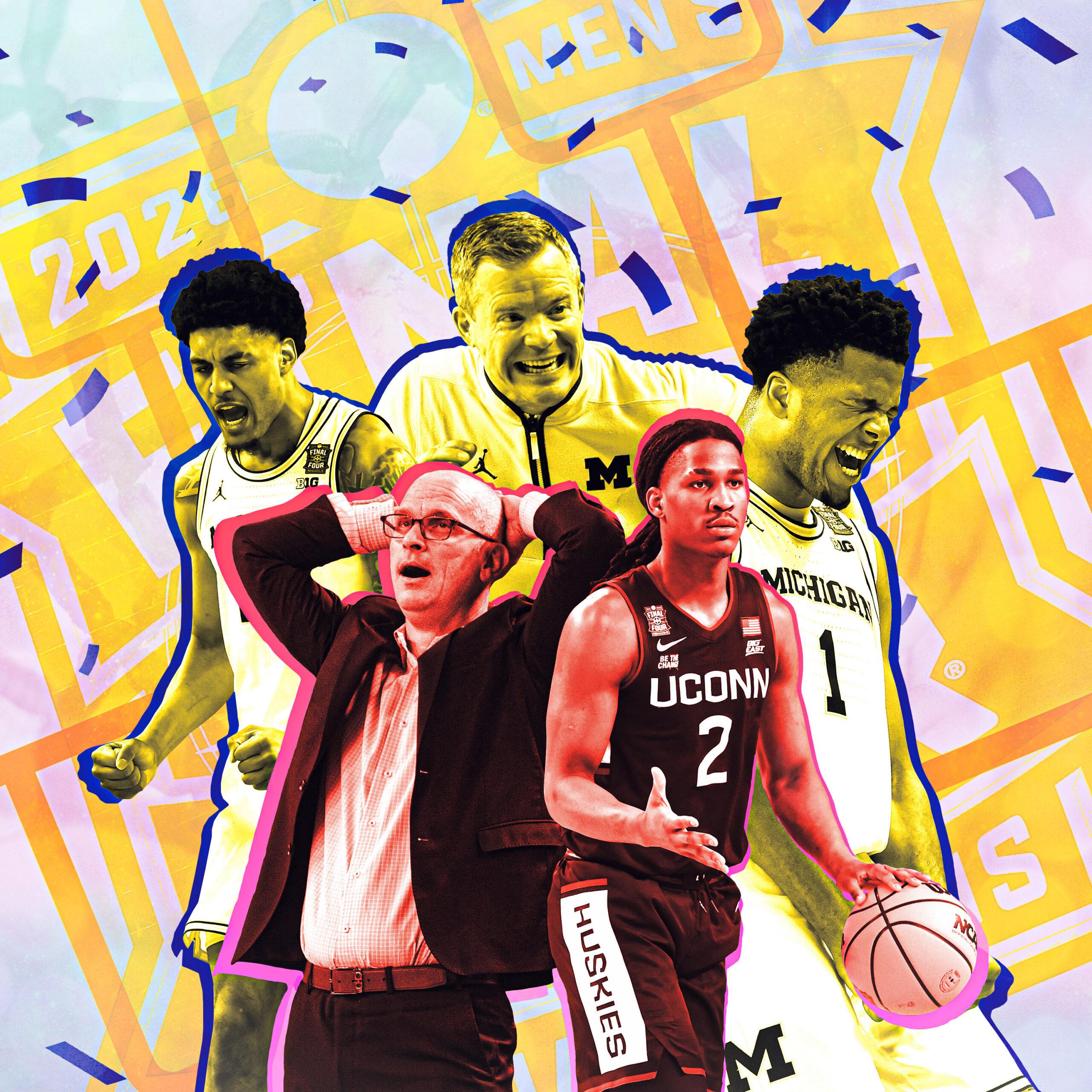

Who shined brightest in the NCAA men’s national championship game? Who fell short? And what will we remember from this men’s NCAA tournament? Let’s dive into a special edition of Winners and Losers.
Winner: Dusty May
This is the future that college basketball traditionalists warned us about years ago. Michigan won a national title on Monday night with a starting lineup featuring five transfers—four of whom joined the program this past offseason. It’s the first time that’s ever happened in the history of the sport, but we’ve been headed in this direction for the past few seasons. Last year’s Florida team that won the title had four transfers in its starting five. The UConn team that won the title before that had three. Championship teams are built—or bought—through the transfer portal now, and no coach has gotten more out of it than May since he arrived in Ann Arbor two years ago.
Having $10 million to splurge on talent certainly made it easier for May to work the portal last offseason, but there were other coaches working with similar, or even superior, budgets who didn’t get near the results the second-year Wolverines coach delivered. St. John’s had the nation’s top portal class and a Hall of Fame coach and couldn’t get past the Sweet 16. Kentucky reportedly spent over $20 million on its roster and needed a miracle 3 to get out of the first round. Kansas State matched Michigan with a five-star transfer and three four-star players out of the portal and didn’t even sniff the tournament. You can’t win without spending on transfers in this era, but spending on talent doesn't guarantee winning.
It’s a bit of a shame that the coaching job May did this season after bringing in all those new players wasn’t commemorated with an award. Nebraska’s Fred Hoiberg won the Big Ten’s Coach of the Year award, and Arizona’s Tommy Lloyd, whose team was run off the court by May’s Wolverines in the Final Four on Saturday, took home the national award. Lloyd gave May a shout-out during his acceptance speech, saying that the Michigan coach was more deserving of the award. It’s difficult to disagree after what we saw over the past weekend, and really the entire college basketball season, which the Wolverines dominated from start to finish. Michigan won 11 games by at least 30 points this season. Monday’s 69-63 win over Connecticut was its first single-digit win of the tournament.
It wasn’t just the dominant nature of this team that made May’s coaching job so impressive, either. Despite the lack of competitive games, Michigan was a blast to watch all season. The offense shares the ball like a team that has been playing together for years. The defense, built around a massive front line led by 7-foot-3 center Aday Mara, is impossible to unlock thanks to its coordinated switching. Because of how connected they looked on both ends of the court, it’s wild to think that this collection of players had never played a game together before last November. Mara was stuck on UCLA’s bench. Yaxel Lendeborg was playing for UAB. Elliot Cadeau was seen as a highly recruited bust at North Carolina. Morez Johnson Jr. couldn’t find a regular spot in Illinois’s rotation. It’s not like these guys were sure things who were expected to thrash through the competition like they did.
The Wolverines were ranked seventh in the AP preseason poll. May needed only a few months to have this group playing a level of basketball we’ve rarely seen at the “amateur” level. If this Michigan team, and the way May’s built it, is what’s wrong with the current state of college basketball, then there isn’t much of a problem.
Loser: Dan Hurley’s Plan
UConn head coach Dan Hurley went into Monday night’s game knowing that he had an inferior team, but that didn’t mean UConn didn’t stand a chance against Michigan. “You don’t have to be the best team,” he said on Sunday. “You don’t have to have the best season to win this tournament. … The good thing for us is it’s not a seven-game series. Just gotta play one game on Monday night.”
Connecticut needed to be better than Michigan for just one night, which is a lot more manageable. To do it, there would be a few nonnegotiables for the Huskies. They couldn’t let Michigan get out on the fast break. The Wolverines are too big, strong, and athletic to stop once they get going downhill. UConn would have to win its one-on-one matchups defensively to avoid having to help and risk leaving shooters open on the perimeter. Michigan shoots the ball too well from deep. And, finally, the Huskies would have to shorten the game and turn it into a low-possession half-court affair. If UConn did all of that, and knocked down shots (obviously), it had a chance of pulling off the upset.
Welp, Connecticut did all of it on Monday night. The Wolverines scored only two fast-break points. Michigan’s first make from 3 didn’t come until the 12:47 mark of the second half, and it hit only one more after that. It was only a 65-possession game, which was right on UConn’s season average and well below Michigan’s average of just over 71 possessions, per KenPom. When CBS’s Tracy Wolfson checked in with Hurley after the under-eight timeout in the first half, he said, “We’re dragging them into the only type of game that we have a chance to win.” Connecticut did what it set out to do; it just didn’t matter.
It turns out that this Michigan team also holds up just fine in a half-court fistfight. If anything, the half-court setting only made the size and athleticism gaps between the two teams more evident. Mara and Johnson were a load to handle for UConn’s smaller frontcourt whenever they touched the ball around the rim. Lendeborg, the Wolverines’ “small” forward, looked bigger and stronger than Tarris Reed Jr., UConn’s center. The Huskies guards couldn’t keep Cadeau out of the paint and couldn’t stop him from putting the ball in the basket even when they fouled him. And while the Wolverines didn’t get much offense from their wings, their defensive pressure overwhelmed UConn’s ball handlers and slowed down the Huskies’ typically crisp passing. Connecticut couldn’t do much of anything in the half court, and by the second half, it seemed like Hurley’s team needed to catch Michigan in transition to have a chance at scoring.
Maybe things would have been different if Connecticut’s shots were falling. The Huskies made just nine of the 33 3-pointers they jacked up on Monday night. These weren’t the quality shots we typically see from the Connecticut offense. Most of them came off the dribble or after a scramble for a rebound. The Huskies rarely shot 3s in rhythm, and even when they did, Alex Karaban and Braylon Mullins didn’t cash in nearly enough to keep the game competitive.
Yet even though his plan wasn’t working out and the foul calls heavily favored Michigan, it was a surprisingly chill night for Hurley. There were no tirades aimed at the officiating crew. No headbutts thrown. He almost seemed happy on the sideline, even with his team chasing the game late. It’s as if he found some measure of contentment knowing that he got his team to play the game it had to play to stand a chance against Michigan, even if it wasn’t enough. Or maybe he just didn’t want to be the second UConn coach to show his ass over Final Four weekend.
Loser: Silas Demary Jr.
I feel a little bad about calling Demary—who’s been playing with a high ankle sprain throughout the tournament—a loser, but the way he so thoroughly lost the point guard battle to Cadeau was one of the bigger determining factors in the game, so I don’t really have a choice.
Demary was UConn’s big portal addition last offseason, and he was viewed as a missing piece after the team’s issues at point guard in 2024-25. Tristen Newton graduated after the Huskies’ back-to-back titles, and Hurley was unable to find another point guard who could attack the paint coming off a ball screen and hit pull-up 3s. Demary had been the solution for much of this season, but he has not played well since the Big East tournament final loss to St. John’s, when he rolled his ankle. He’s scored 22 points total since reentering the starting lineup in the Sweet 16 win over Michigan State. He scored just two against Michigan.
But it wasn’t just Demary's lack of scoring that was an issue on Monday night. He couldn’t crack Michigan’s defensive shell, even when bigger defenders switched onto him. UConn really had no way of getting the ball into the paint without posting up Reed, who was bothered by Mara’s length and not nearly as efficient as he typically is from the block. With Demary getting stonewalled on the perimeter and Reed bricking his hook shots, Connecticut didn’t have many other options. Karaban, Mullins, and Solo Ball aren’t really penetrators and are much better shooting off screens. Since Michigan’s defense was switching, which neutralizes off-ball screens, UConn started spamming screens with Reed. Hurley knew that Mara, the one Wolverines player who doesn’t switch, would drop off, providing more space for the Connecticut player using the screen. At one point, Hurley had Reed set five straight screens on one possession.
UConn’s ball handlers were getting space but couldn’t do much with it. Look at all of the missed shots just outside the restricted area on this shooting map, via ESPN.
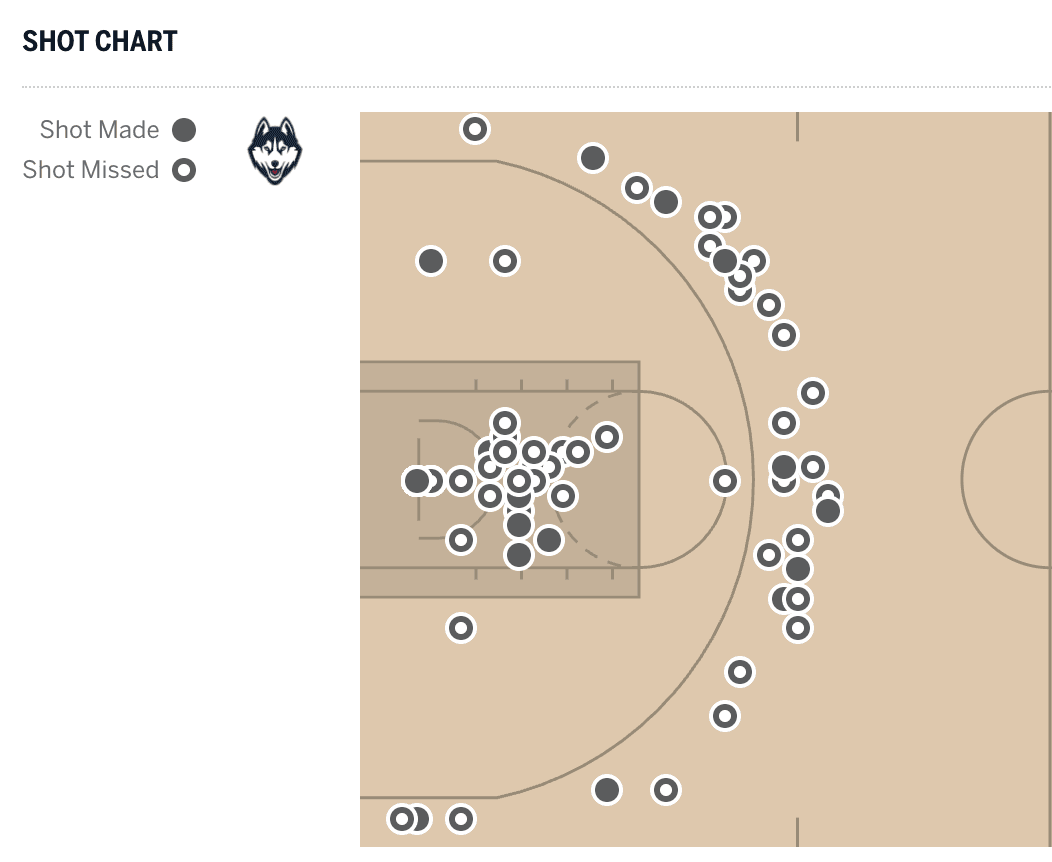
Those are the inefficient shots Michigan wants opponents to take, and it’s as good as any team in the country at forcing them thanks to Mara’s rim protection. By using Mara’s man as the screener, the Huskies were allowing him to camp out in the paint as a shot deterrent. But that was their only way of getting the ball into the paint, with Demary unable to penetrate off the dribble when Mara was dragged away from the basket and out of the action.
Winner: Elliot Cadeau
Michigan’s point guard had no such problem getting the ball into the paint, whether he was taking it in there himself or dishing it off to a teammate.
Cadeau didn’t put up huge numbers over the weekend—he averaged 16 points and six assists—but he was a deserving winner of the Most Outstanding Player award. He led the Wolverines with 19 points on Monday, two days after he handed out 10 assists against Arizona. And that assists number may be shortchanging Cadeau, who was instructed by May to throw passes off the backboard to his big men, according to the Michigan coach. “It’s the genius of Dusty, something he saw in film,” assistant coach Mike Boynton Jr. told The Athletic. “And Elliot is a wizard with the ball. He probably had four missed shots credited to him that were passes.”
After Monday’s game, May said that Michigan had brought Cadeau in to be a “pass-first quarterback” for his team and called him “brilliant” and a basketball “savant.” I don’t know how many coaches would have seen that in Cadeau after his two seasons at North Carolina, where teams would routinely leave him wide open on the perimeter. Here’s Florida State doing it last season.
Cadeau got his redemption this season with May and the Wolverines, and he didn’t pass up an opportunity to hit back at his skeptics. “They said I couldn’t do it,” he said on Instagram Live from the locker room. “They tried to tell me I was ass.”
Typically, I’d scoff at the idea that a former five-star recruit who’s received scholarships from two national title–winning programs is some underdog story. But in Cadeau’s case, opposing teams had defended him like they thought he was ass. Not anymore.
“Loser: Yaxel Lendeborg” —Yaxel Lendeborg
Michigan’s best player turned in a forgettable performance in Monday’s title game, scoring just 13 points on 4-of-13 shooting. But Lendeborg had a valid excuse for his off night: He was playing on both a bad ankle and a sprained MCL, suffering both injuries on the same play on Saturday night against Arizona. With just one day off to recover, it was a minor miracle that Lendeborg was able to even play, much less be a productive member of the team. Lendeborg didn’t seem to see it that way, apparently.
"I feel awful,” Lendeborg told Wolfson in the most honest and self-deprecating in-game interview I think I’ve ever seen. “I feel super weak right now. I can’t make anything. Oh man, I’m trying to push through because it’s the championship game obviously. I'm missing plays that I don't usually miss."
Lendeborg may not have been hitting shots he typically makes, and he missed all five of his 3-point attempts, but he still had a positive impact on the game for Michigan. Most notably on defense, where he defends every position on the court and typically picks up the player bringing the ball up the court. Even with limited mobility, the 6-foot-9, 240-pound forward had no problem staying in front of UConn’s guards.
Lendeborg was better in the second half after his interview. He never found the range from 3, but was able to get more shots around the rim and didn’t look very “weak” when doing so.
Winner: The NBA-to-College Coaching Pipeline
North Carolina was eliminated from the tournament weeks ago, but still managed to snag some of the title-day spotlight by naming Mike Malone its new men’s coach—a move that made the entire basketball world say huh?
Nationally, Malone’s name hadn’t really been thrown around as an option, which contributed to the surprise when the news was announced. North Carolina had seemingly set its sights on big names from the college ranks, but it was turned down by Final Four coaches May and Arizona’s Tommy Lloyd. Vanderbilt’s Mark Byington, Texas Tech’s Grant McCasland, and Iowa’s Ben McCollum were rumored as options before Malone, the former head coach of the Denver Nuggets, was ultimately picked as the replacement for Hubert Davis.
It was equally surprising that an established NBA head coach like Malone would make the rare move from the NBA to college. Mike Woodson made the move to Indiana in 2022 from a Knicks assistant job, but it had been years since he had been in a head coach role in the pros. Fred Hoiberg was fired by the Bulls before taking the Nebraska job. Larry Brown was fired by the Bobcats before heading to SMU in 2012. All of these coaches were forced down to the lower level. Malone, who was fired by Denver a year ago, is going willingly, before the next NBA head coach hiring cycle.
The new money that NIL is pumping into the sport isn’t just attracting players. Maybe coaches want a piece of it, too. And now that player recruitment and roster construction is more straightforward than it used to be—money is often now the deciding factor in where a recruit ends up—running a college program isn’t the grind it once was.
Malone takes over a UNC program that has a general manager in charge of filling out the roster with talent while the coach, for the most part, can just coach. It’s a lot closer to the NBA model. Now that schools are running their basketball programs like professional outfits, they’re starting to look for coaches with that level of experience.