

There is a version of this column, of this NBA season, in which we’d be rhapsodizing about the historic, breathtaking excellence we’re witnessing across the league’s top tier.
We would start with Shai Gilgeous-Alexander, who’s masterfully weaving together another MVP campaign. We would swoon over Nikola Jokic, who’s compiling another mind-bending collection of points and rebounds and assists. We would exalt Luka Doncic, who’s been scoring at an absolutely dizzying rate. We would try to capture the majestic, end-to-end dominance of Victor Wembanyama. The forcefulness of Cade Cunningham. The bravado of Jaylen Brown. The relentlessness of Anthony Edwards.
There is a version of this column, of this NBA season, in which we would compare and contrast all this individual brilliance for the purpose of determining this season’s Most Valuable Player. There is surely a world, in some distant strand of the multiverse, where that debate is happily raging right now.
But this is not that world, and this is not that column.
No, in this particularly stupid strand of the multiverse, we’re being asked to pretend that Cunningham’s outstanding season never happened. We’re deleting Edwards and Doncic from our spreadsheets. We’re praying to the basketball gods that Jokic and Wembanyama don’t trip in the shower this week, for fear it might trigger their own erasure from the historic record.
We’re parsing Article XXIX, Section 6, Subsection B(ii) of the collective bargaining agreement, trying to interpret exceptions and grievance procedures that might allow the NBA’s greatest players to get their deserved recognition, whether on an MVP ballot, an All-NBA team, or an All-Defensive team. The agents for Doncic and Cunningham are already busily preparing their appeals.
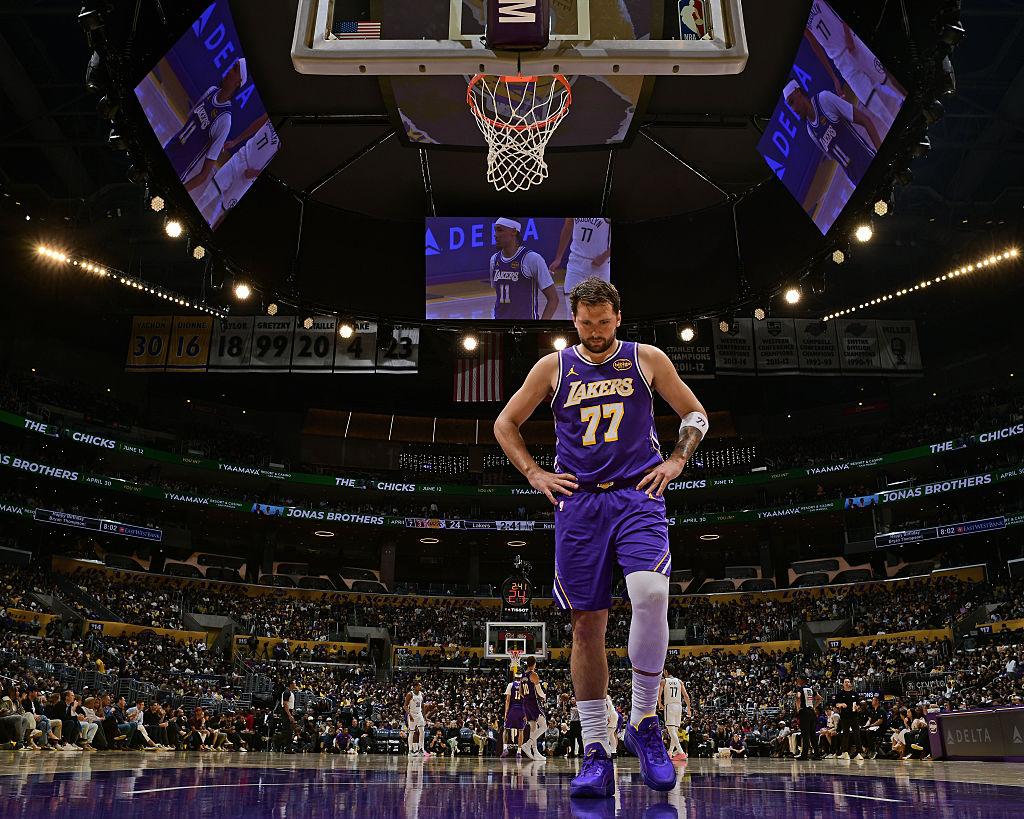
Luka Doncic during the game against the Brooklyn Nets on March 27
So with a week to go in the 2025-26 season, we’re collectively drowning in stupid legal technicalities instead of enjoying the drama and the spectacle—all because of the NBA’s ill-considered, demonstrably flawed 65-game rule, which ties awards eligibility to games played.
A quick summary of the carnage so far:
- The rule eliminated Doncic—the NBA’s leading scorer—from MVP and All-NBA consideration last Thursday, when he suffered a season-ending hamstring injury in his 64th official game.
- The rule knocked out Cunningham—who placed third in a midseason MVP straw poll—when he suffered a (probably season-ending) collapsed lung on March 19, in his 61st game.
- And the rule expunged Edwards—the league’s third-leading scorer and one of its most electrifying stars—last week, when he missed a game because of a right knee injury, ensuring that he’d fall short of the eligibility threshold.
Barring a successful appeal, that means that three of the NBA’s top 10 players will be officially barred from awards consideration when ballots are distributed next week, even though each played more than 70 percent of the season—and even though they played just a handful of games fewer than the likely winners.
And the league might not be done deleting superstars yet.
As of today, Jokic has played in 62 games, and four games are left on the Denver Nuggets’ schedule. Wembanyama has also played in 62 games, and four games are left on the San Antonio Spurs’ schedule. If either one misses any time during the last week of the regular season, they could be purged from the electronic ballot, too.
It’s worth noting that SGA, the current favorite to win MVP, just met the games-played threshold last week. Think of it: We were perhaps three untimely sprained ankles away from having six—SIX!!!—of the NBA’s best players eliminated from MVP and All-NBA contention. We were thisclose to a thoroughly disastrous and embarrassing coda to the NBA season.
As things stand, it’s all still awkward and unfortunate and, frankly, crappy. Edwards, Cunningham, and Doncic might not have won MVP in any case, but they would surely have received downballot votes. And they surely would have made one of the All-NBA teams, even after voters factored in all their missed games (as voters always have).
But the 65-game rule, which took effect in 2023, doesn’t just bar a player from winning these awards; it removes them from the ballot entirely. So Doncic—even though he averaged an absurd 33.5 points, 7.7 rebounds, and 8.3 assists per game—cannot even earn votes for the All-NBA third team, unless his agent wins an appeal.
Again, Doncic will finish with 64 games played; Jokic and Wembanyama will each play, at most, 66 games. But the latter two (assuming they make it) will surely win All-NBA honors and top-three MVP nods, while Doncic is barred from earning a single vote. How is this logical or justified? We’re about to permanently warp the historic record over a two-game difference—all because of an overzealous, mostly fruitless attempt to curb load management.
The irony is that all of the players mentioned here—from Doncic to Jokic to Cunningham to Edwards to Wembanyama to SGA—have suffered legitimate, long-term injuries this season. Load management had nothing to do with their game totals. By and large, they didn’t choose to miss games. (Unless you want to penalize Doncic for missing two games for the birth of his daughter in December. If so, please keep it to yourself.)




More on the NBA
A quick refresher on how we got here: NBA officials were getting increasingly testy about players missing games to “rest” or for “injury management,” especially in high-profile, nationally televised matchups. It was pissing off their broadcast partners, to say nothing of ticket-buying fans who paid a small fortune to watch, say, Steph Curry in his lone annual visit to their town, only to find out that he was taking the night off.
This perceived crisis was occurring just as the NBA was negotiating its latest media-rights deal, which would end up being worth $77 billion, only heightening the urgency to get star players on the court more. (“It was all tied to the new TV deal,” said a source involved in the media discussions.) To be clear: The league’s broad concerns were justifiable. The solutions were not.
The NBA had already instituted a “player rest policy,” followed by a “player participation policy,” to govern when and how teams rest their stars, under the threat of fines. Those measures made sense. But the 65-game rule, adopted in the 2023 CBA, was flawed on its face, for obvious reasons:
- The number (65) is too high, given the demands of the modern NBA game. Today’s players cover more ground, at a higher pace, than their predecessors ever did. They get injured more often. And thanks to modern sports-science and training practices, they take a more cautious approach to returning. Averaging 60-70 games is the new normal. No one plays 82 anymore. (Again, just look at the totals for the stars we listed above.) Also, “rest” decisions are almost always made by the medical staff and the front office, not by the players themselves.
- The number is arbitrary. As we’ve noted, a superstar who logs 64 games could be denied All-NBA recognition while ceding the honor to a lesser rival who plays 65 (possibly with fewer total minutes). This is bonkers.
- The rule is too rigid. Yes, the NBA created some exceptions and appeals options, but the rule effectively makes no distinction between legitimate injury absences and rest absences, and it doesn’t explicitly acknowledge other possibilities—such as missing games for the birth of a child or a family emergency.
The players association, although, according to sources, philosophically opposed to the 65-game rule, reluctantly agreed to it during the 2023 bargaining process. But given everything that’s transpired this season, the union intends to push for reforms, possibly even before the current CBA expires in 2030.
It’s not even clear whether the 65-game rule has had the desired effect of inducing star players to play more games. Sadly, the league can’t ban hamstring strains or collapsed lungs.
Here’s the other thing: Historically, there were only rare instances of players winning the NBA’s highest honors while playing fewer than 65 games anyway. Awards voters (including me) have always factored games and minutes played into the process. In the past, that meant a player with, say, 64 games might fall down a few slots on the MVP ballot or slip to second-team All-NBA. But under the 65-game rule, they just disappear entirely. That judgment has been taken out of the voters’ hands. (A modest reform proposal: If you have to bar players from winning an award based on games played, at least allow them to get ballot votes and secondary recognition.)
Players and their agents have largely taken a wait-and-see approach to the rule’s effects. But the dam is starting to break.
Last month, the players association called Cunningham’s ineligibility “a clear indictment” of the 65-game rule and called for it to be “abolished or reformed.” The union is proposing that any rule should focus on “excessive” load management and should provide greater latitude to players with legitimate injuries that cost them multiple games.
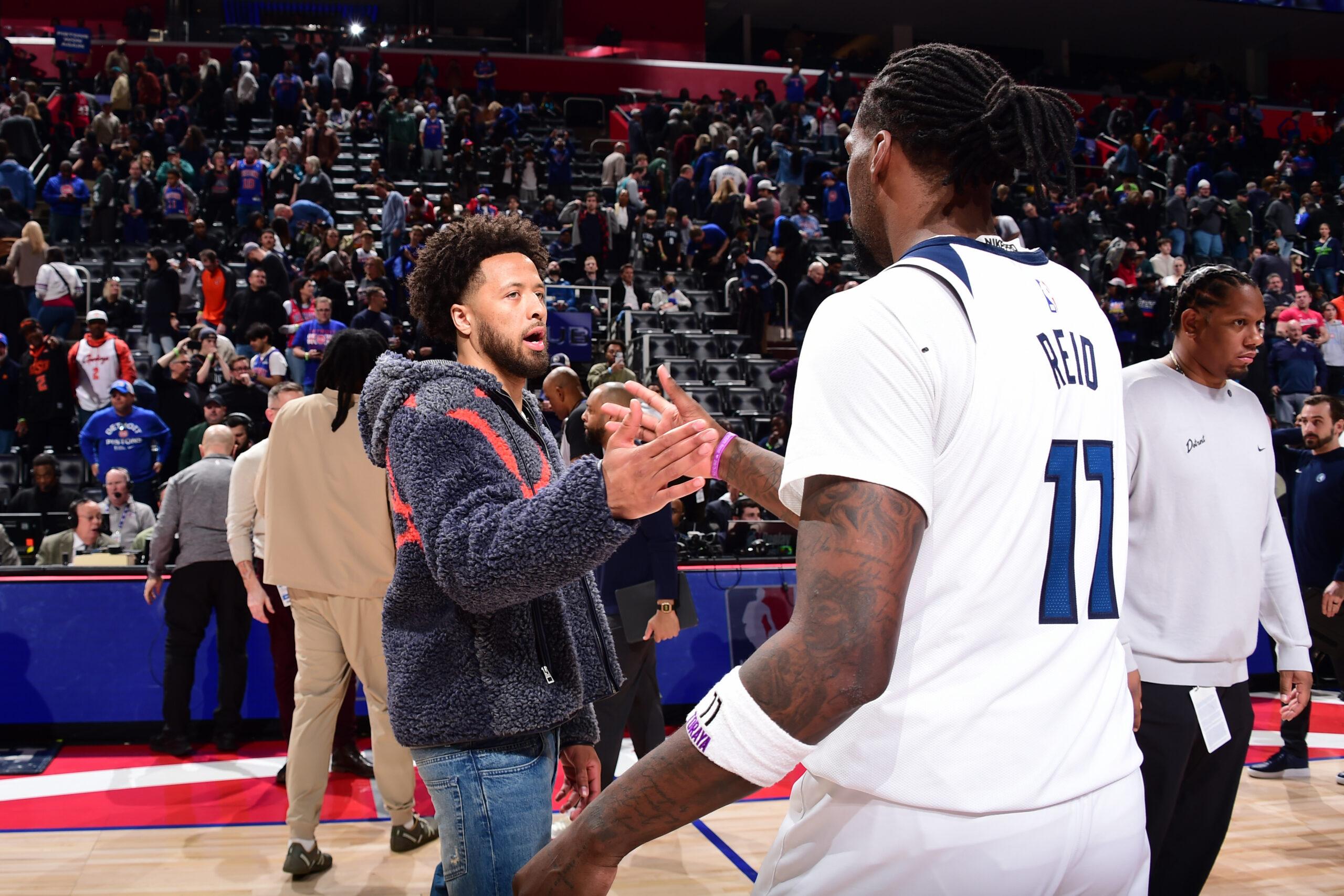
Cade Cunningham and Naz Reid after the game on April 2
Jeff Schwartz, the veteran agent who represents Cunningham (as well as Jokic), assailed the games minimum as “arbitrary” and “rigid” while pleading for an exception, given the seriousness of Cunningham’s injury. Bill Duffy, the longtime power agent who represents Doncic, took a more measured tone, saying that his client’s “record-breaking season deserves to be noted in the history books, despite [his] unfortunate injury and other extraordinary circumstances.”
In an interview with The Ringer (before Doncic’s injury), Duffy expressed a general concern that the 65-game rule made no distinction between legitimate injury absences and “rest” absences. Duffy and other agents also worry that injured players might rush themselves back and risk reinjury just to make the 65-game cutoff.
“If a guy has an injury, that’s not his fault,” Duffy said. “If it’s a legitimate injury … those games should be exempt.”
Commissioner Adam Silver, speaking in late March, said that the league is always open to revisiting policies with the players association. But he sounded reluctant to back off from the 65-game rule, which he still believes is helpful in curbing load management.
“We always knew when there's a line you draw, that somebody's going to fall on the other side of that line,” Silver said. “It may feel unfair in that particular instance. Let's see what happens at the end of this year. … I’m not ready to say, standing here today, that because there may be a sense of unfairness for one player, that that means the rule doesn't work.”
It’s too late for the NBA to fix any of this for the 2025-26 awards cycle. The official ballot needs to be set early next week, following the regular season’s conclusion on Sunday. The league also has little time to weigh appeals and grievances, although it could certainly still decide to reinstate the eligibility of Doncic and Cunningham.
One agent I spoke to in early March predicted that it would take something extreme—some particularly warped and embarrassing outcome—for the NBA to change the rule. Like multiple MVP candidates being disqualified in the same year. Like the fourth-best choice winning MVP by default.
Maybe we’re not quite there yet. But we’re getting damn close. The past few weeks have provided a vivid indictment of the 65-game rule. Let’s hope it’s the last time we have to discuss it.
While we’re here, I have four other awards-related suggestions …
1. Expand the MVP Ballot
I first floated this on a podcast about five years ago, and I still stand by it: The MVP ballot should have seven slots instead of five.
The premise is simple: Most years, we have two or three true MVP candidates and another half dozen guys who are worthy of downballot recognition—with a third-, fourth-, or fifth-place vote. There’s often very little difference in those downballot guys’ qualifications.
Take last season as an example. SGA won MVP with 71 first-place votes and 913 total points, followed by, in order: Jokic, Giannis Antetokounmpo, Jayson Tatum, and Donovan Mitchell. Seven others received at least one fourth- or fifth-place vote: LeBron James, Cunningham, Edwards, Stephen Curry, Jalen Brunson, James Harden, and Evan Mobley.
That’s 12 players who earned at least one vote (out of 100 ballots)—and each one had a case for one of those fourth- or fifth-place slots. The distinctions among the downballot players are minimal. A deeper ballot would acknowledge that and give voters the latitude to recognize more players.
It’s not a radical idea. Major League Baseball has used a 10-slot MVP ballot since 1931. The MLB system awards 14 points for a first-place vote and declines from there, with a 10th-place vote worth one point. The NBA’s MVP ballot is similarly weighted—10 points for a first-place vote, down to one point for fifth—and could easily be adjusted for a seven-person ballot.
There’s also precedent in the NBA. Until 2002, the league used a one-line ballot for all of its awards other than MVP. (That’s how we used to get ties for, say, Rookie of the Year.) Starting in 2002-3, the league adopted a three-line, points-weighted ballot for everything from Rookie of the Year to Sixth Man of the Year to Coach of the Year.
A seven-man ballot wouldn’t change anything at the top of the MVP race—SGA still would have won last season, with Jokic in second—but it would provide a fuller, more accurate picture of the season. There’s really no downside.
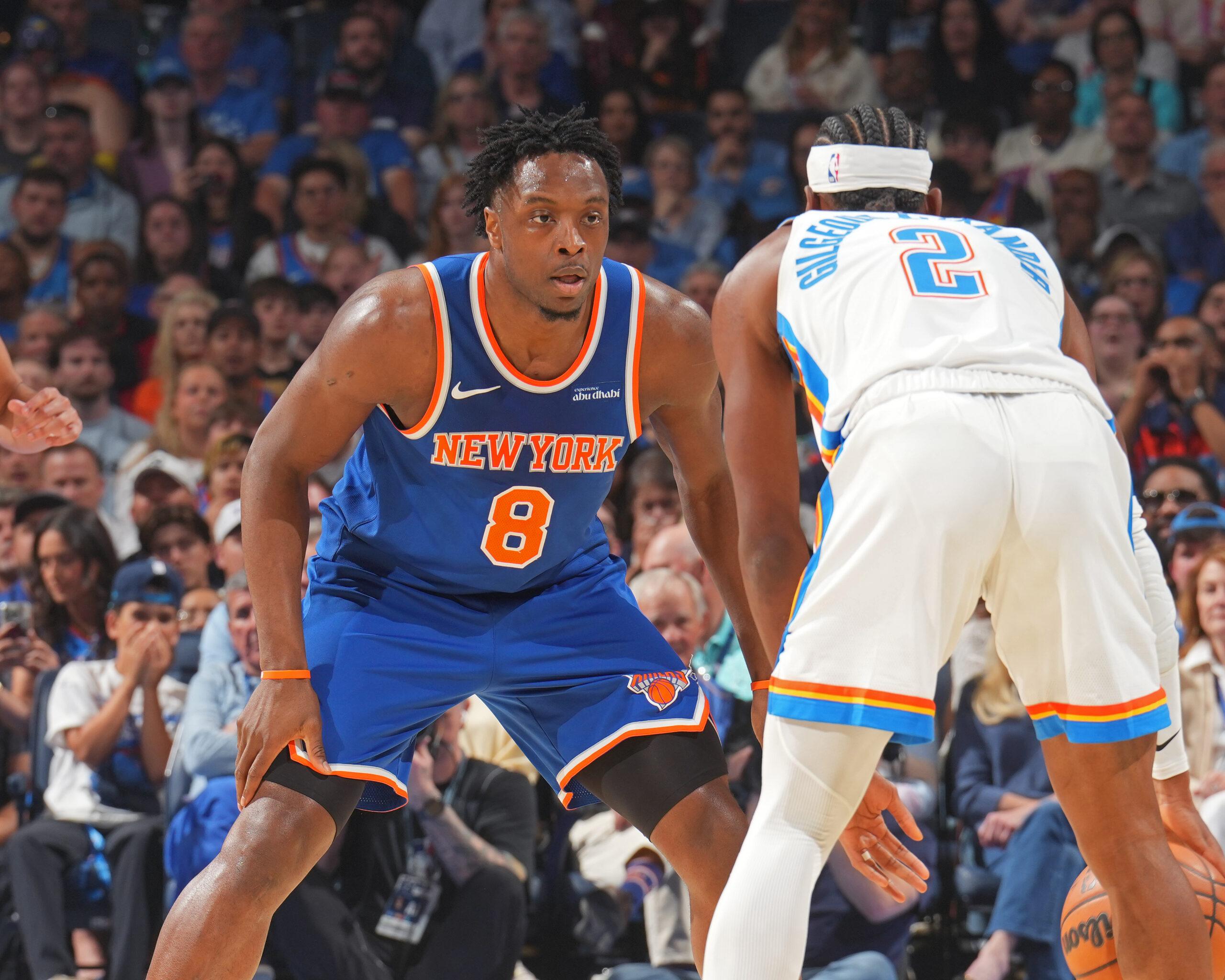
Shai Gilgeous-Alexander is guarded by OG Anunoby during the game on March 29
2. Expand the All-Defensive Teams
This one is easy. The league has forever had three All-NBA teams. But for whatever reason, it recognizes only two All-Defensive teams. And again, there are far more worthy players than there are slots.
Last year, 24 players received at least one vote. Among the “honorable mentions” who missed the cut were OG Anunoby, Bam Adebayo, Derrick White, and Antetokounmpo. All are perennially among the league’s elite defenders. Yet Anunoby, for instance, has won the honor just once (in 2022-23).
There are more than enough worthy candidates each season to justify 15 honorees.
I’ll note here that any change to the major postseason awards would require the approval of the players association, via the CBA. But it’s hard to see why it would oppose more honors.
3. Restore Positions to the All-NBA Ballot
I know we love to say that this is a “positionless” era, but it just isn’t true. It’s certainly a positionally fluid era, and it’s probably murkier than it was in, say, the 1980s. But positions still matter. The league still classifies every player as a G, F, or C in its official box scores and on its website, and it allows you to sort players by those positions.
Yes, we have a center who plays like a point guard (Jokic) and point guards who are built like power forwards (James, Doncic). Basketball is ever evolving. Modern players are more skilled and flexible than their predecessors. But we generally still sort them into guards, forwards, and centers. Positions still matter!
But the league stripped positional designations from the All-NBA ballots starting in 2023-24—probably as an overreaction to the Jokic–Joel Embiid controversy in 2022, when Jokic won MVP and made All-NBA first team, pushing Embiid (second in the MVP voting) to second team.
Positional designations are still useful for making historic comparisons and for keeping today’s All-NBA structure consistent with those of past decades. (And, speaking as a voter, it also makes it a little easier to sort out the ballot.)
4. Abolish Clutch Player of the Year
The NBA sprung this one on us in 2023, without any real advance notice or explanation. No one asked for it. Not the players, not the fans, not the media. (Maybe the league just wanted a way to honor Jerry West, for whom the trophy is named. Which, fair.)
Here’s the problem: “Clutch” is a super squishy term. Clutch when? In the last minute? The last two minutes? The last five minutes? Clutch how? In scoring? In passing? In defending? If you score a lot of “clutch” points (because your team plays a lot of close games) but shoot a really poor percentage in “clutch” situations, are you even … clutch?
The NBA’s website has an entire page dedicated to “clutch” stats, where you can sort the parameters by minutes remaining (last five minutes down to last 10 seconds) and point differential (five points down to one point). So which combo of points and time defines “clutch” for the purposes of this award? Nobody knows.
Obviously, voters have to use some combination of data and personal judgment with all of these awards. But this one, by its title alone, suggests some objective truth—that is, either you’re clutch or you’re not. Yet the league has given no direction on what it had in mind.
If the league wants us to use the most common definition for “clutch time”—five minutes or less, five points or less—then just say so. Make it a purely stat-based award and give it to the player that the NBA.com formula spits out. No voting necessary.