The Winners and Losers of the Men’s Sweet 16 and Elite Eight
Braylon Mullins ended Duke’s tournament, Michigan looks as good as anyone, and Arizona could go all the way

Who shined brightest in March Madness’s Sweet 16 and Elite Eight? Who fell short? Let’s dive into a special edition of Winners and Losers.
Winner: Braylon Mullins
How many times have you watched a replay of the shot already? If your answer is under 50, I’d like to congratulate you for not being glued to a screen on Sunday night. The rest of us couldn’t scroll for more than a few seconds without coming across yet another cut of Braylon Mullins bouncing Duke and its horde of five-star recruits out of the NCAA tournament and sending UConn to its third Final Four in four seasons.
The splash of that net will echo in the ears of Duke fans throughout the offseason. Mullins’s shot was so pure, it seemed like every person in the building knew it was dropping as soon as it left his fingertips. It was a relatively good look given the situation—Mullins’s team was down two with just over two seconds left, and they’d just stolen the ball away from the Blue Devils to earn a final attempt. The freshman gets high marks for drifting into open space after corralling the loose ball and pitching it up ahead to Alex Karaban. Rather than storming downcourt toward the 3-point line, Mullins lagged behind and left a sizable gap between him and his defender, Isaiah Evans, who didn’t contest the shot.
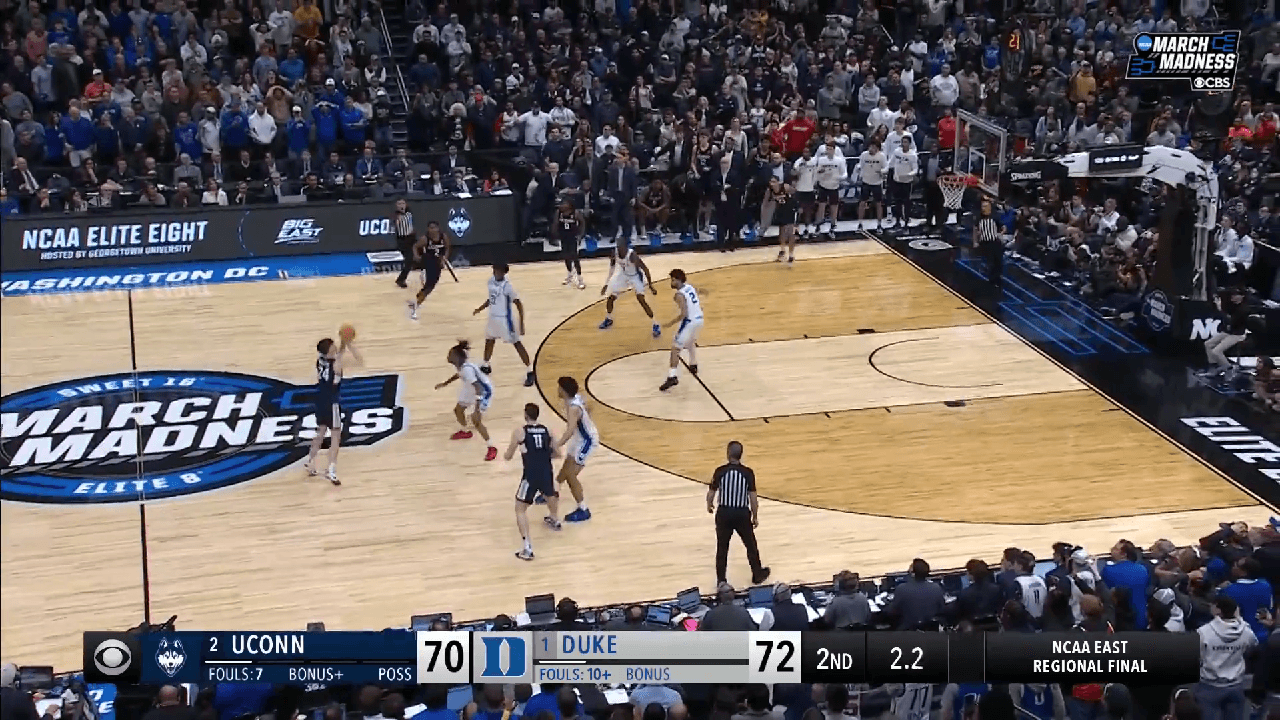
It was a confident stroke from a freshman who’d gone 0-for-4 from deep against the Blue Devils up to that point. As UConn coach Dan Hurley said after the game, one was due to drop. And Mullins said that he was “just happy to see that shit go in” after struggling to get shots to fall all season. The five-star recruit came to Connecticut with a reputation as a knockdown shooter, but he’s made just over 33 percent of his tries from deep this season. Hurley never seemed to lose confidence in the freshman despite his bouts of crappy shooting, though. Mullins has been in the starting lineup since December 12, and with UConn’s season on the line on Sunday, he was on the court over Solo Ball, an upperclassman with a national championship ring. Seems like that was the right call.


Bonus Winners: Tarris Reed and Danny Hurley
Mullins may have been the hero, but he wasn’t UConn’s star on Sunday. That would be Tarris Reed, who kept the Huskies in the game early on and sparked the second-half run that got them back in it late. The Blue Devils were one of the bigger teams in the field, and even they couldn’t cope with Reed’s size down low. Duke tried to double him, but UConn’s spacing and alignment made that difficult. Cameron Boozer blocked a couple of Reed’s shots when helping out, but when any other player tried to contain him, Reed was unbothered. He scored 12 of Connecticut’s first 16 points and finished the game with 26.
Outside of Reed, though, UConn didn’t find much success on the offensive end. Duke is very comfortable switching screens, which disrupted Hurley’s intricate sets. The Huskies got some decent looks from 3 but weren’t able to crack the Blue Devils’ defensive shell and get penetration. At least not early on. But Hurley finally found something that worked in the second half when he started using Reed as a screener. Duke didn’t want to switch a small player onto the UConn big man, so it had Reed’s defender drop instead, which created space for the player coming off the screen. That gave the Huskies just enough of a scoring punch to stay within arm’s reach of the Blue Devils and put pressure on Jon Scheyer’s young team, which eventually wilted under it.
Loser: Jon Scheyer
Duke has now lost four games in the past calendar year, and in each of those losses, it’s held a lead of at least 13 points. Scheyer’s team blew a 14-point lead to Houston in last year’s Final Four loss. It let a 17-point lead slip away in a one-point loss to Texas Tech in nonconference play, and it watched North Carolina lead a 13-point comeback in February, capped off by a game-winning 3 at the buzzer. And then this happens.
That shot of Scheyer watching his team’s demise is important for two reasons: (1) It gave us “the Jon Scheyer face,” which you will be seeing printed onto cardboard cutouts in student sections across the ACC next season:
And (2) it serves as visual proof that Scheyer was instructing Cayden Boozer to advance the ball. There wasn’t enough time remaining for Duke to earn a 10-second violation, so Boozer could have sat on the ball until UConn fouled or the buzzer sounded. Scheyer said after the game that’s what he wanted, but that’s not what we saw on replay. Either way, it’s hard for me to blame the freshman for trying to make that pass when he had two teammates standing wide-open downcourt, and it ultimately falls on the coach if the instruction was unclear.
Outside of that, it’s difficult to find other nits to pick with Duke’s coaching on Sunday. Scheyer devised a solid plan built around Cameron Boozer. No matter how UConn tried to defend him, the Blue Devils had a counter. Karaban, Connecticut’s stretch 4 who’s really just a tall wing, drew the first assignment, but he couldn’t stop Boozer from getting into a good position at the rim. When Reed got his shot, he struggled to keep up with Boozer, who’s shockingly nimble for a 6-foot-9 big man, and he had trouble navigating screens when Duke used Boozer as a ball handler in pick-and-rolls. There aren’t many big men in the country who can play that role. Connecticut then tried switching screens, but Duke countered by setting the screen with a guard and creating a size mismatch. Scheyer had an answer for whatever Hurley could come up with.
There is a concerning pattern forming in these heartbreaking losses, but the larger sample of Scheyer’s career indicates that he's a good coach who will eventually shake this run of bad luck in high-profile games. Scheyer has maintained the talent pipeline that powered Mike Krzyzewski’s decades-long run, and his teams have adapted strategically throughout his first few seasons on the job. As long as he keeps churning out teams that are stocked with future NBA talent, one squad will eventually break through.
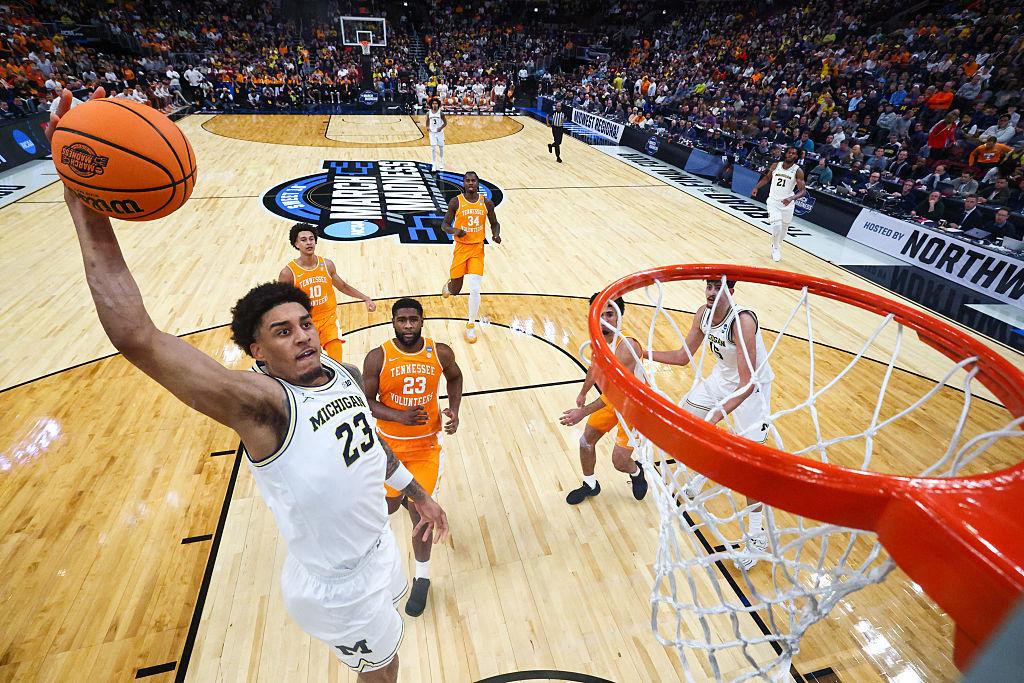
Yaxel Lendeborg dunks against the Vols in the Elite Eight
Winner: Michigan’s NIL Fund
Michigan looked like the best basketball team in the world on Sunday in its blowout win over Tennessee. The Wolverines suffocated the Vols on the defensive end and ran their offense around Tennessee as if the Vols were traffic cones. (Tennessee even dressed the part with its bright orange uniforms.)
I don’t want to be too harsh on Tennessee. I’m not sure that any team could have stood a chance against Michigan when the Wolverines were playing that well. The passing stood out the most. Michigan has talented scorers all over the court, but the ball never sticks in one spot. It flies around until it winds up in the hands of an open guy, positioned either beyond the arc for a 3 or right around the rim for an easy score. It’s like watching a Tim Duncan–era Spurs team—only those teams were developed over years in Gregg Popovich’s system. Dusty May has built this cohesive unit in under 12 months. All five of Michigan’s starters started their college careers with other programs, and his four best players transferred into Ann Arbor just this past offseason.
I credit Michigan’s star transfer, Yaxel Lendeborg, for leading by example. The 6-foot-9 forward is averaging 14.9 points per game this season, but that number could be 10 points higher if he were more of a ball hog. He certainly has the talent to justify a higher usage rate. But with so much firepower around him, Lendeborg can pick his spots, giving him time to suss out the defense and create a plan of attack. Take Sunday, for example. Lendeborg didn’t score over the first six minutes of the game, but he exploded for 15 points before the halftime break. On his way back to the locker room, Lendeborg was asked what had changed, and he broke it down with remarkable detail for a guy who was still trying to catch his breath.
“The first six minutes, I had to realize what the defense was doing,” Lendeborg said. “They were pretty much packed in on my ball screens. I didn’t really have no angles, so I was passing the ball a little more. I started getting easier looks on the fast break—had a lot of one-on-one opportunities with big guys chasing me, so I’m gonna keep attacking [on the] fast break and let the rest come my way.”
Lendeborg continued to attack on the break and in the half court as well, and he finished with a game-high 27 points. But it never seemed like he had to press to get them. If there was an open pass to be made, he made it. And the rest of the team followed his lead, finishing with 19 assists on 29 made baskets.
This team plays beautiful, unselfish basketball, and the way it operates together shows the power of the portal when a coach works it properly. May used the portal to find players who fit his philosophy of up-tempo basketball and a lot of passing. He brought in Lendeborg, an unselfish scorer; Elliot Cadeau, a true pass-first point guard; Aday Mara, a 7-footer who throws flashy passes from the post; and Morez Johnson Jr., who is mostly a finisher but will dish it off to an open man if the defense converges on him. These guys were mostly finished products when they got to Michigan. May knew what he was getting and had a vision for how he’d use this unique set of talent. When the Wolverines are at their best, they look like an NBA team. The first half of their shoot-out with Alabama in the Sweet 16 looked like professional basketball—until the Tide could no longer keep up. I’m not sure you can build a team like this with the more traditional model of recruiting and developing high school players. It’s one that could have been built only through the portal.
Winner: Keaton Wagler
Now that Arkansas’s Darius Acuff Jr. is out of the tournament, we can anoint Wagler as the top “get a bucket” guy left in the field. That’s always an important piece to have in March, when offensive slumps are inevitable. And any time Illinois’s offense bogs down—which doesn’t happen often—coach Brad Underwood can just spread the court and isolate Wagler or set a simple ball screen for him. Either way, Underwood can trust Wagler to create a good shot. Wagler isn’t an explosive athlete, but he’s got a keen sense for creating separation off the dribble and staying balanced when transitioning into a jumper.
That’s an outrageous move that sent the Iowa defender flying toward his own baseline, and two nights earlier against Houston, Wagler had Emanuel Sharp in downward dog with the same spin-stepback jumper.
When a player can do that to elite perimeter defenders and shoots the ball accurately, there’s not much an opposing team can do. And in Underwood, Wagler has a coach who appreciates his scoring talent. Underwood has run a more rigid, system-based offense in the past, but he’s recently pivoted to more of an NBA-style approach. Instead of just running some brand of motion offense, like most college coaches do, he’ll spread the court and hunt for mismatches for his best scorers. Through the first four rounds of the tournament, Wagler and Andrej Stojakovic have been his preferred options.
In the Elite Eight matchup with Iowa, the Hawkeye pressure disrupted Illinois’s flow early, and the underdogs took a four-point lead into the half. But the Illini simplified their approach in the second half, running more ball screens for Wagler and Stojakovic, and scored 24 points on pick-and-roll plays in those final 20 minutes, according to Synergy. Illinois is a good passing team that shares the ball, but Iowa was able to cut off their passing options and force the Illini into playing a one-on-one game. They assisted on just 32 percent of their field goals, their second-lowest mark of the season, according to KenPom. They made just three shots from beyond the arc. The win over Iowa wasn’t a great exhibition of team basketball, but the individual brilliance of Wagler (25 points) and Stojakovic (17 points) was enough to carry the offense to another efficient outing.
Loser: Purdue’s Big Three
As a college basketball fan, I feel obligated to salute Purdue’s senior class of Braden Smith, Fletcher Loyer, and Trey Kaufman-Renn. I don’t think it’s dramatic to say that we may never see a core like that stick together for four years ever again. Smith and Loyer have been in the starting lineup for every game since they’ve stepped on campus, and TKR has missed only two starts in the past three seasons. We’ve watched these three play a lot of basketball in a lot of big games, including a national championship, and have seen them grow into great college players.
Now that we’ve given them their flowers, though, we can acknowledge that Purdue’s golden generation also went out kind of sadly in a 79-64 loss to Arizona in the Elite Eight. The Big 12 champs were clearly the better team, but if the Boilermakers had gotten a good game out of their Big Three, an upset was within the range of realistic outcomes. Instead, they got a combined 31 points from Smith, Loyer, and Kaufman-Renn, on 12-of-38 shooting. Smith got off to a good start, scoring 11 in the first half, but he put up just two points in the final 20 minutes of the game. Kaufman-Renn needed 14 shots to get to 10 points, and Loyer didn’t even reach double figures. Purdue got solid nights from its supporting cast, including a gritty 14 points from center Oscar Cluff, but the stars didn’t show up.
Smith was the best of the Big Three. He hit a few pull-up 3s with the Wildcats playing in drop coverage and looked as if he’d give Arizona problems in the pick-and-roll.
Look at how far back Motiejus Krivas is playing when Smith comes off the screen. Arizona gave the All-American point guard too much space early on, but coach Tommy Lloyd adjusted and had his bigs play a little higher on the ball screens in the second half. That cut off Purdue’s most reliable source of offense. After generating 17 points on 15 pick-and-rolls in the first half, the Boilermakers scored just 11 points on 20 of them in the second, according to Synergy. Once Arizona’s defense plugged that leak, Purdue faded. Kaufman-Renn was bothered by Arizona’s size. He scored on a few of his trademark push shots but couldn’t find the range on his hook shots. With Arizona’s bigs handling Kaufman-Renn one-on-one, the perimeter defenders could stay tight to shooters. Purdue didn’t generate any 3-point attempts on kick-outs from post-ups after averaging nearly two per game this season, according to Synergy.
Smith, Loyer, and Kaufman-Renn kept Purdue at the top of the Big Ten after Zach Edey’s departure in 2024, but they never made it back to the Final Four without the big man. A trip to Indianapolis next weekend might have carved out a legacy all their own. Instead, it will be hard for them to escape his massive shadow when we look back at this era of Purdue basketball.
Winner: Tommy Lloyd
No coach in the country had a better week than Lloyd, who’s headed to the first Final Four of his head coaching career and who’s emerged as a leading candidate in North Carolina’s coaching search. Even if Lloyd isn’t ultimately interested in jumping ship, UNC’s pursuit should earn him a pay raise from Arizona. And after Lloyd ended the school’s 25-year Final Four drought, the athletic department will be happy to pay it.
Lloyd has built some solid teams in his five years on the job, but this group is a juggernaut. It made Arkansas’s roster of future pros look ordinary in a 109-88 beatdown in the Sweet 16 and then slowly ground down Purdue in the second half of their Elite Eight matchup. Arizona has NBA size on the front line, with a 7-foot-2 center (Motiejus Krivas) and a power forward (Koa Peat) who actually plays like one and isn’t just sitting on the perimeter waiting for spot-up 3s. Lloyd has two dominant post threats while most teams don’t have one, and that allows the Wildcats to punish teams in the paint. Those two can also clear out a lot of space for drives from guards by sealing their defenders. Arizona doesn’t shoot a lot of 3s, but the offense remains efficient because the Wildcats generate so many shots around the rim. This team attempted 45 layups against Arkansas and Purdue. It’s gotten off 93 layup attempts in this tournament, which is tied for the competition lead, according to Synergy.
Arizona is basically immune to the dreaded “off shooting night” that has claimed so many teams in this single-elimination tournament. The Wildcats haven’t won the 3-point battle in any of their tournament games thus far. They attempted just eight of them in the Sweet 16 win over Arkansas—and still hit triple digits on the scoreboard. They made just five 3-pointers against Purdue and still finished with an efficient 79 points on 64 possessions, according to KenPom.
And it’s not like the Wildcats can’t shoot; they just don’t have to. Freshman guard Brayden Burries is as talented a shooter as there is in the country. Jaden Bradley can hit an open 3, and Ivan Kharchenkov was starting to find his stroke before going 0-for-4 from beyond the arc this weekend. Anthony Dell'Orso is a streaky shooter off the bench. Arizona ranks 37th in the country in 3-point field goal percentage, so we’re talking about a near 90th-percentile shooting team here.
Lloyd’s team does it all. It scores at all three levels, it defends all three levels, it rebounds, it doesn’t give the ball away, and it doesn’t send teams to the free throw line for cheap points. It’s good enough to win a national championship. If Arizona is providing Lloyd with enough resources to build a roster that’s this deep, then what would be the point of leaving? Even UNC’s money can’t buy a roster like this.