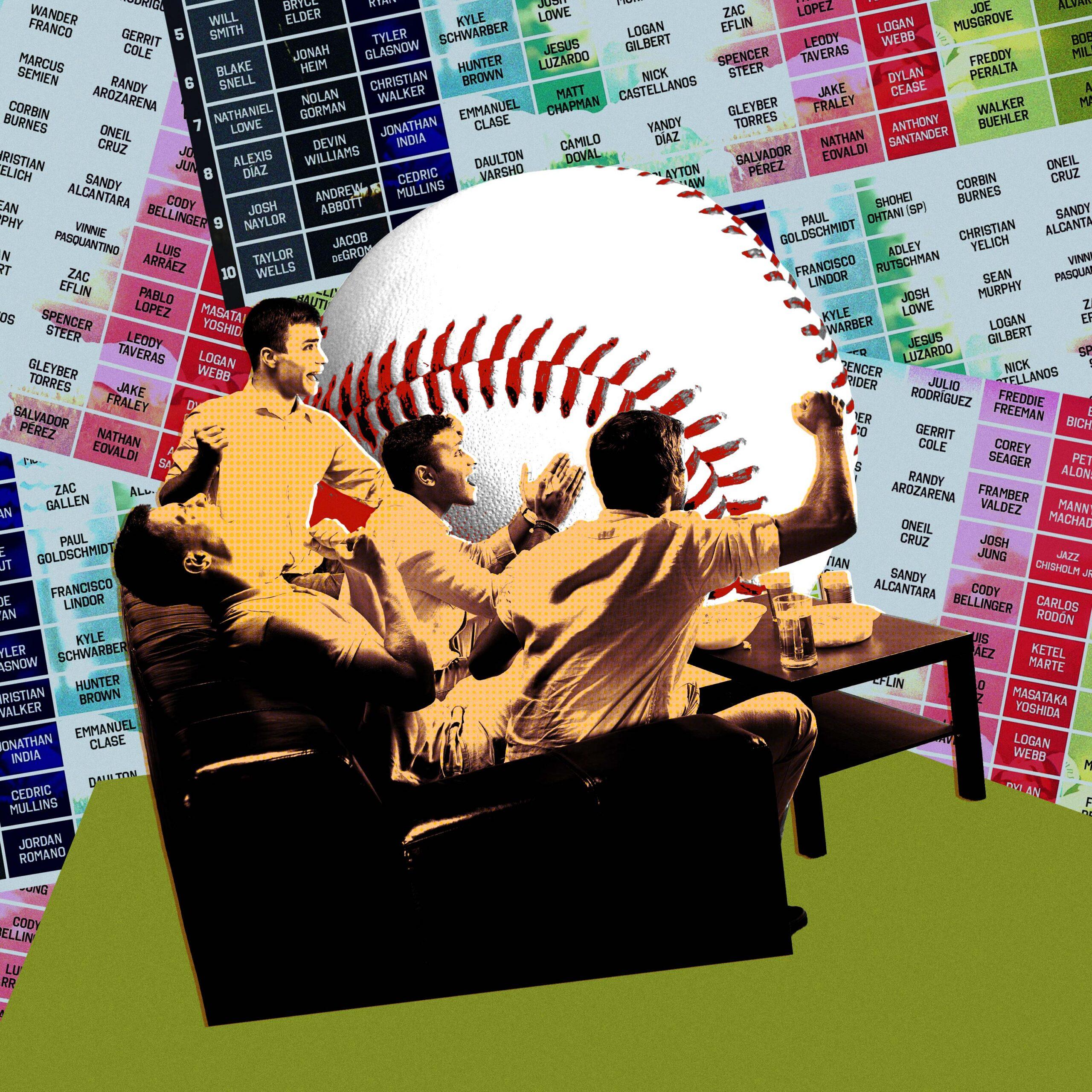
The Fantasy Baseball Ties That Bind
How do fantasy sports leagues fit into the larger story of the male loneliness epidemic? You might be surprised.The Fantasy Baseball Ties That Bind
How do fantasy sports leagues fit into the larger story of the male loneliness epidemic? You might be surprised.
He lived in the suburbs. Newnan, Georgia, just southwest of Atlanta. Beautiful wife, three beautiful children. Cubicle job, pleasant enough, with solid pay. Sometimes, during coffee breaks at work, Joey Triplicata and his buddies talked baseball. Braves fans, all of them, perennially hopeful, perennially disappointed. Most watched a game or two a week, went to Turner Field a few times a year. This was 2008. But when Joey got back to his desk, he wanted more. He wanted to hear from the people who were glued to 162 games a year, who tracked prospects, who dived deep into statistics with complex acronyms, who could rattle off the FIP of random middle relievers just for fun. He wanted to commune with the sickos.
On ESPN’s message boards, he found them. Men, mostly, from all across the United States, logging on to talk ball. They sat before screens in offices and “computer rooms,” at cubicles and kitchen tables. They had debates about men named Edinson Volquez and Jair Jurrjens and speculated on whether they could trust the production of Ryan Ludwick or Jermaine Dye.
Joey had started playing fantasy sports a few years earlier, and baseball quickly became the version he loved most. There were endless statistics to study and players to track, games almost every day of the week from April to September. He played with complete strangers, in leagues hosted by ESPN and Yahoo. One of those strangers was Frank Peavey.
Joey liked Frank. Smart, reasonable, never mean-spirited. Frank lived in Maine and rooted for the Red Sox. Joey had always kind of liked the Red Sox, too. Frank invited Joey to play in a new kind of fantasy league, a dynasty league, in which the rosters rolled over from year to year. Joey loved it. He felt like a real general manager, building an organization brick by brick. Soon some members started fighting and the league fell apart, but Frank started a new league and invited Joey to play in that one, too.
One day, after they’d been talking ball on the internet for a couple of years, Frank made a joke. Something about a regifter or a close talker or a Soup Nazi. Or maybe it was Not that there’s anything wrong with that.
Sitting at his computer, Joey smiled.
“Hey, man,” he asked, “are you a Seinfeld fan?”
Now, they talked about Seinfeld, too. That led to Facebook friend requests, and debates about politics, and eventually updates on work and family. They’d have hours-long phone calls from more than a thousand miles away. “I love him,” says Joey.
They have now known each other for 18 years. They have never once met in person. When I talk to Frank, he pauses a few times, collecting himself. We’ve been talking about baseball, fantasy, and Joey, but also about death and grief, about how to show up for someone amid life’s deepest pains.
“I jokingly call him,” says Frank, “my ‘hetero life mate.’”
Earlier this month, I joined two Facebook groups dedicated to fantasy baseball and posted that I was working on a story about fantasy sports and male friendship. Immediately, I was flooded with messages from men who wanted to tell me about their leagues. I also heard from women who shared what fantasy sports has meant to their relationships; according to a 2023 survey from the Fantasy Sports and Gaming Industry, 35 percent of fantasy sports participants are female. But for this story, I wanted to examine how fantasy sports has taken on outsized importance as a vehicle of community building for men—a group that study after study suggests has trouble making and maintaining adult friendships.
I heard from guys who draft in exotic locations and guys who draft alone in offices, guys who use fantasy to keep in touch with old friends and guys who use it make new ones, guys whose group chats have explicit rules (no politics or religion) and one guy whose thread becomes a hub for chicken recipes during the offseason (its title: Juuuuust Fowl). One guy even invited me to his draft in Los Angeles. (Sadly, I couldn’t make it.) On phone calls over the past couple of weeks, we talked about cheating commissioners and deadbeat team owners, about booze- and weed-fueled draft rooms and end-of-season punishments for league losers. We talked about how difficult it can be to make small talk with other parents at the playground, about the ways relationships wither as we age. We talked, to a shocking degree, about death.
Perhaps you’ve heard: Men are increasingly lonely. If you’ve been online in the past few years, you’ve probably seen the headlines. From The New York Times: “Why Is It So Hard for Men to Make Close Friends?” From PBS: “Why a Growing Number of American Men Say They Are in a ‘Friendship Recession.’” From Gallup: “Younger Men in the U.S. Among the Loneliest in the West.” From The Atlantic: “Are They Still Your Friends If You Never See Them?”
Coming Soon From Ringer Books
American Men
By Jordan Ritter Conn
A deeply intimate portrait of four men that examines—in profound and comprehensive ways—what it means to be a man in America.
Publishing April 21. Preorder Now.
Studies tell the same story: In 1990, 55 percent of men reported having at least six close friends, according to the Survey Center on American Life. In 2021, that number had dropped to 27 percent. The same center showed that 15 percent of men reported having zero close friends, a fivefold increase since 1990.
Over the past five years, I’ve been working on a book, American Men, which follows four men with vastly different life experiences—a gay street brawler, a struggling West Point grad, a law student recovering from childhood trauma, and a young trans man in rural Ohio—as they wrestle with their own relationships to and beliefs about masculinity. One idea I encountered time and again in my reporting is the degree to which men rely on external institutions—religious communities, in-person workplaces and labor unions, organized clubs, the military—to build and maintain friendships. Over the past half century, though, many of these institutions have fallen out of favor or disappeared completely, leading to a precipitous decline in male relationships. While working on my book, I spent years following men whose social lives thrived when they were attached to institutions: the army, an MMA gym, church, community groups.
I also saw how some men have taken to inventing their own institutions: a softball league, a poker night, a regular tailgate, etc. They don’t have the same centrality to everyday life as the more traditional structures, but they’re something. For many men, that new type of institution is a fantasy league. Fantasy sports are ritualistic, tethered to a calendar. They include moments of intense camaraderie, such as the draft. And they give space for regular connection, usually in the form of a group chat. The scaffolding of the friendships may be digital, but many also exist offline. “A lot of people rely on group chats as their way to stay connected,” says Nasr Ahmed, a labor organizer in Toronto and an avid fantasy baseball player. “Fantasy sports can be the impetus for sending that text, for getting the chat going. But it spills over into real life.”
A confession: I don’t play fantasy sports. Years ago, when I was younger and more obnoxious, I decided that fantasy represented everything wrong with sports; sports were supposed to be about connecting a team of athletes to the fans who lived and worked in the cities they represented. Fantasy, I argued, flattened the humanity of the players and forced people to sometimes root against their real teams in favor of the guys on make-believe teams that existed only on a screen.
Now? I’m older and less self-righteous, and I realize that I’ve spent years missing out on what I presume to be a never-ending group chat in which my closest friends, their siblings, one guy someone worked with for a summer in college, and another whom we randomly met at a bachelor party weekend all roast one another in ways that feel, at least occasionally, like love.
I am a man, in my early 40s, and I have regrets.



More on Fantasy Sports
Brett Martin was living in Brooklyn back in 2003, working as an editor at Time Out New York, when one of his friends asked him to join a fantasy baseball league. He initially had no idea what he was doing. He drafted Roger Cedeño, the Mets’ speedy defensive specialist, in the second round, just because he assumed that he should pick players who could steal bases. He then let the computer auto-draft the rest of his roster. Still, he kept up with the team the entire season, finishing somewhere in the middle of the pack. “I was hooked,” Brett says. “That was all I needed.”
The league followed him through his early 30s, serving as his companion every summer. “I find the constant sort of serotonin hit addictive,” he says. “I just like having something to look at.”
“Rotisserie baseball has predated our marriages, our divorces, our second marriages, our children, our grandchildren, everything. It’s the longest-running relationship in our lives.”James Dorrell
In the 2010s, he moved from New York to New Orleans. He’d always been socially adept, and he quickly made friendships in his new city. His fantasy league fizzled, then ended. The group of friends who were part of it moved to different cities; some, including Brett, had young kids. But then, during COVID-19 lockdowns in 2020, they started texting more. They arranged Zoom happy hours. They wondered: Should we start the league back up? “It felt like we’d been given this excuse to do it,” Brett says. “There was a giddiness to it. Whatever inhibitions we had—‘I shouldn’t be wasting my time doing this,’ or ‘There are so many more important things in life,’ or whatever—those were gone.”
James Dorrell never needed an excuse. He’s 65 and has played in the same rotisserie league since the early 1980s. “Rotisserie baseball,” he says, “has predated our marriages, our divorces, our second marriages, our children, our grandchildren, everything. It’s the longest-running relationship in our lives.” Back when his league started, James was fresh out of college, living in Fort Worth, Texas. He and his friends played in a weekly softball league, and one night, when they were out for postgame beers, one of the guys said that he’d just heard about this thing called rotisserie baseball. They would hold an auction on players, then manually keep up with the stats for their teams. The rest of the guys shrugged. Sure. Sounds fun. “I don’t think any of us imagined that we’d be here 43 years later,” he says, “and this would be one of the biggest pieces of our lives.”
Brandon McShane remembers being in his early 20s, listening to his wife’s uncle brag about playing in the “longest-running rotisserie league on Long Island.” It was a big deal, Brandon heard. It’d been started in the ’80s by a group of New York City police officers, and every so often, someone rotated out and they needed a replacement. Ball knowers only. In 2008, Brandon got an invitation. “I knew I had to take it seriously,” he says. They met every year to draft in a conference room at the Long Island Marriott, right next to Nassau Coliseum.
“It was a marathon,” he says. “We would be in that conference room for 10, 12, 14 hours. Guys would travel in from out of town. By the end of the day, that room would stink. Farts, weed. Just awful.” He laughs. “It was the best.”
Eric Smith was sitting in a graduate school classroom, stressed over his studies and searching for his footing in Nashville, when he and a classmate bonded over a shared appreciation of Andrei Kirilenko. It was 2001. Eric had recently begun playing fantasy basketball. Kirilenko, a Russian do-everything forward, had just come to the NBA from Partizan Belgrade, joining the Utah Jazz. He was packing the stat sheet: points, assists, steals, blocks. “You should pick him up,” Eric told his classmate, named Brian Frederick-Gray, whom Eric knew also played fantasy basketball. Brian did as suggested. Both of their teams flourished. A decades-long friendship was born.
The next year, Brian’s league had an opening. He asked Eric to join. He didn’t know anyone else in the league. They were all connected to Brian or Brian’s friends. But soon they started chatting, first on the site’s message board, later over email. Usually it was about basketball, but occasionally it was politics, work, or parenting. Within the thread, a smaller thread broke off, calling itself “The Ring.” Often, they’ve sent more than 300 emails in a day. Once, years ago, the league-mates counted more than 100,000 emails exchanged in total. “After this conversation,” Eric tells me, “I’ll probably go send them an email about the fact that I was talking to you.”
“You’re building a sort of social bond with somebody that says, ‘OK, well I come to this person for X, Y, and Z thing that maybe doesn’t matter that much. Now I have this problem. Why don’t I come to them for this?’”Nasr Ahmed
Eric calls himself an introvert. In other pieces of his life, he says that he has “dormant friendships”: “They come back to life when the occasion presents itself. … And when we get together, we pick up where we left off, and it’s great. But I don’t know if it’s me, or if it’s the way middle age affects you, but we are not really good at keeping it going in the meantime. And I do think that women—or at least the women that I know—are a lot better at that.” He believes that there is something about the online nature of his fantasy friendships that allows for sustained connection. “I think a digitally mediated practice of friendship is nice because it’s always sitting there when you want it,” he says. “It’s asynchronous. You don’t have to get together for beers or for coffee or something. It’s just on your screen whenever you decide to open it.”
Unlike Eric, Nasr, the labor organizer in Toronto, is a serious extrovert. Nasr talks to me about a group of three men who fit a particular kind of male friendship cliché: guys he knows because their wives and girlfriends are friends. Historically, Nasr says, the women had functioned as the glue in their relationship. Sometimes it felt like the men were just tagging along. Then, about five years ago, Nasr decided to start a new fantasy baseball league. He invited the other two to join.
This group of loosely connected men started their own group chat. Memes were shared. Bad trades were mocked. And eventually, real-life plans were made. Now, one of them calls to discuss struggles in his own life. Another invited Nasr to join his wedding party. All of it, Nasr believes, can be traced back to the formation of the league. “If you’re just around people enough, if there’s just enough communication, what you’re doing is building trust,” he says. “You’re building a sort of social bond with somebody that says, ‘OK, well I come to this person for X, Y, and Z thing that maybe doesn’t matter that much. Now I have this problem. Why don’t I come to them for this?’”
In conversation after conversation, I heard about how the guys from fantasy leagues were always around to talk shit, to share memes and highlights, and to dunk on the members of the group chat with the consistently worst takes. But also, at least sometimes, they were there to share in troubles and in triumphs. And occasionally, even to mourn deaths.
Eric tells me about a guy in his league named Ivan. “Ivan was the worst drafter of all time,” he says. “You’re supposed to be on the clock for five minutes. He would take 30. He’d never done any research. And he just was not great at fantasy basketball because I don’t think he cared that much. He just liked being in the league.” Eric never met him. But he knew that he was a teacher and that he was a dear friend to the other guys in the league. Ivan’s team was named the Creamy Tacos, after his favorite childhood dish involving Velveeta. Every time it came up, the other members of the league laughed. Once, on a Sunday night, Eric checked his email. “Guys,” a message said. “Ivan died.” He was in his mid-30s. He’d had a stroke.
Eric is familiar with grief. He’s an ordained minister. He has officiated many funerals. “But this felt different,” he says. “Here’s somebody that I had this kind of intimacy with, but who I’d never met. I didn’t quite know how to grieve about it.” Together, the league figured out how to remember and honor Ivan. Someone else took over the Creamy Tacos. That season, they rigged the league so that Ivan’s team would win the championship. They set up a scholarship fund for students at the school where he’d taught. To this day, the league champion contributes their winnings to the fund.
I also talked to Sean Kernick, a 50-year-old who lives in Bentonville, Arkansas. Back in 2000, Sean stumbled on a site called sandbox.com, which served as a home for fantasy leagues of all kinds. He joined a keeper league. He loved talking with the other members about sports and life. He remembers one of them announcing, soon after 9/11, that he had decided to enlist in the military. Eventually, communication moved from the league forums to a text chain. “I’m closer to these guys than some of my actual real-life friends,” he says. “We’re in touch almost every day.”


Similar to other guys I talked with, Sean says that the conversation in the fantasy chat evolved over the years from being only about sports to being about other, more personal topics. When one of them is going through something, it’s easiest to tell the guys they’re already talking to every day. When Sean fell in love with a woman named Laura, he peppered the group with questions. “How do I know she’s the one? When should I propose? How do I ask her parents?” They got married. About five years after they got together, she died of cancer. Sean returned with more questions. “How do I make it through this?” Every time, he says, they were there.
He has met these guys once, back in 2006, when one of them hosted the league for an in-person draft at his Texas ranch. The year before, they’d gone to Vegas, but Sean couldn’t afford it. Now, with most of the league members around age 50, they fantasize about scheduling another trip. But despite the lack of time spent together, he finds it easier to turn to them with his struggles than to his friends in Arkansas. “With my friends here, we’ll go watch football somewhere, and we’ll sit, and we’ll watch the game, and then during the commercials we can talk, we can talk, we can talk, but then it’s like, ‘Oh wait, the game’s back on, and so we’re back to the game.’”
He thinks that maybe the text chain allows guys to process their friends’ updates a little more slowly, to take the time to think about how to respond. Or that the constant texting about frivolous things makes it easier to send that text asking whether someone is OK. “They were really good,” he says, “about checking on me.”
It feels the same for Joey and Frank, the men who met on the ESPN message boards. In 2020, Joey experienced a shattering loss. His 18-year-old daughter, Jeanna, died in a skydiving accident. “She was special,” Joey says. Kind, warm, deeply devoted to her family. She loved the color guard and Harry Styles. She’d just graduated high school, over Zoom. She was excited for the day when COVID-19 restrictions would be lifted and she could walk across the stage to get her diploma.
After Jeanna’s death, Joey and his family received an outpouring of love and support. “I don’t think we cooked a meal for a month,” he says. But over time, he found that some friends didn’t quite know what to say. He watched his wife process her grief with her friends. “Sometimes, in a loss, I think the woman is consoled more than the man,” he says. “Sometimes we’re left out. But my job is to make sure she’s OK. That’s the way I looked at it. Her and my other kids. My job is to make sure they’re OK.”
Frank was the one person who kept checking in on Joey. Random texts to ask how he was doing. Questions about his grief when they talked on the phone. Messages every birthday and anniversary of her death. “Other people,” Joey says, “just don’t want to bring it up. If I bring it up, they’re not going to stop listening or change the subject, but they’re just not going to ever bring her up.” Frank has never struck Joey as a particularly “touchy-feely” guy. “But he would always let me know he was thinking about me,” Joey says. “He was there if I ever needed him.”
When I talk to Joey, he’s blustery and full of passion. He speaks about Jeanna at length, happy to remember his girl. When I talk to Frank, though, he’s slow and direct. After I ask about Joey and Jeanna, he pauses.
“This was a young lady that I watched grow up online,” Frank says. “A young lady I’d heard endless stories about. He’s such a proud, caring, loving, awesome dad.” He goes silent. “I hurt,” he says, “so much for him.”
Frank thinks often about the shape of Joey’s life. About the waves of support he got right after Jeanna’s death and about how those waves slowly faded over time. About how much Joey needed to be there for the rest of his family. “As a father, it sounds kind of old-fashioned, I guess, but I know he feels like he has to be the pillar for his wife and his two younger kids. And when you do that, and you’re a good man like he is, you do everything you can to comfort the people that you love,” Frank says. “But sometimes you need to be comforted. Sometimes you need somewhere to go where you don’t have to be the pillar. I wanted to be that for him.”
Now they’re in two leagues together. They text daily, talk on the phone often. They’ve still never met. They talk about Fenway. About the Braves and the Sox. Frank tells Joey that New England summers are the kind of spectacular he has to experience once for himself. “If we were to meet each other, I would be elated,” Frank says. “I would be so far beyond excited.” But he says that he’s already grateful for their friendship as it exists, spanning this distance. “If I go the rest of my life never meeting the man face-to-face, that doesn’t change anything about our friendship. So, in some sense, it doesn’t matter to me at all.”
He thinks back to those early days on the ESPN forums, to the baseball chatter and the Seinfeld jokes, the ways this game they both love brought them into each other’s lives. “I’m not a real believer in esoteric forces or destiny or anything, but this is the one thing that maybe might make me believe in stuff like that,” Frank says. “I think certain people are supposed to find each other. And I think no matter what, we would’ve found each other, one way or another.”