

There are some works of fiction that earn a reputation for being unfilmable, whether it’s due to their scale or, in the case of the 14-book Wheel of Time saga, the concern that no streamer would ever commit to the entire series. (Sure enough, Prime Video’s The Wheel of Time was canceled after three seasons.) Conversely, some novels seem ripe for adaptation, and excitement builds around seeing iconic settings and creatures translated from the page to the screen. Hogwarts in the Harry Potter movies. The dragons of Game of Thrones. Daemon companions throughout His Dark Materials. To that end, the first time I read Andy Weir’s Hugo Award–nominated novel, Project Hail Mary, all I could think about was how badly Rocky needed the Hollywood treatment.
Like Weir’s book, Project Hail Mary begins with Dr. Ryland Grace (Ryan Gosling) waking up on a spaceship with no memory of who he is—or why he’s traveling light-years away from Earth. Over time, Grace recalls in a series of flashbacks that energy from the sun is being absorbed by an alien microbe, known as Astrophage, and that he’s on a one-way trip to find out why the Tau Ceti star system is immune to Astrophage’s star-dimming effects. While the mission is a long shot—hence the code name “Hail Mary”—if Grace were to succeed, his findings could save humanity from an extinction-level ice age. No pressure.
The setup of Project Hail Mary, which crushed at the box office over the weekend with an $80 million domestic opening, closely mirrors its source material, and there are plenty of similarities to The Martian, Weir’s first novel that also hinged on scientific problem-solving with life-or-death stakes. (The Matt Damon–led film adaptation wasn’t too shabby, either, grossing more than $630 million at the box office while earning seven Oscar nominations, including Best Picture.) But when you pick up a copy of Project Hail Mary, you’ll see that the synopsis of Weir’s novel vaguely hints at Grace not being alone in his mission, and while you’ll probably deduce that means first contact, nothing can prepare you for how the story morphs into an interspecies buddy comedy with the unlikeliest of creatures.
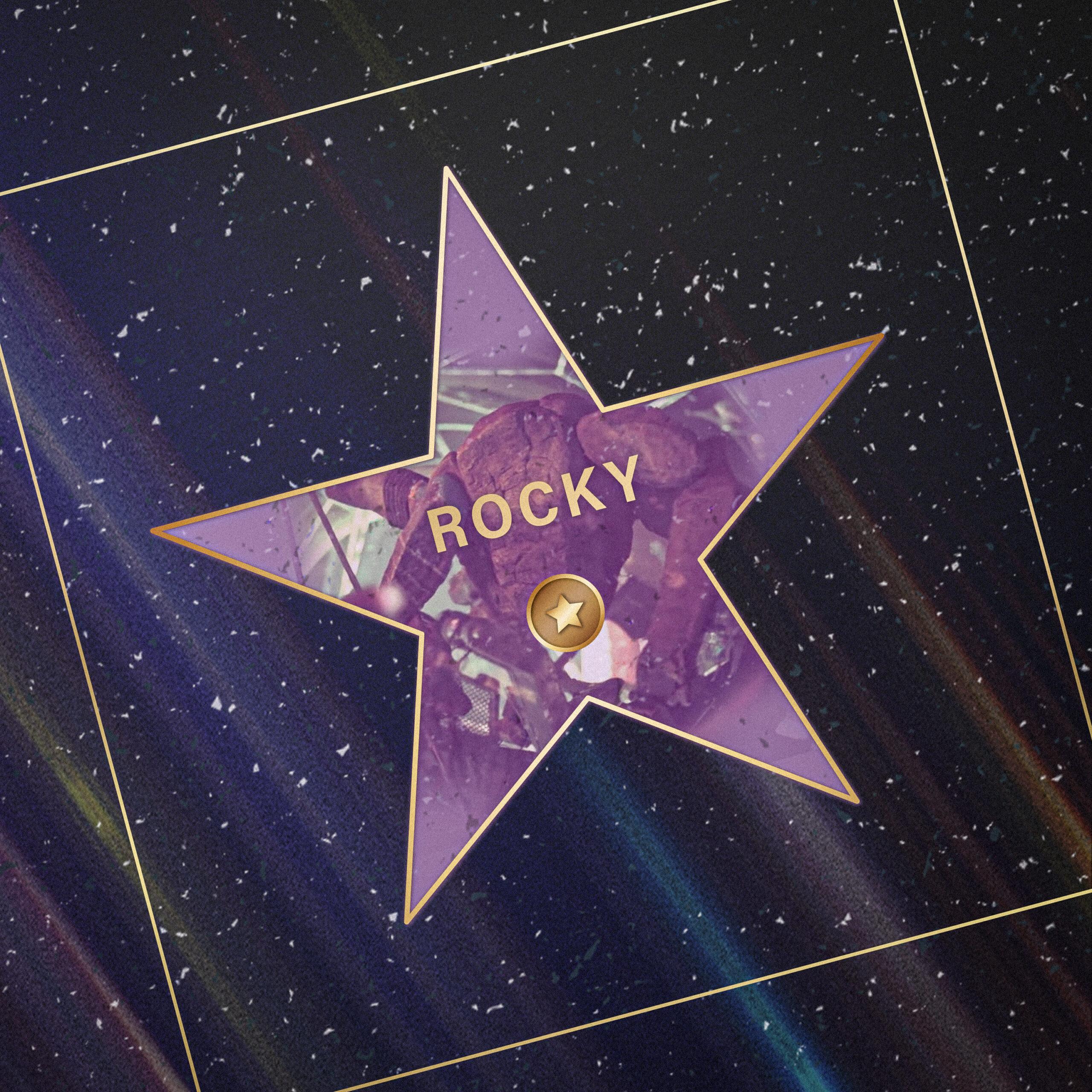
As described in the book, Rocky is a small, five-legged being with a rocklike carapace, which is why Grace comes to name him after Philadelphia’s favorite fictional boxer. But reading about Rocky is one thing; seeing him in the flesh—er, stone?—is a breathtaking experience. More than anything, I wasn’t expecting Rocky to be so darn cute. The character is certainly faithful to the novel, but the moment he appears on-screen, he triggers the same neural reflex that a plucky Pixar sidekick you’d take a bullet for does. It’s especially charming that Rocky’s form of communication—speaking via musical notes—sounds like a cross between a dove’s gentle coo and the otherworldly burbles of whale song. It’s all the more surreal that these noises are coming from a creature that could be Geodude’s distant cousin.
The Project Hail Mary adaptation truly improves upon its source material in how Rocky comes across on-screen. While the Grace of the book struggles to understand Rocky’s emotional state in certain moments—a by-product of Rocky having no eyes and the characters being unable to share the same atmosphere—the movie allows Rocky to be more anthropomorphized. Their earliest contact is imitating dance moves; when Rocky enters the Hail Mary for the first time, he barrels through like a hyperactive toddler; after Grace creates a computer program to translate Rocky’s musical tones into English, his tenor grows increasingly sassy, and he tends to say things three times for emphasis. (“Dirty! Dirty! Dirty!” is how Rocky describes the ship, with the same blunt honesty as my 3-year-old nephew.)



It also helps that Rocky was brought to life through a combination of puppetry and animation, grounding his expressiveness in something tangible that the audience instinctively buys into. (Same for Gosling, who doesn’t have to act opposite a tennis ball attached to a stick.) That tactile presence makes Rocky feel less like a feat of creature design and more like a genuine scene partner—one whose emotions are easy to read even when his physiology is so, well, alien to us.
While Weir’s novel goes to great lengths to explain how Rocky’s physiology actually works—he breathes ammonia; he creates polymers from solidified xenon; he can live for hundreds of years—the film gives us a better glimpse into the loneliness he’s endured. The rest of his crew died, unaware they had been exposed to radiation aboard their ship, leaving Rocky to continue the mission to save his home planet from Astrophage entirely by himself. In other words, the first alien that humanity encounters isn’t an existential threat or a mystery to be solved, but someone just as stranded and desperate for companionship as Grace himself. These qualities don’t just elevate Project Hail Mary beyond its central scientific conundrum; they make you more emotionally invested in Grace’s mission, as it can also save Rocky’s homeworld. As a result, Rocky is more than just cute comic relief—he’s the movie’s heart and soul.
When it comes to sci-fi blockbusters, Project Hail Mary falls neatly into the “benevolent alien communication” canon alongside the likes of Arrival, The Abyss, and Close Encounters of the Third Kind, the latter of which is cheekily referenced when Grace initially attempts to speak with Rocky through the film’s iconic five-note motif. But while Arrival, in particular, is certainly a tearjerker, there’s really only one movie in which the alien’s ultimate fate takes you on an emotional roller coaster. No matter how many times you watch E.T., you’re gonna get choked up when our beloved extraterrestrial is on death’s door.
It’s the clearest point of comparison as Project Hail Mary builds up to its emotional climax. After Grace collects a sample from Tau Ceti e—a planet that could be home to Astrophage’s natural predator—the Hail Mary is caught in a vicious cycle where the engines lose power and artificial gravity intensifies. As Grace is pinned against the ship’s control panel—unable to move, moments away from death—Rocky leaves his own atmosphere to save him, knowingly exposing himself to lethal conditions in the process. The film lets you believe the worst: that the weird little rock spider you’ve come to love like your own pet made the ultimate sacrifice. Seeing Rocky slumped in a corner, leaving a trail of ash from his carapace, is a gut punch of Spielbergian pathos.
The fact that a book reader already knows Rocky will be fine doesn’t blunt the scene’s effectiveness; if anything, it underscores how visceral it feels in motion. This isn’t just the mark of a great adaptation; it’s a reminder that going from the page to the screen can enhance the emotional impact of a character if the filmmakers understand that fidelity to feeling matters more than fidelity to detail. (For anyone seeing Project Hail Mary cold, apologies for getting your heart ripped out.) Suffice it to say, codirectors Phil Lord and Christopher Miller nailed the assignment.
The success of Project Hail Mary was always going to hinge on how audiences respond to Rocky, and while no moviegoing experience is universal, it’s hard to imagine anyone having a heart of stone about the little guy’s fate. Without Rocky, the stakes would feel clinical and abstract; with him, we bear witness to a bromance powerful enough to save two planets. By leaning into sentiment more than science, Project Hail Mary achieves something rare: It’s an adaptation that doesn’t simply honor its source material but deepens it. Or, to borrow Rocky’s favorite catchphrase: Amaze! Amaze! Amaze!