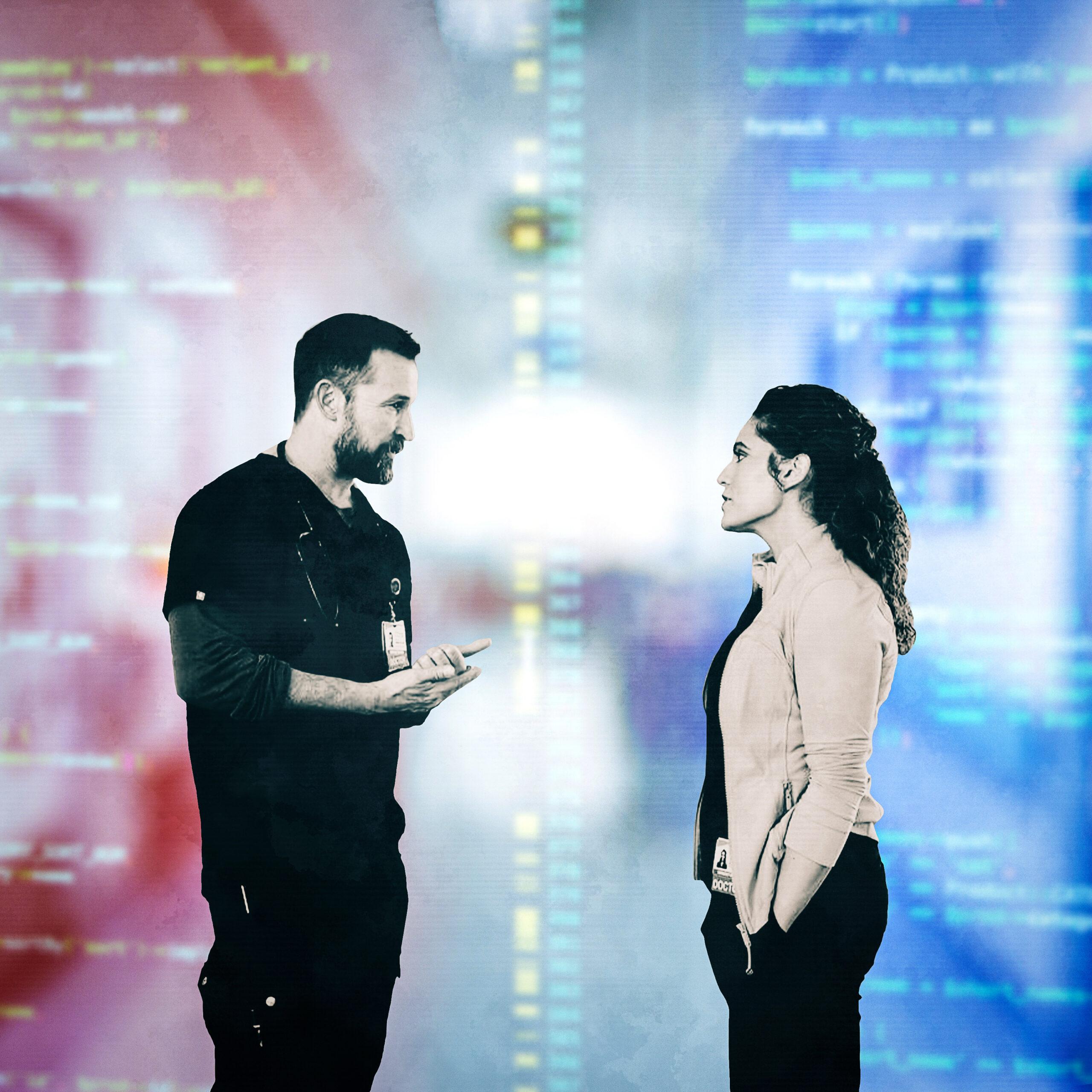

The seventh episode of the second season of The Pitt—“1:00 P.M.”—ends with the Pittsburgh Trauma Medical Center CEO skulking into the emergency room and making a dramatic announcement to the staff: Two nearby hospitals have been hit with a debilitating ransomware attack, so now the trauma center, as a preemptive measure, is taking all of its patient systems offline. The next episode begins with Drs. Robby, Al-Hashimi, and Abbot hastily briefing the rest of the team on the fallback protocols for the ER, now heavily dependent on the tech and tools of yesteryear. Med student Joy Kwon is dumbstruck by the arrival of a fax machine for the nurses’ station; Javadi is bewildered by the dry-erase board that displays patient statuses. In the ensuing low-tech chaos, Nurse Dana is constantly correcting the younger staffers on the finer points of these analog workflows. The ER is on the brink of total administrative collapse—and that’s before it’s inundated with patients injured in a slide collapse at a local water park.
It’s at this point—“3:00 P.M.,” when the first helicopter arrives carrying a patient separated from her limb—that seemingly everyone on staff becomes a bit meaner, sloppier, and less themselves. Dr. Mohan breaks into a sweaty fever and appears to be having a heart attack that turns out to be a panic attack. “I’m doing everything right,” she shouts as Dr. Robby begins to diagnose her. “It’s everything around me that’s all fucked up!”
Medical dramas are always scripting catastrophes for dramatic effect. This is The Pitt, though, a series renowned for its intensely engrossing and uncommonly accurate take on hospital life. Whereas Grey’s Anatomy was concerned with its rom-com bomb plots and House with its zany diagnoses, The Pitt is a simulation of institutional strain in which mass casualty events and other critical disruptions aren’t so much tests of character as they are stress tests of the system, via these characters, in toto.
The first season of the show culminated in the Pitt’s response to a mass shooting at a local music festival, an all-hands ordeal that exhausted every resource at the hospital’s disposal. The second season, set on the Fourth of July, is an omni-crisis of sorts. Dr. Robby and his staff expect the usual influx of holiday patients with injuries from grilling, fireworks, and drunk driving. The ransomware attack and subsequent water park disaster are gnarly exponents, however, and together they push the department into a fail state. The dose of realism in even these high-drama escalations is notable: Cyberattacks on hospital networks are distressingly—and increasingly—common, and hospital staff do struggle mightily to treat patients in the resulting downtime (and furthermore to protect patient privacy in the aftermath).
In February 2024, a Russian ransomware group known as BlackCat extorted the United States medical claims processor Change Healthcare for $22 million after compromising the medical records of some 190 million Americans and causing disruptions so widespread that the American Hospital Association found that 94 percent of surveyed hospitals suffered financial losses from the attack. Just a few months later, in May 2024, the ransomware group Black Basta attacked Ascension, one of the largest nonprofit hospital systems in the U.S., disrupting access to electronic health records in 140 hospitals across 19 states for six weeks. The attack on Ascension seems to be an explicit inspiration for The Pitt: Doctors and nurses in that case were forced to rely on paper charts, handwritten orders, and frequent diversions of patients to other facilities. Last year, researchers found that the number of patient records affected by medical data breaches had surged from 6 million in 2010 to 170 million in 2024, with ransomware accounting for 39 percent of the records compromised in that span.
The ransomware crisis of Season 2 doesn’t merely make the ER more frantic than usual. It also risks compromising care in ways both obvious and subtle. In “2:00 P.M.,” Javadi and med student Ogilvie mistakenly take on the same patient suffering from an outbreak of massive blisters, and neither is able to diagnose him properly. In “3:00 P.M.,” one of Javadi’s patients nearly dies because her case isn’t logged on the whiteboard. From “11:00 A.M.” through “4:00 P.M.,” Dr. McKay and Javadi tend to a lung cancer patient with a death doula, a doting husband, and two young boys. It’s one of the more devastating cases of the season, right up there with the sudden death of Louie, because the only care that McKay and Javadi can reasonably offer a woman at this stage is patience—an exorbitance in an emergency room that sure could use her bed.
That case is heartbreaking on its own terms, of course, but it’s doubly excruciating as a logistical problem, and that’s the tension at the heart of Season 2: the balance of empathy and expediency in a setting—and under extraordinary circumstances—where withholding either costs lives.
One of Season 2’s new characters is Dr. Baran Al-Hashimi, the attending physician who will cover for Dr. Robby while he’s on sabbatical for a few months—riding his motorcycle to Alberta, on a “spirit quest”—after he clocks out for the day. Dr. Al-Hashimi can be an off-putting figure: She’s a technocrat prone to brochure speak who pushes “modernization” via an AI transcription software and other so-called optimizations. She’d previously worked with Drs. King and Mohan at a VA hospital but is nevertheless, in the Pitt, an interloper with all the credibility of a substitute teacher. She’s something—a constraint, a worldview—imposed on the team from on high. Dr. Robby clashes with Dr. Al-Hashimi much as he’d clashed with Dr. Collins in Season 1, but Dr. Robby’s specific disagreements with Dr. Al-Hashimi are more ideological in nature. She speaks the language of operational efficiency, while he views the ER as a fragile human ecosystem that can be streamlined only so much before both staff and patients suffer.
This philosophical tension is evident throughout the second season. Even before the cyberattack, Dr. Santos is succumbing to the weight of her administrative responsibilities as she struggles to catch up on completing documentation for patients who have long been discharged. So while she voices skepticism about Dr. Al-Hashimi’s AI charting tool, especially after she sees it mangle a prescription, she’s nevertheless desperate to resolve her massive backlog and is lured down the path of least resistance. Her and her colleagues’ workload in the ER has become a clusterfuck of efficiency strides and cost-cutting measures that broadly demoralizes everyone.
The reality of AI’s impact in health care beyond The Pitt is even messier. More than 40 million people consult ChatGPT for health information on a daily basis, according to OpenAI. The demand far exceeds the current capabilities of the various AI models: Lay users who tried to self-diagnose with chatbots identified relevant conditions in only a third of cases, per a 2026 study published in Nature Medicine. The study found that patients are generally ill-equipped to prompt AI chatbots with relevant and accurate details. And researchers at Duke found that chatbots generally don’t tell patients what they need to know so much as what they want to hear. Doctors and nurses are still somewhat optimistic, according to a recent physician survey by the AMA, about the potential for “augmented intelligence” to improve operations and alleviate burnout in their practices. But the advancements are rapid and unwieldy. The doubts expressed by Dr. Santos and others on the show are real.
Dr. Al-Hashimi is no villain. She’s an earnest reformer who proves careful and compassionate in her own ways. In “10:00 A.M.,” Dr. Mohan treats an uninsured father who had passed out at a worksite and turns out to have been rationing the insulin treatments for his diabetes; Dr. Al-Hashimi supports a treatment plan that would cleverly limit his out-of-pocket costs. In “12:00 P.M.,” Dr. Al-Hashimi stalls Dr. Robby in his rush to discharge a malnourished prisoner recovering from a violent assault; she collaborates with Nurse Dana to get the prisoner admitted for inpatient treatment. Dr. Robby is an effective counselor to the junior staff when it comes to proper procedure and conscientious care, but he’s lacking when it comes to engaging constructively with systemic limitations. Dr. Al-Hashimi is at least eager to think through problems—and solutions, however flawed—at the institutional level. “Just because it’s broken doesn’t mean you stop trying,” she fumes to Nurse Dana, a remark that’s obnoxious as an assessment of her team’s passion but effective as a prayer for institutional renewal.
So many more vignettes of institutional failure appear throughout Season 2: that uninsured father, who ends up fleeing the ER to escape the threat of a six-figure bill if he lets the hospital treat his life-threatening diabetic ketoacidosis; the young Black woman whose polycystic ovary syndrome went undiagnosed for years by doctors who didn’t take her pain seriously enough; the basic and brutal fact that the Pitt is downstream of so many other failures from so many other institutions. The ER can absorb only so much trauma.
Dr. Mohan’s uninsured patient may have fled the ER, but she’s able, at the urging of Dr. Abbot, to courier a handful of supplies to his doorstep. Dr. McKay holds her wary patient for further observation, if only to confirm her own suspicions that something else might be going on; ultimately, Dr. McKay is able to identify ovarian torsion as the root cause of her patient’s distress. These are small but meaningful victories in one institution’s mission to recover public trust—a mission subverted by the sort of extraordinary circumstances that squeeze these teams for the very last ounces of their hypercompetence.
The collective response to a tragedy may well bring out the best in humanity, but it’s equally likely to make a mockery of our systems. The show’s second season pulls our heroes in both directions at once. They’re fumbling with the instruments of the past while harboring real trepidation about the tools of the future. There are no easy answers on The Pitt, only the most exhilarating of warnings.