The New Season of ‘The Bachelorette’ Is a Mess Before It’s Even Begun
In casting the star of ‘The Secret Lives of Mormon Wives,’ Taylor Frankie Paul, ABC garnered genuine interest for the first time in years. But at what cost?

Editor's note, March 19: ABC has removed the upcoming season of The Bachelorette from its schedule.
On Season 4 of The Secret Lives of Mormon Wives—a series that films almost year-round and produces two seasons annually, making the lives of these wives neither a secret nor particularly Mormon—the women in the cast talk about needing to get their thrice-named social leader, Taylor Frankie Paul, across the 700-mile expanse from Salt Lake City to The Bachelorette, as though they're exfiltrating her from a hostage situation. They just have to get her to The Bachelorette—for the sake of the friend group, and their jobs, and her mental health, they need this woman to get her ass on a plane and take her position as the head of a polyamorous amoeba made up of enterprise sales executives, former minor league baseball players, and at least one of Lana Del Rey’s ex-fiancés (that we know of). If they can just get her inside the stucco walls of the Bachelor mansion, where ABC has invited her to date 22 men as the lead of Season 22 of The Bachelorette, then they can theoretically save her from being mentally and spiritually consumed by a Cabelas-forged demon named Dakota Mortensen, who is also the father of her youngest child. And after witnessing the events of SLOMW Season 4, any viewer could understand why. What these young women perhaps did not consider is that, when they send Taylor Frankie Paul to the Bachelor mansion with a Vera Bradley duffel full of strapless gowns and tie-dye T-shirts, the promise of a mutually beneficial union between ABC franchises is, almost definitely, destined to be a pact of mutual destruction. Because if there’s one thing the Bachelor franchise can be reliable for, it’s the ability to, in spite of decades' worth of experience, get things deadass wrong each and every time they are so close to getting it right.
The Bachelorette won’t save Taylor Frankie Paul—and following reports of a domestic violence incident between her and Dakota after her Bachelorette season wrapped, it’s looking like she won’t be saving the Bachelor franchise, either.
But let’s rewind a bit first. When The Secret Lives of Mormon Wives premiered in 2024 following a viral TikTok spectacle wherein Taylor Frankie Paul—always at the eye of the zero-impulse-control storm—exposed her social circle of young Mormon couples for “soft swinging,” it managed to do what no other reality series had done before it: make a show about influencers that wasn’t really about being an influencer. The Mormon Wives already had large social media followings when they were cast, and their brand deals (admittedly much more modest in Season 1 than in Season 4) were the least interesting thing about them. The most interesting thing about them was their background: They're women raised in the LDS church, with all the moral and patriarchal expectations that come along with that; women who, at very young ages, had already achieved the marital and maternal expectations of their upbringing; but also, women who, through a combination of their own ambition and the charge of Mormon women and girls to document their well-lived lives as a form of evangelism—or as it might be known more secularly, influence—had become the dominant breadwinners of their households. Their social media powers combined were dubbed MomTok, and the most fascinating aspect of early SLOMW—other than how they were always referencing smashing the patriarchy—was the ease with which they could break the fourth wall to talk about how their financial livelihoods depended on one another because they were, inherently, already coworkers when we began watching MomTok. If the cast of a Real Housewives franchise argues over money or hierarchy, it breaks the spell that they’ve gathered together at this Beverly Hills dinner table because they’re actual friends who want to eat dinner together. But cross-collaborating is built into the construct of SLOMW. Their desire for fame and attention was always on the table, while the larger secrets of their Mormon lives remained, tantalizingly and purposefully, unearthed.


The Bachelor franchise, one of our oldest reality institutions, has allowed itself no such conceptual luxuries since it debuted 24 years ago, before anyone even knew what an affiliate link was or what a vial of Juvéderm costs. Despite having slightly more modern iterations like Bachelor in Paradise that allow for more casual dating among well-known entities—and despite playing with form a bit on The Golden Bachelor—The Bachelor and The Bachelorette have always stuck to their central conceits: This process works (even though, historically, it doesn’t); anyone there for the wrong reasons will be weeded out (even as they cast younger and younger contestants with less and less established careers); only leads from the previous contestant pool can become leads (even when there’s no one good, even when the franchise is dying).
As SLOMW became a huge hit on Hulu, it became clear that other ABC series stood to benefit from its metaverse of cross-platform influence. When Whitney made it onto Dancing With the Stars, her portrayal on Season 3 of SLOMW—semi-villainous due to her straightforward confession that she returned only in order to have a shot at DWTS—cast a shadow over her DWTS reception. But when her dancing quickly proved to be exceptional, it overrode her negative reputation, softened her edges in Season 4, and made her a star. When she was cast as Roxie Hart, her run on Broadway in Chicago earned the highest weekly gross in the show’s 29-year history. Another Hulu spinoff, Vanderpump Villa, seems to function as a sort of rumspringa for the entire cast of SLOMW. “Last year, MomTok went to Vanderpump Villa,” says a member of “DadTok” named Jordan on SLOMW, about a show you could not pay me to watch.
At some point, even the legacy Bachelor franchise saw the ways in which its plummeting ratings and social cachet could benefit from this kind of crossover, and it finally allowed itself to take a break from its uroboros casting methods. By making the Bachelorette someone who was already an influencer, they could drum up interest in a lead who was new to their world but known to the larger world, bringing in viewers who may never have tuned into the franchise (or, more likely, tuned out four or five years ago). In September of last year, after Season 3 of SLOMW ended—and as Season 4 was filming—Taylor Frankie Paul, one of three unmarried Mormon Wives, was announced as the next Bachelorette. It was the most interesting thing The Bachelor had done since casting Hannah Brown, a contestant on Colton Underwood’s season who'd completely choked while trying to give a simple Champagne toast and who positively flourished as the Bachelorette.
Taylor went on Alex Cooper’s Call Her Daddy podcast to elaborate on how she was ready to find love, how she would still be wearing her signature sweatpants in the process, and how she was completely, romantically done with Dakota, a recovering heroin and fentanyl addict whom Taylor had (1) previously dated and sadly had a miscarriage with; (2) been dating when she was arrested in 2023 on domestic violence charges also involving Dakota, which “were all dropped,” she assured Cooper; and (3) broken up with and then gotten pregnant and had a baby with … all in the span of the series premiere of SLOMW.

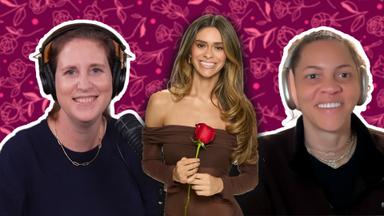
Taylor Frankie Paul didn’t just make MomTok famous and then get them a TV deal—she was the tiny sun around which MomTok orbited. And so throughout Season 1, the rest of the cast was still constantly (and hilariously) pondering: “Can MomTok even survive this?”—the “this” in question being Taylor’s salacious behavior and seemingly well-intentioned but ultimately poor decision-making. But the answer was always clear: MomTok will only benefit from Taylor’s antics, even if the Mormon church does not.
It seems that The Bachelorette thought this tactic could work for them, too. What the show’s producers did not realize is that their legacy institution—what with its history of exploitation and outdated romantic methodologies and fantasy-suite rituals shrouded in mystery—is much more akin to the church than to MomTok. ABC ordained Taylor Frankie Paul as the next Bachelorette, even while knowing what Season 4 of SLOMW—released a week before the Season 22 premiere of The Bachelorette—would portray: Taylor learning she’s going to be the next Bachelorette and then immediately entering into multiple rounds of fighting and fucking with her ex-boyfriend. After finding out that Dakota slept with another woman at Vanderpump Villa, Taylor promptly crashes out on the floor of Jessi’s closet, calling Dakota and demanding to know whether he—excuse me—finished or not. (As a reminder, she is currently contracted to date 22 other men and, conceivably, get engaged to one of them in the very near future.) (Also, yes, he did finish, but he didn’t like it.) Later, she tells her friends that after demanding more details about the hookup from Dakota, they had sex because she was so turned on by how angry she was at him. On a group trip a week or so later, after reaming Dakota out in front of all their friends for the same Vanderpump Villa hookup, Taylor is awoken by her friends the next morning with Dakota naked in her bed because, as she says, he walked past her room and his walk reminded her so much of their son—who is a toddler—that she just had to invite him inside. One thing led to another, and …
These are not the impulses of a woman who is mentally prepared to be in a relationship, let alone 22 of them. These are not the impulses of a woman ready to be … out of a relationship. These are impulses unlike anything I’ve ever seen. But ABC had seen it. They knew that on the eve of flying to L.A. to begin dating 22 strangers, Taylor Frankie Paul had her ex-boyfriend over to her house and, the next morning, refused to get out of bed to catch her flight with her family, including her children. They knew that she didn’t want to go to her new gig as the Bachelorette at all. They witnessed her taking one last FaceTime from Dakota, during which he sneaked in one last apology for all his misdeeds and told her that if things didn’t work out with these other guys, she should “save a rose for him.” They saw her giggle at that.
And ABC knew that, eventually, we’d know. We’d know they had been witness to all of this throughout the filming of Season 4 and still stuck to their casting anyway. We’d know that this was a woman who was coming undone, whose family and friends were treating a reality television show as the only place Taylor could possibly go to break her self-described “trauma bond” with Dakota. But as Season 20 Bachelorette Charity Lawson said recently on Instagram, dating shows are not a place one should go to heal. And of course they aren’t. Dating shows are a place where the best-case scenario is super anxiously falling in love, and the worst-case scenario is crossing paths with a handful of sociopaths and still not falling in love. (It’s like The White Lotus in that way.) SLOMW was a lifeline for the Bachelor franchise, but also an argument for why its most prominent cast member should have never become the Bachelorette.
Season 4 of SLOMW manages to completely undermine the premise of a series that had just managed to garner genuine curiosity for the first time in years. And now, in the wake of TMZ’s reporting on Taylor’s involvement in a domestic violence incident between her and Dakota, which took place in the presence of their son a month after she returned from filming The Bachelorette, the story has moved beyond television. The Draper City Police Department told People on Monday—less than a week after SLOMW premiered and less than a week before the new season of The Bachelorette is set to debut—that there is an open “domestic assault investigation” involving Taylor and Dakota, both of whom have made allegations against the other.
Believe it or not, there actually are rules to consuming reality TV in modern society. Most of them are unspoken and balance on extremely thin margins between earnest investment in the study of human behavior and a hedonistic craving for spectacle. We’re peeling back the curtain hoping for glimpses of things that reinforce what we already believe to be true about the world. But the real magic comes in the surprises—the glimpses of humanity we didn’t know to expect. The performance of authenticity is inherent to anyone agreeing to be consumed by strangers on television, but that agreement to ultimately give up control—to be perceived by people who will never truly know you—is a vulnerable exchange. And in return, the audience is invited to judge, to empathize with, to rage against, to admire. We cannot, however, exploit that proffered vulnerability; the extension of humanity is still necessary. For reality TV, it is the most necessary.
In the age of Netflix’s increasingly complicated psychological experiments and Love Island’s sexy, sweaty daily formatting, The Bachelor’s simplistic premise has struggled to remain relevant. When approaching its impending next season, the franchise basically had two options: bow out with dignity or break the Extended Reality Universe glass in case of emergency. It chose the latter—but then took it one step further and cast Taylor Frankie Paul, who it knew (and who we now know) was the least eligible lead in franchise history. We’re willing to ignore plenty of glaring truths to enjoy the curated reality of reality television. But you cannot frame Taylor Frankie Paul as an eligible Bachelorette—not after everything we’ve learned in the past two years, and especially the past week. Not because she has children, or has been divorced, or has almost certainly worn a pair of Tweety Bird pajama pants in public at some point in her adult life. Rather, because she is not currently, in any way, shape, or form, prepared to healthily partner with another person. Because she deserves better circumstances—and so do we.
ABC took the opportunity to use our preconceived notions of a person known outside the franchise and squandered it by prioritizing chaos over its own premise. It did what The Bachelor has always done at its worst: It made us complicit. Can MomTok survive Taylor Frankie Paul? Almost certainly; it was forged in her image. Can The Bachelorette survive casting someone it knew to be in a precarious mental state and still airing her season after multiple allegations of domestic violence? The best reality TV reflects our world back to us in a fun-house mirror. When you stop being able to see the fun, or when what’s reflected back is too dark to bear—that’s usually when it’s time to cash in your tickets and leave the carnival.