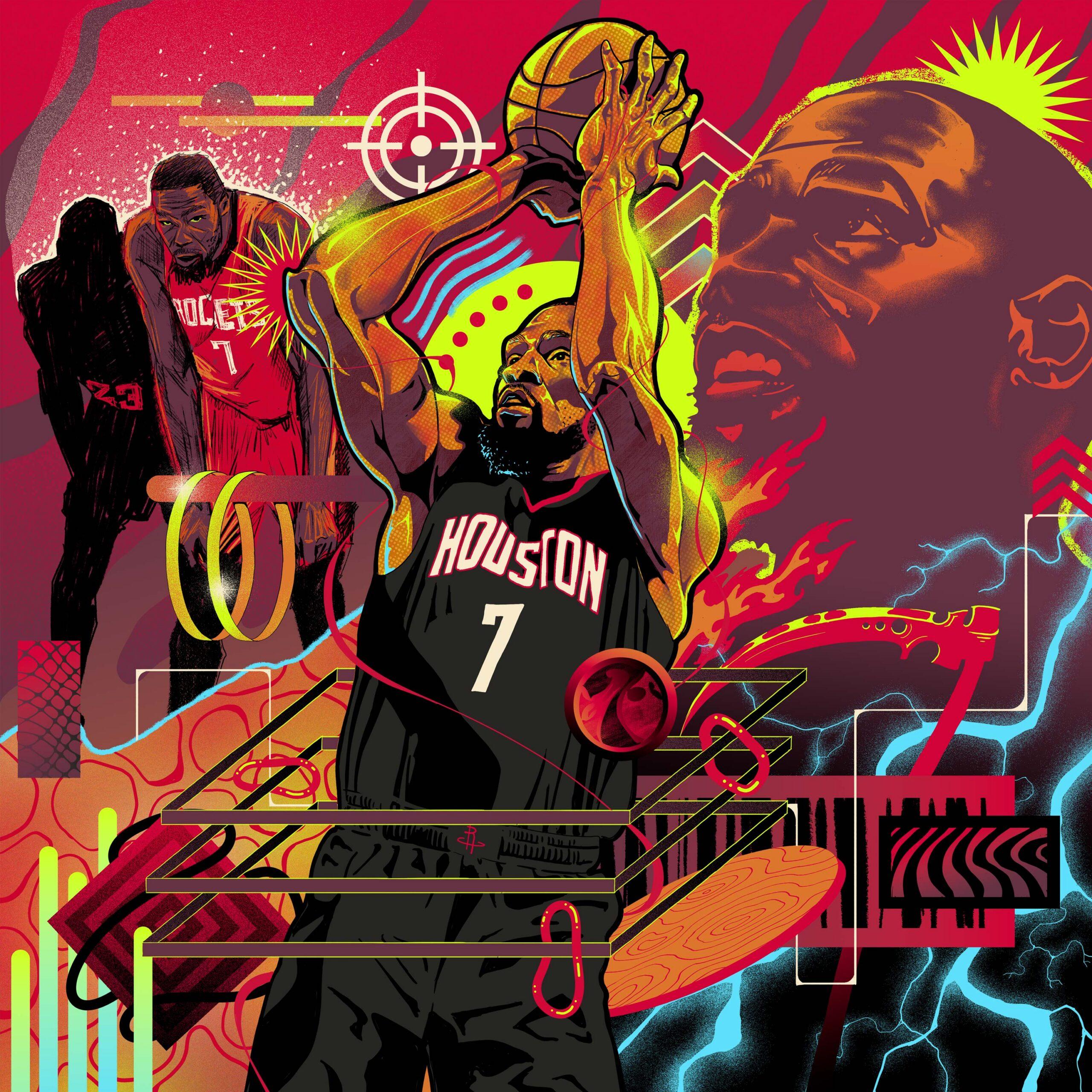
Buckets Over Bullshit: The Real Legacy of Kevin Durant
Don’t let Twitter fingers obscure the hands of maybe the greatest scorer ever. As KD approaches MJ, he’s still chasing perfection—and the legend he calls “the blueprint of this whole thing.”Buckets Over Bullshit: The Real Legacy of Kevin Durant
Don’t let Twitter fingers obscure the hands of maybe the greatest scorer ever. As KD approaches MJ, he’s still chasing perfection—and the legend he calls “the blueprint of this whole thing.”
Kevin Durant is married to the game and frequently renews his vows with even greater conviction.
The dedication required to be so good for so long, to continue to reimagine what’s possible for someone his height, and now, his age, is impossible without an insatiable desire to hoop. Asked recently what, if anything, was lost in his relentless hunt for basketball immortality, the 37-year-old Durant thought for a second and gave the kind of response you’d expect from someone who has spent more than half of his life in the NBA.
“You hear the clichés. You give up your friends. You give up partying. You give up having fun. But I just think that, for the most part, once you commit yourself to this, you’re not giving up nothing,” Durant told The Ringer. “This is what you want to do every day. It’s what you care about. Sacrificing is not really a thing. After a while, you just make this your whole life. All you think about is the game. You’re just immersed in the game mentally.”
Durant stands as a monument to that immersion. And where Durant has sought to go with the game is a place that’s unattainable for most, inconceivable for the rest. Mastery of the craft—total command of what he does on the floor—has been Durant’s biggest obsession for the past decade. He hasn’t stopped chasing perfection, even if he’s oblivious to the cost.
“I just wanted to be Teflon as a player,” Durant said.
The “KD Files” to which Durant has committed his focus and discipline have nothing to do with burner accounts, or any of that “Twitter nonsense” that may, or may not—OK, it probably did—involve him. It’s all about the 18 seasons of sustained bucket getting that he’s stored up and that have him on the cusp of passing Michael Jordan for fifth on the NBA’s all-time scoring list.
Jordan, whom KD is 68 points shy of, will become the third legend that Durant has passed in this calendar year alone. Durant eclipsed Wilt Chamberlain on a 3-pointer, a shot that hadn’t even been invented yet when the Big Dipper was setting his ridiculous statistical standards. To pass Dirk Nowitzki, Durant honored the previous greatest shooting big man ever by hitting one of Dirk’s patented one-legged fallback jumpers. However he chooses to honor Jordan—a midrange fadeaway? A shoulder shrug after hitting a 3-pointer? A Flu Game?—Durant is already honored to share the same table as the one he considers basketball’s North Star.
“He’s the standard,” Durant said of Jordan. “He’s the blueprint of this whole thing.”
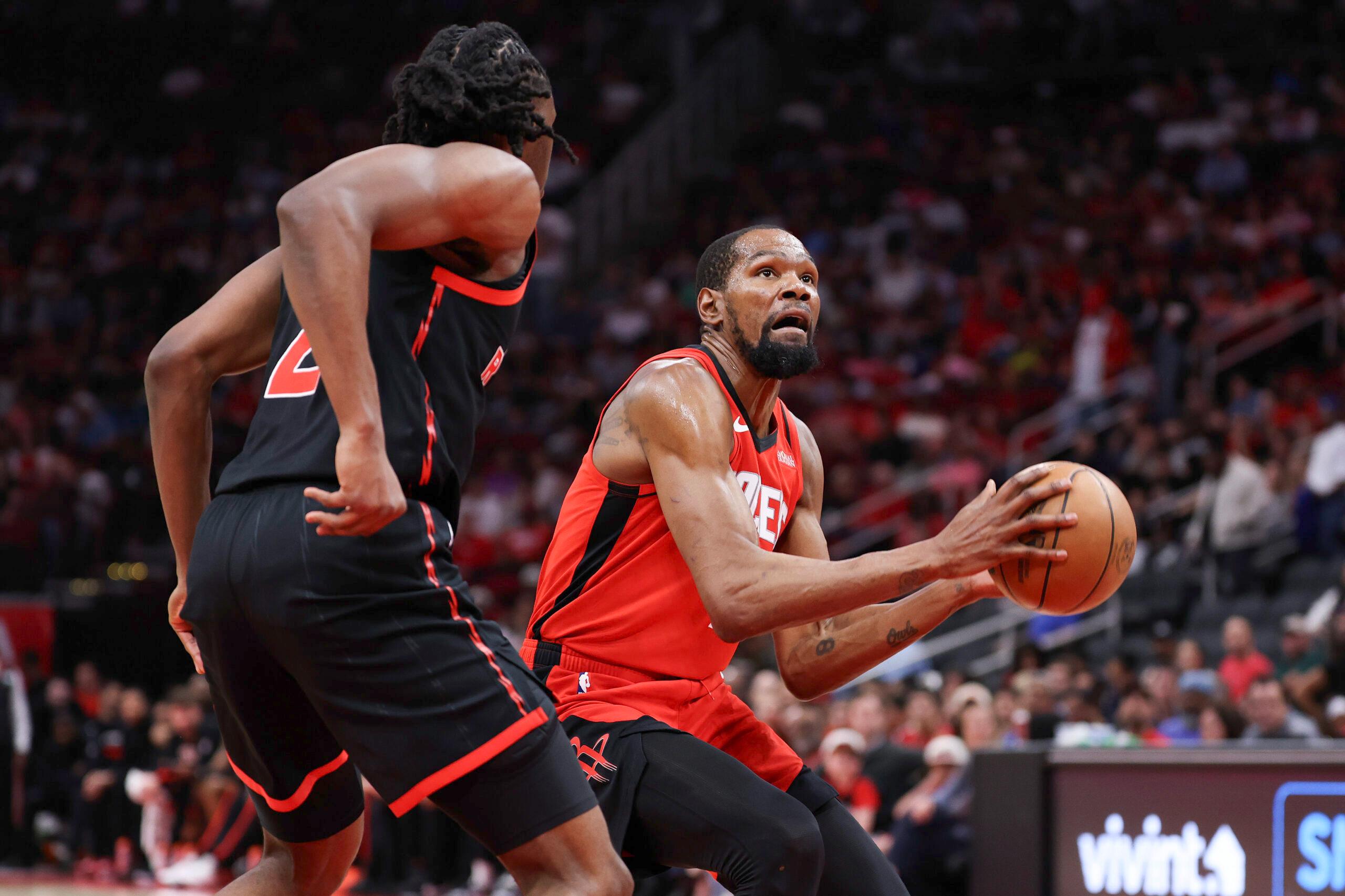
Kevin Durant shoots as Jonathan Mogbo defends during a game against the Raptors
The last two players who had the privilege of passing Jordan—Kobe Bryant and LeBron James—both carried the unfair burden of constant comparisons to His Airness. They rarely, if ever, had a chance to have their career achievements appreciated outside of the prism of what Jordan had done. Bryant needed an 81-point game and two Shaq-less rings for his Mamba Mentality to make him a legend in his own right. James needed to scratch off every possible statistical marker—most points scored, most buckets made, most minutes played, most All-Star appearances, most consecutive double-digit scoring games, and so on—for sustained excellence to place him in his own stratosphere.
Durant never faced that “next Jordan” scrutiny. He has, however, pursued that same ghost. He has also earned Jordan’s respect. When Jordan was asked to pick between Kobe and LeBron in 2013, his lighthearted response was, “I’d say Kevin Durant.” And, in the latest installment of his drawn-out NBC interview with Mike Tirico, Jordan downplayed the greatest of all time conversation while giving props to three players who came after him—LeBron, Kobe, and KD—for how “they’ve elevated the game tremendously.”
The versatility and skill at nearly 7 feet made Durant one-of-one, the NBA’s original unicorn. He has also inspired the next evolution of big men with a bag. Victor Wembanyama is a branch off Durant’s tree; a Yao Ming–sized alien with handles and a 3-ball. And, in stubbornly making a torn Achilles a mere footnote on his career, Durant has given Jayson Tatum, and soon, Tyrese Haliburton, reason to believe that maintaining elite status is realistic after returning from an injury that turned too many careers into glue.
But Durant hasn’t reached greatness unscathed. As his career has become more nomadic (the Houston Rockets are his fourth franchise in seven years), Durant has been criticized for bouncing from team to team, leaving behind unfinished business or unfulfilled promise. He’s soured on situations that appear ideal. His relatable but debatable use of social media has opened him up to more ridicule. Where the hate can’t stick to Durant is in his ability to score, regardless of what surrounds him, or the system his team employs. Like any artist, Durant is sensitive about how his work is received. But he won’t scrounge for more recognition, even if deep down inside he feels it’s warranted.
“People don’t truly appreciate anything until it’s not here anymore,” Durant said. “Anybody want the credit. But after a while, it don’t really matter. It’s not going to make or break my life. I don’t expect any love or praise or anything from the game or anybody. I just go out there, do what I do—and I love what I do—without getting anything back from it.”
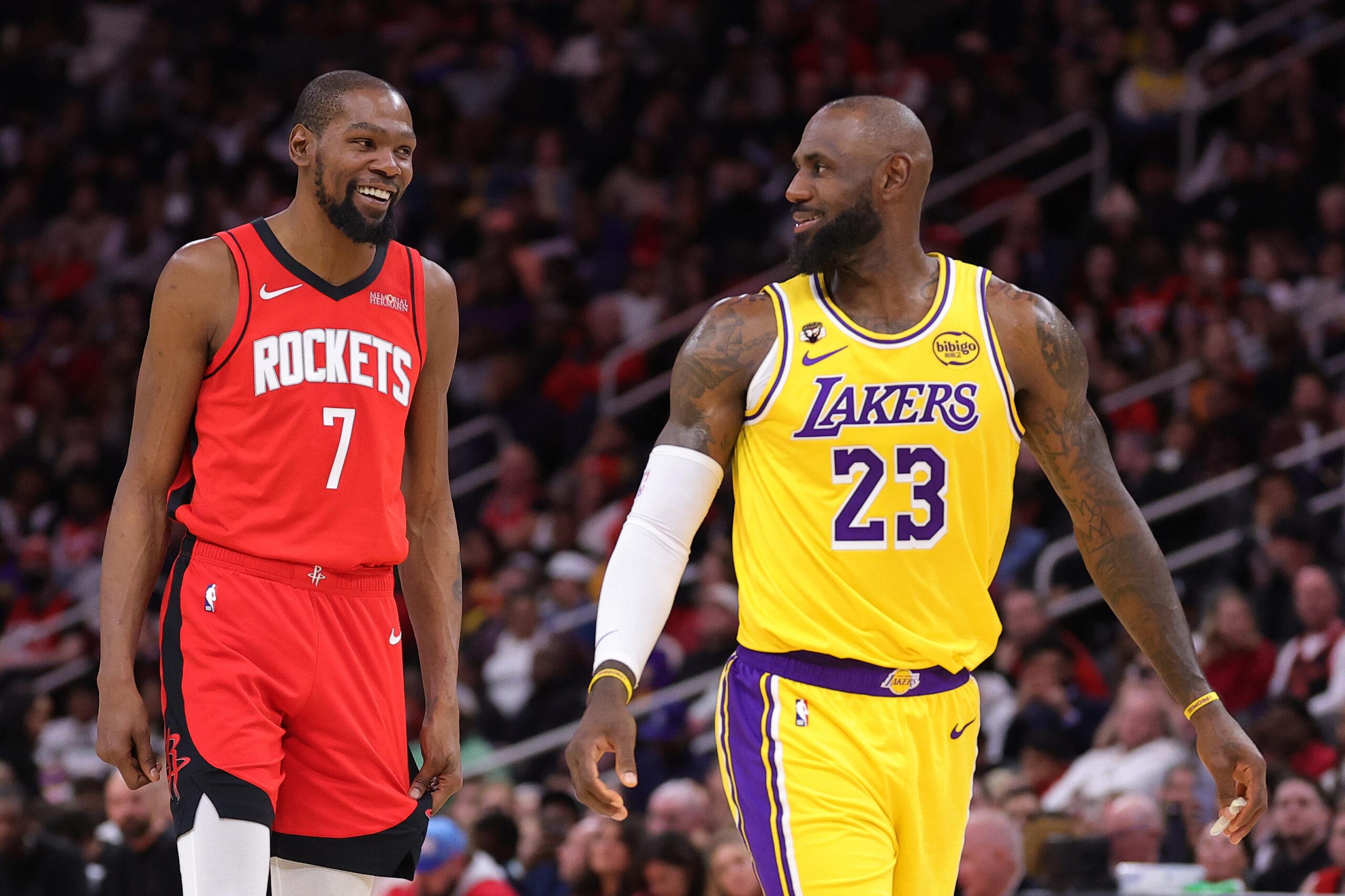
Durant and LeBron James during a game on March 16
As a ninth grader in Seat Pleasant, Maryland, who could only dream about making the league, Durant got tickets to Jordan’s final home game with the Washington Wizards in 2003. It was the only time he ever saw Jordan play in person. Not quite the same Jordan from his unassailable peak with the Chicago Bulls, but his aura card wouldn’t be declined. “I just remember the excitement in the building, the excitement around town when he decided to come,” said Durant, as he reflected while back home in D.C. for a game earlier this month. “The reaction to Mike was just different.”
It still is. Jordan’s GOAT status, which is protected like the Mona Lisa and garners more debate in the social media era than ever, has only been enhanced since he stepped away for the final time. Any attempts to fairly assess Jordan’s career that aren’t deferential to a fault can be interpreted as hating. Despite the reverence he holds for Jordan, Durant was once caught in those crosshairs.
While appearing on the Mind the Game podcast last July with LeBron and Steve Nash, Durant spoke about the difficulty of staying the course as an elite scorer and attaining longevity. “You got to recommit and sign that contract with yourself. … Some people say, ‘I want to go play baseball. Yeah, and then I wanna come back.’ Or some people say ‘I’m gonna go 22 straight.’” Durant got considerable backlash at the time, but said he still stands by those words.
“It’s true,” Durant said. “MJ took time off. It’s times where he was like, ‘I’m sick of the game. I want to take time off and regroup and come back into the game.’ And that’s what he did. Bron, he played straight through. I’m sure it was times when he was sick of the game and didn’t want to play. Sick of all the b.s. that come with the game. It was a different time. He probably had more of a shield around him than MJ had at the time. It’s different eras but guys choose their paths how they want to choose them.”
I don’t expect any love or praise or anything from the game or anybody. I just go out there, do what I do—and I love what I do—without getting anything back from it.Kevin Durant
Like MJ, Durant’s career was interrupted twice. But unlike Jordan, neither was by choice. The first injury-related reprieve came in 2014-15, in the ill-fated encore to his MVP season, when a foot injury limited him to just 27 games. The second break came after tearing his Achilles tendon in the 2019 NBA Finals. He returned from the former with an urgency to collect rings and emerged from the latter still with the ability to sleepwalk into an efficient 30 points. But there will always be a fascination about where Durant would already be on the all-time scoring list if he could have back those prime seasons and other time lost to injury. “You give me those 200 more games, you never know,” Durant said. "But the only reason I’m even close to MJ is because he retired twice.”
Jordan played 15 seasons spread out over 19 years. Durant usually plays it cool when addressing most topics, but he turns into a fanboy when comparing his accomplishments with Jordan’s greatness, with a nerd-like appreciation for the intricacies that separate icons from all-timers. Most see Jordan’s career total of 32,292 points. Durant sees a disclaimer. That point total only marks the completion but can’t measure its reach; the difference between painting a ceiling and delivering the Sistine Chapel.
LeBron would have company in the 40,000-point club, Durant vehemently contends, if Jordan’s second season wasn’t limited by a foot injury, if he hadn’t retired after both of Chicago’s three-peats from 1991 to 1993 and 1996 to 1998, or if he’d tried to keep going after that glossed-over run as Floor Jordan with the Wizards.
“He could’ve played past 40, too,” Durant said. “I would say MJ took off four to five years combined. You give him 300 more games of 30 points a night. That’s not an exaggeration. That’s what he averaged—30! I don’t want to take that away from him when I pass him. I think that’s key for any historian to know that about MJ. It’s cool to still be in that same realm as him but he’s more than a 32,000-point scorer to me.”
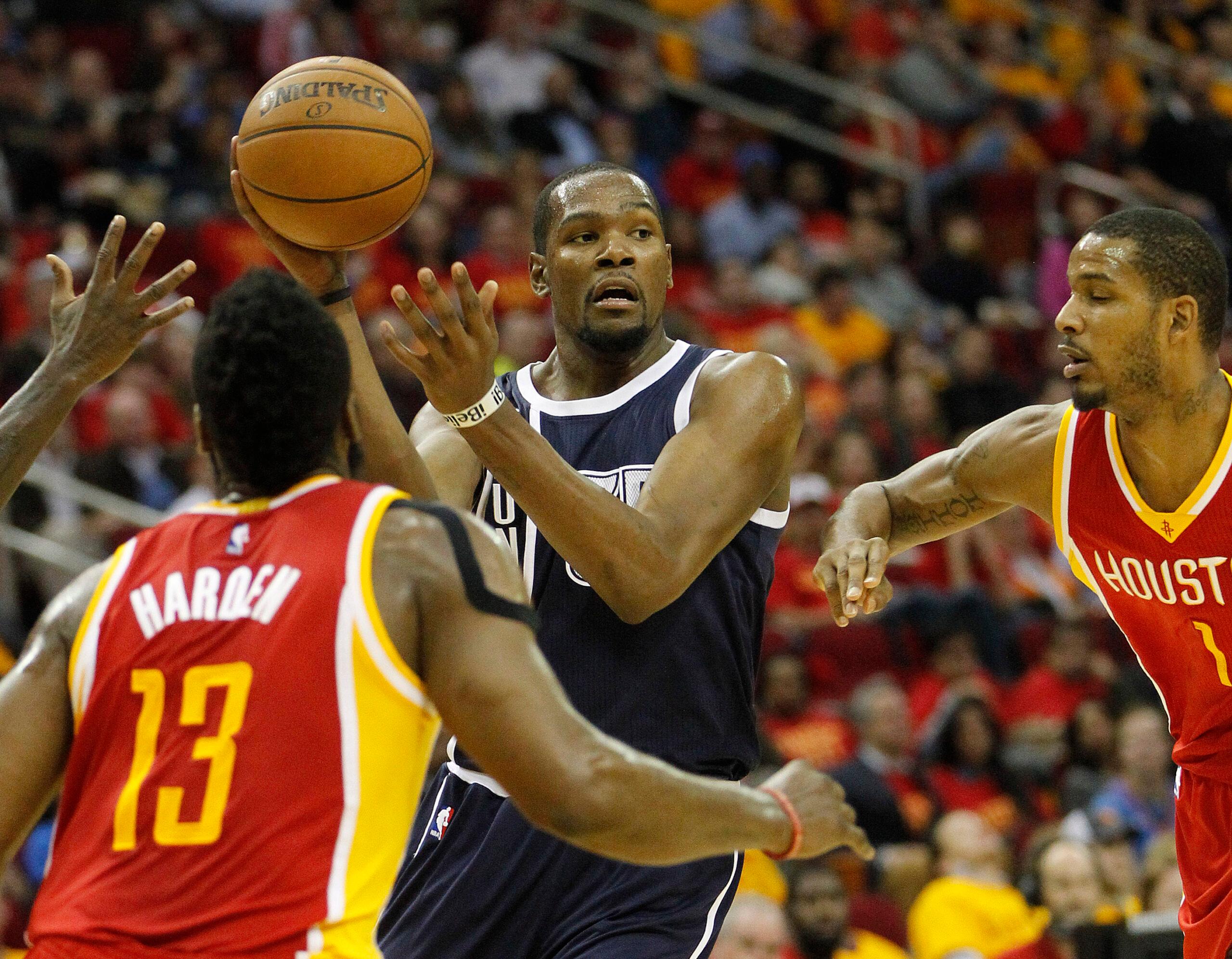
Durant during his abbreviated season with the Thunder in 2015
Durant has been a bucket from the beginning but has never tried to run up the numbers to prove a point. The noise that he can’t ignore when he’s bored on his phone doesn’t affect his approach to scoring. He’s content with consistency, cool with being chill. Had he, and not Bam Adebayo, been the one to surpass Kobe’s 81, or perhaps make Wilt’s 100 appear within reach, Durant would have been perceived as a more likely heir. But whereas the Mamba Mentality was to seek and destroy, the Easy Money Sniper Mentality is to avoid looking thirsty. He has the fourth-highest scoring average (27.2) in history among players who have played at least 500 games. But he’s also never topped 55 in a game, never had to be scrutinized for an unethical, stat-padding performance. He is just 12th all-time in 50-point games with nine, and just 10th in 40-point games with 72. Yet he’s topped 30 points in 434 of 1,186 career games, which speaks to his consistency.
For someone considered one of the greatest scorers, if not the greatest scorer in league history, why did Durant never chase one of those indelible moments? Why have there been 38 players in NBA history to reach 60 points but he’s not among them? The answer can probably be found on Durant’s left calf, where there’s a tattoo of Tupac, a rapper whose body of work is greater than any singular hit and whose famous line from “I Get Around” rings true with regard to Durant’s scoring exploits: “Ain’t no need in being greedy.”
“I’m in it for the long haul, man,” Durant said. “I just want to win the game and go home. I know that’s been a talking point for me: ‘You don’t have 60, 70.’ You can’t just look at a 60-point game and say, ‘That’s what KD about.’ You got to look at my whole career and really dissect what I did to truly understand the type of player I am. I like it that way. It’s more of a story that way. I don’t want to be a flash in the pan. I just wanted to be consistently great. I haven’t had 60, but it’s a lot of stats that I’ve created on my own.”
Durant is the only 55-40-90 player in NBA history. He and LeBron are the only players to average at least 25 points for more than 12 seasons. He has never had a game in which he made more than 19 field goals and has averaged fewer than 19 shots a game for his career. The night he scored his career-high 55 points, he took just 28 shots. He also reached 32,000 points in fewer games than any player other than Jordan. To which Durant asked, “What’s more important to some people—that or 60 points?” Durant remains the youngest NBA scoring champion and the youngest to win three scoring titles in a row. He could have won five in a row but Carmelo Anthony went bonkers in the final month of the 2012-13 season, averaging 36.9 points over the final seven games to claim his only scoring crown and beat Durant by 0.6 points. “I tried to get that one, but Melo just played better,” said Durant, who came back the next season to not only win his fourth scoring title with a career-high 32 points per game but also claim his only Most Valuable Player award. He remains tied with George Gervin and Allen Iverson with four scoring titles, surpassed only by Chamberlain’s seven and Jordan’s 10. But it’s not because he couldn’t get another, Durant said. It’s because he decided to move on.
You give me those 200 more games, you never know. But the only reason I’m even close to MJ is because he retired twice.Durant
“I wanted to stand on something as a player, and I wanted to have an identity. Scoring was an identity,” Durant said. “After I kind of got through that scoring phase, I learned how to be more efficient. I didn’t want to be a guy to force up shots. I tried to play the game and dissect the defense from a strategical standpoint. Once I made myself a [scoring] threat, I was able to build other sides of my game.”
Since winning his lone MVP, Durant has averaged more than five assists per game for a season eight times. He’s on pace to shoot better than 50 percent from the field for the 13th consecutive season, and on pace to complete his 15th season in which he’s averaged at least 25 points with a true shooting percentage of 60 or more. (No other player has 10.)
Durant was a big toe short of glory in Brooklyn and got the boot from Phoenix, but is back to playing meaningful basketball again in Houston, where, for better or for worse, the Rockets are depending on him to still be the Kevin Durant that he’s always been. But aging stars typically only go as far as the best young star can take them—think Kareem Abdul-Jabbar with Magic Johnson, Tim Duncan with Kawhi Leonard, or LeBron James with Anthony Davis—and one or more of the Rockets’ youngsters would have to take a transcendent turn for Durant to experience the team success he achieved in Oklahoma City or Golden State.
In the extended twilight of his career, Durant plays a game that works for him, even if the league chooses to operate differently. He defies analytics with his reliance on the least-reliable shot in the game—the midrange jumper, a Jordan staple that Kobe duplicated, only to have Durant elevate it. When getting to the basket became harder than in his youthful days, Durant targeted spots on the floor where he could be so consistent, those shots would feel like layups. And despite having just one season in which he played more than 62 games since returning from his Achilles injury, Durant isn’t the load-management type. He is third in the league in minutes per game this season, behind only Sixers star Tyrese Maxey and Rockets teammate Amen Thompson, who were ages 6 and 4, respectively, when Durant made his NBA debut.
Passing Jordan would be the palate cleanser Durant needs, a lifetime achievement that means he’s forever stamped—whether he’s hated for leaving Oklahoma City, not acknowledged for raising Golden State to the level of a dynasty, or scorned for failings in Brooklyn and Phoenix. Durant’s legacy is complicated, but Twitter fingers shouldn’t obscure the hands of maybe the greatest scorer ever.
With the NBA looking to possibly add an expansion franchise in Seattle in 2028—when he is set to become a free agent and will turn 40—Durant could set himself up for a potential storybook ending with the SuperSonics, the organization that drafted him. But Durant has never been interested in going back to where he’s been. He resisted blatant overtures from his hometown Wizards as he approached free agency in 2016, and he rejected a trade that would have reunited him with the Warriors last season. He might be more open to nostalgia since being on the Rockets has brought him back to Texas, where he starred in college. But even athletes who are able to leave the game on their own terms don’t always choose the ending that makes the most sense. If that were the case, Jordan would have stopped playing in 1998 after pulling up over Bryon Russell.


More on Kevin Durant’s Career
As Durant made his way to the team bus after a Rockets game in Philadelphia earlier this year, a father and his 12-year-old son approached him in the tunnel to ask about joining Durant’s AAU program, which was established in 2016 and bears his name. Frowning, a skeptical Durant asked, “Why are you here? Why aren’t you in the gym?”
The kid smiled and replied, “I already put up 500 shots today.”
Durant’s eyes widened. He beamed. He gave the kid a high-five and brought him in for a hug.
Durant’s basketball love language has always been to go all in. Ain’t no half-stepping to history.
“I’m going to keep pouring into the game every day,” he said, “keep getting better and try to put on a show every time I step on the floor.”