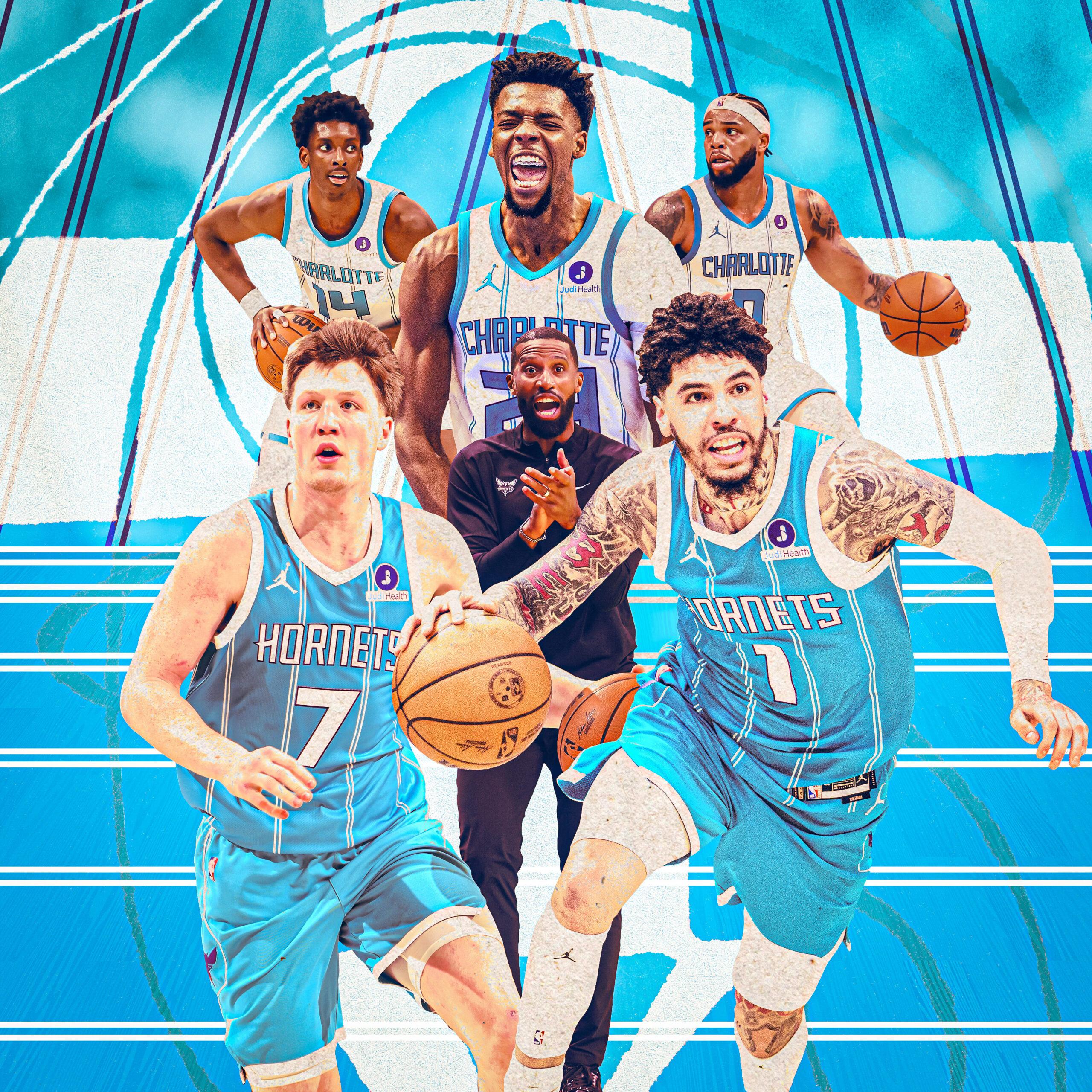

Charles Lee saw the turnaround coming before it was reasonable to believe one could happen. On New Year’s Day, the Charlotte Hornets were 11-22 with the NBA’s 26th-ranked defense and a bunch of injuries that had seemingly sunk their season before it could get off the ground.
There’s a good chance, if you’re reading this, that you already know what happened next: arguably the most abrupt and exhilarating U-turn in league history.
Since that day, the Hornets are 22-11 with the NBA’s most efficient offense, highest net rating, sixth-best defense, and most potent starting lineup. Over the summer, it wasn’t that hard to look at Charlotte’s potential and think the team would exceed expectations. Health willing, LaMelo Ball, Brandon Miller, and Moussa Diabaté can be very good. Splash in Kon Knueppel—the fourth overall pick in 2025 who’s become the most efficient rookie in NBA history—and you have several extremely appealing and complementary winning ingredients. But this? Absolutely not. Unless you’re Lee.
Last week, in a phone interview, I asked Charlotte’s head coach when exactly he realized something special was happening. “I felt it during the offseason,” Lee told The Ringer, citing the team’s personnel moves and a general uptick in professionalism from Charlotte’s returning players. “And, you know, even as we went through that period where the results might not have been there, you still felt our team was learning. They were growing. They were still believing in everything that we did.”
When he was hired in May 2024, after assistant coaching gigs with the Hawks, Bucks, and Celtics, Lee’s primary focus was “elevating the standards for competitiveness and really trying to get the group to play hard.” That mostly revolved around establishing some of the defensive principles that Charlotte hadn’t seen in a decade. He didn’t even discuss offense during his first training camp practice. “The players probably couldn’t stand me,” Lee said. “Some of the coaches were probably pissed at me, but I thought that’s where we needed to start.”
Using pieces of an identity carried over from the Celtics, whom Lee helped coach during their 2023-24 championship run, the Hornets choked off corner 3s and dramatically reduced the number of points they allowed in the paint. There was plenty of room for improvement, but after establishing some baseline defensive habits in his first year, Lee spent this past summer prioritizing the other side of the floor.
The Hornets were plagued by the NBA’s worst half-court offense last season. Better players helped turn that around, but an augmented system that leveraged all the shooting, passing, intelligence, and skill on Charlotte’s roster was just as vital. The upshot has been one of the more transformational and entertaining developments in the entire league: an offense that has successfully adopted the same quick-twitch tendencies that nearly won the title last season.
“I will say, you know, watching the [Indiana] Pacers on their Finals run last year definitely contributed to a little bit of our thought process of how we can get a little bit more random,” Lee said.


The most observable similarity can be found in all the small-small actions they run on any given play. Guards and wings are constantly setting ball screens for each other, injecting some upbeat chaos into their flow. “We’re not always depending on our 5-man to have to come screen, come back up, and screen again if we need an after action. It just brings a little bit more variety to how we play.”
In addition to Indiana, Charlotte has also been influenced by the defending champions. Two years ago, Oklahoma City unleashed an attack that was simultaneously innovative and necessary, full of floor-inverting two-man actions that caught the rest of the league off guard.
On-ball screens that don’t involve a big are increasingly prevalent throughout the NBA, but right now no team utilizes them more than Charlotte; per Sportradar, it ranks first in slip screens to a pop or a roll. There’s also no contact or redirect on 49.3 percent of all the screens it sets, which is the highest rate in the league. Lee steered into this tactic once he realized how effective and versatile his guards and wings truly are. All of them can dribble, pass, and shoot while garnering attention without the ball in their hands. These aren’t big men, but they’re comfortable reading a defense as they roll into the paint:
Charlotte’s system is a blender that forces multiple defenders to constantly communicate through a series of split-second decisions. Just watch the clip above and imagine being Jalen Green. The ball crosses half court, and he immediately has to think his way through two screens before he can take one breath. On any given possession, the Hornets will execute half a dozen seemingly random actions that occupy every inch of the floor. They’ll pass and chase, run a stagger away, sprinkle in a rip screen on the backside, have someone sprint off a pin-down into a dribble handoff, and then reverse the ball over to a wide-open shooter. It’s frenetic energy, like a cue ball breaking the rack:
One of Lee’s goals was for the Hornets to be more expeditious before plays even start. The earlier they could begin, the more time they’d have on the shot clock to make a defense feel dizzy, create mismatches, and maximize their talent. “We did a ton of work on just quick inbounds [plays],” Lee told me. “More pass-aheads, more pass-acrosses.”
Normally, the center would take the ball out of bounds when Charlotte gave up a basket, so Lee worked on having the closest player do it instead. Interchangeability is good!
Now, once the Hornets flow into their half-court offense, the opposing defense is plunged into hell. It’s here where one of the most satisfying viewing experiences in all of sports transpires: watching one team fail to stop the other despite knowing exactly what it wants to do. This is how it must feel to guard my favorite Hornets play.
As three players mill along the baseline, one wing—usually Knueppel or Miller—comes up from the free throw line to set a pick for the ball handler. It looks so simple when you watch it develop, but the screen’s angle and whether the setter chooses to make contact at all are two variables that flood the play with myriad options. More often than not, the screen is flat, allowing the ball handler to read the defense and decide whether he wants to drive right or left. From there, the screener (who just so happens to also be a knockdown shooter) will usually pop out to the opposite wing. It’s a predictably unpredictable whirlwind that almost always generates a good look:
All this motion tends to confuse defenses. And they’re just as vulnerable whenever Charlotte misses a shot thanks to Diabaté, a human gamma ray and nationwide sensation. According to Sportradar, the 24-year-old moves toward the rim to snatch an offensive rebound on 93 percent of his opportunities to do so—good for the 99th percentile. “Everyone knows the energy and activity he plays with and how good he is at offensive rebounding,” Lee says about his starting center. “But then what about the fact of, like, how many kick-out 3s he creates because of those offensive rebounds?”
Sidebar: I know I’m focusing on Charlotte’s offense right now, but, truth be told, its mind-blowing turnaround isn’t enough to drive winning by itself. If the Hornets weren’t suddenly interested in getting stops, the staggering amount of points they can score wouldn’t be enough to make me believe a deep playoff run is possible. Diabaté ranks fifth in on/off point differential in part because he might be the most switchable big in the entire league; it’s kind of amazing that guards still test him off the bounce:
It’s not easy to capably integrate a style of play that falls flat sans constant movement, speed, and intention. But the Hornets have done it in a short period of time by embracing a selfless mentality, trusting the extra pass, and, critically, drilling a high percentage of the quality looks they create for one another. It isn’t just LaMelo, Knueppel, and Miller. Josh Green, Grant Williams, and Coby White are all genuine threats who can’t be left alone, and no other team’s 3-point percentage has rocketed up the charts like Charlotte’s this season:
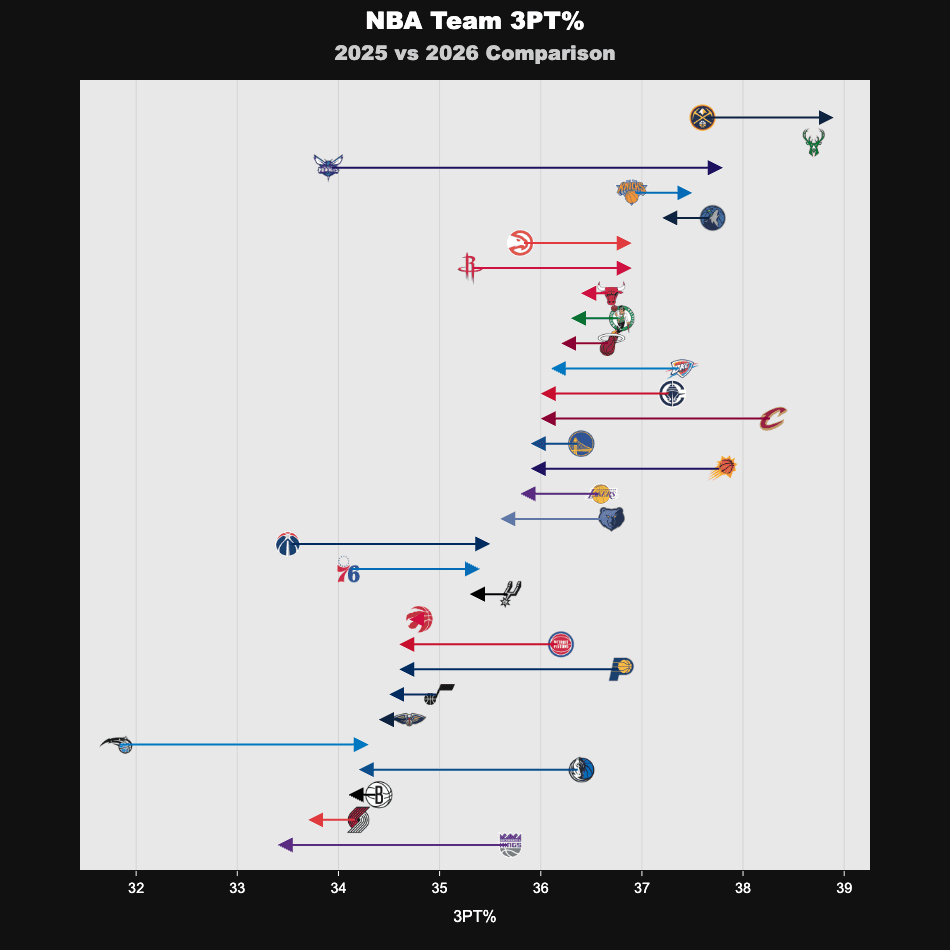
The Hornets have also made dramatic strides in both taking and limiting shots behind the arc. Last season, the Hornets attempted 1.6 fewer 3s per game than their opponent, a net differential that ranked 21st in the league. This season, they’re launching 6.6 more 3s, which trails only the Golden State Warriors.
Anointed as Charlotte’s best player by Miles Bridges back in November, Knueppel is a major reason for that. As arguably the best movement shooter in the NBA, he’s dramatically altered the franchise’s trajectory while adding pages to Lee’s playbook. We’re talking about the most efficient rookie in league history and, with apologies to Cooper Flagg, the obvious choice for Rookie of the Year. At 20 years old, Knueppel leads the entire freaking NBA in 3-pointers and ranks seventh in 3-point percentage. Among players who’ve appeared in at least 50 games, he’s 15th in estimated plus-minus. That is ridiculous. A walking winning play who makes life easier for everyone he plays with, Knueppel not only ranks first in off-ball gravity this season according to BBall Index, but he’s currently sixth all time in that website’s entire database, which stretches back to 2014. When he slips a screen, best believe it’s a five-alarm fire:
Then there’s Miller. Not even three full seasons into his career, Charlotte’s second-leading scorer poses a real threat with or without the ball. He’s an ideal fit on a team that loves to have him set screens, fly around screens, and dribble off screens. He isn’t an elite three-level scorer yet, but you can see him becoming one very soon. In his past 25 games, Miller is averaging 22.2 points and making 52.7 percent of his 2s, 40.7 percent of his 3s, and 93.5 percent of his free throws. He knows how to harness his 6-foot-7 frame against smaller defenders and can create space for himself in myriad ways that have a tendency to make him look like the ultimate luxury:
Neither Miller nor Knueppel is the straw that stirs Charlotte’s drink, though. That’d be LaMelo. I’m not necessarily suggesting he should be in the MVP conversation—he’s still not particularly efficient and averages only 27.6 minutes per game—but I’m not not willing to recognize his impact on a team that’s obliterated the league for two straight months. Only four players are creating more points per 100 possessions than Ball this season: Nikola Jokic, Luka Doncic, Shai Gilgeous-Alexander, and Cade Cunningham; Charlotte generates 13.6 more points per 100 possessions when he’s on the floor, and the only player above him is Jokic.
Pretty much every Hornet is more efficient when they play with Ball. Knueppel’s true shooting percentage rises 10 percentage points to a comical 70.3. Bridges’s is 7.8 percentage points higher (at 59.8). Diabaté’s is 7.2 percentage points higher (at 69.6). Green’s is 13.5 percentage points higher (at 75.9). Williams’s is 12.2 percentage points higher (at 68.8). Also impacted immensely: Miller’s shot diet. The percentage of shots he takes at the rim nearly doubles with Ball on the court, while his accuracy spikes by a whopping 29 percentage points.
The scariest thing about these Hornets? They’re the third-youngest team in the league and still have so much room for improvement. Charlotte can stand to play even faster than it does, and it has the third-worst turnover rate in the league since January 1. Some of these issues can be chalked up to oversharing—ultimately a good problem for such a young team to learn from; selfishness is a mindset that’s easier to encourage than to tone down. But lapses of focus help explain why this group is just 10-17 in crunch time.
Will some of that sloppy play prevent them from following in Indiana’s footsteps? It’s a lofty comparison that, given the aesthetic resemblance and late-season success, is worth making. But there are a few key differences, too. The 2024-25 Pacers already had playoff experience and were coming off a competitive run to the Eastern Conference finals. They’d won 50 games that year and entered the postseason as a 4-seed. Meanwhile, the Hornets have not won a playoff game since … 2016. They haven’t won a playoff series since 2002.
Assuming Charlotte qualifies for the playoffs this year, it’ll most likely be as a play-in team that has to square off against the Pistons, Celtics, or Knicks in Round 1. In the event that happens, pray for the Pistons, Celtics, or Knicks. The Hornets’ record is 33-33, but their net rating for the entire season signals a team that’s on pace to win 49.2 games. They’ve proved they can go punch for punch with anyone.
Like those Pacers, the Hornets have more than enough shooting and operate with a ton of space. Their offense creates indecision, unfolding at a velocity that can neutralize just about any defensive game plan. This is one of the hardest teams in the league to prepare for.
Whether or not Charlotte can stand up to the physicality and focus that’s required to win in the postseason is unknowable. Age and experience matter. But none of what the Hornets have accomplished to date is a fluke. If they do win a playoff series, don’t call it an upset. Their coach saw it coming a mile away.