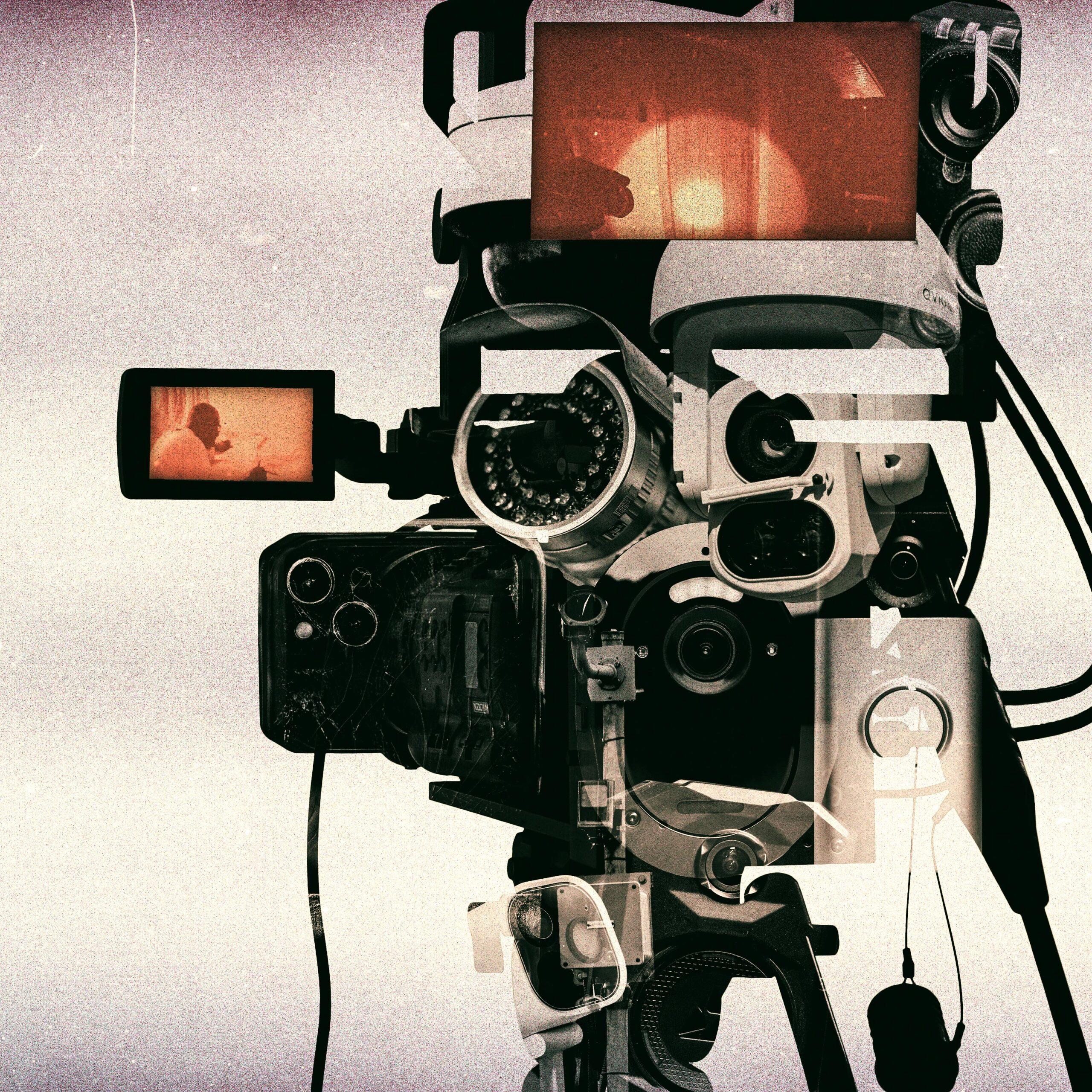
The Panopticon Age of Documentaries Is Here
Video is now being captured of everyone and everything, and two of the contenders for documentary honors at Sunday’s Oscars—‘The Perfect Neighbor’ and ‘The Alabama Solution’—make fundamental use of it, changing the nature of the genre. Do the ethical guidelines of documentaries need to change with it?The Panopticon Age of Documentaries Is Here
Video is now being captured of everyone and everything, and two of the contenders for documentary honors at Sunday’s Oscars—‘The Perfect Neighbor’ and ‘The Alabama Solution’—make fundamental use of it, changing the nature of the genre. Do the ethical guidelines of documentaries need to change with it?
It’s just about the most difficult scene you’ll ever have to watch in a documentary. A father arrives at the scene of a shooting in Ocala, Florida, and is informed by police that the mother of his young children has been killed; next, he gathers their kids and tells them the news himself. There’s no blurring of faces, no cuts to outside interviews or voiceover—just a life-altering moment captured from the perspective of three unwitting police cinematographers with cameras strapped to their chests, hesitantly taking it in themselves.
“Y’all love me?” the boys’ father asks. “We all love mom? All right. Well, I got some bad news to tell you. Mom’s not coming back anymore.”
The rest of The Perfect Neighbor, directed by Geeta Gandbhir, is not much easier to take in. To tell the story of the 2023 death of Ajike Owens, a Black woman who was shot by her white neighbor, Susan Lorincz, Gandbhir shed many of the tropes and traditions of true crime, instead opting to tell the story almost entirely through a database of primary footage from various sources: police body cameras, CCTV, doorbell video.
Being a fly on the wall for this tragedy—watching with helpless dread as the situation escalates through Lorincz’s repeated 911 calls to complain about children playing near her home—is so gripping that it took an incident that initially received moderate media coverage and turned it into one of the most scrutinized shootings in recent American history. Since its release this past October, The Perfect Neighbor has been viewed over 50 million times, and was for several weeks the top overall film—scripted or nonscripted—in the country on Netflix. And after being lavishly praised by critics, the film is currently the front-runner to win the Academy Award for Best Documentary. It is a milestone film—one of those rare documentaries to cross over into the mainstream (it was semi-parodied by Saturday Night Live) while at the same time being artfully told. But something still nags around the periphery: Is database directing the right way to make a documentary? Should we really be watching this?
“There’s so many questions that using this type of material raises, as it should,” Gandbhir told me on a video call. “I am a fan of that. I think we need to discuss all this.”
Gandbhir is very well aware of how to make a traditional documentary. In the last several decades, she’s become one of the most prolific documentarians in the field, producing or directing a litany of feature-length films and docuseries. It can be a little difficult to keep up: Just this past year, Gandbhir co-directed The Devil Is Busy, an HBO short about a day at a women’s healthcare clinic that’s also nominated at this year’s Oscars, and the first episode of the three-part Netflix series Katrina: Come Hell and High Water, sharing the directorial duties with Samantha Knowles and Spike Lee. There are not many people in the world with more experience in the challenges of making a compelling documentary while keeping it ethically sound.
There’s so many questions that using this type of material raises, as it should. I am a fan of that. I think we need to discuss all this.Geeta Gandbhir
But as Gandbhir began sifting through the 30 hours of footage released by police in the Ajike Owens case, a different film presented itself than any she had made before. “Honestly, I’d never encountered anything like this,” she said. There was raw footage of everything—each phase of the saga jaggedly accounted for, from rising community tensions to the immediate aftermath of the shooting to Lorincz’s interrogation and arrest. If the whole story was solidifying in front of her, Gandbhir realized, why suddenly break it apart again just to make it fit the expectations of the documentary form? What if the footage was the movie? “I think because I used to be an editor,” she said, “I thought it was possible.”
Experimental as it may be, The Perfect Neighbor is just an extreme entry in a growing phenomenon within documentary filmmaking—one initiated by rapid technological innovations and societal shifts that are enough to give Orwell whiplash. Cameras are now placed almost everywhere in city environments, and most adults walk around with reasonably high-definition video cameras in their pocket at all times. Police are recording their interactions, citizens are recording whatever catches their eye, Ring cameras are recording everything that moves past the front door.
If you are outside of your home—and perhaps sometimes inside of it—it’s reasonable to assume that you are being captured on video. And what this hivemind panopticon provides, besides a profound loss of privacy, is an opportunity: The sheer amount of footage that now exists means that documentarians suddenly have a groundswell of primary material to work with. If a true-crime film was previously lucky to have blurry security footage of an incident, it now increasingly has that incident crisply accounted for, from multiple angles.
“It’s so different than seeing a movie about the Korean War,” said Andrew Jarecki, the director of Capturing the Friedmans and The Jinx, “and hearing from the brigadier general, or hearing from the people that were on the front lines—and then really being able to see and feel those moments.”
Jarecki’s latest HBO documentary, The Alabama Solution, which he co-directed with Charlotte Kaufman, hinges upon a collection of footage shot by inmates in Alabama prisons and sent to the filmmakers via contraband cell phones. The notion that America’s prison system runs rampant with violence and abuse is nothing new, but to see it firsthand—to see the rooms stacked with overheating and underfed inmates, to see blood smeared on the floor where guards have dragged an inmate away—makes it clear that it was not possible for words to capture the extent of the depravity. You had to see it for yourself.
“We’ve been trying to tell this story for so long—currently and formerly incarcerated people—and we just haven’t been believed,” said Alex Duran, a producer of The Alabama Solution who previously spent 12 years in New York state prisons. “What hasn’t occurred is an unvarnished account, where the camera is coming into the darkest corner of the carceral state.” The footage from inside the prisons, Kaufman pointed out to me on a video call with Jarecki and Duran, actually only makes up around 30 percent of the film. “But when you watch it,” she said, “it feels like so much more than that, because it is the revelatory thing. It’s the thing that we haven’t been able to see. It’s very impactful. It punches above its weight.”
The Alabama Solution is also nominated for Best Documentary at the Oscars, and several other prominent documentaries from the past year make crucial use of this renegade vérité—footage not originally created by the filmmakers and not intended to be consumed as a piece of “entertainment.” Mr. Nobody Against Putin, co-directed by David Borenstein and Pavel Talankin, consists largely of video shot by Talankin, a Russian school employee who was tasked with recording government-prescribed propaganda routines. 2000 Meters to Andriivka, directed by Mstyslav Chernov, covers the Russia-Ukraine war through the lens of Ukrainian soldiers, using body-camera footage to place the viewer directly into the trenches of war.
“This is a floodgate opening,” said Wesley Morris in an episode of his podcast, Cannonball, about The Perfect Neighbor. “What we’re talking about—the use of archival anything to make anything—old, old, old. But filing a Freedom of Information Act request to get this footage? This body-cam footage? And turning that into art and entertainment? That’s new. We’re in a new realm here.”
Andrew Jarecki likes to use big whiteboards to keep track of ideas and goals for his documentaries, and one phrase that stayed on the board throughout the six-year production of The Alabama Solution was a mnemonic to remember what kind of film they didn’t want to make: SMITWTNOES, which stands for “saddest movie in the world that no one ever sees.” Even social-justice-focused documentaries—perhaps especially social-justice-focused documentaries—have to play like “page turners,” Jarecki explained. “That was always in our minds,” he said. “It has to grab people’s attention.”
“The problem for us as filmmakers,” Gandbhir explained, “particularly if we are making something about social justice, is we end up just talking to each other. It’s like, how do we reach outside of our bubble? We can’t remain siloed.” Gandbhir, who first broke into film working on Spike Lee’s Malcolm X, looked at The Perfect Neighbor like a “scripted thriller” in the lineage of The Blair Witch Project or Paranormal Activity. “I believe that will hold people,” she said, “and I can reach an audience that way and maybe make them think about these things.”
Jarecki has a proven knack for turning dark and difficult subject matter into a successful thriller. In 2015, his docuseries The Jinx became national news after it procured what appeared to be smoking-gun evidence and a hot-mic confession suggesting that its subject, the real-estate heir Robert Durst, was guilty of murder. (Despite some debate about the presentation and reliability of Durst’s ramblings, he was arrested the day before the Season 1 finale and was later convicted.) But The Alabama Solution is a different breed of page-turner—one making the case that many of its subjects likely should be freed from prison rather than held within it. To tell that story in a compelling way, the footage was key, not just for the access it provided to its main characters, but also for how it helped cinematically communicate elements of the film’s core message.
“The signal goes in and out, the footage gets grainy sometimes,” Kaufman said. “The lighting isn’t perfect all the time, their voices crackle—that’s a constant reminder of the conditions under which we’re able to speak to them, and how difficult it is for them to talk to the public and talk to the press. That was very important to us—that we didn’t smooth all of that out or we didn’t try to conceal that.”
“Also, just the image itself is like in a cell, right?” added Jarecki, referring to the vertical videos that they were receiving. At first, Jarecki explained, he and Kaufman were worried about audiences being able to sit with the “cramped” footage. “And then we realized that it gives the audience the feeling of what it’s like to not be able to see the whole picture—what it’s like to feel constricted.”
In the 2023 short film Incident—which uses only surveillance, dash-camera, and body-camera footage to reconstruct the fatal 2018 police shooting of Harith Augustus in Chicago—director Bill Morrison was struck by the ways that primary material alone could be used to provide thematic commentary. Prior to making Incident, Morrison told me, he had been talking with journalist and human rights activist Jamie Kalven about the idea of making a scripted film that unfolded through rotating perspectives: a cell-phone camera, a police body camera, a dog-door camera, etc. “Each view would tell a slightly different story, in the style of Rashomon,” Morrison said.
Years later, Kalven was working on a journalistic investigation of Augustus’s shooting and acquired a swath of police footage. Morrison started going through it and saw his unvarnished vision for the movie, highlighting the manner in which police started adamantly coming up with varying and questionable narratives about what had just happened. “In a way,” he told Kalven, “this is our Rashomon.”
Incident was nominated for Best Documentary Short at the Oscars, and Gandbhir has cited it as an influence on The Perfect Neighbor. It’s reasonable, as well, to place Incident and The Perfect Neighbor within the lineage of the broader vérité and direct cinema documentary genres, in which directors like Frederick Wiseman and the Maysles brothers have embraced unadulterated footage that immerses viewers within a place and time—in line at the welfare office, say, or staying as a houseguest at Grey Gardens. These experiences are less about some form of journalistic truth than they are an emotional one, and their goal is theoretically to capture a scene in which the camera is almost forgotten.
But it’s simply not possible for any traditional film crew to be truly forgotten, no matter how they position themselves. That makes a movie like The Perfect Neighbor, in which none of the subjects know they’re being recorded for a documentary, almost more vérité than vérité. “There’s no journalist there directing things or asking pointed questions,” Gandbhir said. “There was no film team there directing anything or making the people aware of their presence. The events are literally as they unfolded. You become a part of the neighborhood. You become a witness. It’s so immersive that you feel that you are a neighbor.”
It seems like a quaint issue now, but when Errol Morris first released The Thin Blue Line in 1988, there was substantial criticism surrounding his decision to use reenactments. The documentary is an examination of the fatal 1976 shooting of a Dallas police officer, and Morris essentially makes the case that the man who was convicted of the crime, Randall Adams, was innocent. Of course, there is no footage of the shooting, so Morris uses reenactments to work through various possibilities for how it occurred, suggesting that the official account of what happened—largely based on witness testimony—was deeply flawed. Adams’s conviction was overturned, and the film was named the best documentary of the year by the National Society of Film Critics. But the Academy of Motion Pictures deemed the film ineligible for Best Documentary because of its inclusion of reenactments, which they referred to as “scripted content.”
The irony is that reenactments have since become standard practice in the documentary world—particularly in true crime, where it’s often added as casually as a witness interview or interrogation video. In The Thin Blue Line, Morris was trying to sow doubt on the police narrative rather than suggest a definitive representation of how the shooting took place. But in the almost four decades since the film’s release, other documentarians have since adopted his reenactment method more recklessly, less in search of truth than something that can serve as visual filler.
Writing about the complex dynamics of reenactments for The New York Times in 2008, Morris explained that people tend to miss the point in conversations like these. “There is no mode of expression, no technique of production that will instantly produce truth or falsehood,” Morris wrote. “There is no veritas lens—no lens that provides a ‘truthful’ picture of events. There is cinéma vérité and kino pravda but no cinematic truth.” He added, “The engine of uncovering truth is not some special lens or even the unadorned human eye; it is unadorned human reason.” Memories fail, vision deceives, he was saying—and one person’s testimony is not necessarily better than another’s recreation. In the realm of documentary, debates on form are often a distraction from more important debates on critical thinking about fact and truth.
In Wesley Morris’s Cannonball episode about The Perfect Neighbor, he discussed a few criticisms of the film with fellow New York Times critic Parul Sehgal. “It’s a film,” Sehgal said, “but it’s also a fairy tale, in which there’s this beautiful, multiracial community that is cohesive, that looks after each other and their children, and there is this—”
“Ogre,” Morris suggested. “Who lives under the bridge.”
“We don’t think deeply about motivations,” Sehgal added. “We don’t really know very much about anybody in this film, do we?”
In relying solely on primary-source footage, The Perfect Neighbor risks committing something like journalistic sin. There’s the question of whether Lorincz, who was convicted of manslaughter and is currently serving a 25-year sentence, was due the opportunity to provide any kind of comment in the film. And there’s also the question of whether outside information or analysis of her mental health was relevant to the story, or changes the calculation to make the film at all. (At Lorincz’s sentencing hearing, her sister testified that their father abused them sexually and physically as children; it was also revealed by a forensic psychologist that, prior to the shooting, Lorincz had been diagnosed with post-traumatic stress syndrome.) How effectively and fairly can a story like this be told just with the raw footage alone?
“I don’t know that the film is ultimately fair to her,” Jaimie Baron, a film and media studies lecturer at UC Berkeley, told me. “She shot an innocent woman, but she also seems to be a disturbed person. So it’s also hard to know if it’s ethical to put her on display in this way.” Baron, who wrote a book about the ethics of appropriating footage—Reuse, Misuse, Abuse—said the matter ultimately has to be a question of whether the film reveals enough about our society to validate its approach. “Is there enough there to make it worthwhile or ethically justified? It’s a fine line. I don’t think that’s a question that has a yes-or-no answer. It’s something we have to deal with now that we have all this footage of all kinds of things.”
Is there enough there to make it worthwhile or ethically justified? I don’t think that’s a question that has a yes-or-no answer. It’s something we have to deal with now that we have all this footage of all kinds of things.Jaimie Baron
When I asked Gandbhir about Lorincz’s presentation in the film, she told me that it was vital to her that both sides of the central dispute were journalistically accounted for. “If one side tells you it’s raining,” Gandbhir said, “and the other side tells you it’s not raining, your job is to go outside and see if it’s raining. So it was really important to me to make sure that Susan had her say.”
Lorincz’s accusations of being terrorized by the neighborhood are well documented in the film, as are her claims and explanations of self-defense in shooting Owens through her closed front door. At several points in the film, there are also oblique references to Lorincz’s assertion of trauma and prior abuse; it’s subtle, and it’s difficult to know how to take given Lorincz’s behavior, but it’s there. “Even though we don’t get that backstory,” said Nora Stone, a film professor at the University of North Alabama and the author of How Documentaries Went Mainstream, “I think we do get a sense of her character in the aggregate.”
But there’s one other ethical wrinkle to the movie that complicates all of this: Ajike Owens was the best friend of Gandbhir’s cousin-in-law, and the film came into being because Gandbhir was already helping the family get media attention to the story, in the hopes of securing an arrest and conviction of Lorincz. Gandbhir has been candid about this fact in interviews about The Perfect Neighbor, but there’s no disclosure within the film itself. (At the end of the credits, the film states that it’s dedicated to Owens and her children.) In a New York Times review, critic Alissa Wilkinson asserted that the connection “probably should be disclosed in the documentary (and may have made for an even stronger film if revealed).”
Gandbhir’s response to this was that she didn’t want to center herself in the film. “Susan had equal airtime and equal say,” Gandbhir said. “If I was in the film in some way—if I’d been interviewed—that would make sense to me, but I don’t feel like it matters.” She said that “had this story landed in my lap some other way, I would have made the same film.”
It’s worth wondering if this might all be the same type of uncomfortable shifting of the chairs that happened when Errol Morris brought a revelatory new approach to the forefront of documentary filmmaking in 1988. And as Natalie Bullock Brown, director of the Documentary Accountability Working Group—a collective designed to provide a centralized, ethical framework for documentaries—told me, it’s also worth considering whether the same critiques would be made if it were a different film made by a different filmmaker.
“I do think there’s a way that social-justice films created by people of color are scrutinized on every level,” Bullock Brown said, “in ways that films that have a similar aim—which is to promote change, to promote some sort of equity, some sort of social justice—but that are done by white filmmakers do not.”
One way to look at this is that documentarians like Errol Morris and Geeta Gandbhir are the rare types to experiment with different approaches—that they’re bold enough to attempt threading a new ethical needle while still searching for truth within complicated stories. But their innovations carry with them the risk that lesser filmmakers will co-opt their approach and subsequently blunt its edge, reducing nuance and mashing it into trope. Morris made a masterpiece with The Thin Blue Line, and yet it’s fair to say that his reenactment method helped spawn generations of lazy, insensitive true-crime films and television programs doing some version of the same thing. With the benefit of hindsight, perhaps the initial critics were onto something when they suggested that Morris’s personal vision for using reenactments could present a broader problem for the genre. Perhaps the same could be true for The Perfect Neighbor.
Within the first few minutes of Capturing the Friedmans, Andrew Jarecki’s landmark 2003 debut documentary, the viewer is almost immediately placed in a precarious position: “Well, this is private, so if you’re not me, then you really shouldn’t be watching this,” says David Friedman, one of the subjects of the film, speaking to the camcorder in self-shot footage from 1988.
Naturally, Jarecki had permission to use the footage—and other home-video material shot by the Friedman family at the time of the trial of David’s father and brother, who were charged with sexually abusing children. From the outside, the details of the case against Arnold and Jesse Friedman—in which they were tried for working together to repeatedly assault children in Arnold’s care as a teacher—make them sound like monsters. But in seeing footage of the family in their environment, it becomes easier to consider the possibility that they are not the monsters they’ve been made out to be, and that there’s been a miscarriage of justice. What Jarecki provides with the home videos is a window into something concrete in an otherwise slippery tale: It’s unknowable whether the reported crimes against children occurred, but in that footage we see who the Friedman family members really are either way. (Arnold and Jesse Friedman were eventually convicted, but several of the reported victims have recanted their accounts, and advocacy groups continue to push for full exoneration.)
Rather than being the entire story in The Alabama Solution, the smuggled prison footage is used as an anchor of objectivity for a boat otherwise swirling within the choppy sea of unreliable narrators. “The cell-phone footage alone is powerful,” Kaufman said, “but when you put it in dialogue with what’s happening on the outside, with the lies that are being told, with the experience of a mother who is being lied to… Certain truths emerge from that that wouldn’t be revealed if any one of those things were presented alone.”
The new class of primary footage in documentaries is such an asset to filmmakers like Gandbhir and Jarecki that it makes you wonder whether their movies would even exist without it. When I asked Gandbhir if she’d have made a version of The Perfect Neighbor had there not been all this police material to work with, she didn’t hesitate to say no. “Maybe a short,” she said, “but really, the footage was the reason to make the film.” Jarecki, on the other hand, believes he and Kaufman would have made The Alabama Solution no matter what: “The most candid answer to your question is we still would have made a movie about it,” he said, “and it just wouldn’t have had anywhere near the audience.”
Bill Morrison remains compelled by body-camera footage, and is working on another short film based on it—this one examining what he describes as an abduction by the U.S. Customs and Border Protection in Chicago. In some sense, Morrison’s new FOIA-core focus could be seen as a pretty significant departure for him. Several of his earlier films, like 2002’s Decasia and 2016’s Dawson City: Frozen Time, function as ruminations on the nature of analog film.
Decasia, for instance, is a vérité collage of salvaged, century-old nitrate footage. It jumps from scene to scene, some of the frames rotting in front of your very eyes, like “a lost memory,” Morrison said. (Watching Decasia for the first time, Errol Morris is reported to have muttered that “this may be the greatest movie ever made.”) But Morrison sees a throughline here—something about a shared obsolescence that links the two types of material. “You or I could track our path through the world today, probably,” he said, “but how much of that footage would still be available next week or next month?”
Above all, Morrison views his surveillance collage films as “documentary journalism” intended to honor victims and hopefully serve some societal good. From a filmmaking perspective, though, he also likes the challenge of searching for touches of artistry to be recognized and highlighted, like a seagull gracefully flying across the scene at the beginning of Incident. With the world in permanent frame, filmmaking becomes less a matter of what to capture and more a question of what, in the rolodex of life, is worth directing your audience’s attention to. Until artificial intelligence gets to a point where we can no longer believe what we see, there are many more films to be made out of the chaotic scraps of our digital existence.
Really, Morrison’s biggest challenge in making his new short is tracking everyone down who appears in the CBP-released footage of the incident, so that he can ask permission to use their image. It’s a gut feeling based upon what he believes is the right thing to do when making a documentary like this. “I think, legally, I don’t have an obligation,” he said. “Morally, I do.”