
Evy is a professional skeptic. Her role on the popular paranormal podcast that she records every Friday is to act as allergic as possible to whatever bowl of reheated creepypasta is being served up by her more easily spooked cohost. She’s the Scully to his Mulder and the perfect avatar for a Patreon-funded chattering class whose numbers have swelled in the decade since Serial.
She’s also a mirror for the potential audience of undertone, which addresses itself to horror junkies who’ve seen and heard it all and are hoping—if not expecting—to be pushed out of their collective comfort zone. The film, which wowed witching-hour audiences at Sundance last year, arrives duly billed as the freakiest new mainstream horror release in a while, with festivalgoers posting breathless encomiums alongside critics. “If there’s an award for keeping audiences up at night, undertone should easily win it,” Tim Molloy wrote for MovieMaker.
It is, at least, the beneficiary of the savviest online campaign for a genre picture since Longlegs deployed Maika Monroe’s electrocardiogram readings to scientifically prove that Nicolas Cage in pancake makeup and jeans was the new face of fear. (Hail Satan! Or at least Neon’s trailer department!) “It wants to be heard,” warned the film’s trailer back in January, underlining undertone’s status as a sound-based horror movie while slyly playing up the idea that something so independent requires—and invites—mainstream amplification. This is what it sounds like when hype gets turned up to 11. More than any other contemporary genre, horror cinema works as a forum for new voices, whether it’s Jordan Peele’s sinister deadpan or Jane Schoenbrun’s hushed intensity or Robert Eggers’s period-precise diction; enter Filipino Canadian filmmaker Ian Tuason, primed to whisper sweet nothings into our collective ear.
From William Castle to Osgood Perkins, horror moviemaking—and marketing—exists at the unholy intersection between artistry and carnival barking. It’s the only genre where you can pack ’em in with the premise that less is more. Undertone, which features only two visible actors and was shot at Tuason’s childhood residence in Rexdale, Toronto, has been positioned persuasively as an heir to Paranormal Activity, and not just because of its souped-up, literal home-movie production. Like that paradigm-shifting hit, undertone works industriously to split the difference between low budget and high concept. The gimmick, put simply, is found-footage horror minus the footage; the premise pivots on the sturdy neo-Lovecraftian schadenfreude of watching a rationalist who believes they’re above the fray get sucked down the proverbial rabbit hole. The results are mixed but fascinating, as much for what they say about contemporary, extremely online superstitions as for any fleeting moments of pulse-racing terror.
Evy (Nina Kiri) is a tough customer: You can imagine her as the kid at the sleepover who goes into the bathroom after watching Candyman and says his name five times in the mirror. But as the film opens, it’s clear she’s podcasting under duress, not just because she tends to record in an insomniac haze at 3 a.m. to offset the time difference between herself and U.K.-based urban legend addict Justin (Adam DiMarco). Evy is currently living with and caring for her terminally ill mother (Michèle Duquet), a religious type with whom she has had a strained relationship; over the telephone, a doctor explains that it’s all over for Mama but the death rattle, which is taking a long time to come out. Our heroine’s grief is compounded by the unexpected results of a pregnancy test and suspicion that her boyfriend, who’s holding down the fort at their apartment, might not be a forever partner. Given all of this, the fact that Justin—who, like all of the other characters in the film except for Mama, exists only as a disembodied voice in Evy’s headphones—is clearly in love with her doesn’t register as a priority, although he’s also the only thing standing between her and desperate, all-consuming loneliness, which is why she’s happy when he calls in with what seems to be a genuinely puzzling new conversation piece.
Or rather, 10 of them: a set of untitled audio files, forwarded to The Undertone from an anonymous email account (any attempt to contact the sender bounces back). Their contents describe the ongoing nocturnal drama of two unknown strangers, a man and a woman, the latter of whom is experiencing what sound like episodes of sleepwalking and talking. “Sound like” is the key here: What Evy and Justin—and we—hear is nothing more than whispers and snores. What pulls us in is the inherent tension between Evy and Justin’s technologically precise, semiprofessional podcaster setups—the meticulously calibrated audio channels, the expensive, lossless, noise-canceling headphones—and the ambiguities of the recordings themselves. These discrepancies open up a powerful vortex of (un)reasonable doubt; by the end of the first listening session, Evy is anxious that her ears are playing tricks on her—or maybe that they aren’t. Even if she won’t admit it in front of a live microphone, her stress is making her susceptible to suggestion—are those “Helter Skelter”–style hidden messages in the mix, or just auditory artifacts? What’s more, Mama’s house seems to be making some strange noises of its own: water running in the sink, footsteps on the stairs, things going bump in the night, etc.
For a movie like undertone to work, the actors—or in this case, the sole actress—have to be good, and the filmmaker has to be ruthless within whatever set of rules they’ve established. Kiri certainly holds up her end of the bargain; she’s got the alert, engaged expression of a good listener and sells the impression that the audio files on Evy’s desktop could plausibly be haunted, along with the presence of some personal and decidedly non-supernatural demons. It’s predictable, bordering on ritualistic, that Evy’s issues with Mama are rooted in a mix of spiritual angst and holier-than-thou judgment; ever since Regan MacNeil, demons have exploited the schisms that occur naturally between mothers and their daughters. What Tuason is really zeroing in on, however, bypasses cliché: the helplessness of watching a loved one decaying and dying in real time, which gets etched in a series of stark, unsettling vignettes, carried by Kiri’s uncanny evocation of a loneliness that’s actually deepened by the presence of the other woman in the room.
In interviews, Tuason has explained that the morbid, emotional texture of undertone is rooted in personal experience; six years ago, he moved back to Toronto to care for both of his parents after they were diagnosed with terminal cancer. “You’d never think you’d wish death upon anyone you love, but then it’s a weird situation when it feels like it would be better for everybody,” he told the Los Angeles Daily News. And to its credit, undertone examines these ambiguities rather than exploits them. The problem is that the personal nature of the material bumps up against Tuason’s almost algorithmically anonymous directorial style; in a candid, revealing interview with Indiewire, he confessed to jerry-rigging undertone’s script to help sync his film with aspects of other recent horror hits, including Hereditary, The Babadook, and, obviously, Paranormal Activity. “I saw a formula, kind of a rhythm, to the number of creepy parts … leading up to a scare or leading up to nothing,” Tuason explained. “I remember color-coding my script. If it’s highlighted green, it’s just a creepy part, like a light turning on. And then if it’s a blue part, it’s a scream, right? … A scream, something like a jump scare. And I just made sure that the rhythm was the same as these other movies.”
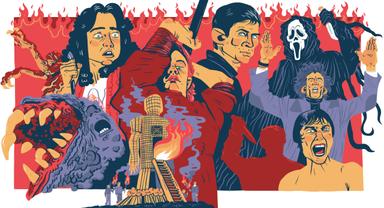
On one hand, Tuason’s methodical, gamified directorial approach fulfills its purpose: Undertone’s rhythms—and plot points and iconography—are very similar to those of its influences. The problem, beyond questions of derivativeness and familiarity, is that the film ends up stranded between the slick, carefully measured precision of Tuason’s filmmaking—all stealthy tracking shots and near-subliminal peekaboo reveals of wraiths reflected in mirrors or lurking in doorways—and an open-ended approach to narrative exposition and continuity that verges on messiness. It’s one thing for characters to be confused about their situation; it’s another to pile on obscure backstory and lore (including an Eastern European demon borrowed from 2012’s goofy studio B-movie throwaway The Possession) in an attempt to distract from the thinness (as opposed to lean-and-meanness) of a conceit.
Such issues are a matter of degree, though. If undertone were slightly tidier on a level of basic cause and effect and less shameless about its array of repetitive, enervating fake-outs, the story’s deeper implications about grief and guilt might resonate more effectively, the way they do in Ari Aster’s airtight (some might say airless) contraptions. If it were wilder—more determined to throw caution to the wind and to blow past its predecessors—it could exist as a weird, cultlike outlier, à la Skinamarink. That film was willing to plunge fully and perilously into visual and thematic abstraction—it was supremely creepy because its maker was unafraid of anything except compromise. Tuason is clearly talented and on target in terms of his subject matter. The setup of a haunted podcast should be enough to make his rookie effort a hit, especially in a moment when the majority of movie journalism has moved into the online space (he’s going to be booked on every horror movie podcast in existence). This is also, clearly, a moment when genre fans seem especially susceptible to savvy advertising. It’s clear that we want to be scared at the moment, and a movie like undertone plugs into our doomscrolling zeitgeist with aplomb; it’s a skillful exercise in ambient room-tone dread. But it’s not much more than that, which is to say it’ll do until the next supposedly scariest movie ever comes along and breaks the promise all over again. It’s one thing to believe in demons; what skeptics really need to beware of is a really good trailer.