
YouTube Face Has Infected the Internet
Spurred by the influence of MrBeast, YouTube Face has dominated the site’s thumbnails for years. Whatever works—by any means necessary.YouTube Face Has Infected the Internet
Spurred by the influence of MrBeast, YouTube Face has dominated the site’s thumbnails for years. Whatever works—by any means necessary.It was 2017, and Chucky Appleby, then 19 years old, was ready to retire. At first he was just another YouTube-obsessed teenager, and his Call of Duty–focused personal channel was actually making enough money for him to get by. But then he figured out a way to use the platform to do much more than that.
“I was like, ‘Why did my videos not get as many views?’” Appleby told me, calling from his home in Greenville, North Carolina. “I kind of realized that certain videos appeal to a large audience, and I was like, ‘Wait, I actually understand click-through rate and retention really well. What if I just created a passion-project channel that reached the largest audience possible?’”
Appleby kept expanding his thinking and soon started creating a variety of “faceless” channels—non-personality-based content designed to tap into preexisting markets. Think of it like video SEO: reverse-engineered content about subjects that already have substantial audiences who are looking for something to watch. Every video had a target goal of around 20 million views, and within a few months, Appleby said, the channels were generating “hundreds of thousands of dollars a month, consecutively.” Cresting the wave, he sold them all and started thinking about what he wanted to do now that money was no longer a concern. It was around this time that he began hanging out more with a new friend he’d been introduced to online named MrBeast.
In the late 2010s, MrBeast—a.k.a. Jimmy Donaldson—was a rapidly rising YouTube star, but nowhere near the world superpower he is today. He was then evolving past his early videos, which were often Dadaist stunts like counting to 100,000, and moving into a realm of capitalistic battle royales at a scale unlike anything else online. Sizing up the potential of MrBeast’s channel, Appleby saw one major flaw. “He would show me his thumbnails,” Appleby says, “and they would be horrible.”
Just for fun, Appleby offered to make Donaldson some thumbnails for free, taking the previously ramshackle MS Paint–looking images and revamping them with color and contrast. But perhaps most importantly, Appleby also started focusing the thumbnails around Donaldson’s face, usually in ridiculous and expressive form, like he had just seen something silly and unbelievable or just tried out his dad’s aftershave. Appleby didn’t know it at the time, but he was supercharging an entire visual genre of the internet—an undeniably effective and contagious one, but also one that would progressively become more loathed. He was the J. Robert Oppenheimer of YouTube Face.
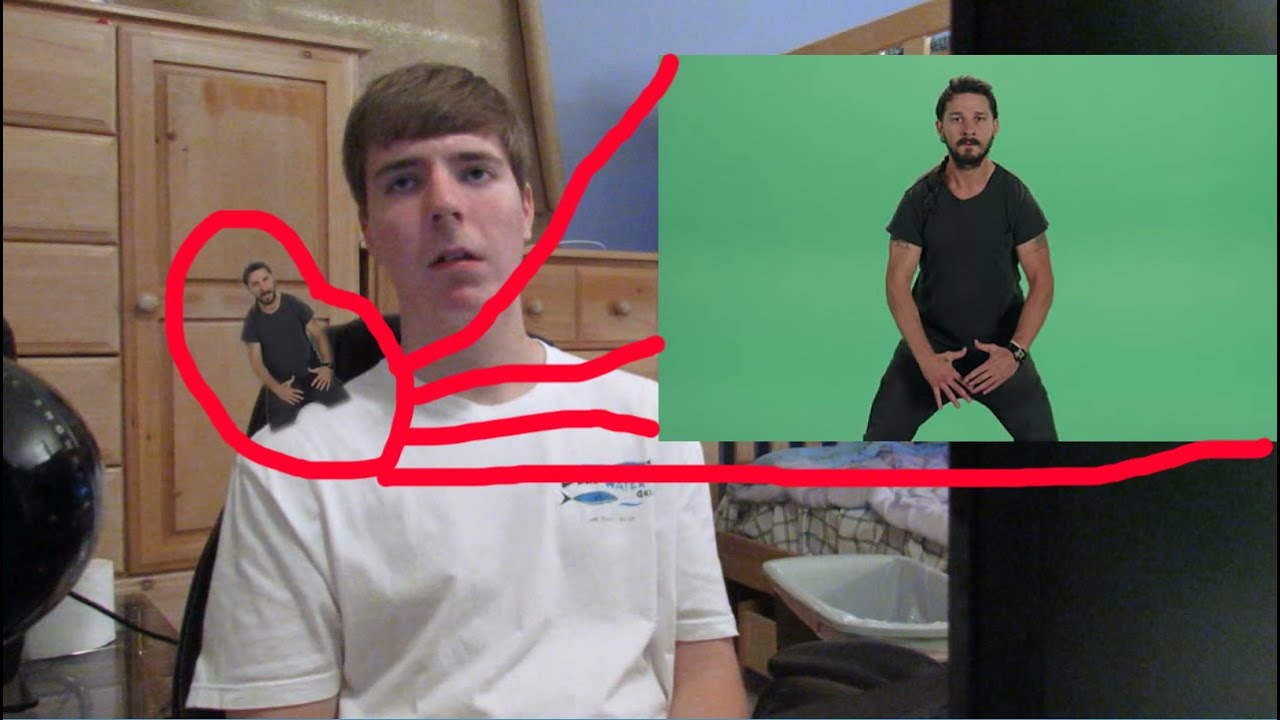
Appleby said that he first tried to teach Donaldson the dark arts of thumbnail creation but figured out around 2019 that his calling was in a more permanent capacity. “I was showing him literally how to use Photoshop and what matters in a thumbnail versus what doesn’t,” Appleby remembered, “and he was like, ‘Yeah, I wasn’t paying attention at all. Can you just do my thumbnails?’” Since then, Appleby, now 29, has been MrBeast’s designated thumbnail guy, in addition to specializing in making “banger titles” and helping the broader production team conceive and execute videos. (Appleby’s LinkedIn notes that he doesn’t have a formal title.) In 2023, he and Donaldson launched Viewstats, an online service that guides YouTube creators on their titles, thumbnails, and video ideas—to help them “know what will go viral before you hit record.”
The thumbnail is that billboard on the busiest highway you can imagine.Ryan Hall
What Appleby saw early on was that, as YouTube continued its cultural siege on the world, the competition would be increasingly stiff and viewer attention increasingly warred over. “The thumbnail is that billboard on the busiest highway you can imagine,” said Ryan Hall, a YouTube creator who made a video in 2022 looking into what was going on with “cringe” thumbnail faces. “Trying to stand out is really difficult in and of itself. You could make the best video ever, but if your packaging isn’t right, then it’s going to fail.” Thumbnails and titles, Hall told me, “are almost more important than the video itself.”
Hoping to understand what works in advertising has historically been a nebulous operation; a product’s billboards go up, for instance, and sales hopefully rise with them, but to what degree the two are correlated is impossible to formally determine. On the internet, however, that’s often not the case. What works on something like a video thumbnail is easily identified by click and retention rates, and platforms like YouTube provide tools to experiment with different titles and thumbnails in real time, algorithmically determining what works best almost as a proven fact. And in the case of many YouTube creators—particularly the personality-driven brands similar to MrBeast—the answer is that over-the-top thumbnail faces are the winner, regardless of whether you like what that says about humankind.
“The goal is always to get you into the content,” Appleby said. “And that’s what a lot of these companies realize: You don’t even know what you like.”
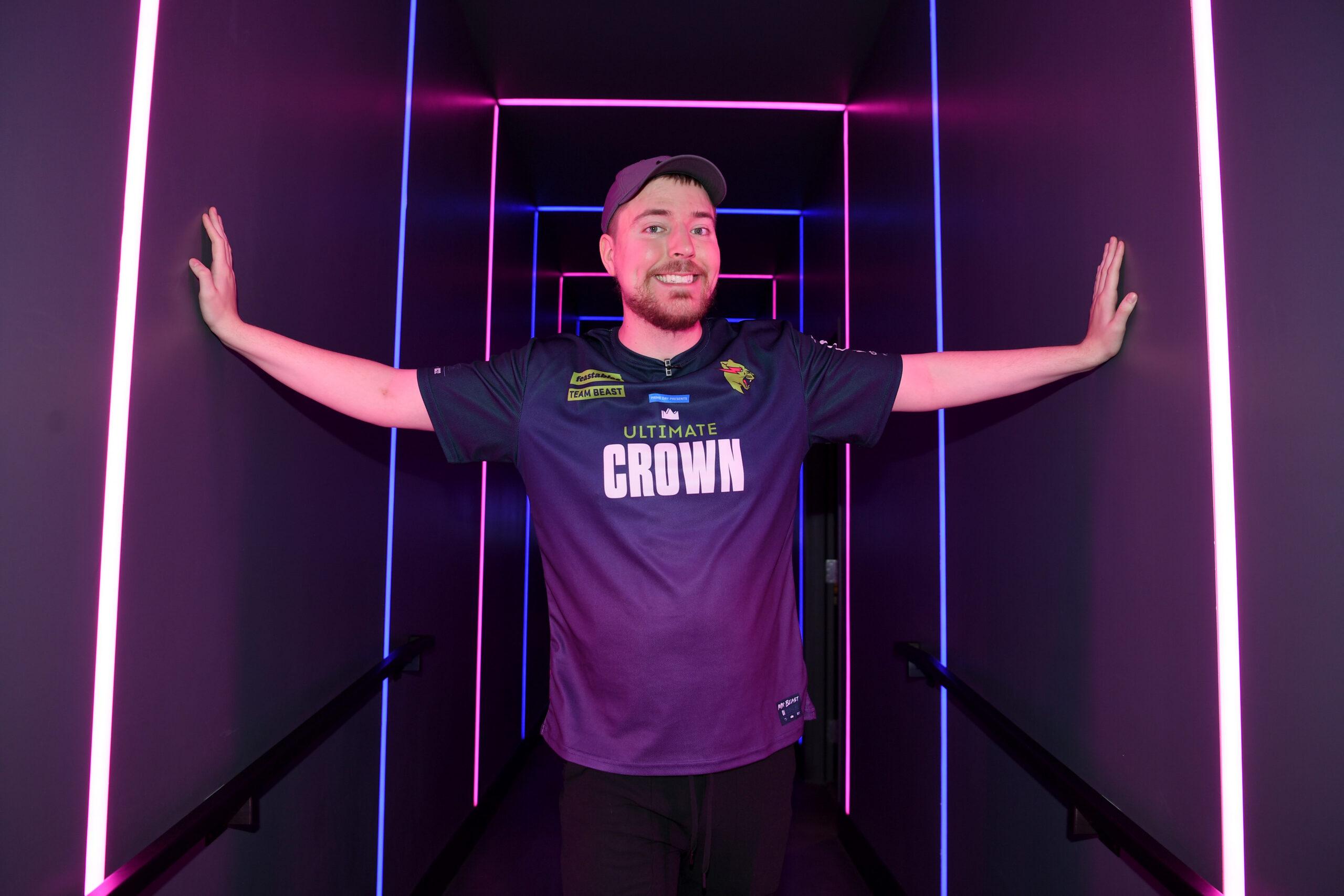
MrBeast at the “Ultimate Crown” gaming event
For the first few years after YouTube launched in 2005, thumbnails weren’t even a part of the equation. Random stills—some good, many bad—would be automatically assigned, and any effect they had would be purely guesswork. The ability to upload a custom thumbnail didn’t arrive until 2012, at which point creators began to slowly wrap their heads around the massive difference the tiny image could make for their channel’s relative performance.
“It was just very confusing back then because no one really strategized anything,” Appleby said. “So that was the first thing that we were obsessed with: How do we turn to strategy and just optimize—min/max, basically—every detail?”
With improved control, many YouTubers realized that it was helpful to feature themselves in the thumbnail—that some human instinct makes viewers more likely to connect to a face. “I was very shy when I started,” said Rene Ritchie, a longtime tech pundit and YouTube creator who now serves as YouTube’s head of editorial. “And it was hard for me to actually put my face on a video. But then I saw that when I did that, people engaged with it. They saw that, ‘Hey, there’s a human being here.’ There was some emotional resonance there. I think it’s why, over the course of history, magazines often will put a person on the cover, or a book will have the hero. There’s just something relatable in humans that we put up front to make that connection.”
Appleby picked up on this, too, and because thumbnails were often relegated to a small size on someone’s screen, he decided to boost Donaldson’s face in the frame as much as possible. “I also wanted to build up brand identity,” he added. “If you saw the MrBeast face, there was a trust factor, where it’s like, ‘Oh, I clicked on his video last week, and he did exactly what he said he was going to do in the title and thumbnail. This guy doesn’t mislead.’”
As for the arrival of the slack-jawed maws, one explanation lies with the surging popularity of reaction videos. For the most part, the genre is literally just people filming themselves reacting to any kind of footage you could imagine—Rage Against the Machine, marching band formations, Tom Hanks storming the beaches of Normandy in Saving Private Ryan—and extends outward toward channels that feature people simply trying all kinds of new things for the first time. In the 2010s, channels like SSSniperWolf and the Try Guys amassed billions of views by serving as hosts for a virtual peanut gallery; they consumed video games and food and other YouTube videos, and viewers vicariously and parasocially consumed along with them.
Reaction channels have a lineage in midcentury television shows like Candid Camera, which usually featured clips of people watching the pranks, and in Japanese game shows’ use of the “waipu box”—a superimposed image of someone reacting to other videos at the same time that the audience watches them. Some laugh track–related social impulse makes audiences enjoy sharing the experience of watching a piece of media—and, naturally, big emotions with big expressions have the biggest resonance. (This is probably related to the fact that people who make expressive faces tend to be viewed as more likable overall; a 2025 study in Scientific American about the psychology of the principle explained that “someone who is easier to read may seem to be a more appealing prospect than someone who is more guarded.”)
It was hard for me to actually put my face on a video. But then I saw that when I did that, people engaged with it. They saw that, “Hey, there’s a human being here.”Rene Ritchie
What the YouTube reactionists often added—and then prominently advertised in their bombastic thumbnails—was the promise of a digitally native, post-Jackass type of dangerousness or recklessness. In a 2018 piece for Open Space, the writer Joe Veix noted that these widely prevalent mischievous thumbnail faces were “perhaps manipulating some kind of primal feeling of empathy or morbid curiosity in the pain of others.”
Eventually, the Thumbnail Face method began leaking into many realms of YouTube, and it became MrBeast’s calling card right as his channel exploded in popularity. When Appleby started making MrBeast’s thumbnails in 2019, the channel had roughly 14 million subscribers. By November 2022, it had 112 million, making MrBeast the most-subscribed-to individual YouTuber. For Donaldson and others, the absurd thumbnail faces were clearly a potent ingredient for success.
“I think what it does for me is it’s kind of a counterculture move, in a sense,” said James Verdesoto, a creative director and artist who designed the posters for Pulp Fiction and Ocean’s Eleven, among many others. “Because you expect everything to be pretty. You expect everything to look composed. … It creates an energy force that I think people respond to—they’re kind of invited to the party, right? A goofy host is always a fun host.”
As with most popular elements of counterculture, though, there’s an inevitable pushback when it goes mainstream. Driven by MrBeast, YouTube Face became predominant to the point that it evolved into a source of obvious irritation for video creators and viewers alike. “It’s the most bizarre thing in the world when you’re sitting at home and just taking pictures of yourself, pulling various faces,” said Hall. “If you look at the comments in the video as well, people hated it.”
Appleby has fine-tuned MrBeast’s expressions over the years; exhaustive A/B testing—using software to simultaneously deploy different titles and thumbnails and see which one works best—eventually brought him and the channel’s team to the dramatic conclusion in 2023 that it was advantageous to start closing Donaldson’s mouth. “Every A/B test, less cringe expression won,” Donaldson said in an interview after the shift. “I was like, ‘I need to go fix that!’ It’s kind of funny, because once I started closing my mouth and smiling and making it a little less cringe, a lot of other creators started switching over, and I was like, ‘Oh, I probably should’ve done that sooner.’”
Even so, Appleby seems aware that he unleashed some kind of monster that remains out there, rampaging across the digital landscape. “The smiling, open-mouth face … was fine in the beginning,” Appleby said. “But then when we used it so much, people kind of got sick of it, and then everybody copied it, too. Another thing to consider is, like, when we do something, people tend to try to do it as well because they think that might be successful.” This is part of what people refer to as the “Beastification of YouTube,” Appleby pointed out. “I think that also created a lot of negative publicity.”
A common perception online is that YouTube Face is a form of clickbait—but that depends on your definition of the term. Clickbait is probably best understood as an image or headline designed to generate mindless traffic for unsatisfying, cheap content. It doesn’t matter what’s there once you click; what matters is only that you clicked at all. YouTube, on the other hand, insists that its A/B software isn’t designed to favor content that solely gets people to click, but rather to prop up videos that people stick with and watch.
“Someone could make a thumbnail that gets a lot of clicks, but the video doesn’t back it up and people will feel burned and drop out quickly,” said Ritchie, YouTube’s head of editorial. “And we don’t want to incentivize that. So the thumbnail that makes the best promise that the video then delivers on is the one that we measure as the winner for you. … We don’t want people to sabotage themselves. We want to give them tools that really help their videos and their channels grow.”
It’s easiest to dismiss YouTube Face as a symptom oozing out of a bottom-feeder level of the internet or as the opiate of a largely young demographic of viewers—and perhaps those explanations cover some of the overall dissonance between many viewers’ opinion of it and its ascendance. But trashy clickbait doesn’t generate significant media personalities, and children don’t control enough of the platform to dictate its aesthetics. A more telling explanation lies within YouTube’s goal to figure out what works, for the most possible viewers, in the long term, beyond a shadow of a doubt.
“You are dealing with statistics,” said Ritchie. “And the system is intentionally built to get you to a point of statistical certainty.”
Jess Maddox has a doctorate in media studies, but she often has to work overtime to explain why she focuses on the internet and social media as a professor at the University of Georgia. “Even though I’m a tenured professor,” she told me, “other academics still look at me like, ‘What do you do?’”
Part of the surprise that some people might have in hearing about Maddox’s work is no doubt due to the relatively short amount of time that’s passed since the dawn of the internet; meeting her would be akin to meeting a professor of photography in the late 19th century. But part of it could also be self-preservational blinders, which we put up to avoid facing how much of a troubling influence new creations like YouTube already have on our lives. “I think there’s still some belief, even on some subconscious level of a lot of people, that social media is not as real as quote, unquote ‘real life,’” she said. “If we had to admit that social media was real and the things we do online have real implications, I think a lot of people would not like what is reflected.”
What people make on YouTube exists somewhere on the continuum of art, however high or low that may be. And the growing crop of “serious” filmmakers who have emerged from the platform hints that you underestimate influencers and creators at your own peril. Not long ago, Danny and Michael Philippou, as RackaRacka, were making stunt YouTube videos about driving underwater cars and selling porn star Riley Reid’s bathwater. Now they’re celebrating back-to-back horror film smashes, 2022’s Talk to Me and 2025’s Bring Her Back. Four years ago, Mark “Markiplier” Fischbach was doing “Try Not to Laugh Challenge” videos. Now he’s one of Hollywood’s stories of the year after he mobilized his fans to request that theaters play his feature-film debut, Iron Lung, which ultimately made over $50 million worldwide.
“At the end of the day, YouTube is just a platform,” Orr Piamenta, known as Pinely on YouTube, wrote to me in an email. “So whether a YouTuber is posting art or something that is just content mainly depends on their intention. Creators like Joel Haver and Bobby Fingers are artists in my eyes. They’re filmmakers.”
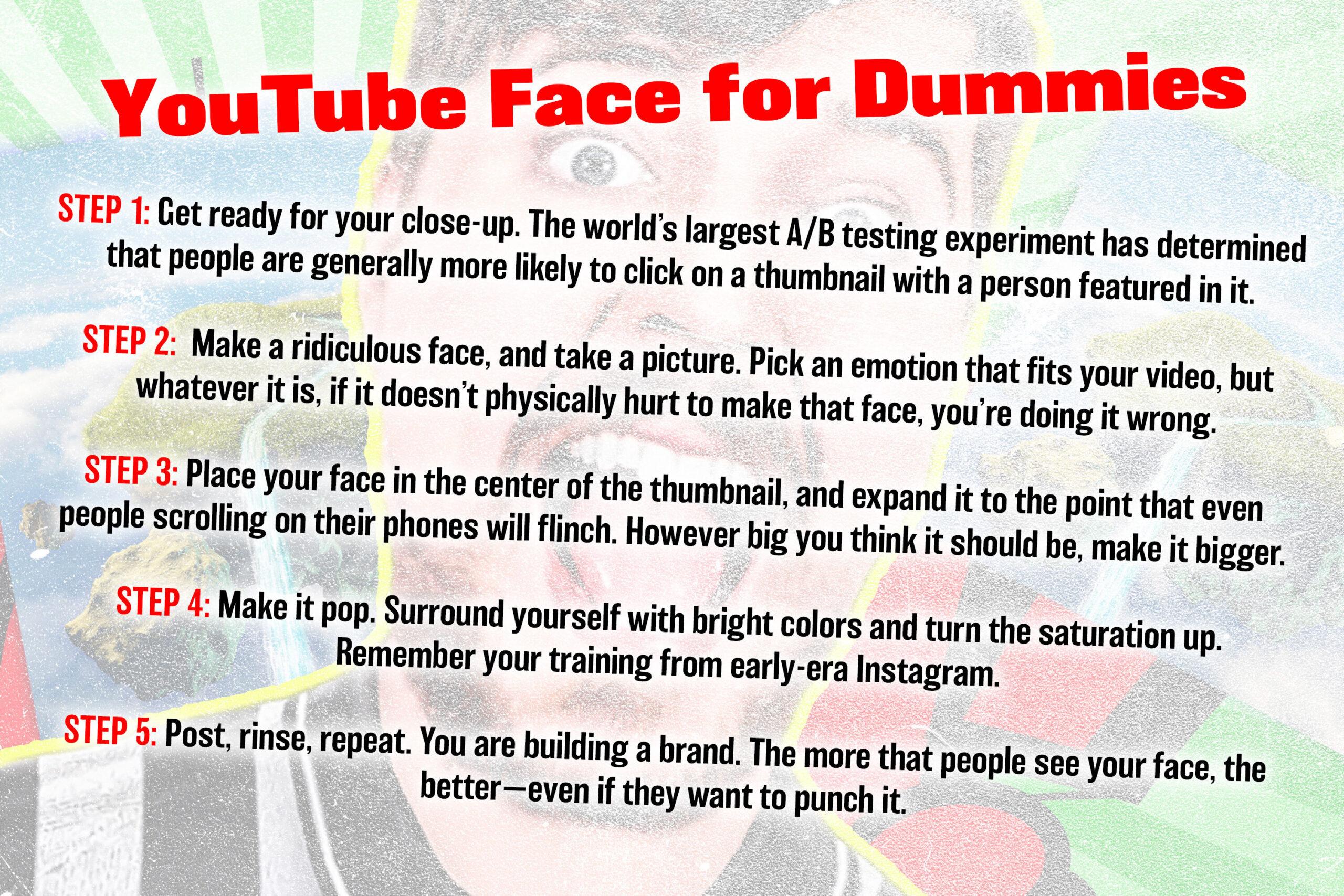
But there’s still something different about YouTube content. Even a studio-funded movie, for instance, is produced as a broad swing its makers hope to monetize in a variety of ways, many of them difficult to predict or define. YouTube, on the other hand, exists within a realm of instant, perpetual optimization. Appleby referred to making YouTube videos as a “strategic art” in which there’s “way more critical thinking involved than just being like, ‘Oh, I’m just gonna paint something.’”
Thumbnails are only one facet of a YouTube video, but the way they’ve been algorithmically gamified is revealing in terms of how the platform works and the way it makes creators behave. Hall, the creator who analyzed thumbnail faces, noted that MrBeast “kind of mainstreamed using formulas” on YouTube. “He always talks about the data when he’s talking about his videos,” Hall said. “And when he does something, I think people pay attention.”
MrBeast didn’t invent making funny faces on the internet, but his influence helped push YouTube Face to become second nature all over the site, widely imitated to the point that not imitating it is itself a liability. “Thumbnails used to be more varied,” said Piamenta, “but YouTube nowadays really rewards playing it safe, so seemingly, what would be safer than copying the biggest YouTuber in the world?”
Maddox, the social media professor, referred to this kind of machine-trained content as presenting a chicken or the egg scenario. “Do people like it and the algorithm noticed and started pushing it more?” she wondered. “Or did the algorithm start pushing a bunch of stuff and people liked it and now we’re in that feedback?”
Hall, who used to make content for Veed, a video-editing software, described the Sisyphean effort to be successful on YouTube as one that puts you at risk of having the creative control taken out of your hands: “You naturally get pigeonholed,” he said, “and the algorithm tells you what sort of content you should be making.” Last year, Hall joined the artificial intelligence company Synthesia, which offers to turn text into “studio-quality videos with AI avatars and voiceovers in 160+ languages.” The company was recently valued at $4 billion.
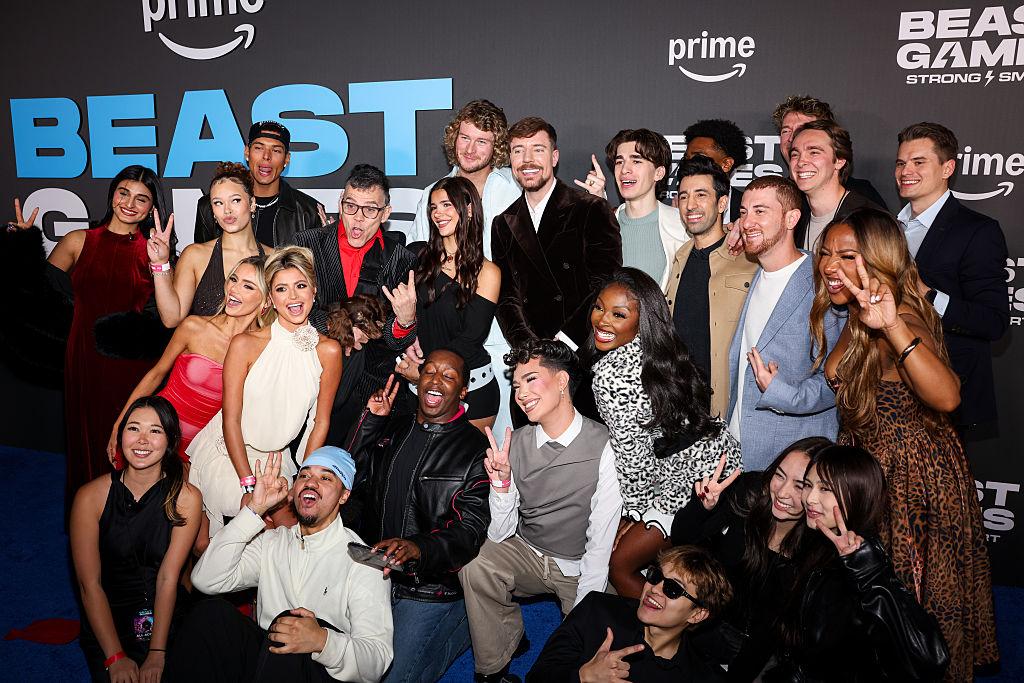
MrBeast and a bevy of other YouTubers and influencers at the Season 2 premiere of ‘Beast Games’
Several people I spoke to for this story seemed to think that YouTube Face was on the decline—a soon-to-be relic of a specific era of the internet. The rebuttal to this belief is: Look around you. MrBeast recently brought YouTube Face to mainstream media with Beast Games, his Amazon Prime reality show, and it’s reasonable to doubt any significant decrease of its omnipresence anytime soon. But for any YouTubers, big or small, modification tools aren’t a requirement. If they would prefer not to be overly dramatic in their thumbnails, they’re always welcome to do their own thing. You can still counter the counterculture.
“I think we’ve done some internal research and not found faces to be that important,” said Derek Muller, whose science-focused channel, Veritasium, has been a mainstay of highbrow YouTube since 2011. “I don’t know what that says about my face. I know it works wonders for other YouTubers, and people love making those crazy faces. Personally, of course, I don’t love making those crazy faces. I don’t think it expresses the quality or style of the channel that we’re trying to put forth, so I think stylistically it’s just a bad fit for us.”
With 20 million subscribers, Veritasium is proof that a channel can do just fine without relying on engagement-farming tricks like YouTube Face. And if anything, the biggest opportunities going forward may lie with those brave enough to try something original. Verdesoto, the movie poster artist, noted that his Ocean’s Eleven poster was, appropriately enough for a movie about a casino heist, a gamble made by the studio: “The biggest stars in the world,” he noted, “and we only showed their feet.” Obviously, that tradition-bucking approach worked just fine, and a beloved franchise was reborn. There are risks in trying to stand out, but there are also risks in blindly defaulting to routine.

Don’t copy us. The person who ends up being the quote, unquote “next MrBeast” is going to be doing something totally different.Chucky Appleby
Still, YouTube wields tremendous influence on its own videos, and without an active effort to prioritize creative thinking, the platform risks becoming a snake that eats its own tail. “Even with my more lighthearted videos, I really try my best to make something that adds some value to someone’s day,” said Piamenta, who made a video in 2022 about the perils of Beastification. “I think YouTube’s responsibility is to find new ways to encourage that sort of content. I truly believe that experimentation benefits them. It’s what keeps it as an interesting, growing platform.” Piamenta has over a half million subscribers, but he’s talked about quitting YouTube when he turns 27 later this year, citing burnout. Lately, he’s been focusing on directing music videos.
Appleby’s advice for others is pretty simple: “Don’t copy us,” he said. “The person who ends up being the quote, unquote ‘next MrBeast’ is going to be doing something totally different.” When it comes to his current job, though, he knows what works, and he reminds himself of that every time he makes a thumbnail. “Could a grandma understand this? Could a kid understand this?” he said. “Our goal is to be able to get everybody, a whole family, to sit down—very different types of people—and then say, ‘Yeah, let’s all watch this.’”