
The first big domino of the 2026 NFL offseason has fallen. The Cardinals reportedly informed Kyler Murray on Tuesday that he’ll be released before the start of the new league year on March 11, adding the 28-year-old to this year’s free agency class. It’s a big addition to what was previously seen as a weak group at the top. Murray is just four seasons removed from inking a five-year, $230.5 million contract in Arizona, and this time last year, he was coming off a top-10 season by QBR.
The Cardinals are giving Murray up for nothing. If they designate him as a June 1 cut, the team will save about $5 million in cap space but won’t have access to those savings until the summer. If he’s a pre–June 1 cut, the Cardinals will lose $2 million in 2026 cap space. So either way, this move won’t improve the team’s financial flexibility over the next few months. Since Murray is being released, he won’t count toward the team’s compensatory draft pick formula, either. And Arizona will still owe the QB $36.8 million guaranteed for 2026.
Based on all of that, you’d think that Murray must be some irredeemable slouch, but, again, he’s just one season removed from a top-10 year despite playing in a flawed Cardinals offense. Arizona isn’t dropping him due to a lack of talent; it's getting rid of him because he’s always injured. He’s started a full slate of games just three times in seven career seasons—and he’s done it only once (in 2024) in the past five. Since signing his big extension in 2022, Murray has taken 1,543 dropbacks. Twenty other quarterbacks have taken more, including Aaron Rodgers, a man in his 40s who has a surgically repaired Achilles. Murray tried to play through a hamstring strain in 2022 and ended up missing two games. In his second game back, he tore his ACL, which kept him out until midseason the following year. In both years, Murray finished outside the top 18 in QBR. If he had played enough games to qualify in 2025, he would have finished outside the top 20 again.
Even when Murray’s been healthy in recent seasons, his statistical results have been middling. But they look a lot better when held up against Arizona’s results when he wasn’t on the field. The Cardinals were just 16-25 in his starts since 2022, but they went an abysmal 3-24 in the starts he missed.
The Cardinals With and Without Murray, Since 2022 (TruMedia)
Murray isn’t a top-10 quarterback, someone who’s capable of elevating a suspect roster and dragging it to wins. But he’s firmly in the group that’s just outside the top 10. That group is made up of quarterbacks who can give a solidly built team top-10-level production—and the rankings of passers in that middle tier are almost always based on team success. The Cardinals haven’t won many games, so Murray’s stock has plummeted. But he’s still an above-average starter with an expansive (albeit unique) skill set who is reaching free agency. That nearly never happens! Arizona may have wanted out of the Kyler Murray business, but more than a few teams will be vying for his signature when free agency starts next Wednesday.
The Vikings, Jets, and Dolphins have been linked with every available quarterback this offseason. The Falcons can be added to that list, with Kirk Cousins on his way out of Atlanta and Michael Penix Jr. recovering from a significant knee injury. And the Steelers could be a fifth team that’s in the market for a new starting quarterback if Rodgers finally decides to retire and disappear from public life like he promised.
Murray could land anywhere, but it would be shocking if he doesn’t sign with one of those five teams. So let’s go one by one and look at how well the soon-to-be free agent could pair with each team. For each of the potential landing spots, we’ll look at whether the franchise has the cap space to add him, how Murray fits the team’s competitive timeline, and how he’d work in the coach’s preferred offense.


Miami Dolphins
Can they afford to sign him?
Even with the salary cap rising by over $20 million this year and Murray likely playing on the veteran minimum, this is still a no for the Dolphins, who are currently about $1.7 million over the cap. While they’ll clear out more space by releasing Bradley Chubb and potentially Tua Tagovailoa, among others, that’ll be just enough to sign the few young foundational players on their roster to extensions, pay their rookie class, and round out the roster with inexpensive free agents. After purging the roster of several overpaid vets, the new front office will be working around absurd amounts of dead cap, so it will be an offseason of austerity for the Dolphins. That probably takes them out of the running for Murray, who will likely pull in the highest annual salary of any free agent this offseason.
Does he make sense for Miami’s competitive timeline?
Even if the Dolphins could sign Murray, that doesn’t mean they’d want to. First-year general manager Jon-Eric Sullivan is coming over from Green Bay’s front office, which has used a draft-and-develop approach at quarterback. If Miami is even looking for a starter this offseason—which is an “if” with Tagovailoa still on the roster—it should be one with a longer developmental runway, like Malik Willis, and not an expensive short-term solution, like Murray.
Is he a fit for the offense?
Let’s make it a clean 0-for-3. The Dolphins can’t afford Murray, he doesn’t fit their timeline, and he’d be a poor fit in the offense, since former Texans offensive coordinator Bobby Slowik is bringing his pared-down version of Kyle Shanahan’s offense to Miami.
New York Jets
Can they afford to sign him?
The Jets have more cap room ($74.3 million) than any team on this list, so they could afford to make a multiyear commitment to Murray. Whether Murray would want to sign such a long-term deal now is another matter. His stock has never been lower, but he’d be in line for another big payday if he has one bounce-back season. Given the state of the Jets, a team known for derailing quarterbacks’ careers, they’d likely have to pay a premium to convince Murray to sign. The allure of playing in a big market like New York isn’t as strong as it once was.
Does he make sense for New York’s competitive timeline?
That’s a tricky question. Head coach Aaron Glenn’s seat is already heating up after a brutal first year in New York, and the 2026 offseason is off to a poor start after cameras appeared to catch him dozing off while taking in combine drills last week. Glenn already seems to be working on borrowed time, and he’ll need to start winning games soon to earn some job security. Adding Murray would be his best avenue toward making that happen. But Glenn’s timeline is likely very different from that of general manager Darren Mougey, who will likely get another crack at hiring a head coach if Glenn does flame out sooner rather than later. Signing Murray this offseason would raise expectations for the rest of the roster and speed Mougey’s timeline up unnecessarily.
Is he a fit for the offense?
After firing a young, inexperienced offensive coordinator in Tanner Engstrand, Glenn went in the other direction this offseason by bringing in former Colts and Panthers head coach Frank Reich to call the offense. In theory, Reich’s offense, which is built around spread formations and run-pass options, would be a solid fit for a quarterback like Murray. But Reich struggled to adapt his scheme for Bryce Young, a shorter quarterback who prefers to work outside the numbers and whose strengths and weaknesses are similar to Murray’s. Would Reich want to work with another sub-6-foot passer in what could be his last shot at running an NFL offense? Would Murray want to risk his last chance to prove he’s a good starter by working with a play caller who already failed with Young? This looks like an awkward fit all around.


Atlanta Falcons
Can they afford to sign him?
Yes. They have just over $8 million in cap space, so they can technically afford Murray, who won’t be looking for a lot of money this season. But the Falcons are already paying Penix a decent chunk, and releasing Cousins will stick them with a $35 million dead cap charge. The Falcons are in desperate need of help at the position, but a low-cost bridge quarterback would make the most sense.
Does he make sense for Atlanta’s competitive timeline?
The Falcons were just a tiebreaker away from hosting a playoff game this past season, and they have enough talent on both sides of the ball to justify a win-now move (especially since the franchise hasn’t made the postseason since Matt Ryan and Julio Jones were in their primes). If the goal is to end that drought in Kevin Stefanski’s first season as head coach, Murray makes a lot of sense. The Falcons could run away with the weak NFC South if they have competent quarterback play.
Is he a fit for the offense?
This is where things start to fall apart. Murray proved to be an odd fit in Drew Petzing’s offense in Arizona, and that system’s awfully similar to what he’d be running in Atlanta. Petzing worked under Stefanski in both Minnesota and Cleveland before getting the Cardinals OC job. And given how things ended with Murray and Petzing in Arizona, it’s difficult to see the quarterback being interested in working in that offensive environment again. The feeling is probably mutual from Stefanski’s perspective.

Minnesota Vikings
Can they afford to sign him?
At first glance, you’d think that the answer is no. Minnesota’s current cap situation is even more dire than Miami’s, but the Vikings have a lot more wiggle room, with a few veterans who could be cut for major savings and others with contracts that can be restructured. And in contrast to Miami, it would make sense for a team as talented as the Vikings to make room for a win-now option like Murray.
Does he make sense for Minnesota’s competitive timeline?
This team is just a season removed from winning 14 games and playing for playoff home-field advantage in its regular-season finale. Ownership just fired general manager Kwesi Adofo-Mensah after a 9-8 season, so expectations are obviously high. Kevin O’Connell is feeling real pressure to win for the first time since taking over the head coaching job, and the team isn’t hiding the fact that it wants to bring in a veteran starter to take QB duties away from J.J. McCarthy. Interim GM Rob Brzezinski will also need a strong season if he wants to lock down the full-time job. The Vikings desperately want to win now, and they know that improving the quarterback room is a must. Murray is the clearest upgrade among the available options.
Is he a fit for the offense?
The thought of Murray slinging deep balls to Justin Jefferson and Jordan Addison, with O’Connell calling the plays, is tantalizing in theory. But in practice, it would be another awkward fit for a quarterback who (a) prefers to work out of the shotgun and (b) doesn’t throw over the middle of the field very often. O’Connell’s ideal offense would operate from under center on early downs and requires a quarterback who’s willing to throw intermediate and deep in-breakers. Here’s a side-by-side comparison of the Vikings’ passing heat map from last season and Murray’s from the past five seasons, via TruMedia. It’s not difficult to spot the big difference, but I’ve circled it for you anyway.
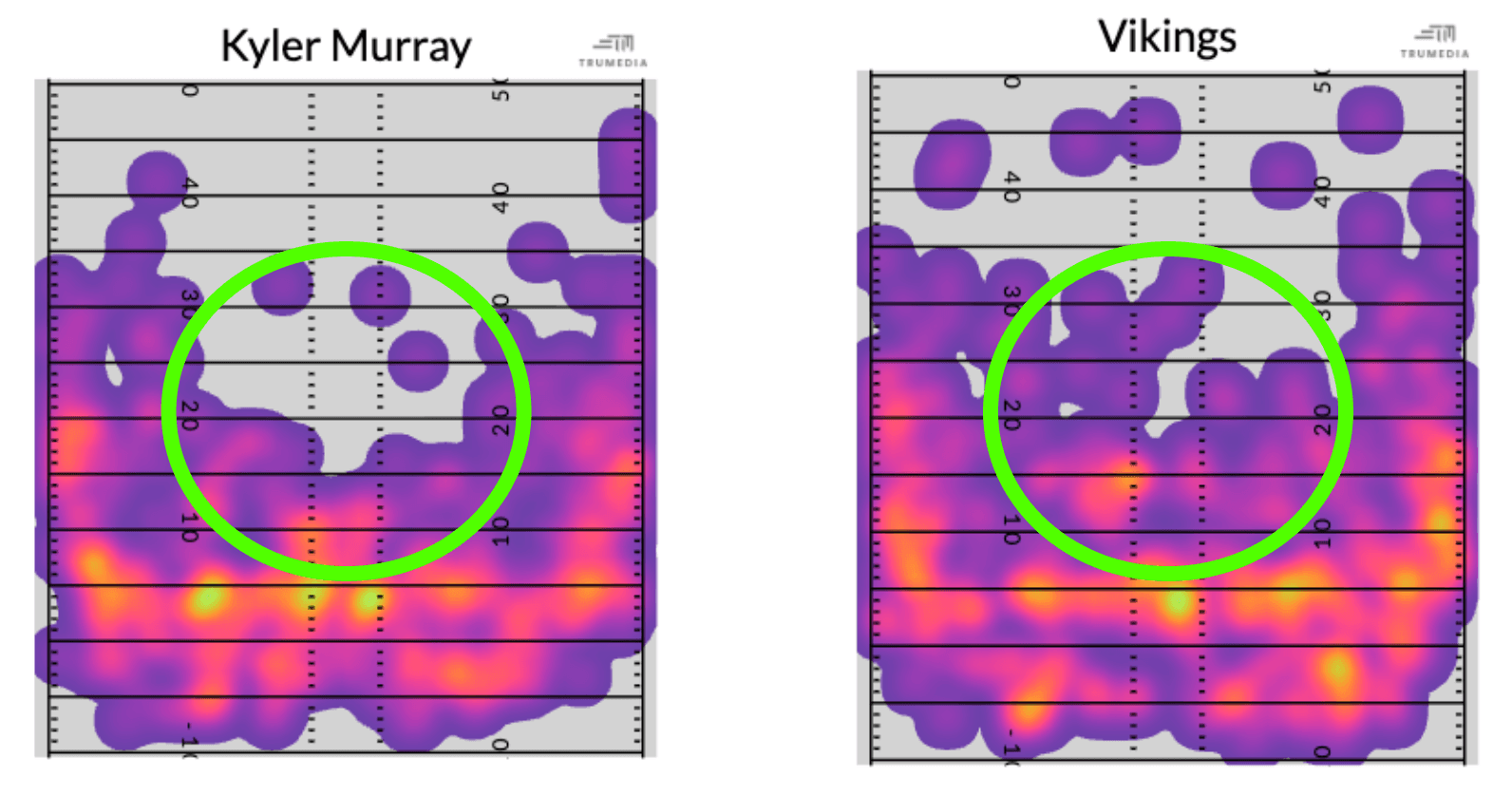
O’Connell runs a version of Sean McVay’s offense, and Mike LaFleur, who’s coming over from McVay’s staff to coach the Cardinals, just let us know how his staff views Murray’s fit in that scheme. It’s hard to imagine O’Connell watching Murray’s film, seeing all the examples of him turning down open receivers running over the middle of the field, and still thinking that this pairing would work.
The Vikings coach is good at his job and would likely adapt the offense to make Murray comfortable. But that doesn’t mean he’d want to do it after already running pared-down versions of the scheme with Sam Darnold and McCarthy these past few seasons. With more traditional pocket passers—like Geno Smith or Cousins—on the market, O’Connell will have more attractive options.
Pittsburgh Steelers
Can they afford to sign him?
For a team that’s saddled with several overpaid veterans, Pittsburgh’s cap situation is surprisingly good. The Steelers are set to enter the offseason with over $40 million in cap space, so paying Murray wouldn’t be an issue. It’s just unclear whether the Steelers would have space for him on the depth chart with Rodgers contemplating a return—and the front office open to the idea.
Does he make sense for Pittsburgh’s competitive timeline?
Ownership just let Mike Tomlin, a Hall of Fame coach who’d never posted a losing record, walk away after leading the team to a divisional title. Then they replaced him with 62-year-old Mike McCarthy. You don’t bring McCarthy in to lead a rebuild. As delusional as the aspiration may be, the Steelers expect to win now. A healthy and productive Murray would give them the best chance to compete in 2026.
Is he a fit for the offense?
From a schematic standpoint, this is easily the best fit for Murray. And at this point, he might be a better fit for McCarthy’s West Coast offense than even Rodgers, who won a Super Bowl and a pair of MVP awards when he was playing under the new Steelers coach. Murray’s and Rodgers’s schematic preferences are closely aligned. Both quarterbacks prefer to be in the gun. Both are at their best when working quick-game concepts or making vertical throws to the perimeter. And both seem to have an allergy to throwing over the middle of the field. At his peak, Rodgers was a much better version of this archetype. But in their current states, Murray is better—mostly thanks to his athleticism and ability to create out of structure. Murray right now is essentially a worse version of Rodgers at his best and a much better version of Rodgers in his 40s. If Murray is interested in joining the AFC North champs, the Steelers should make Rodgers’s decision for him and send him off into retirement.