Scrubbing Back In
Zach Braff, Donald Faison, Sarah Chalke, and Bill Lawrence have revived the hit 2000s sitcom ‘Scrubs,’ with a keen eye on resuscitating the vibes of the early seasonsScrubbing Back In
Zach Braff, Donald Faison, Sarah Chalke, and Bill Lawrence have revived the hit 2000s sitcom ‘Scrubs,’ with a keen eye on resuscitating the vibes of the early seasons
It’s been 16 years since she last heard it. Sarah Chalke thought she was finally free of the sound forever.
She was wrong.
During the original run of the hospital comedy Scrubs, Chalke found herself frequently tormented by costars Zach Braff and Donald Faison. The duo, who had developed a friendship not dissimilar to the bromance of their young doctor characters, J.D. and Turk, had a sort of high-pitched whine that they would harmonize on, just to mess with her.
“There was a specific sound Zach and Donald would make,” Chalke recalls, “and if it was late enough at night, I just couldn’t keep it together.”
“We would do it so quietly that only Sarah could hear it,” says Braff, after he and Faison have re-created the sound on a Zoom with Chalke. “It would always make her crack up, and then we'd be like, ‘Sarah, hold it together! Everyone's fucking tired. Come on.’"
When Braff, Faison, Chalke, and many of their former colleagues got back together for a Scrubs revival, which debuts on February 25 on ABC, Chalke—back in her white lab coat as Elliot—found herself living through this high-pitched hell all over again. “You'd think some things would be different,” she says, shaking her head. “You would not believe how much of it is the same.”
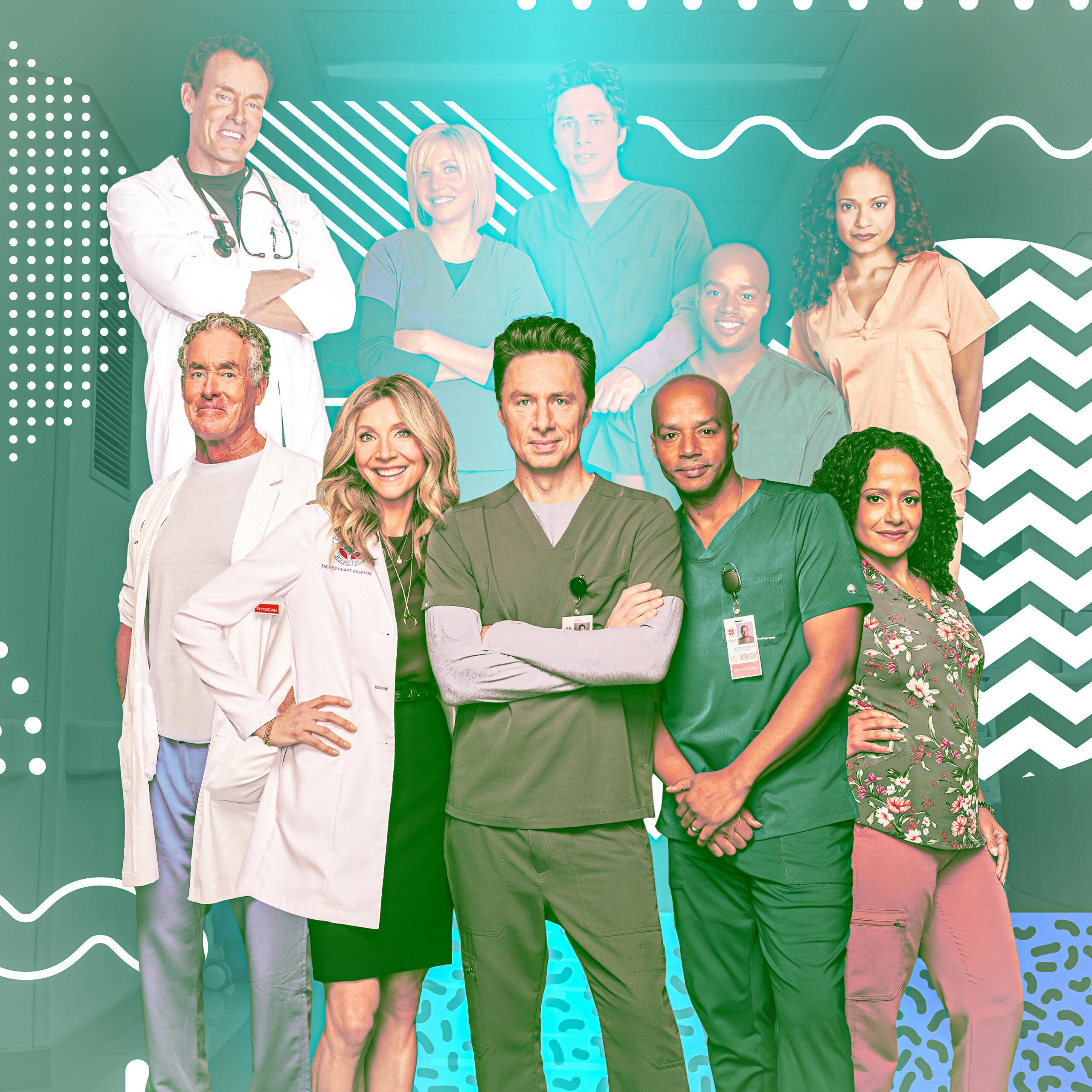
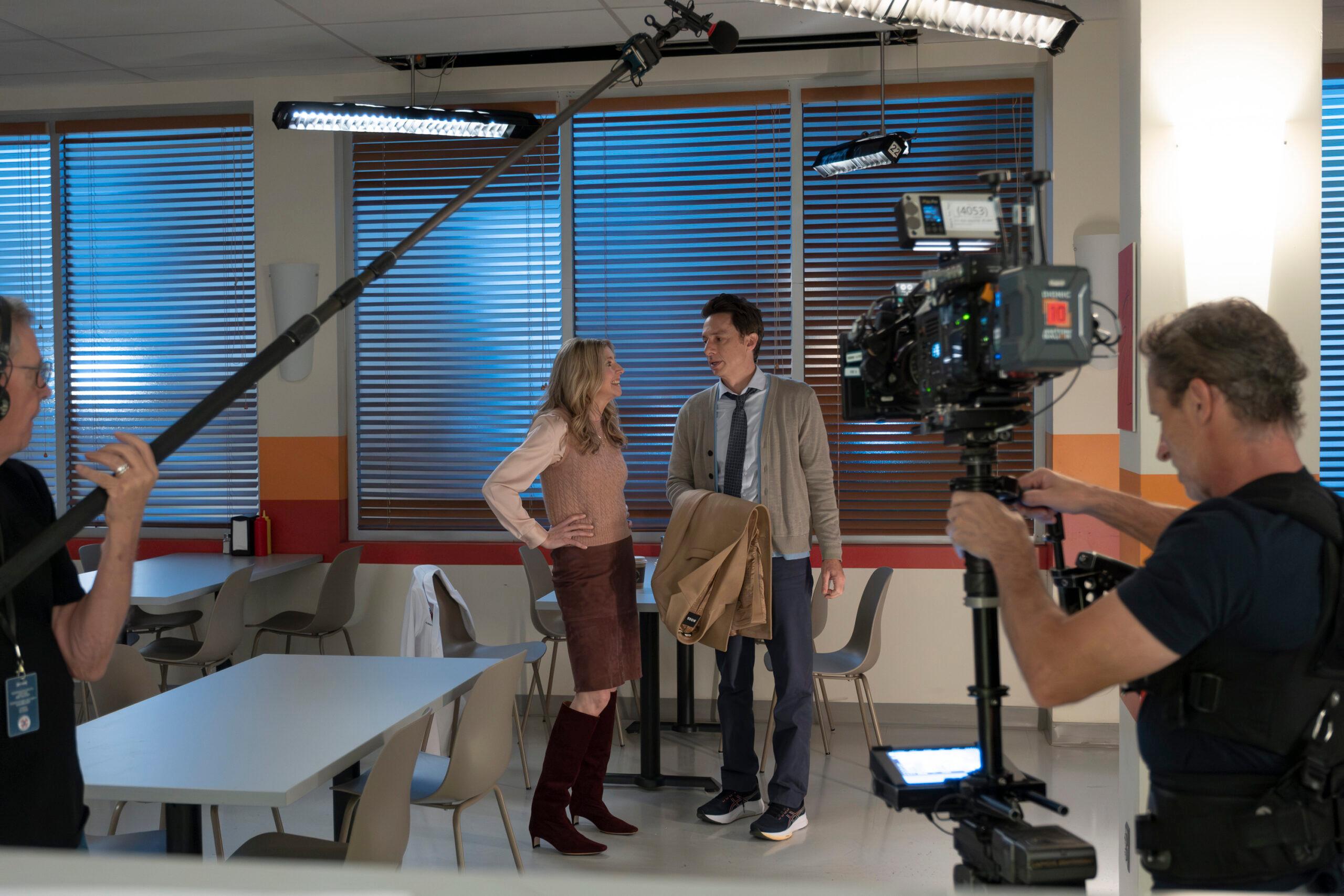
This has proved to be a theme for the Scrubs revival, which has been talked about in one form or another since the last season aired in 2010. Braff, Faison, and Chalke are back, with J.D., Turk, and Elliot now acting as mentors to a new generation of doctors. Scrubs creator Bill Lawrence is back producing, although, since he’s currently managing so many different projects, fellow Scrubs veteran Aseem Batra is the hands-on showrunner. Judy Reyes (as Carla, a veteran nurse and Turk’s wife) and John C. McGinley (as sarcastic veteran Dr. Cox) have other TV jobs, but they’ve come back to put in part-time shifts. And although production has moved from a decommissioned hospital in North Hollywood to a Vancouver TV studio, the new set was built using the old one’s blueprints. “From the feel of the paint to the tiles on the floor, it's an exact replica of where we were for the better part of eight years,” says McGinley.
Almost from the minute the original series ended, both Scrubs fans and the people who worked on the show started talking about bringing it back, but the moment has never been riper than now. Revival and reboot fever has gripped the TV business for the past decade, and a hospital show—even one that was originally about kids who had just become doctors five minutes before—lends itself to being revived more than, say, Gilmore Girls or Sex and the City.
“Anytime Donald and I would run into fans or anytime we would do a panel,” says Braff, “they would ask, ‘When are you gonna do a reboot?’ There’s always been chatter about it.”
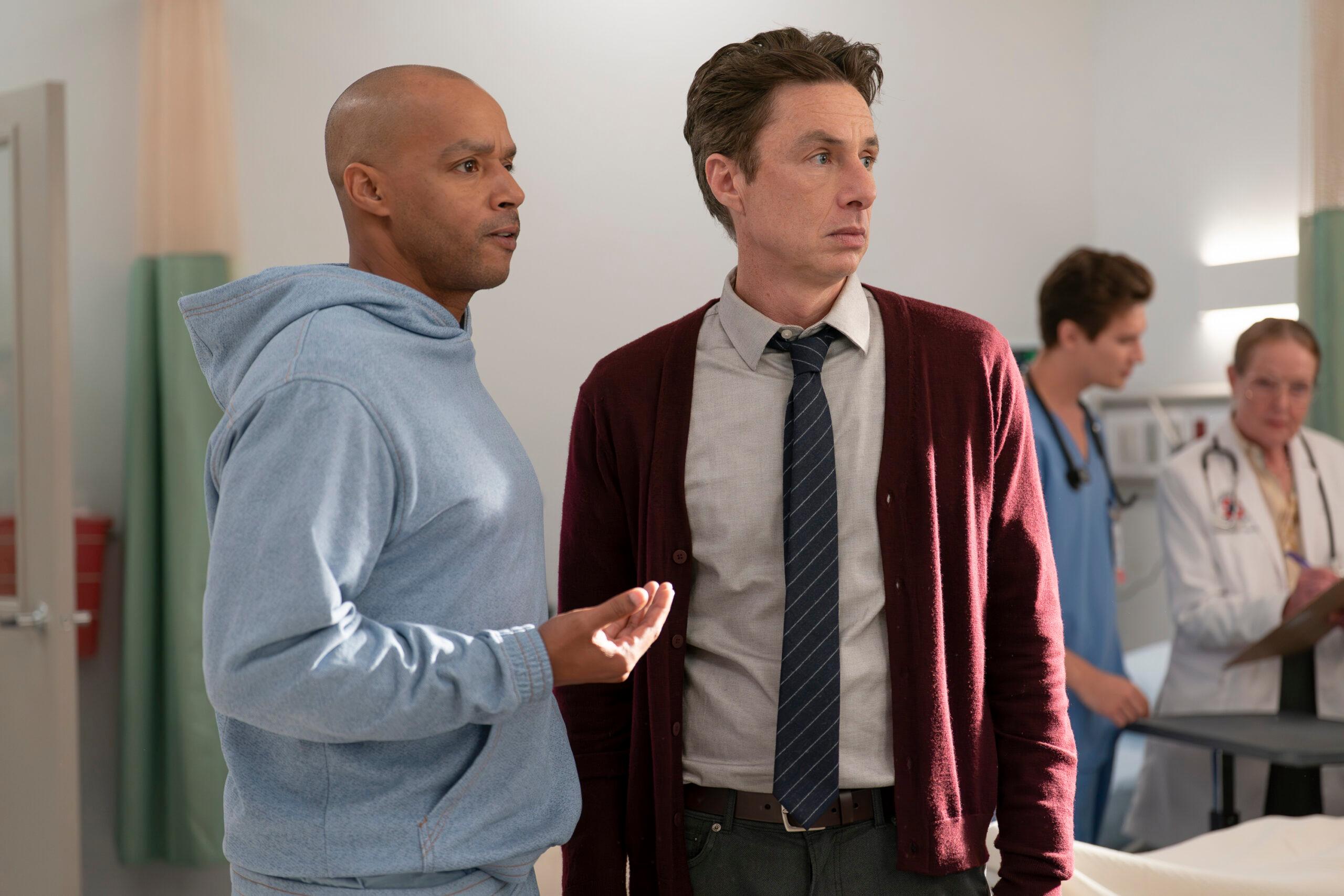
The chatter picked up steam during the pandemic, when Braff and Faison began hosting a Scrubs rewatch podcast. It brought the show back into the zeitgeist and made the hosts more fully appreciate what they had done 20 years earlier. “Watching it just reminded me that, one, you gotta live in the moment,” says Faison. “Because it’ll pass you by really fast. But two, we did something really good. I took it for granted.” Then the duo began starring in a series of T-Mobile ads that had them playing, as Faison puts it, “an exaggerated version of ourselves, which is pretty much Turk and J.D.” One of the earliest ads aired during the Super Bowl in 2023, putting Scrubs back into the consciousness not only for fans obsessive enough to listen to the podcast but also for a broader audience that had fond memories of the show. As actors’ schedules cleared up, the momentum to bring the series back became inevitable.
The revival makes some concessions to middle age. Turk’s back is no longer strong enough to shoulder J.D.’s weight for another “Eagle!” pose. There are also concessions to the passage of time. McGinley’s reduced role works out well. “We asked the real J.D. [Lawrence’s college friend Dr. John Doris] and other doctors, ‘What would Dr. Cox do now?’” Lawrence explains. “And they’d say, ‘Oh, he’d be let go immediately.’” Real-life interns and residents are no longer subject to his brand of verbal abuse or to the exhausting schedule that we saw J.D. and friends go through during their residencies. In the revival, Vanessa Bayer plays Sibby, an HR rep who’s constantly trying to get Cox and other senior doctors to tone things down while encouraging the interns to take naps in a break room that didn’t exist when J.D. started out.
Bayer’s one of many new faces wandering the halls of this re-created version of Sacred Heart Hospital. With McGinley not around a lot and Neil Flynn’s unnamed janitor not back at all, J.D. has a new antagonist in the form of Joel Kim Booster’s supremely confident Dr. Park. There are also five new interns. Some, like Jacob Dudman’s nervous Asher, function as echoes of how our returning heroes behaved when they were that age. Others, like Ava Bunn’s Sam—a social media obsessive whom Cox dubs “TikTok Doc”—are there to illustrate the generation gap J.D. and his friends have to confront as teachers.
Lawrence is a student of television as well as a prolific producer of it. For him, Asher, Sam, and the other interns are the key to whether the revival succeeds creatively or not. “Reboots work when it’s a new story,” he insists.
“For me, it’s not overdoing the nostalgia,” acknowledges Braff, who is a producer and directed the first new episode. “You have a few touchstones that the audience loves. But you’re building out new stories and new places in their lives. ... You’re not just going, ‘Oh, remember this? Remember that?’ That gets old quick and also doesn’t invite in a new audience.”
“Zach was like, ‘I can't come back here and just be going, [unintelligible Jerry Lewis noise] and be like a 28-year-old,’” says Lawrence. “He's like, ‘I have to at least pretend I'm a grown-up.’” The goal was “to make it clear that even though he might be the same person emotionally in his head, that he has aged and there are limitations to this thing, and there are certain things that have to be left behind.”
But J.D.’s imagination still flares up under stress—one episode has Braff, Faison, and Chalke all in pro wrestling outfits—and he still has a fondness for appletinis (“easy on the tini”) that he tries to share with the interns.
And the returning cast and crew members still felt the bond that formed when they first worked together a quarter century ago, under intense circumstances. “9/11 happened [while we were making] the second episode,” says McGinley. “That was pretty disorienting. Everybody just leaned into work and each other—like the whole country did. But we had the nucleus of a new family and we were grinding, man. We were grinding hard.”
More on ‘Scrubs’
Chalke and Faison had briefly met before their auditions, and they were the clear front-runners to play Elliot and Turk before Braff even showed up. Lawrence then had Braff and Chalke spend time together before their chemistry read in front of a few dozen executives. “That was really helpful,” Braff says. “I was smitten, just like J.D.”
Lawrence has a “no assholes” policy on the shows he runs. Working in that creaky old hospital, away from a traditional studio back lot, the cast grew close in a hurry—Braff and Faison especially. “We knew early on that we had created a monster with those two on some level,” says Lawrence with a fond smile. “It becomes harder to get the work done because they're being idiots every five seconds and ruining scenes.” Always fond of tailoring his characters to the actors playing them, Lawrence would get his revenge for their shenanigans by making those characters particularly biographical.
“We would go out for the weekend and come back to work and tell Bill about our adventures,” says Faison. “And somehow in the next script, our adventures made it into the story.”
Scrubs was never a huge hit, and it won only a couple of technical Emmys during its run. It debuted during the tail end of the ER phenomenon, and then Grey’s Anatomy and House debuted midway through its run—it never even had the hospital-show lane to itself, even though it was much more of a comedy than the others. But it quickly developed a rabid cult following. Viewers were drawn to the palpable chemistry of the three leads. They loved McGinley’s incredible breath control and intonation as Dr. Cox rattled off various long lists of all the things he hated. (These lists almost always included Hugh Jackman.) They loved the wild fantasy sequences conjured up by J.D.’s overactive imagination. And the moments when the stories turned serious—J.D., Turk, and Elliot each lose a patient in the same episode; Dr. Cox realizes he’s been hallucinating conversations with his late brother-in-law because he’s in denial about his death—made the absurdity of the rest of it feel even funnier. The humor provided relief from the kind of angst and despair that Meredith Grey and her peers were dealing with on the other medical shows.
Although there was only one full-on musical episode, many of the most beloved Scrubs moments involve a little song and/or dance. Asked to name his favorite Dr. Cox insult, McGinley begins to sing Cox’s “You’re wrong” ditty to the tune of Big Ben’s chimes, which he once aimed at Carla. (Reyes still remembers it so well that she joins in on harmony.) The moment that has most transcended the show—to the point that it was incorporated into Fortnite—saw Turk doing an elaborate dance to Bell Biv Devoe’s “Poison” when several colleagues held open auditions for their “air band.”
Inadvertently, it turned out to be another case of Scrubs art imitating Scrubs life.
“I was hungover like a beast” the day of filming the dance, Faison admits. “I probably got four hours of sleep the night before. I know I probably still had booze on my breath from the club the night before, and I didn't know I was supposed to be dancing to ‘Poison’ because that was back in the day when I didn't read the scripts. I walked into the room, and the room was packed with everybody from the crew. I'm like, ‘What's going on?’ And they're like, ‘You're supposed to dance.’ I was like, ‘Oh shit, I'm in so much trouble. This is going to be the worst day of my life.’ And I was like, ‘What am I dancing to?’ And they were like, ‘You're dancing to Bell Biv DeVoe's “Poison.”’ And I perked up, like, ‘Oh, I was just dancing to this shit last night at the club. What's up?’”
Although an all-time classic TV moment, the “Poison” dance came in the fifth season, at a point when many of the actors felt that the show had started leaning too often into cartoonish territory. Faison calls the more understated tone of the revival episodes “a revival of the way we were the first three seasons, when everything had heart. Before we turned into a—” He pauses to think of the most tactful way to phrase it before Braff interjects: “a broader version.”
J.D.’s story concluded at the end of the eighth season, which is what Braff, Lawrence, and many others consider to be the conclusion of Scrubs proper. There was a ninth season, with Faison and McGinley as cast regulars alongside a younger group of actors like Eliza Coupe, Dave Franco, and Kerry Bishé, plus occasional appearances from Braff and the others. Lawrence wanted to treat it as a spinoff and change the name, but ABC insisted on presenting it as a continuation. Parts of it worked, although, ironically, not the parts where J.D. himself returned. “I cringe when I watch Season 9,” says Braff. “I go, ‘This is so broad.’ I just lost the plot. None of it was grounded. I was being a cartoon version of the character. None of it was based in reality. To be honest, I was just exhausted.” The J.D. of the revival can still be silly, but Braff also wanted him to be a good teacher and more down-to-earth overall.
Scrubs is returning in what feels like a full-circle moment for the genre. Grey’s Anatomy is still on the air, now in its 22nd season. ER star Noah Wyle is playing an emergency physician again on HBO Max’s The Pitt. (The revival opens with a J.D. fantasy that’s shot and edited very much like a Pitt scene.) And now here come J.D., Elliot, and Turk, working in a health care system that feels even more dysfunctional and depressing than the one they joined 25 years ago. One episode finds the interns treating a patient whose insurance company won’t cover the prescribed dosage of an essential medicine, forcing him to parcel out the pills he can afford.
The zeitgeist wants old-school doctor shows again. After COVID-19, and in the midst of all the darkness out there in the world, doctors, nurses, and other caregivers feel more welcome and necessary as fictional characters than ever before. “These are our heroes,” says Faison.
Some of these heroes just happen to be more ridiculous than others.